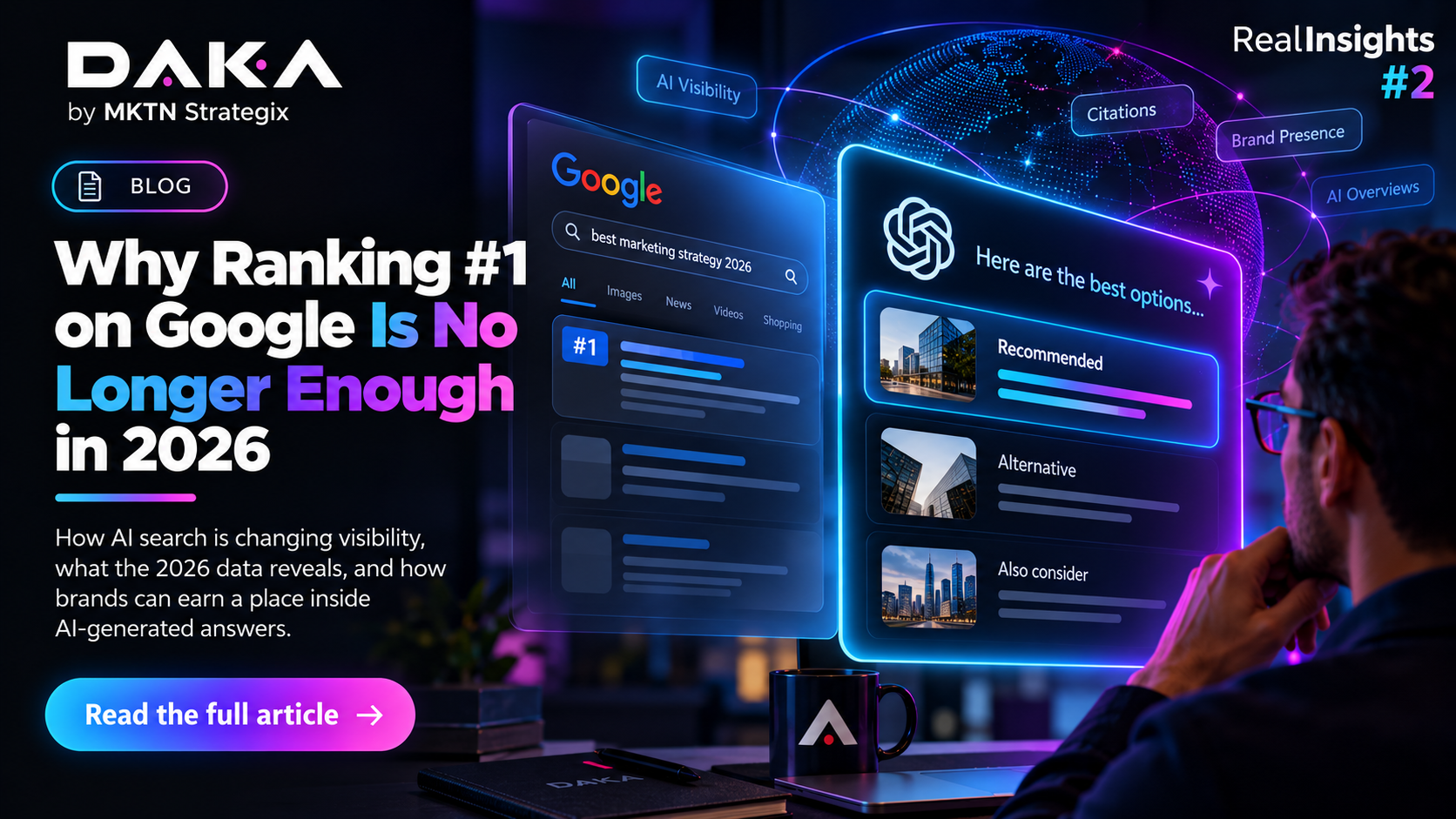
You can rank well on Google and still disappear when your customer asks AI what to buy.
That sounds strange.
For two decades, digital visibility followed a familiar logic: get indexed, earn authority, climb the rankings and win the click.
Then the interface changed.
Someone researching a product can now ask ChatGPT, Gemini, Perplexity or Google a complete question and receive an answer before opening a single traditional search result.
And something important happens at that moment.
The user is no longer simply asking:
Which page should I visit?
They are asking:
What should I believe, compare or choose?
That difference is creating a new visibility problem for marketers.
Call it Generative Engine Optimisation (GEO), AI search optimisation or simply AI visibility. The terminology is still settling.
The behaviour is not.
Semrush's 2026 AI Visibility Index analysed 126 million US AI-search prompts between January and April 2026, which gives some sense of how seriously brand discovery inside AI interfaces is now being measured. Semrush
The question for marketers is no longer just whether a page ranks.
It is whether the brand makes it into the answer.
AI search visibility is the extent to which a brand, product or website is mentioned, cited or recommended inside AI-generated answers.
Traditional SEO asks:
Where does my page rank?
AI search adds a few uncomfortable questions:
Does the AI mention us at all?
Does it cite our website?
Does it recommend a competitor instead?
Does it understand what our brand is actually good at?
These outcomes are related to SEO.
They are not identical to it.
Broadcastwell's July 2026 research offers a useful snapshot. It analysed 860 AI-generated buyer answers across 85 B2B software companies and 61 categories.
The median company appeared in only 20% of answers for its own category.
Even more striking, 30 of the 85 companies — 35% — were never named at all. Broadcastwell
That's a fairly brutal form of invisibility.
Traditional search gives you positions. AI search gives you selection.
And selection is harsher.
A Google results page can show ten organic links, ads, videos, maps and other modules.
Broadcastwell found that the average AI answer in its dataset named just 2.05 vendors.
The median category leader appeared in 80% of its category's answers. Broadcastwell
In other words, AI discovery can turn a long competitive list into a very short shortlist.
If you are not selected, position number four may as well be position number forty.
It would be tempting to declare that SEO is dead and GEO has replaced it.
That would make a great LinkedIn headline.
It would also be misleading.
Semrush analysed the top 10,000 domains appearing in its AI Visibility Index and found a strong relationship between conventional organic visibility and AI citations.
The correlation between the number of keywords a domain ranked for and the number of AI citations it received sat between 0.86 and 0.87 across the AI platforms studied. Semrush for Enterprise
That is a substantial relationship.
So no, good SEO did not suddenly become irrelevant.
Quite the opposite.
A broad organic footprint appears strongly associated with being cited in AI search.
But there is an important caveat.
Correlation is not guarantee.
A page can rank.
A domain can have authority.
An AI system can still select another source when constructing its answer.
That is where GEO begins.
Not as a replacement for SEO.
As another layer on top of it.
The change is not limited to ChatGPT.
It is happening directly inside Google.
Ahrefs analysed 146 million search results pages and found that AI Overviews appeared on 21% of all tracked keywords.
That number rises sharply depending on the query.
AI Overviews appeared on:
Those numbers matter because longer, question-led searches are precisely the sort of searches content marketers have spent years targeting.
“How does X work?”
“Why does X happen?”
“What is the best X for Y?”
Historically, the goal was straightforward.
Write the best page.
Earn the ranking.
Win the click.
Now Google may place a generated answer between the searcher and your page.
The ranking can survive.
The click may not.
France provides an unusually useful recent example.
Google launched AI Overviews there on 22 July 2026.
Ahrefs then examined 963 domains, comparing 28 days before the launch with nine days after it.
The domains most heavily exposed to AI Overviews experienced a 23.1% median decline in click-through rate.
Across the full panel, the median CTR decline was smaller, but the heavily exposed group clearly moved differently. Ahrefs also notes that this was an early post-launch measurement and should not be treated as a universal prediction for every site. Ahrefs
That's the part marketers should pay attention to.
The pages did not necessarily vanish.
People simply had less reason to click them.
AI had already absorbed part of the answer.
Impressions can remain healthy while the economics underneath them change.
That matters because marketers have traditionally treated rankings, impressions and clicks as parts of the same funnel.
AI answers can break that relationship.
You might remain visible to Google while becoming less visited by humans.
So perhaps we need another question:
Did our content influence the answer, even when the user never reached our page?
That question hardly existed in mainstream SEO reporting a few years ago.
Now it matters.
Here is where GEO gets even stranger.
Imagine an AI uses your article to build its answer.
Good news, right?
Maybe.
Semrush studied 3,981 domain appearances across 115 prompts, 14 countries and four AI-search environments.
It found that 61.7% of citations were “ghost citations”.
The AI used the website as a source...
…but never mentioned the brand in the answer itself. Semrush
So there are really two different visibility outcomes.
The AI uses your content as evidence.
The user actually sees your company name.
Those sound like the same thing.
They aren't.
A publisher can help answer the question without gaining much brand recognition from it.
That's awkward.
But it also gives marketers a much better measurement framework.
Don't simply ask:
Are we being cited?
Also ask:
Are we being named?
There's another reason this matters commercially.
AI does part of the research before the customer visits a website.
Imagine somebody asking:
“Which CRM is best for a five-person agency that mainly sells through WhatsApp?”
The AI can compare options.
Explain pricing.
Mention weaknesses.
Eliminate tools that do not fit the requirement.
By the time that person clicks a vendor's website, much of the early research may already be finished.
Semrush reports that visitors arriving from AI search converted at 4.4 times the rate of traditional organic visitors in its analysed dataset. The company attributes part of this difference to users arriving after AI systems have already helped them compare and evaluate options. Semrush
That figure should not be treated as a universal conversion benchmark for every business.
But the behaviour behind it makes sense.
The AI click may arrive later in the buying journey.
Less volume.
Potentially stronger intent.
That's a very different acquisition model.
SEO taught an entire generation of marketers to think in keywords.
One query.
One SERP.
One ranking.
AI conversations are messier.
A customer might start with:
“What's the best accounting software for freelancers?”
Then continue:
“Which ones work in Morocco?”
Then:
“What if I invoice European clients?”
Then:
“Which is easiest if I don't understand accounting?”
That is not four isolated searches.
It is one evolving decision.
This creates a different content challenge.
A brand cannot simply own one phrase.
It needs enough useful information around the topic for an AI system to understand where that brand belongs across several variations of the problem.
This is why topic depth becomes more valuable.
Not keyword stuffing.
Not publishing thirty near-identical articles.
Actual coverage.
Questions.
Comparisons.
Use cases.
Constraints.
Evidence.
Definitions.
Original data.
That is much harder to fake.
There is no magical GEO recipe.
Anyone claiming to know exactly how every AI engine ranks brands should probably be treated with caution.
Different systems retrieve information differently, their behaviour changes, and generated answers can vary between runs.
Still, the 2026 data points towards a few useful principles.
One article about AI marketing agents is useful.
A connected body of useful material around:
AI marketing agents → market intelligence → competitive analysis → funnel analysis → agentic workflows → decision intelligence → human oversight
creates something much stronger.
It gives search engines and AI systems more context about what your site actually knows.
This is where a publication strategy such as RealInsights becomes useful for MKTN Strategix.
The goal should not be fifty unrelated blog posts.
It should be a network of connected expertise.
One article answers the main question.
Another handles the comparison.
Another publishes data.
Another examines a use case.
Another challenges an assumption.
Over time, the site stops looking like a collection of keywords.
It starts looking like a source.
Compare these two sentences.
“The ever-evolving nature of artificial intelligence is fundamentally reshaping the digital marketing paradigm.”
Now this:
“AI search visibility measures how often a brand is mentioned, cited or recommended inside AI-generated answers.”
The second sentence is less fancy.
It is also vastly more useful.
A human can understand it immediately.
A search engine can classify it.
An AI system can quote or summarise it without reconstructing the entire paragraph.
That is not robotic writing.
It is clear writing.
A strong GEO article can still have personality, opinions, stories and unusual observations.
But when a section answers a specific question, answer the question.
Don't make the machine — or the reader — excavate it.
This is probably where DAKA can eventually build a genuine advantage.
Everyone can cite Gartner.
Everyone can summarise McKinsey.
Everyone can rewrite a Google announcement.
But imagine MKTN Strategix publishing something like:
We analysed 1,000 competitor landing pages. Here are the five trust signals missing most often.
Or:
Across 500 DAKA market analyses, these are the objections that appear most often before purchase.
Or:
We analysed 50 e-commerce categories. Here's how wide competitor pricing actually varies.
That content changes your role.
You stop merely explaining information created elsewhere.
You become part of the evidence layer.
And AI systems need evidence.
The strongest GEO content may not be the article that explains the internet best.
It may be the article that adds something useful to the internet.
That is a much higher bar.
It's also a much better moat.
There is an old positioning problem hiding inside this new technology.
If someone lands on your website, can they understand in ten seconds:
What do you do?
Who is it for?
Which problem do you solve?
Why are you different?
If humans struggle with that, machines are not going to magically fix it for you.
Brand consistency now has another audience.
AI systems.
They encounter your company through multiple surfaces:
your website, third-party articles, social profiles, reviews, comparison pages, directories and citations.
When those signals tell wildly different stories, entity understanding becomes harder.
GEO therefore has a surprisingly old-fashioned requirement:
clear positioning.
Traditional SEO metrics still matter.
But they no longer describe the entire discovery journey.
Traditional SEOAI Search / GEOKeyword rankingsAI answer visibilityOrganic impressionsPrompt coverageOrganic clicksAI referral trafficBacklinksAI citationsSERP shareShare of AI mentionsCTRCitation-to-mention ratioKeyword coverageTopic coverageLanding-page conversionsAI-referred conversions
You do not need to choose one side.
A mature measurement model needs both.
You do not need an enterprise GEO platform to discover whether you have a problem.
Start with ten questions.
Not ten keywords.
Ten questions a real customer might ask before buying something in your category.
For example:
What's the best solution for X?
What are the alternatives to X?
Which product is best for a small company?
What should I choose if my budget is limited?
What are the main drawbacks?
How much should I expect to pay?
Which option requires the least technical knowledge?
Run them across the AI systems your customers are likely to use.
Then record four things:
Are you mentioned?
Which competitors are mentioned?
Which websites are cited?
How does the AI describe the category?
That simple exercise can expose a gap your ranking report will never show you.
You may rank extremely well and barely exist in the AI answer.
Or you may discover the opposite.
Both are useful insights.
If all of this still feels abstract, these figures help put the shift into perspective.
Signal2026 DataWhy It MattersSemrush AI Visibility Index126M prompts analysedAI visibility is becoming measurable at enormous scale. SemrushAI Overviews across tracked queries21%AI answers are already a substantial part of Google search. AhrefsAI Overviews on question queries57.9%Informational content is particularly exposed. AhrefsMedian B2B brand visibility in Broadcastwell sample20%Many companies appear in very few AI buying conversations. BroadcastwellCompanies never named35%Ranking somewhere online does not guarantee AI visibility. BroadcastwellGhost citations61.7%Being used as a source does not guarantee brand recognition. SemrushCTR decline for highly AI-Overview-exposed French domains23.1%Search visibility and search traffic can increasingly diverge. Ahrefs
These datasets use different methodologies, markets and samples.
They should not be mashed together into one universal benchmark.
But the direction is difficult to ignore.
Search is moving from ranking pages towards assembling answers.
Generative Engine Optimisation (GEO) is the practice of improving the likelihood that a brand or its content will be discovered, cited, mentioned or recommended inside AI-generated answers.
It complements conventional SEO rather than automatically replacing it.
No.
Current research suggests strong SEO visibility remains closely associated with AI citations. Semrush found correlations of 0.86–0.87 between a domain's organic keyword footprint and its AI citations across the platforms it studied. Semrush for Enterprise
SEO remains foundational.
GEO adds another question: once your information is discoverable, will the AI actually use and represent it?
Yes.
AI systems create their own selections when answering a prompt.
Broadcastwell's 2026 research found that 35% of the B2B companies in its sample were not named once across the ten category questions tested for them. Broadcastwell
A ghost citation occurs when an AI system cites a website as a source but does not mention the brand in the generated answer.
Semrush found this happened in 61.7% of cited appearances in its study. Semrush
Useful metrics include:
AI mentions, AI citations, prompt coverage, category share of voice, competitor mentions, topic visibility, AI referral traffic and conversions from AI-referred visitors.
No single metric tells the whole story.
It can.
Ahrefs observed a 23.1% median CTR decline among the French domains most heavily exposed to Google AI Overviews shortly after the feature's July 2026 launch in France. The study was an early post-launch analysis and does not imply that every site will experience the same effect. Ahrefs
For years, marketers fought for the click.
Now something increasingly happens before the click.
An AI system searches.
Reads.
Compares.
Filters.
Compresses.
And gives the user an answer.
Sometimes your website receives the visit.
Sometimes your content influences the answer without receiving the visit.
Sometimes a competitor becomes the recommendation.
Sometimes your brand never enters the conversation.
That changes the job.
The goal is no longer simply:
Rank higher.
It increasingly becomes:
Be clear enough, useful enough and credible enough to become part of the answer.
That is a much tougher standard.
It also fits a broader principle behind DAKA: Data → Insight → Decision → Action. Instead of collecting signals for their own sake, the system is designed to connect evidence with the next decision and eventually feed the result back into the next cycle of learning. DAKA_Final_Speech_Deep_RTL
Because GEO should not become another race to publish hundreds of forgettable articles.
More content is not necessarily the answer.
Better evidence might be.
Clearer expertise might be.
Original data certainly helps.
And perhaps the most useful question is still the simplest one:
What is the market telling us to do next?
Search is changing.
The smartest response is probably not to produce more noise.
It is to become a better source.
In traditional SEO, visibility meant earning a position on a page.
The two are connected.
They are no longer identical.
DAKA connects market signals, competitor intelligence, funnel analysis and decision support around a straightforward operating model:
Data → Insight → Decision → Action
The goal is not simply to generate more marketing output.
It is to understand the evidence, reduce uncertainty and identify what deserves to be tested next.
MKTN Strategix — RealInsights Market intelligence for better decisions.