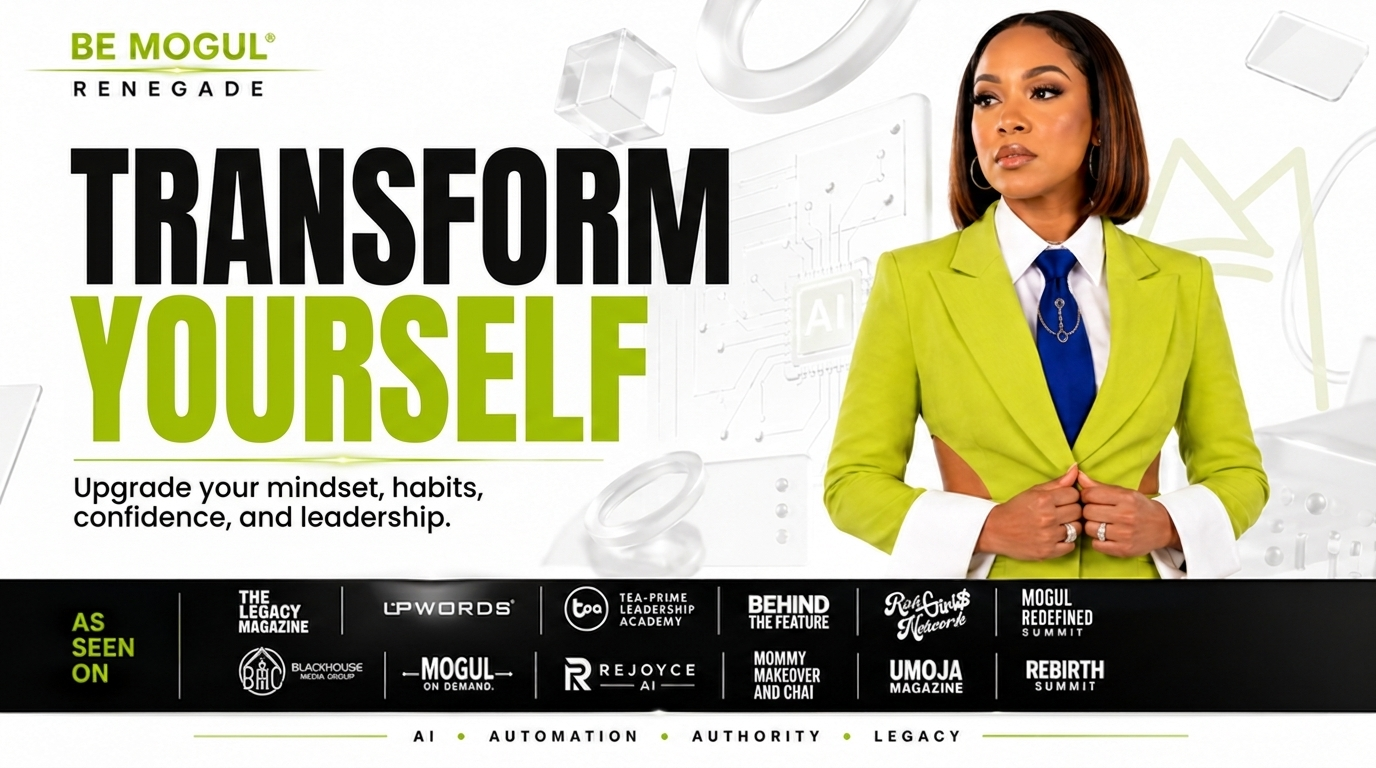
MODERN DAY MOGUL LEVERAGING AI IN HTEIR ONLINE BUSINESS. JOIN BEMOGUL.AI AND BUILD BRAND AND LAUNCH YOUR AI POWERED OPERSTING SYSTEM TODAY
If you’re a woman coach or entrepreneur ready to evolve from “solo-preneur” to modern-day mogul, building an AI-powered operating system (AI-OS) is the strategic move that scales your expertise, automates routine decisions, and turns your brand into an experience that sells while you sleep.
Why an AI-OS matters for your brand An AI-OS is more than a set of tools: it’s a unified architecture that captures your brand voice, client processes, content strategy, and revenue workflows. Instead of juggling disparate apps, an AI-OS centralizes intelligence — client insights, content personalization, lead nurturing, and signature program delivery — so every touchpoint feels consistently high-caliber and uniquely you.
Core components of a robust AI-powered operating system
- Data layer: A clean, governed repository of client profiles, purchase history, session notes, and engagement signals. This is the single source of truth your models train on.
- Knowledge layer: Your brand voice, curriculum frameworks, FAQ banks, and SOPs converted into embeddings and retrieval-augmented datasets so AI responses match your coaching approach.
- Orchestration layer: Workflow automation and decision logic that route leads, trigger follow-ups, schedule sessions, and launch campaigns based on real-time signals.
- Interaction layer: Chatbots, email generators, voice assistants, and client portals that deliver personalized experiences across channels.
- Monitoring & governance: Performance metrics, feedback loops, bias checks, and privacy controls that keep the system predictable, compliant, and aligned with your values. Practical implementation roadmap (12–16 weeks) Week 1–2: Strategy & scope
- Define outcomes (e.g., 30% increase in trial-to-paid conversion, 50% reduction in admin hours). - Map client journeys and prioritize high-impact automation points.
Week 3–5: Data preparation & knowledge ingestion - Consolidate CRM, calendar, content, and coaching notes. - Structure curriculum and brand voice into knowledge artifacts for retrieval.
Week 6–9: Model selection & integration - Choose models: fine-tune where brand voice matters, use retrieval-augmented generation for knowledge fidelity. - Integrate with Zapier/Make or direct APIs for CRMs, booking systems, payment platforms.
Week 10–12: Orchestration & UI build - Implement workflow engine (e.g., Prefect, n8n, or managed orchestration inside Bemogul.ai). - Build client-facing UI components and test conversational flows.
Week 13–16: Testing, monitoring, and rollout - Run pilot with a small cohort, collect behavioral KPIs and NPS. - Iterate on prompts, thresholds, and escalation rules. - Full launch with documented SOPs and staff training.
Example use-cases that drive ROI for coaches and entrepreneurs - Automatic intake and qualification: An AI-led intake that segments prospects into high-fit, nurture, and self-service tracks, reducing lead response time to minutes. - Scalable personalized content: Generate personalized onboarding sequences, session recaps, and micro-resources based on client goals and progress markers. - Revenue optimization: Dynamic offers and payment-plan recommendations driven by client lifetime value predictions. - Time liberation: Automate scheduling, billing follow-ups, and content repurposing so you spend more hours coaching and creating. Technical best-practices and governance - Data hygiene first: Garbage in, garbage out — invest in de-duplicating contacts, standardizing fields, and tagging cohorts. - Hybrid approach: Use retrieval-augmented generation (RAG) to keep answers factual and fine-tuned models for brand tone. - Privacy by design: Encrypt PII at rest, implement role-based access, and give clients clear consent choices about AI-assisted interactions. - Observability: Track model drift, response latency, conversion impact, and error rates. Set alerting for anomalous patterns. - Human-in-the-loop: For sensitive coaching conversations or sign-offs on program changes, route to a human reviewer with annotated AI suggestions. Common pitfalls and how to avoid them - Trying to automate everything at once: Start with one high-impact workflow (intake, onboarding, or program delivery) and scale iteratively. - Over-personalization without consent: Personalization increases conversion, but must respect privacy and transparency. - Ignoring client trust: Use explainable prompts and easy opt-outs so clients feel safe and in control. - Neglecting staff training: Your team needs playbooks showing when to rely on AI versus human judgment. Measuring success: KPIs that matter - Business metrics: Conversion rate, LTV, churn, average revenue per client, time-to-first-value. - Operational metrics: Hours saved per week, reduction in manual tasks, error rate in automated responses. - Experience metrics: Client NPS, satisfaction with AI interactions, adoption rate of AI-enabled features. A quick tech stack suggestion for Gen X founders who value control and clarity - CRM: HubSpot, Keap, or a privacy-first alternative. - Embeddings & RAG: OpenAI/Anthropic for embeddings + vector DB (Pinecone, Weaviate). - Orchestration: n8n or Zapier for simple automations; Prefect or Dagster for complex pipelines. - Interface: Webflow/Memberstack for client areas; Intercom or custom chat widgets for conversations. - Analytics: Segment + Looker/Metabase for unified reporting. Case snapshot: How one coach scaled without losing soul A leadership coach moved her signature program online using an AI-OS to automate onboarding, deliver personalized weekly micro-assignments, and surface at-risk clients for proactive outreach.
Result: 3x cohort capacity, 40% decrease in admin hours, and a lift in client outcomes measured by goal attainment. The AI handled routine personalization while the coach remained the decision-maker on escalations — preserving the human relationship that mattered most. Next steps you can take this week - Audit one process (intake, onboarding, or follow-up) and map out data sources and decision points. - Identify 2–3 knowledge assets (workbook, FAQs, session transcripts) to feed into a RAG prototype. - Run a low-cost pilot with a micro-cohort to test assumptions before full build.
You don’t need to be a developer to start — you need clarity, priorities, and governance. Bemogul.ai is built to help women coaches and entrepreneurs stitch this architecture together without losing the heart of their brand. Want templates, a checklist, and a 30-minute strategy call to jumpstart your AI-OS? Subscribe to our newsletter for exclusive build guides, case studies, and early access to Bemogul.ai workshops. Subscribe and transform your coaching business into an AI-powered, brand-forward operation.
.png)