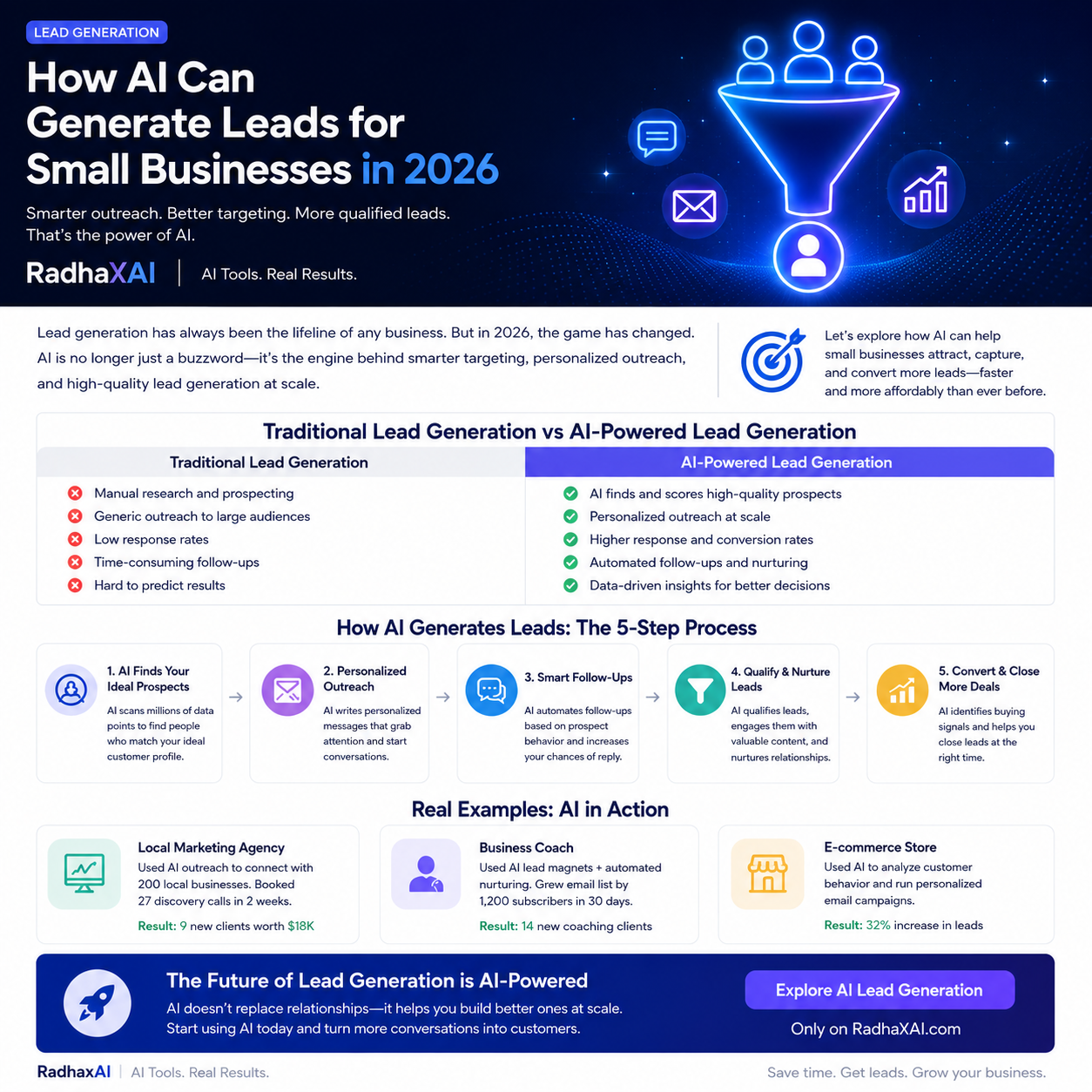
Traditional lead generation vs AI-powered lead generation Traditional lead generation relies heavily on manual effort: list purchases, cold calling, trade shows, untargeted email blasts, and basic CRM segmentation. Success often depends on volume and repetitive outreach, with long sales cycles and inconsistent lead quality. Metrics like lead-to-opportunity conversion rates and cost-per-lead move slowly because human curation and intuition are the bottleneck. AI-powered lead generation flips that model by automating discovery, enrichment, scoring, and personalization at scale. Instead of blasting broad audiences, AI systems use predictive models, intent signals, and natural language understanding to surface prospects who are more likely to convert — and deliver highly personalized outreach that resonates. The result: higher-quality pipelines, shorter sales cycles, and more efficient use of SDR/BDR time. Key differences at a glance: - Discovery: Manual research vs. model-driven prospect identification using intent and firmographic/technographic signals. - Enrichment: Static lists vs. dynamic enrichment (real-time company events, tech stacks, public filings). - Scoring: Rule-based qualification vs. predictive scoring using supervised and unsupervised models. - Outreach: Template-heavy personalization vs. context-aware, dynamically generated messaging and conversational AI. - Measurement: Lagging indicators vs. near-real-time feedback loops and continuous model retraining. AI tools for prospecting Use the right mix of tools across four layers: data, enrichment, intelligence, and orchestration. Below are categories with examples and how they fit into a modern stack. 1) Data providers and intent platforms - ZoomInfo, Clearbit, Cognism: broad firmographic and contact data for initial lists. - Bombora, G2, 6sense: intent and topic-seeking signals indicating buyer interest. How to use: Combine intent spikes (e.g., “marketing automation”) with firmographic filters to prioritize accounts demonstrating active interest. 2) Enrichment and identity resolution - FullContact, Clearbit Enrichment, Leadfeeder: fill missing firmographic/contact fields and map behavior to real identities. How to use: Enrich inbound leads automatically to drive consistent routing and personalization in sequences. 3) Predictive scoring and propensity models - Custom models built with scikit-learn, XGBoost, or AutoML platforms; commercial options include Lattice Engines-like solutions and 6sense predictive modules. How to use: Train models on historical CRM outcomes (won/lost deals) to predict propensity scores; use SHAP or LIME to interpret features driving predictions. 4) Personalization & content generation - GPT-based models (OpenAI), Jasper, Copy.ai for generating personalized subject lines, email bodies, and follow-ups. How to use: Use templates augmented with dynamic tokens and AI-generated context (company news, role-specific pain points), then A/B test variations. 5) Conversational AI & chatbots - Drift, Intercom, Ada: qualify visitors via chat, route high-intent visitors to SDRs or meetings. How to use: Implement triage flows that capture intent, qualify budget/timeline, and book meetings automatically. 6) Outreach orchestration & engagement platforms - Outreach, SalesLoft, HubSpot Sales Hub: manage sequences and measure engagement. How to use: Feed predictive scores and AI-generated messaging into sequences; automate cadence adjustments based on engagement signals. 7) Vector search & knowledge augmentation - Pinecone, Weaviate, Milvus + RAG (retrieval-augmented generation) workflows. How to use: Build semantic search across customer touchpoints (emails, call transcripts, case studies) to craft deeply relevant outreach. Real examples (case studies and tactical playbooks) Example 1 — SaaS company improves MQL-to-SQL conversion by 48% A mid-market SaaS vendor combined intent data from Bombora with ZoomInfo firmographics, and trained a gradient-boosted model on two years of CRM data. They routed top-propensity accounts to a high-touch ABM sequence and used GPT-generated personalized insights in outreach (company event + suggested ROI metric). Outcome: 48% lift in MQL-to-SQL conversion, 27% reduction in CAC for enterprise deals. Example 2 — B2B services firm shortens sales cycle by automating qualification A consulting firm implemented Drift’s conversational AI on pricing pages to capture buying intent and budget ranges. Leads scoring above a threshold were automatically booked into SDR calendars. The firm integrated to HubSpot and used automated enrichment (Clearbit) to add context. Outcome: average sales cycle dropped from 74 days to 52 days; SDR efficiency improved by 35%. Example 3 — High-volume outbound with semantic matching An AI tooling company built an embedding-based search over public engineering blogs, GitHub READMEs, and job postings to identify accounts using complementary stack components. They used similarity scores to prioritize outreach and generated role-specific messages via a fine-tuned GPT model. Outcome: response rates increased from 2.3% to 6.9% and technically qualified meetings rose by 210%. Practical implementation blueprint (actionable steps) 1) Define the success metric Choose leading indicators (qualified meetings/week, MQL-to-SQL conversion) and downstream metrics (pipeline value, CAC). 2) Assemble your data foundation Ingest CRM history, web analytics, intent signals, and third-party enrichment. Ensure data cleanliness and identity resolution. 3) Build or select predictive models Start with a simple propensity model using logistic regression or gradient boosting. Validate with cross-validation and monitor feature importance to ensure interpretability. 4) Create personalization primitives Define dynamic tokens: company triggers, recent announcements, tech stack signals, pain points. Feed these into your content-generation model with strict guardrails to avoid hallucinations. 5) Orchestrate outreach and feedback loops Automate routing and sequencing in your engagement platform. Capture outcomes (meeting booked, no-show, conversion) and feed them back to retrain models. 6) Monitor, iterate, and govern Track model drift, fairness, and privacy compliance. Use A/B tests to validate messaging variants and sequence cadences. Technical considerations and best practices - Use explainable models for scoring in sales contexts so reps trust the recommendations (SHAP values, feature importance). - Guard against hallucinations: when using generative models for messaging, append source citations and limit claims to verifiable company facts. - Respect privacy and compliance: align with GDPR/CCPA. Use hashed identifiers when matching cross-systems and honor opt-outs. - Balance automation and human judgment: use AI to surface and draft, but keep humans in the loop for final touches on strategic accounts. - Continuous retraining: schedule weekly or monthly retraining depending on data volume and market shifts to avoid stale models. Risks, limitations, and mitigation - Data quality: poor input yields poor predictions. Mitigate with validation rules and periodic data audits. - Overfitting to historical behavior: markets change; include recent data windows and monitor out-of-sample performance. - Ethical concerns: avoid manipulative personalization; focus on relevance and value for the prospect. - Dependence on third-party platforms: diversity of data sources reduces single-point failures. Measuring ROI and KPIs Track both early-stage and business-level KPIs: - Early-stage: click-through rate, response rate, meeting conversion rate, propensity score lift. - Mid-stage: MQL-to-SQL conversion, average deal size, sales cycle length. - Business-level: pipeline contribution, win rate, CAC, LTV:CAC ratio. Aim to build dashboards that show leading indicators (intent lift, AI-generated outreach performance) so you can iterate before revenue impact manifests. Conclusion AI-powered lead generation isn’t about replacing salespeople — it’s about amplifying human skills with faster, smarter data-driven insight. By combining intent signals, enrichment, predictive scoring, and generative personalization, businesses can find the right buyers sooner, engage them with relevance, and close deals more efficiently. Start with clear metrics, a solid data foundation, and conservative model governance, then scale the parts that demonstrate measurable lift. If you want regular insights on building scalable AI-driven marketing and sales stacks, subscribe to get practical playbooks, tool comparisons, and real-world case studies delivered to your inbox.
Implementation checklist — a one-page playbook to get started - Objective: Define one primary leading metric (e.g., qualified meetings/week) and one business metric (e.g., pipeline value). - Data inputs: CRM history, web analytics, intent feed, enrichment provider, public signals (news, filings), and event/engagement logs. - Identity resolution: Implement deterministic + probabilistic matching; normalize company and role titles. - Baseline model: Train a simple propensity model (logistic regression or XGBoost) and hold out a test set for validation. - Personalization primitives: Build tokens for company trigger, role pain point, recent announcement, and product-fit signal. - Orchestration: Wire predictive scores and generated content into your engagement platform with routing rules. - Feedback loop: Log outcomes (reply, meeting, no-show, deal stage) and plan weekly or monthly retraining cadence. - Governance: Document model features, performance, drift thresholds, and data retention/consent policies. - Experimentation: Define A/B tests for messaging, cadence, and scoring thresholds; run long enough to reach statistical power. Sample prompt templates for personalization (safe, constrained) - Email subject line (tokenized): “[Company] + [trigger event]: quick question for [Role]” - Email body prompt (to a GPT-style model): “Write a 4-sentence B2B outreach email to a [Role] at [Company]. Include: 1) a one-line acknowledgment of [recent announcement]; 2) a concise pain statement tied to [tech stack signal]; 3) a suggested ROI metric; 4) one clear next step. Keep tone professional and avoid unverifiable claims. Limit factual assertions to the provided tokens.” - Chatbot qualification flow: “Ask intent (commercial/educational), timeline (immediate/3–6mo/6+mo), budget range (brackets), and one business challenge. If intent=commercial and timeline<=3mo and budget>=threshold, offer calendar link.” Dashboard KPIs to track (examples) - Leading indicators: intent-spike count, top-propensity accounts engaged, AI-generated outreach open & reply rates, meeting conversion per sequence. - Model health: AUC/ROC, precision@k for top-N accounts, calibration plots, SHAP-driven feature stability. - Business outcomes: MQL→SQL conversion, average deal size per cohort, sales cycle length by source, CAC by channel. - Operational: SDR time saved (hours/week), automation rate (percentage of leads enriched/auto-routed), error/rollback incidents from hallucinated content. Governance guardrails (practical rules) - Do not include unverified claims in outreach; only reference verified facts from enrichment sources. - Tag all AI-generated messages in internal logs so reps can review and correct before send for priority accounts. - Maintain an opt-out registry and ensure all systems honor suppression lists in real time. - Periodically audit model fairness across verticals, company size, and geographic regions to catch systemic bias. Quick troubleshooting FAQ - “My model degraded after a market event.” Solution: retrain on recent-window data, weight recent examples higher, and add features capturing the event. - “AI-generated messages sound generic.” Solution: increase context tokens (company news, recent technical signals) and enforce template constraints that require specific facts. - “Reps don’t trust scores.” Solution: surface explainability (top 3 features per account) and run side-by-side tests where reps see recommended vs. baseline lists. - “We’re seeing data mismatches across tools.” Solution: centralize identity resolution and use hashed IDs; run nightly reconciliation jobs and alert on mismatch rates. Final takeaways AI-powered lead generation is iterative: start small, instrument everything, and prove lift on clear KPIs before scaling. Prioritize data hygiene, model explainability, and human oversight — those three elements convert AI experiments into repeatable revenue engines. When done responsibly, AI doesn’t replace the salesperson’s judgment; it amplifies their ability to find the right buyers faster and engage them more meaningfully.