WHY AI- DRIVEN DIGITAL MARKETING
In an era where attention is the scarcest commodity, AI-driven marketing isn’t a nice-to-have — it’s a strategic imperative. By combining advanced algorithms, vast data sets, and real-time automation,
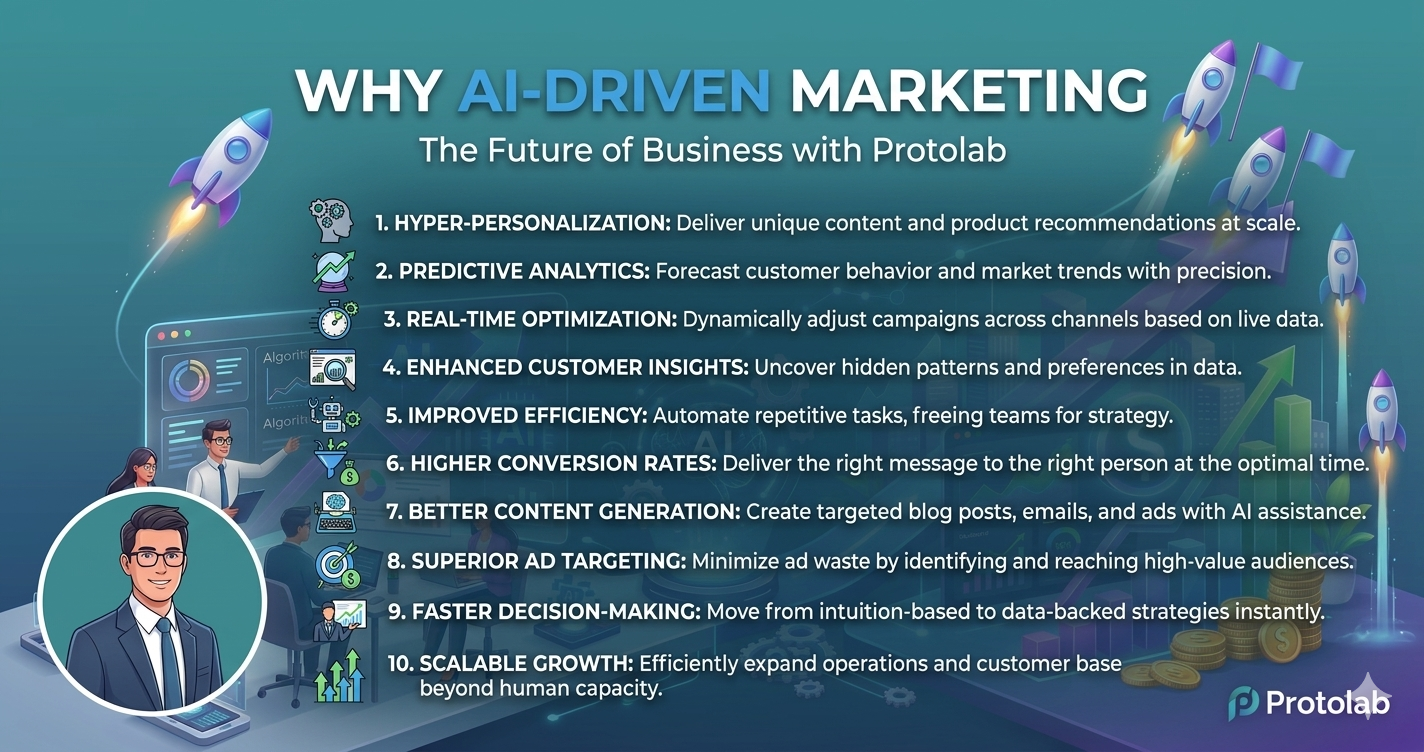
AI transforms how brands discover, engage, and retain customers. The result: smarter decisions, faster execution, and measurable growth. At its core, AI-driven marketing amplifies two capabilities that determine business outcomes: personalization at scale and predictive insight. Traditional segmentation groups customers into broad buckets. AI, using machine learning and deep learning models, creates hyper-personalized experiences for individuals — recommending the right product, message, channel, and timing for each person. 🎉That precision increases conversion rates, average order value, and customer lifetime value. Predictive analytics is the other linchpin.
AI models can forecast customer behavior — who’s likely to churn, which leads will convert, which campaigns will outperform enabling marketers to act proactively rather than reactively. Companies using predictive analytics report higher campaign ROI and more efficient budget allocation because they focus resources where they’ll have the biggest impact. Operational efficiency is a third major benefit.💎 Marketing automation powered by AI streamlines repetitive tasks: ad bidding, creative optimization, email scheduling, content testing, and audience targeting. ⚡This reduces cost per acquisition and frees teams to focus on strategy and creative work. Programmatic advertising, dynamic creative optimization, and automated A/B testing are concrete examples that drive measurable performance improvements. AI also enhances customer experience across the entire funnel. Conversational AI (chatbots and virtual assistants) provides instant, personalized support at scale, improving satisfaction while lowering support costs. Natural language processing improves sentiment analysis and market research, turning unstructured feedback into actionable product and messaging insights. And computer vision enables visually-driven commerce experiences, such as shoppable images and more accurate product recommendations.
From a measurement perspective, AI helps untangle attribution and multi-touch contribution. Multi-channel journeys are complex; AI-driven attribution models analyze cross-channel signals to assign credit more fairly and inform future spend decisions. This leads to optimized media plans and more accountable marketing investments. Ethical and privacy considerations are essential as💡 AI becomes central to marketing. Responsible AI practices — transparency, explainability, bias mitigation, and strong data governance — protect customer trust and ensure compliance with regulations like GDPR and CCPA. Prioritizing privacy-preserving models and anonymization techniques allows marketers to reap AI’s benefits without eroding consumer confidence. Real-world impact is already evident. Brands leveraging AI for personalization see conversion rate uplifts of 10–30% and significant improvements in retention. Retailers using dynamic pricing and inventory forecasting reduce stockouts and markdowns. B2B marketers using intent data and predictive lead scoring shorten sales cycles and increase win rates. These outcomes translate into competitive advantage:🚀 faster growth, lower churn, and higher margins.
Adopting AI-drmarketing is a staged journey, not a single project. Start with clearly defined business goals, an audit of your data assets, and a prioritized use-case roadmap — for example:
- Implement personalized email and product recommendation
- Deploy predictive lead scoring,
- Automate campaign optimization, and
- Integrate conversational AI for support.
Invest in clean, centralized data infrastructure, and pair technology with cross-functional talent: data scientists, analysts, and marketers working together. Finally, measure continuously. Establish KPIs tied to revenue impact — conversion lift, CAC, CLV, churn rate — and validate model performance regularly. A feedback loop of measurement and model retraining ensures AI keeps pace with changing behavior and market conditions.
AI-driven marketing is not about replacing human creativity; it’s about augmenting it. When data-driven prediction meets strategic insight and compelling storytelling, brands can create experiences that resonate deeply and scale efficiently. To explore how AI can accelerate your marketing outcomes and build a practical roadmap tailored to your business,👋 contact us for a consultation.