Every few weeks someone asks me a version of the same question. It usually goes something like, "What's the best hull form for a boat doing xxxxxxxx?"
I want to be upfront: this article isn't going to answer that question. I'm not dodging it, it genuinely can't be answered properly without a full set of technical, operational, and commercial requirements in front of me. What I can do is walk you through how we, as naval architects, actually think about that decision, so that next time you're looking at a monohull, a RIB, a catamaran, or a tri-hull, you understand why each one behaves the way it does, and why "best" depends entirely on what you're asking it to do.
This is general information, not a design brief. It's written for someone with a working knowledge of boats and the water, but no design or engineering background, so some of the explanations are simplified. If you want the precise version, that's what we're here for.
Years ago we ran a proper technical study comparing hull types for small rescue boats. We've kept that original data and generalised it to suit small commercial vessels in the 6 to 12 meter range. The size where this question comes up most often. It's also written from an Australian commercial vessel regulation perspective, under the National Standard for Commercial Vessels (NSCV) as enforced by AMSA. Different countries have their own rulebooks, but the underlying design drivers are much the same the world over.
To make a fair comparison, we picked four platforms around eight meters in length, sized to carry roughly equivalent loads:
Particulars | 8.5m RHIB | 8.3m Mono | 7.5m Cat | 8.0m Tri-Hull | |
| Hull Length | m | 8.50 | 8.30 | 7.50 | 8.00 |
| Beam | m | 3.10 | 2.70 | 2.60 | 2.70 |
| Half Load Displ. | t | 3.33 | 3.13 | 3.43 | 3.13 |
| Installed Power | hp | 400 | 400 | 400 | 400 |
| Max. Speed | kn | 44.5 | 45.0 | 39.0 | 40.0 |
This particular study was built around patrol and rescue boat duty, which happens to translate reasonably well to general purpose workboat use in coastal or restricted offshore waters. Change the brief, say, to a passenger ferry or a load-carrying barge, and the comparison shifts. Keep that in mind as you read on.
If you've ever been thrown out of your seat in a boat punching into a head sea, you already understand why this matters. We assess ride comfort against vertical acceleration, calculated to classification society rules. These rules don't capture every design nuance, but they represent decades of accumulated knowledge from the organisations that certify vessels for a living, and they give a solid baseline for comparing ride quality.
The main inputs are chine beam, effective deadrise angle, displacement, speed, and significant wave height. The output models a wave impact slam, a section of hull rising clear of the water and landing hard enough to re-immerse to the full chine beam.
One term worth unpacking: effective deadrise angle isn't the deadrise most people talk about around the boat ramp, which is just the angle of the bottom plate from horizontal. The effective deadrise is measured from keel to outer chine, and it matters because the chines turn water that's been pushed out and up from the V-bottom back downward on impact, which adds significantly to the vertical loads. It's also measured at the boat's centre of gravity, so it averages the deadrise along the hull's length while accounting for the chines.
Ride comfort isn't just a rescue boat concern. Any small craft will cop significant motion in anything but flat calm conditions, purely due to scale. It affects crew fatigue and operability on every vessel, and it can be the deciding factor on a passenger boat.
Worth noting: the catamaran in our study could have performed noticeably better with a modest increase in demi-hull beam. We generally build in a bit more demi-hull beam on our own cat designs, for extra margin on stability and control in a following sea. And because the human body is remarkably sensitive to vertical accelerations, a 25% difference between two options, say the RHIB and the monohull, won't show up as a rounding error on a spec sheet. You'll feel it.
Seakeeping is the bigger umbrella that ride comfort sits under. It covers directional stability, steering control, course keeping, dynamic stability, and how a boat handles wave impact more broadly. It's a deep topic on its own, so I'll touch on the most relevant points for each hull type as we go through them below.
This is a vessel's resistance to capsizing at rest. There are speed-related stability effects in planing mode, but at displacement speeds they're negligible, and in practice it's static stability that gets used to assess regulatory compliance.
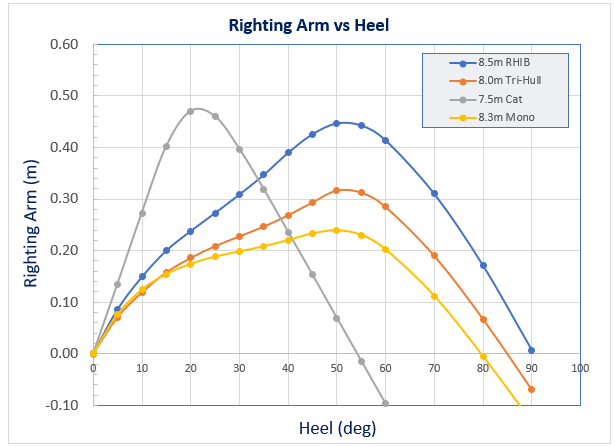
Righting arm, the force required to heel a vessel to a given angle, is arguably the single most important stability measure there is. A vessel with a steep righting arm curve, like a catamaran, feels stiff and stable at rest, and tends to contour with the wave profile so the deck line follows the wave slope. The trade-off is quicker motion, and a boat that's too stiff can actually become uncomfortable over a long day on the water.
Vessels with very high initial stability also tend to have a curve that peaks early and tapers off quickly. The excellent initial stability is real and valuable, but that narrow peaked curve, combined with generally low heel angles, can mask from the operator just how close to the stability limit the boat actually is.
A boat with a shallower righting arm is more sensitive to side-to-side weight shifts, but rolls more smoothly, has a larger range of stability, and gives a more progressive warning as it approaches its limits, better seat-of-the-pants feedback for the operator.
It's worth knowing that NSCV stability requirements for vessels this size are built around low-angle, or initial, stability, which is why a steep early righting arm curve carries real regulatory advantages. Stability at larger angles rarely decides rule compliance, but that doesn't mean it should be ignored, particularly for rescue boats or anything doing towing work.
Maximum achievable speed matters a lot for rescue boats, less so for most other applications. Each hull type carries a different power-speed relationship, which I'll get into hull by hull below.
Our example here is a derivative of one of our deep-vee recreational designs, adapted to meet commercial stability requirements. It trails the RIB on ride quality but still performs solidly. That picture changes quickly, though, if you start adding passengers or a larger superstructure with more windage, to hold stability you then need to raise the deck higher above the water or reduce bottom deadrise, or increase beam, and none of those moves help ride quality.
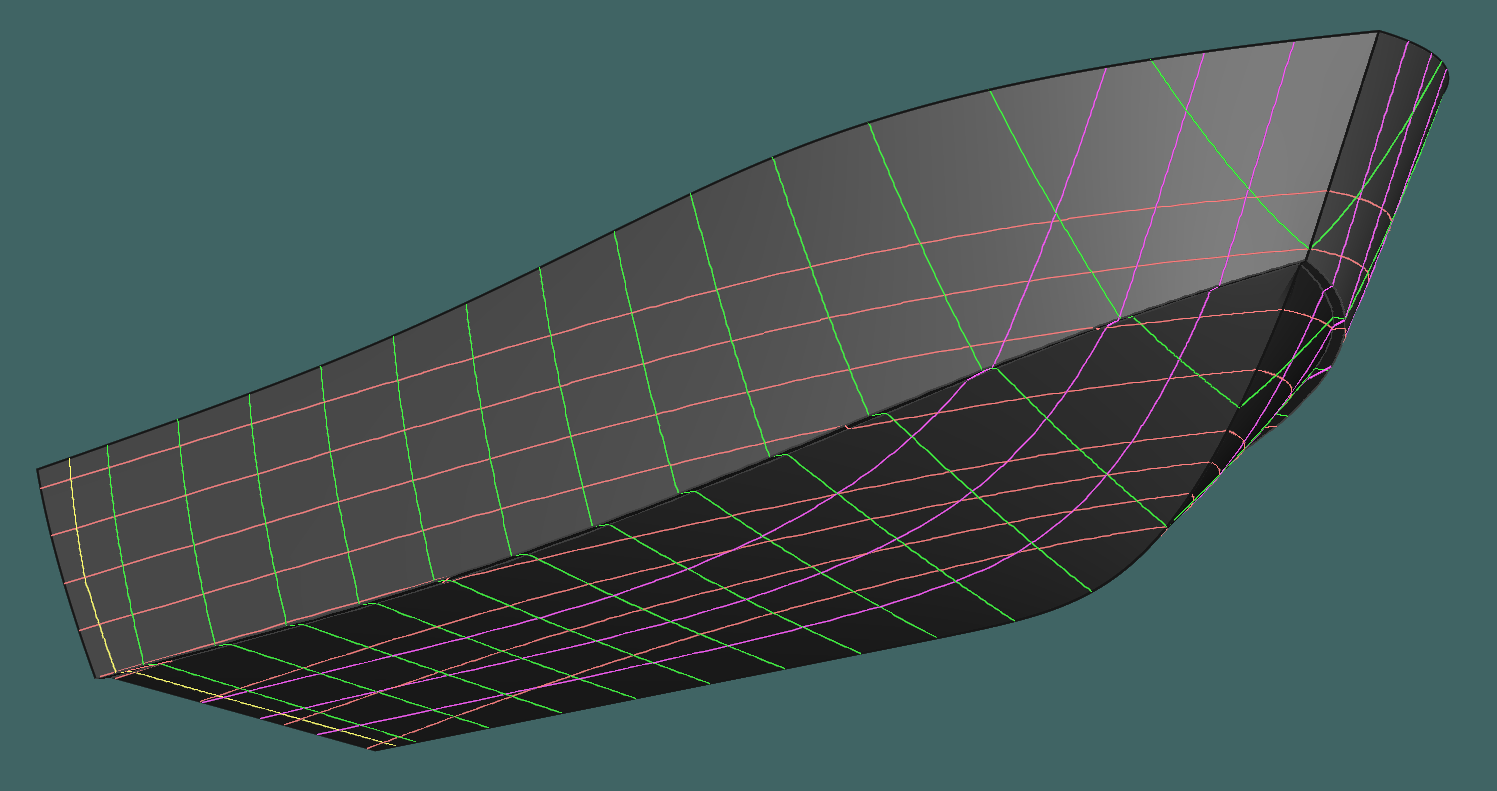
The monohull takes top spot for maximum speed in this comparison, although outright speed is rarely a deciding factor for most commercial work. In relative efficiency terms it sits ahead of the RIB, and well ahead of the cat, at moderate speeds. Below 20 knots, the tri-hull takes over as the efficiency and load-carrying leader.
Static stability under normal operation is the weakest of the group, no surprise, given the regulatory weighting toward low-angle stability. Looked at more holistically, particularly in extreme conditions, the range of stability can be very good with careful attention to downflooding points and immersion angles. Cockpit coaming immersion at around 60 degrees of heel is achievable with the right design attention.
Monohulls have historically been the preferred rescue boat over any multihull. A well-designed conventional monohull shows good all-round seakeeping in rough conditions, with no inherent flaws to worry about.
In short: the monohull is the all-rounder of the group. Its main weakness is low-angle stability, which makes life harder for passenger vessels and anything carrying significant deck cargo or doing lifting work.
The RIB's excellent ride quality comes from the combination of a relatively narrow chine beam and a large effective deadrise angle. The sponsons handle stability at rest, and level flotation comes built into the package almost as a given.
Paired with a well-designed bow, a RIB offers secure, safe handling on every heading, and it's effectively the unchallenged go-to rescue boat worldwide in this size range. That same inherently good seakeeping makes it a strong general purpose workboat offshore. For passenger operations, level flotation also means you can avoid the weight, space, and maintenance burden of carrying a life raft under the NSCV Code.
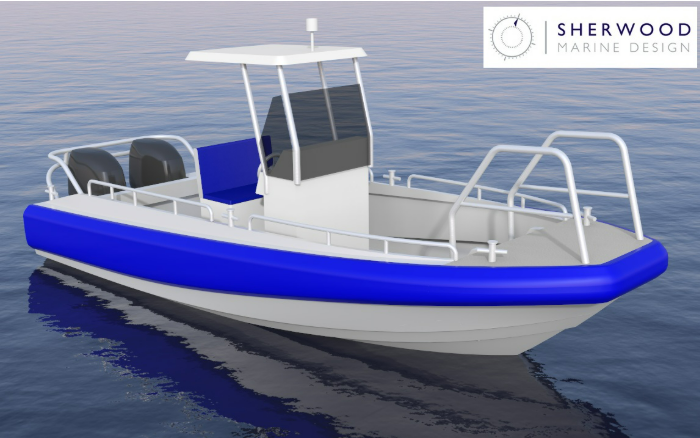
The drawbacks are real: the sponsons eat into usable space, and build and maintenance costs run higher, depending on materials and construction. Those costs can be optimised but never fully eliminated. There's also a maintenance consideration with the level flotation foam fitted below decks, something that's largely managed through good design attention to trapped water, minimising contact with the aluminium, and allowing for ventilation and inspection.
A RIB can carry heavier loads, but depending on the load, speed, and other requirements, a catamaran or tri-hull might be the better fit.
For ride quality, the catamaran is the magic carpet of this group. There's a persistent myth, usually heard in pleasure boat circles, that a planing cat's ride comes from aerodynamic lift or compressed air in the tunnel. The real explanation is much simpler: the combined beam of the two hulls is much narrower than the chine beam of an equivalent monohull. That smaller landing area is what cuts impact loads, even at moderate deadrise, and delivers a head-sea ride quality that's genuinely hard to match.
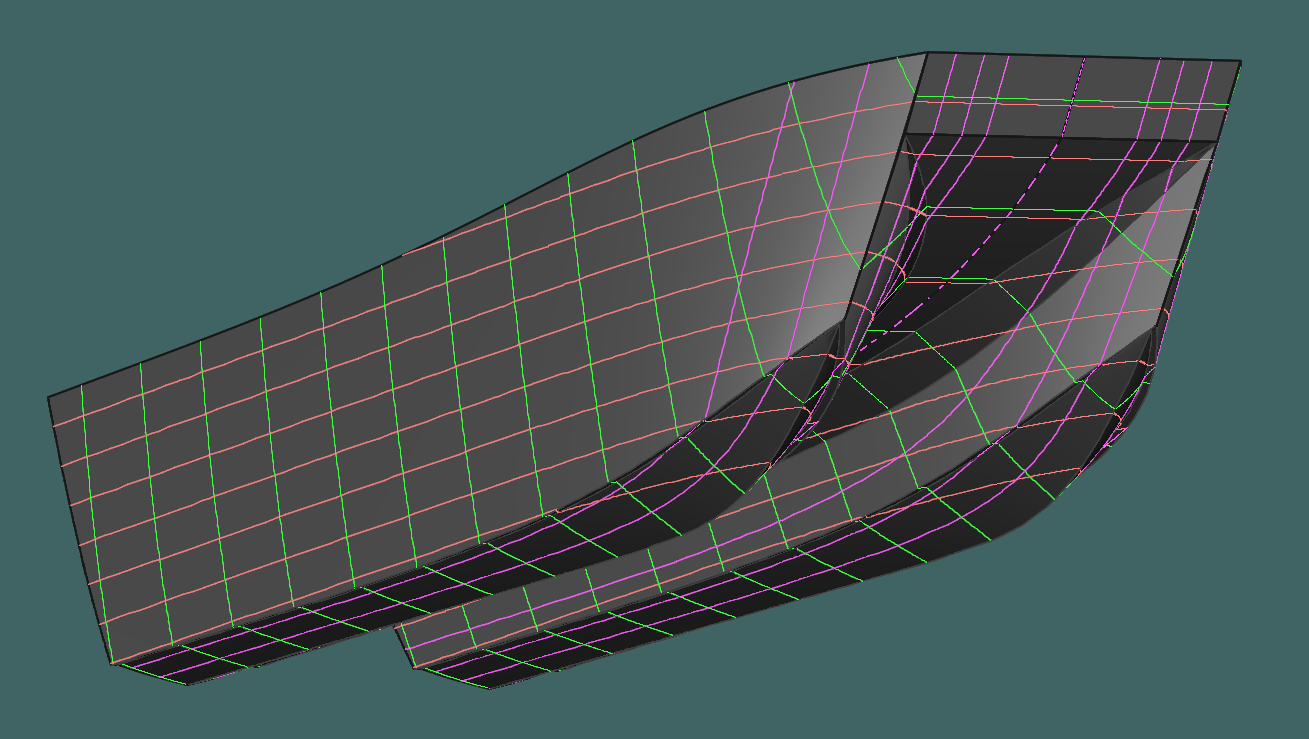
The cat's rectangular footprint gives excellent at-rest stability, with a very steep righting arm curve, making it an excellent choice for load carrying, particularly on passenger vessels or anywhere lifting is involved. It's also good for towing (up to a point), and the wide engine separation gives excellent maneuverability for general workboat duties in tight spaces.
The trade-offs: ride quality depends on running height, so the boat needs to run "lifted" at planing speed to keep the tunnel clear of wave impacts. As speed drops off, ride quality goes with it, and at displacement speed the waterplane is effectively one large rectangle, uncomfortable, and hard going in a serious head sea. Anchoring in exposed locations can also be tricky.
The cat has the lowest top speed of the group, and generally needs more power across the speed range — a representative figure is around 25% more, varying with speed.
Planing cats can also show poor handling in beam-on to following seas, depending on design and conditions, described variously as bow diving, bow tripping, or broaching, which in the worst cases can lead to capsize. It's important to understand this is almost entirely preventable through good design in all but the most severe conditions. I raise it to inform the discussion, not to suggest there's an inherent flaw in catamarans. Monohulls with overly fine, deep bow shapes can suffer the same issue, the difference is a cat's hulls are naturally finer and deeper to begin with, so the effect is amplified, which makes bow shape and slenderness even more critical to get right.
Our view, in a like-for-like comparison, is that a RIB remains preferable to a catamaran for rescue duty in severe weather and large seas. That's not a knock on catamarans where there's effectively a cap on maximum wave height, a bay or other partly protected waters, for instance.
The tri-hull, or cathedral hull, is essentially an improved low-deadrise monohull. In concept, the angled bottom surfaces give a softer initial impact in relatively benign conditions. Once you get into moderate sea states and above, where full bottom slams start happening, the ride deteriorates quickly. Largely because the effective deadrise angle, measured from centreline to the lowest point of the outer sponson, is generally quite low. There's a range of platforms out there with different tunnel heights and features, but the underlying principles hold across the type.
This hull form gets onto the plane at very low speeds, and carries load efficiently at low to medium planing speeds. As speed climbs, the large wetted surface starts working against it, and efficiency tails off. Reflected in one of the lower top speeds in our comparison.
Stability characteristics are very good, and arguably easier to tune than a conventional monohull's. It's well suited to general purpose workboat duties in more protected waters, particularly for load carrying and potentially for lifting work.
As I said at the start, this was never about landing on one answer. There isn't a single best hull form. Only the hull form best matched to a clearly defined set of operational and commercial requirements. The monohull, the RIB, the catamaran, and the tri-hull each strike their own balance between ride comfort, seakeeping, stability, powering, and load carrying. Improve one of those and you'll almost always give something up elsewhere. The real skill is in weighing those trade-offs against what the boat actually needs to do.
This comparison was deliberately built around equivalent patrol and rescue platforms, and the conclusions move as soon as the brief changes. A boat optimised for passenger comfort in protected waters, for towing, or for carrying cargo on deck will land in a different place entirely. The real value in an exercise like this isn't the numbers themselves, it's understanding why each hull behaves the way it does. An informed buyer makes a far better decision from that position.
I hope this has given you a useful window into how we think about these bigger calls, and into the design judgement and experience that sits behind every recommendation we make.
If you're weighing up hull options for your own project, that's exactly the kind of conversation we're set up to have. Get in touch and let's talk through what your boat actually needs to do.
Explore our aluminium boat design range, Contact David directly.