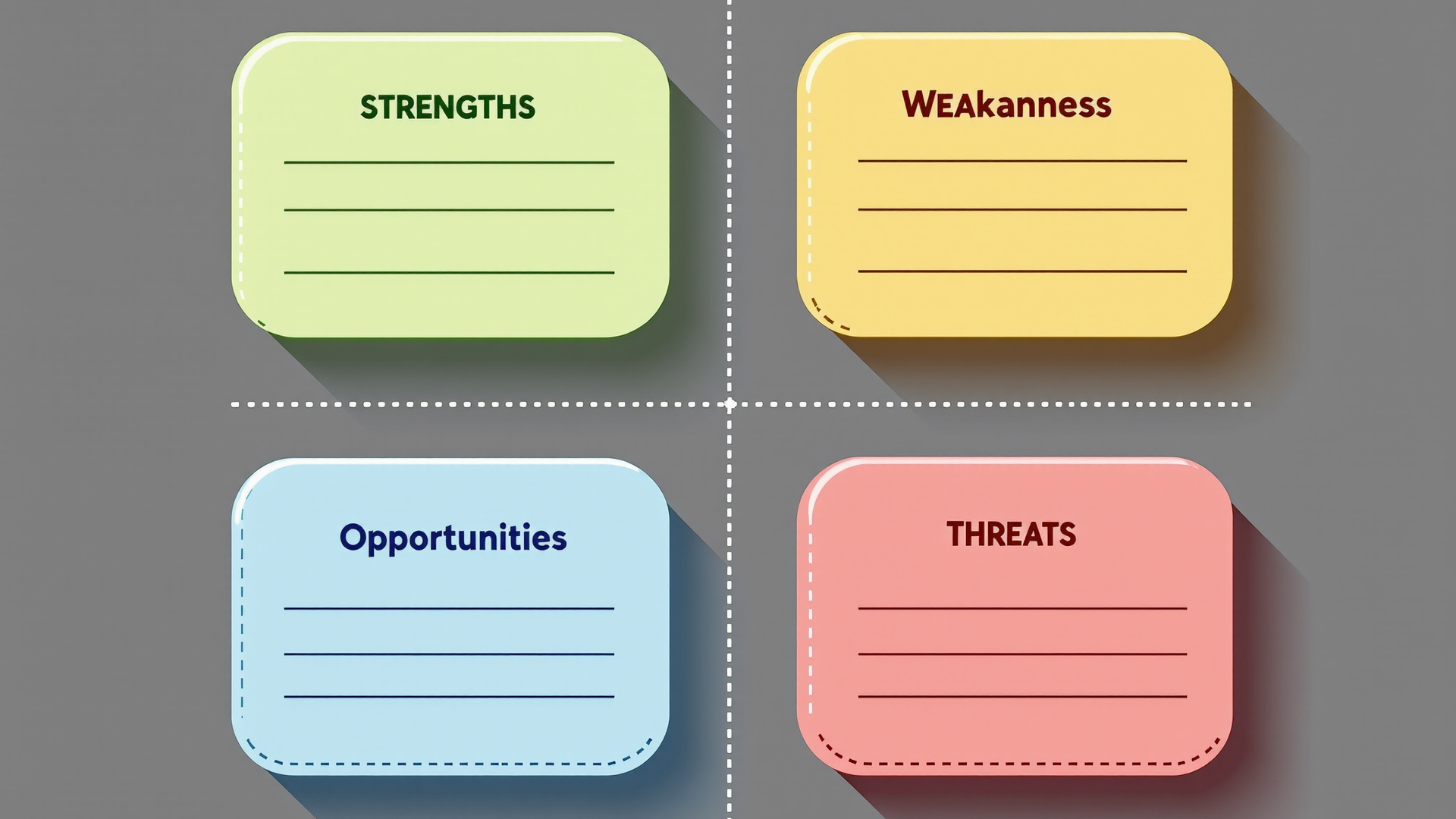
Strengths (internal: “in me”)
- Which 2–3 subjects do I consistently score highest in? What evidence (marks/projects)?
- What tasks feel easy for me but hard for others (analysis, writing, speaking, design, coding)?
- What study habits help me (notes, revision schedule, asking doubts, practice tests)?
- What personal qualities do teachers/peers notice (focus, teamwork, creativity, discipline)?
- What resources do I already have (quiet study space, mentor, reliable internet, library)?
- When did I overcome a tough challenge—and how did I do it?
Weaknesses (internal: “in me”)
- Which subjects/topics pull my average down—and why (concepts, practice, time)?
- What habits hurt me (procrastination, late sleep, distraction, irregular practice)?
- Where do I avoid asking for help or feedback?
- What happens to me near exams (anxiety, rushing, blanking, skipping revision)?
- Which core skills need work (writing, math basics, English speaking, coding, SOPs/interviews)?
- What is one pattern I repeat that slows me down?
Opportunities (external: “around me”)
- Which school resources can I use (clubs, labs, teachers’ office hours, competitions)?
- What online options are available (free MOOCs, webinars, Olympiads, hackathons, essay contests)?
- Are there scholarships, mentorships, or career fairs I can apply for this term?
- Which colleges/courses are adding new programs that match my interests?
- Who in my network (alumni, relatives, teachers) can I talk to for 2 informational calls?
- What local internships/shadowing/volunteering could I try in the next 4–8 weeks?
Threats (external: risks “around me”)
- What time/budget/transport limits can affect my plan?
- Do I face power/internet issues or a noisy study environment?
- Are there exam date clashes or very high competition on one path?
- What digital distractions or social pressures could derail me?
- Any health/family duties that reduce study time?
- What misinformation or unreliable sources could misguide my choices?
Now that you’ve answered those SWOT questions, let’s turn your answers into a clear plan you can actually follow. Start by picking the top 2 items from each column (Strengths, Weaknesses, Opportunities, Threats). These will become the focus of your action plan. Turn strengths into tools: For each strength, write one way to use it this term. Example: “I score highest in Science — I will lead our study group once a week to teach a chapter I understand well.” Or “I learn fast from practice tests — I’ll take one timed test every Sunday.” Fix one weakness at a time: Choose the weakest topic that pulls your average down and set a small, specific goal to improve it. Example: “Improve fractions — do 10 practice questions three times a week” or “Get help with essay structure — ask my English teacher for one tip after class each week.” Make opportunities concrete: Pick 1–2 external chances you can act on right now. Sign up for a school club, join an online introductory course, or book two short informational calls with people in fields you find interesting. Treat these like appointments—put them on your calendar so they actually happen. Plan for threats so they don’t stop you: For each threat you listed, add one simple solution. If internet is unreliable, download lessons ahead of time. If distractions are a problem, set a 30–45 minute “focus block” with your phone in another room. If you have family duties, talk with someone at home and agree on specific study hours. Create a weekly schedule you can keep: Use three short sections in your plan—Study Blocks, Practice Tasks, Help Actions. - Study Blocks: 40–50 minute focused sessions for subjects that need the most work. - Practice Tasks: Short, specific exercises (10–20 minutes) like past-paper questions, spelling drills, or coding exercises. - Help Actions: Tiny steps to get help—email a teacher, join one extra class, or ask a classmate for notes. Set SMART mini-goals: Make goals Specific, Measurable, Achievable, Relevant, Time-bound. Examples: - “Raise algebra score by 8% in the next monthly test by doing 5 practice problems every weekday.” - “Complete the free online coding course’s first module within 3 weeks.” Use simple tracking and review: Keep a one-page tracker (paper or digital) with weekly checkboxes: Did I finish my Study Blocks? Did I do Practice Tasks? Did I ask for help when stuck? Every Sunday, review progress for 10 minutes: what worked, what didn’t, and one change for next week. Use strengths while fixing weaknesses: Pair a strength with a weakness. If you’re a strong reader but weak at writing, read short model essays and then write one paragraph every other day copying their structure. If you’re good at explaining topics aloud, teach a friend a difficult chapter to strengthen both your understanding and your communication. Practice low-pressure mock exams: Simulate an exam once every two weeks: set a timer, do a paper, then mark it. This reduces test anxiety and helps you learn how to pace yourself. Ask for feedback often and early: Don’t wait until grades drop. Show one problem or one paragraph to a teacher each week. Small corrections early prevent big problems later. Celebrate small wins: Improvement is built from tiny steps. Celebrate when you complete a week of Study Blocks, improve a single test section, or ask a teacher for help. These keep you motivated. Quick example plan (4 weeks): - Week 1: Identify 2 strengths, 1 key weakness (fractions), sign up for a free math webinar, download lessons in case of bad internet. - Weeks 2–3: Do fractions practice 3× per week, one mock test every Sunday, ask teacher for feedback after class. - Week 4: Take a full timed practice test, compare results, set next 4-week goal based on which topics still need work. Final thought: A SWOT is only useful if you act. Use what you’re good at, focus on one weakness at a time, grab the opportunities around you, and plan around the threats. Keep your steps small, track them weekly, and ask for help whenever you get stuck—small, steady actions lead to big improvements.