By Solar Eye Energy
5-Minute Read | Consumer Awareness
You've probably seen the advertisements.
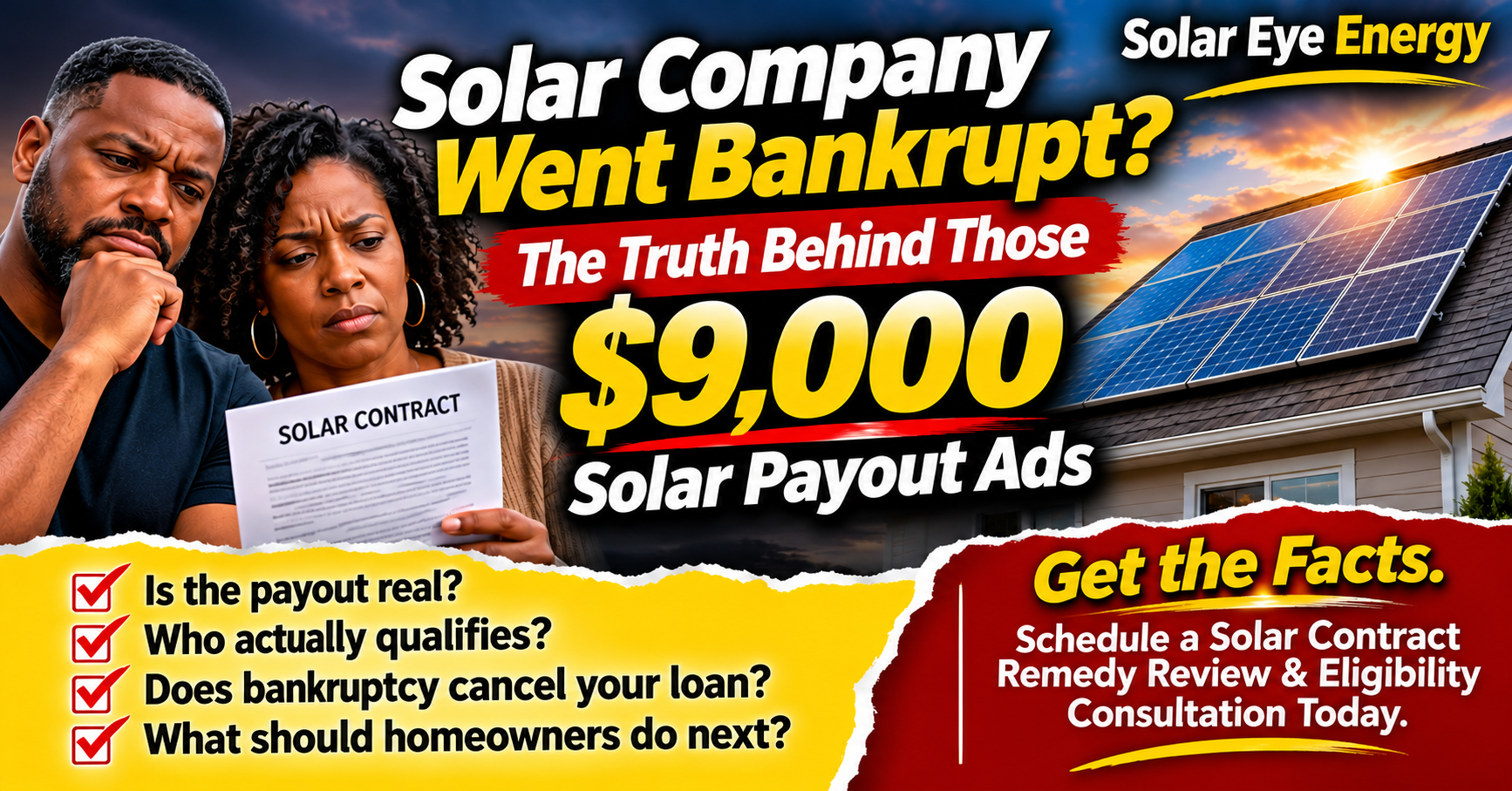
A solar company supposedly went bankrupt. Homeowners are being told they may qualify for thousands of dollars. Some advertisements even mention payouts of $9,000.
If you have solar panels on your home, those advertisements are designed to get your attention.
But here's the question: Where is that money supposedly coming from, and what actually makes a homeowner eligible to receive it?
The answer isn't as simple as the advertisements make it sound.
When a solar company files for bankruptcy or goes out of business, the consequences can extend well beyond the company itself.
Homeowners may be left with unfinished installations, malfunctioning systems, unanswered warranty questions, and financing agreements they're still expected to pay.
But a solar company's bankruptcy doesn't automatically mean homeowners are entitled to compensation.
It also doesn't necessarily eliminate their solar loan.
In many transactions, the company that installed the panels and the company financing the purchase are two separate businesses.
That means the installer can disappear while the financing obligation remains.
The company's financial problems and the homeowner's contractual obligations are not necessarily the same issue.
This is where homeowners need to pay attention.
An advertisement mentioning a $9,000 solar payout does not, by itself, establish that a nationwide compensation program exists or that every solar customer qualifies.
These advertisements may refer to different types of potential financial relief.
1. Consumer settlements
Some solar companies have faced lawsuits or government enforcement actions involving deceptive marketing, financing practices, or other consumer protection concerns.
Certain cases have resulted in financial relief for eligible consumers.
However, each settlement has its own eligibility requirements. A homeowner cannot assume they're entitled to money simply because they purchased solar panels.
2. Contract-related claims
Some homeowners may have grounds to question how their solar agreements were presented, documented, or financed.
Potential issues can involve representations about savings, financing charges, installation obligations, or promised services.
Whether those issues support a remedy depends on the specific transaction and applicable law.
3. Bankruptcy claims
Customers may sometimes submit claims in bankruptcy proceedings when a company owes them money or has failed to fulfill certain obligations.
But filing a claim doesn't guarantee payment. The amount available depends on the bankruptcy proceedings, the nature of the claim, and other factors.
4. Lead-generation advertisements
Some advertisements use large dollar figures to encourage homeowners to complete eligibility questionnaires or submit contact information.
The advertised amount may be an estimate, a reference to a particular case, or simply a marketing claim.
Submitting your information does not establish that you're entitled to compensation.
The real concern for some homeowners may have started long before a solar company went bankrupt.
In August 2024, the Consumer Financial Protection Bureau published findings describing potentially harmful practices in residential solar financing.
The report discussed concerns involving misleading savings representations, hidden or poorly understood financing costs, and complicated loan terms.
Consider a homeowner who was told their new solar system would substantially reduce their monthly electricity expenses.
They sign the agreement expecting the savings to offset the financing payment.
Later, they discover the savings aren't what they anticipated, or that the financing terms are more expensive than they understood.
Now imagine the installation company closes.
The homeowner may still be responsible for payments while trying to determine who is accountable for the original promises.
That's why reviewing the actual transaction can be more important than responding to an advertised payout amount.
These concepts are frequently confused.
Bankruptcy concerns a company's financial condition and the legal process for addressing its debts and obligations.
Contract cancellation concerns whether an agreement can legally be terminated or rescinded under applicable circumstances.
Compensation concerns whether a homeowner is entitled to receive money or another form of financial relief.
One does not automatically establish the others.
A solar company can go bankrupt without creating a right to cancel every customer's financing agreement.
A homeowner may also have a legitimate contractual concern even if the solar company remains in business.
And a successful consumer claim may produce relief other than a cash payment.
The details matter.
Before responding to a solar compensation advertisement, homeowners should understand what is actually being offered.
Does the advertisement identify a specific settlement or legal proceeding?
Does it name the company involved?
Does it explain the eligibility requirements?
Is the advertised $9,000 an actual approved payment amount, a possible recovery figure, or an unsupported marketing claim?
And perhaps most importantly, is the advertiser administering a real compensation program, or simply offering a service to evaluate potential claims?
Those are very different propositions.
A legitimate review process should not begin with a guarantee that every homeowner will receive money.
Solar Eye Energy approaches these concerns from a different starting point.
Rather than beginning with the promise of a payout, the focus is on the homeowner's solar transaction.
Through its Solar Contract Remedy Review & Eligibility Service, Solar Eye Energy provides a consultation-first process for identifying concerns associated with solar agreements and determining whether further administrative and contractual review is appropriate.
Areas of review may include:
The objective is not to promise that every homeowner has a claim.
It's to determine whether the homeowner's circumstances present issues worth examining and what additional documentation or professional assistance may be appropriate.
A consultation is the starting point, not a guarantee of compensation, cancellation, or any particular outcome.
A $9,000 payout advertisement might get a homeowner's attention.
But the advertisement alone doesn't establish a right to receive money.
The more meaningful questions concern what the homeowner was promised, what they signed, what actually occurred, and whether those circumstances support further review.
A solar company going bankrupt doesn't automatically create a financial recovery.
And a homeowner doesn't necessarily need to wait for a bankruptcy to question a problematic solar transaction.
Before focusing on what an advertisement says you might receive, understand what your solar agreement actually requires.
Solar Eye Energy provides a Solar Contract Remedy Review & Eligibility Service for homeowners seeking clarity about their solar transactions.
The service begins with an initial consultation to assess the homeowner's concerns and determine whether additional documentation and contract review may be appropriate.
Schedule an Initial Consultation with Solar Eye Energy.
Services are consultation-based. Eligibility and available options depend on individual circumstances. No financial recovery, debt elimination, contract cancellation, or specific outcome is guaranteed.
Sources and further reading