3-Minute Read
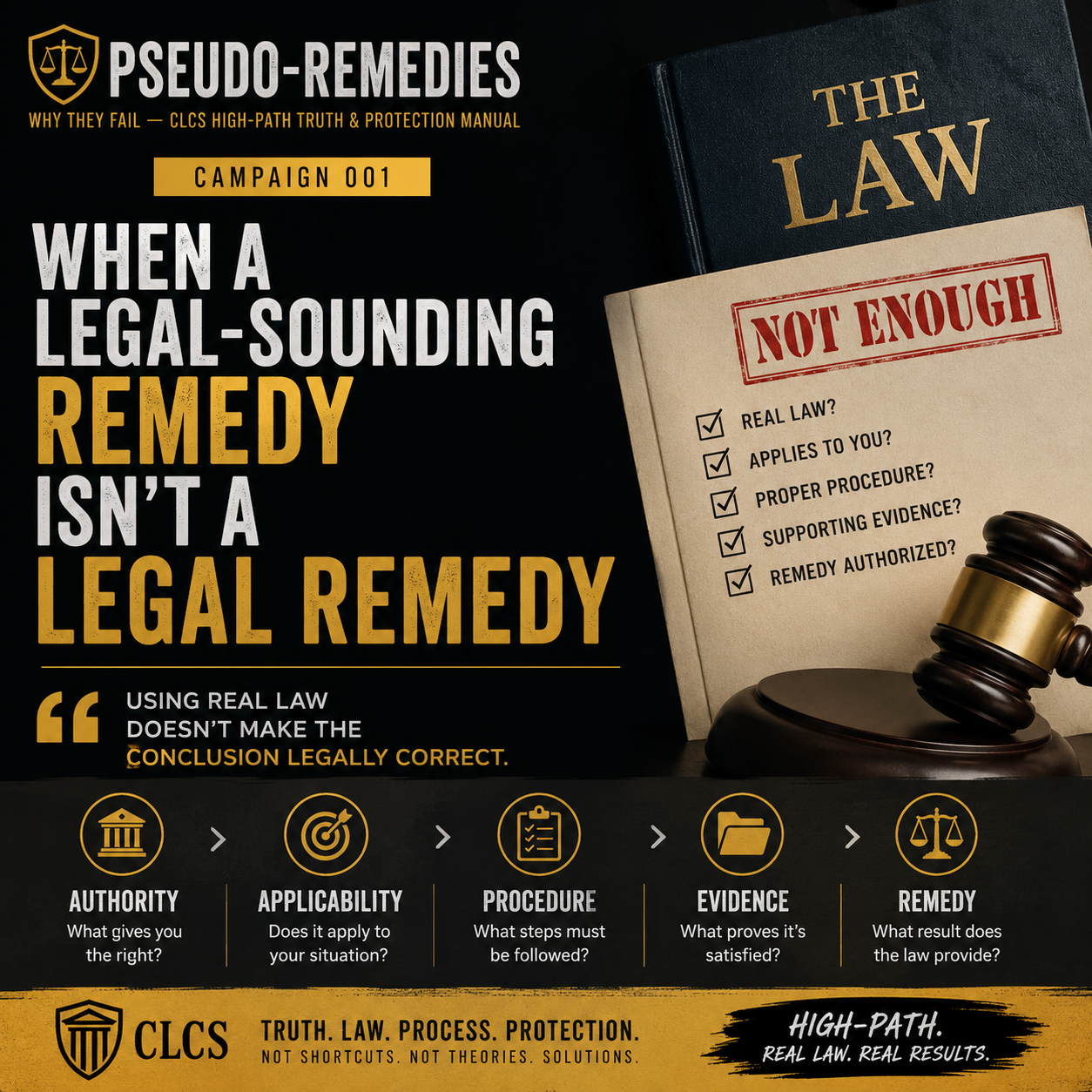
“Using real law doesn’t make the conclusion legally correct.”
One of the reasons pseudo-remedies can be so convincing is that they don't always sound ridiculous.
In fact, they may sound extremely sophisticated.
Someone quotes a federal statute. They reference the Constitution. They cite a court case. They start discussing trusts, contracts, negotiable instruments, the Uniform Commercial Code, jurisdiction, secured interests, or some other legitimate area of law.
You look up the statute—and it's real.
You find the court case—and it exists.
So naturally, you think:
“If they're using real law, how can the remedy be wrong?”
Because finding real law is only the beginning.
The real question is whether that law actually applies to what you're trying to do.
Imagine someone quotes a completely legitimate provision of the Uniform Commercial Code.
The citation itself may be accurate.
But that doesn't automatically mean the UCC provision governs a criminal proceeding, eliminates a tax obligation, cancels a mortgage, prevents a creditor from enforcing a judgment, or creates whatever other remedy the person claims.
The law can be real while the application is wrong.
The same problem occurs with court decisions.
Someone may pull a sentence from an actual judicial opinion and present it as though the court established a broad rule that applies everywhere.
But what was the case actually about?
What court decided it?
What jurisdiction was involved?
What facts were before the court?
Was the language part of the court's actual holding?
Has the decision been limited, distinguished, superseded, or overturned?
And most importantly:
Does that decision actually apply to your circumstances?
Without those questions, a real case citation can become little more than decoration around an unsupported theory.
Pseudo-remedies often become even more persuasive when they're surrounded by complicated terminology.
Trust. Beneficiary. Secured party. Assignment. Affidavit. Notice. Jurisdiction. Commercial claim. Constitutional right.
Those are real concepts.
But combining legitimate legal terms doesn't automatically create a legitimate remedy.
For example, trusts are real legal structures with legitimate purposes.
Assignments are real.
Affidavits are real.
Commercial law is real.
But the existence of those concepts doesn't mean placing something into a trust automatically makes it unreachable, signing an affidavit makes its contents legally established, or labeling a transaction “commercial” gives someone powers the governing law doesn't provide.
The label doesn't create the legal effect.
The governing law does.
Before relying on a supposed remedy, ask:
What is the actual legal authority for the result being claimed?
Not simply:
“What statute did they quote?”
Instead:
“Where does that authority say I can do what they're telling me to do?”
That's a very different question.
A person may show you ten pages of statutes without identifying a single provision that actually authorizes the remedy they're selling.
That's where structured analysis becomes important.
A legitimate legal or administrative theory should survive more than one question.
What statute, regulation, rule, contract provision, or controlling decision creates the right or remedy being asserted?
Does that authority actually govern the person, transaction, proceeding, jurisdiction, and circumstances involved?
Even if the right exists, what procedure must be followed to invoke it?
Rights and remedies frequently have deadlines, filing requirements, evidentiary standards, notice requirements, jurisdictional rules, and specific forums where they must be asserted.
What facts and documents establish that the requirements have actually been satisfied?
A theory without supporting evidence may collapse even when the underlying law is legitimate.
Finally:
What does the law actually authorize as the result?
This is where many pseudo-remedies make their biggest leap.
The authority may establish one limited right, while the person promoting the theory claims it produces a dramatically larger result.
That gap matters.
Another warning sign is the idea that a single document automatically changes someone's legal position.
You may hear claims involving a special affidavit, trust document, UCC filing, declaration, notice, assignment, status correction, or particular wording that supposedly forces another party—or even a court or government agency—to accept a desired result.
Documents can absolutely have legal significance.
But their effect depends upon authority, facts, procedure, jurisdiction, and the legal relationship between the parties.
A document doesn't acquire extraordinary power simply because it contains legal terminology.
This may be one of the simplest tests of any supposed remedy.
Someone tells you:
“Send this document and they have to accept it.”
Ask:
“What happens if they don't?”
What court or agency has jurisdiction?
What cause of action or procedural mechanism allows enforcement?
What must be proven?
What authority requires the other party to comply?
What have courts actually done when people presented this argument?
A legitimate remedy should be capable of surviving those questions.
If the entire strategy depends upon everyone voluntarily accepting the promoter's interpretation of the law, you may not have a remedy at all.
A theory isn't stronger because it's difficult to understand.
Sometimes complexity creates the appearance of authority.
Pages of statutes, definitions, Latin phrases, commercial terminology, historical references, and court citations can make an argument feel powerful.
But strip everything away and ask five questions:
Where is the authority?
Does it apply?
What procedure invokes it?
What evidence supports it?
What remedy does the law actually provide?
If the theory cannot survive those questions, adding another twenty statutes won't repair it.
Because the goal shouldn't be finding law that sounds like it supports the result you want.
The goal is determining what the law actually supports.
Using real law doesn't make the conclusion legally correct.
Common Law Credit Solutions
Pseudo-Remedies: Why They Fail — High-Path Truth & Protection
