By Common Law Credit Solutions (CLCS)
5-Minute Read | Consumer Education
What if someone told you that your birth certificate was worth millions? That a special phrase could eliminate your debt? Or that a few government forms could unlock money you never knew existed?
Across social media, videos and online communities continue promoting these ideas as hidden remedies the public was never taught.
Some come packaged as legal education. Others are sold as paperwork systems, private processes, or financial secrets.
But there's a question that rarely gets answered:
What happens when someone actually tries to use these methods in the real world?
That's where the conversation needs to begin.
People are looking for solutions.
Some are overwhelmed by debt. Others are dealing with court proceedings, government agencies, financial institutions, or contracts they don't fully understand.
When conventional options seem limited, the idea of discovering a hidden legal remedy can be extremely appealing.
Especially when someone online claims the solution has been available all along.
The presentation often follows a familiar pattern: an obscure statute, a government form, an unfamiliar legal term, and an explanation suggesting that ordinary people have been denied access to a powerful financial or legal process.
But citing a law doesn't necessarily mean the proposed application of that law is correct.
A legitimate legal term can be used to support an illegitimate conclusion.
And that distinction is where many pseudo-remedies begin to fall apart.
One widely circulated theory claims that the government creates a secret financial account or bond when a child is born.
According to various versions of the theory, the birth certificate supposedly represents an asset that can be accessed, transferred, or used to discharge financial obligations.
The problem?
A birth certificate is a vital record documenting a birth. It does not, by itself, establish ownership of a secret Treasury account or create a personal financial instrument that can be redeemed for money.
The U.S. Treasury has repeatedly warned about schemes involving fictitious Treasury accounts and attempts to use birth certificates or Social Security numbers to obtain funds.
Yet variations of these claims continue circulating online.
Another popular concept is commonly called Accepted for Value, or A4V.
Supporters sometimes claim that writing specific language on a bill, invoice, court document, or financial instrument can transform the obligation into something already paid or accepted.
Some versions involve special endorsements, references to the Uniform Commercial Code, or instructions directing payment through supposed government accounts.
But a written declaration doesn't automatically satisfy a financial obligation.
The Uniform Commercial Code governs particular commercial transactions. It doesn't create a universal mechanism for eliminating debts through unsupported endorsements or private declarations.
Whether a debt has been paid, discharged, disputed, or otherwise resolved depends on the applicable agreement, law, and actual circumstances—not simply the wording someone places on a document.
Tax forms are another common feature of pseudo-remedy programs.
Forms such as 1099-A and 1099-OID are sometimes presented online as tools for acquiring property, obtaining refunds, or eliminating debts.
But these forms have specific tax-reporting purposes.
Form 1099-A generally concerns reporting certain information when a lender acquires an interest in secured property or knows the property has been abandoned.
Form 1099-OID concerns reporting original issue discount income associated with certain debt instruments.
Neither form is a general-purpose payment instrument.
Submitting inaccurate tax information can expose individuals to penalties, investigations, and other consequences.
A government form is not a financial remedy merely because someone has found an unconventional way to fill it out.
Another recurring claim suggests that a person's name, particularly when written in capital letters, represents a separate corporate or legal entity.
Some versions argue that individuals can separate themselves from that supposed entity to avoid debts, taxes, court jurisdiction, or other obligations.
These claims frequently rely on interpretations of capitalization, legal terminology, and historical commercial practices.
But the appearance of a person's name in capital letters does not, by itself, establish a separate corporate identity or eliminate legal obligations.
Courts have repeatedly rejected attempts to use these theories as a general defense against established legal responsibilities.
That doesn't mean questions about identity, jurisdiction, service of process, or legal authority are irrelevant.
Those can be legitimate legal issues.
It means they must be evaluated under the actual governing law and supported by facts—not assumptions about typography or hidden financial identities.
Many pseudo-remedies share a common weakness.
They begin with something real—a statute, a regulation, a court procedure, a commercial instrument, or a government agency.
Then they assign that real thing a meaning or power it doesn't actually possess.
A filing is treated as proof of entitlement.
A declaration is treated as a binding legal determination.
An unanswered letter is treated as automatic agreement.
Or an administrative procedure is presented as a substitute for a court ruling.
The underlying problem is not necessarily the use of paperwork.
It's the assumption that paperwork creates legal authority simply because it has been prepared, signed, notarized, or mailed.
A document's legal effect depends on much more than its appearance.
A legitimate remedy has an identifiable legal or contractual foundation.
There must be a recognized basis for the requested relief, an applicable procedure, and facts supporting the position being asserted.
A pseudo-remedy often promises the same outcome without establishing those necessary elements.
That distinction matters because the consequences can be significant.
People may spend money on ineffective document packages, miss important deadlines, submit inaccurate information, or make decisions based on rights they don't actually possess.
In some circumstances, those mistakes can leave someone in a worse position than when they started.
And that's precisely why education should come before execution.
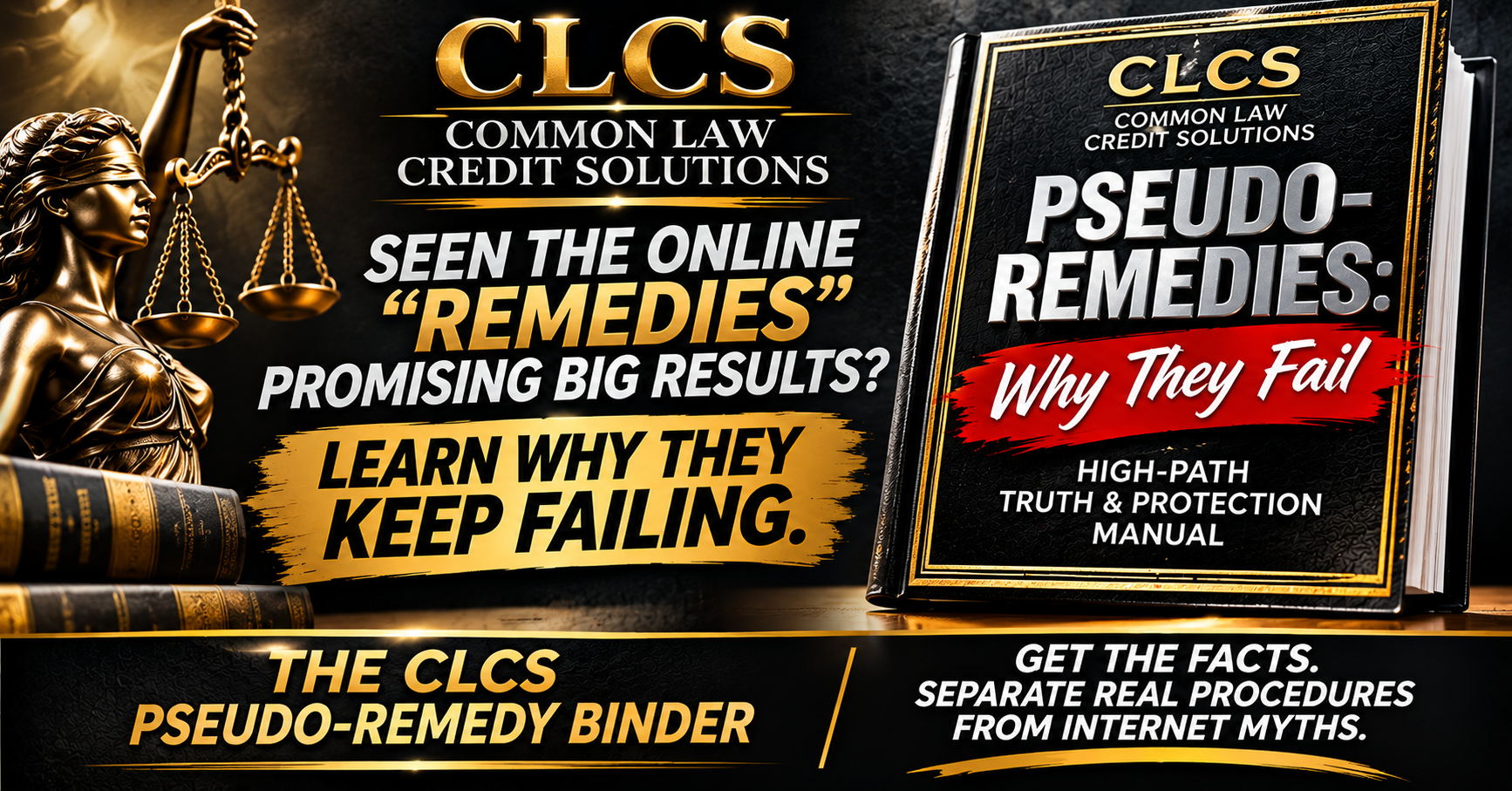
Common Law Credit Solutions developed its Pseudo-Remedy Binder as an educational resource for individuals who want to examine these claims more critically.
Rather than selling secret legal shortcuts or promising extraordinary financial outcomes, the binder focuses on understanding the claims themselves.
Its educational approach examines what people are being told, where those ideas originate, why the proposed methods fail as advertised, and how to distinguish legitimate administrative or legal procedures from unsupported interpretations.
The objective is not to discourage people from questioning institutions, contracts, or government actions.
It's to encourage better questions.
What authority actually supports the claim?
What procedure applies?
What evidence is required?
And what does the law really authorize?
Those questions are more valuable than memorizing a phrase someone claims will make an obligation disappear.
The internet has made legal and financial information more accessible than ever.
But accessibility doesn't guarantee accuracy.
A person can spend hours studying an elaborate theory, purchase hundreds of pages of documents, and still misunderstand the legal foundation of what they're attempting.
The solution isn't necessarily more paperwork.
Sometimes the most important step is learning why a proposed remedy doesn't work before investing time, money, or legal standing in it.
Understanding the difference between legal authority and an unsupported legal theory can prevent an expensive mistake.
Pseudo-Remedies: Why They Fail — CLCS High-Path Truth & Protection Manual is an educational publication developed by Common Law Credit Solutions.
It examines widely circulated alternative legal and financial theories, including birth certificate bond claims, Accepted for Value, misuse of IRS forms, strawman theories, and misconceptions about commercial law and administrative procedures.
The binder is intended to help readers recognize unsupported claims, understand why particular approaches fail, and develop a more informed perspective before attempting document-based remedies.
Explore the CLCS Pseudo-Remedy Binder.
Educational material only. The binder does not provide individualized legal advice, establish attorney-client representation, or guarantee any legal or financial outcome.
