3-Minute Read
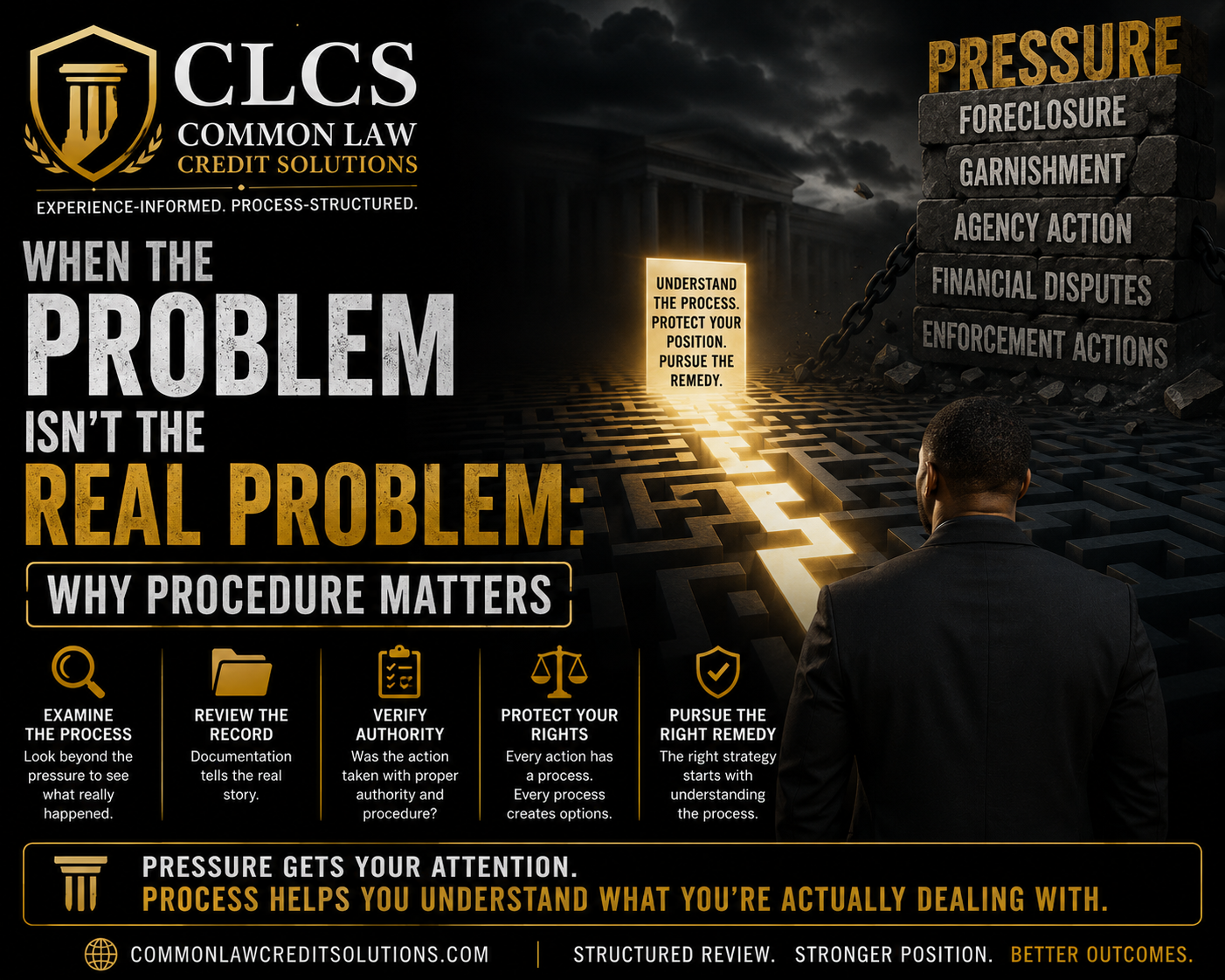
“Pressure gets your attention. Process helps you understand what you're actually dealing with.”
When a foreclosure notice arrives, wages are garnished, an agency takes action, or a financial dispute begins creating immediate consequences, most people respond to the same thing first:
The pressure.
That's understandable. When your money, property, business, or financial stability is being affected, the immediate concern is usually, How do I stop this?
But focusing exclusively on the pressure can cause you to overlook another important question:
What process produced it?
Foreclosure is pressure.
Garnishment is pressure.
An enforcement action is pressure.
A government or agency determination can create pressure.
A financial or commercial dispute can create pressure.
These are the consequences people experience directly. But those consequences usually didn't appear out of nowhere. Something happened before them.
Notices may have been issued. Decisions may have been made. Documents may have been filed. Deadlines may have passed. Authority may have been asserted. Opportunities to respond may have existed.
Together, those events create a record of the process.
Understanding that record can be just as important as understanding the problem itself.
Instead of looking only at the consequence, a structured review begins asking questions such as:
Who took the action?
What authority was relied upon?
What notice was required and what notice was actually provided?
What procedures were supposed to occur?
What documents support the action?
What opportunities existed to respond, object, correct, or challenge the matter?
What does the actual record show?
These questions don't automatically establish that something was done incorrectly, nor does identifying a procedural issue automatically create a particular remedy.
They do something more fundamental:
They help establish what actually happened.
People often remember conversations, phone calls, promises, explanations, and disagreements.
Administrative and procedural matters, however, frequently turn on what can be documented.
A record may include notices, contracts, correspondence, filings, account histories, agency communications, responses, dates, delivery records, decisions, and other supporting documents.
Looking at those materials chronologically can reveal a very different picture than simply reacting to the latest notice or demand.
That is why documentation matters.
The question isn't only:
“What are they doing to me now?”
It is also:
“What happened before we reached this point?”
Understanding procedure doesn't mean searching for a technicality or assuming every mistake eliminates an obligation.
It means determining whether the process can be verified and understood before deciding what should happen next.
Depending on the circumstances, that review may identify unanswered questions, missing documentation, inconsistencies, unresolved disputes, procedural concerns, or additional information that needs to be obtained.
Sometimes the record confirms the process.
Sometimes it raises new questions.
Either result is valuable because decisions can then be based on the record, rather than assumptions.
Pressure creates urgency.
Urgency can cause people to react quickly—make a phone call, send a random letter, agree to something they don't fully understand, or jump directly toward a remedy without first examining how the situation developed.
A more structured approach begins differently:
Understand the pressure.
Examine the process.
Build the record.
Then evaluate the available path forward.
At Common Law Credit Solutions, our work is built around structured administrative and procedural review. We examine documentation, chronology, communications, and process to help clients better understand their position and prepare an organized path toward the appropriate next step.
Because sometimes the most important question isn't simply:
“How do I stop the pressure?”
It's:
“What process created the pressure in the first place?”
Common Law Credit Solutions
Experience-Informed. Process-Structured.
