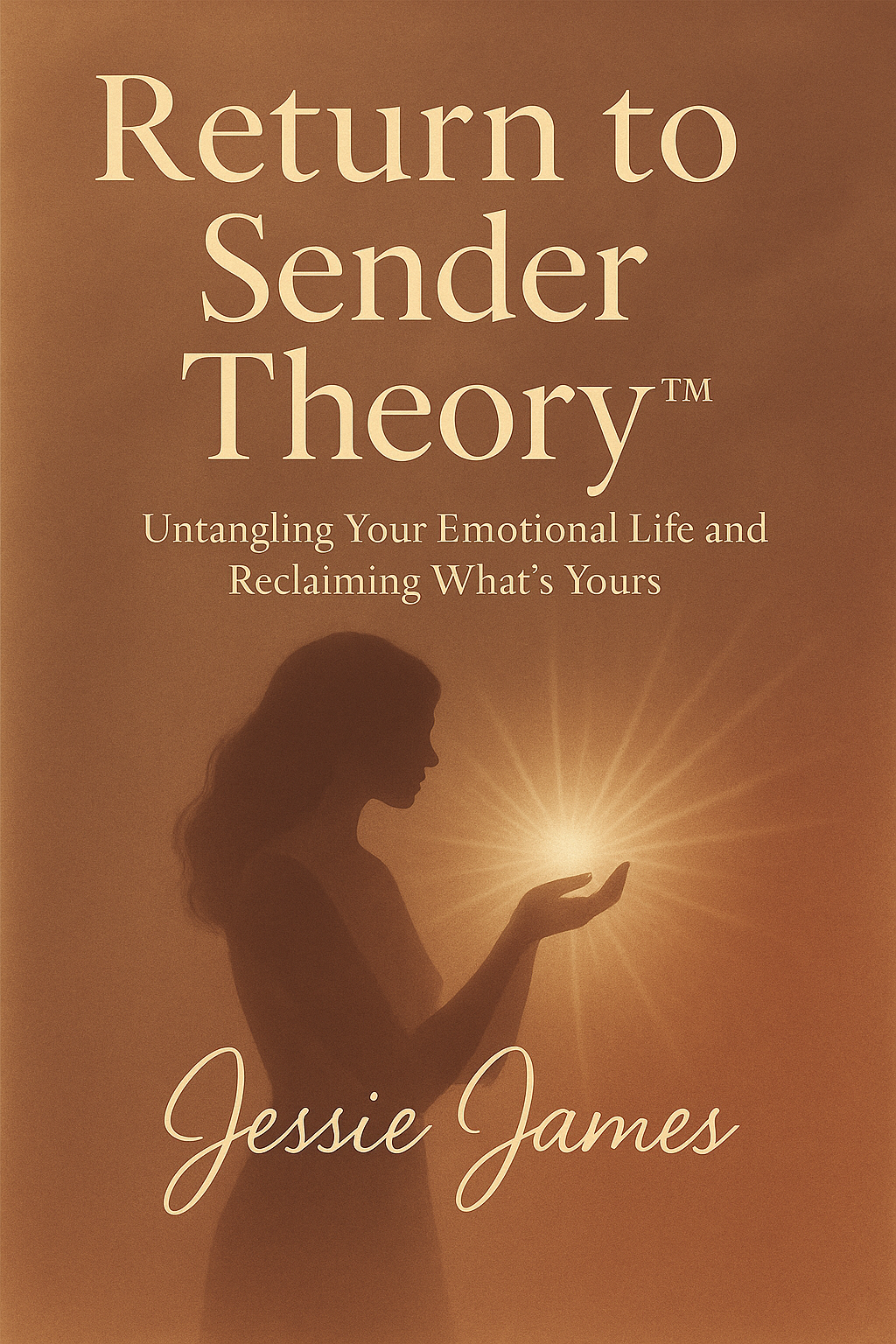
Avoid clinical diagnoses, therapy claims, or telling readers to “set boundaries” without explanation. End with a soft, reflective close that invites curiosity rather than pressure, and subtly positions the book Return to Sender Theory™ as a deeper exploration of this concept.
You leave a conversation feeling exhausted — not because you’re weak, but because you’ve been carrying more than was handed to you. It’s a familiar, muddled kind of tired: your mind busy replaying someone else’s words, your chest tight with an emotion that arrived without invitation, your ability to engage afterward dulled. People call this “being sensitive,” or tell you to toughen up. What they miss is how often this fatigue comes from emotional absorption — a learned, habitual way of taking on other people’s feelings as if they were yours.
This exhaustion isn’t a moral failing or a character flaw. It’s a pattern, and patterns are learned. If you grew up as the one who smoothed over conflict, listened until others felt lighter, or absorbed tension so the household didn’t explode, you learned a useful survival skill: attunement. Over time, attunement can calcify into absorption — the automatic intake of other people’s emotional material. The skill that once made you dependable becomes the mechanism that drains you. Recognizing this isn’t blame; it’s a map. It tells you where to look and what to practice differently.
Empathy and emotional absorption can look similar at first glance, but they operate differently. Empathy is noticing another person’s inner state and maintaining a separate internal boundary: you understand their sadness without inheriting it. Emotional absorption, by contrast, is the unintentional taking-on of that state until you lose track of whose feeling it really is. Empathy allows you to respond from choice. Absorption leaves you responding from occupation — your energy occupied by someone else’s unresolved weather.
Consider two quick examples. In a team meeting, a colleague unloads frustration about a project and, an hour later, you’re left jittery and second-guessing your work — not because you did anything wrong, but because their stress landed inside you and colored your perception. In a family dinner, a parent recounts an old disappointment; you walk away apologizing for things you didn’t do, feeling responsible for soothing a wound that you inherit in the moment. In both cases, you were present, attentive, and caring — and you also absorbed emotions that weren’t inherently yours. That absorption then shows up as exhaustion, irritability, or emotional numbness.
This is where Return to Sender Theory™ comes in. Think of it not as a one-step fix but as a practical lens for distinguishing ownership of feeling. The core idea is simple: not every feeling that shows up in your body belongs to you. Some belong to the person speaking, some are echoes of past relationships, and some are cultural or situational atmospheres you’ve learned to carry. The practice is about learning to notice the origin of an emotion, then intentionally redirecting — or “returning” — what isn’t yours, like mail delivered to the wrong address.
Return to Sender Theory™ is method, not magic. It asks you to slow down after an interaction and check three things: where did this feeling originate (who was speaking, what was the context), what does the sensation ask of me (does it want action, repair, or distance), and does responding to it actually belong to me? From there, small, embodied practices help. A simple pause: take three grounding breaths and name the feeling (“anger,” “sorrow,” “overwhelm”). Then ask quietly, “Is this mine?” If the answer leans toward no, imagine a clear pathway back to the person or place it came from — picture sliding the emotion into an envelope and saying mentally, “Return to sender.” This isn’t avoidance; it’s clarity. It preserves your capacity to empathize without turning you into a repository.
A practical nuance: returning an emotion doesn’t mean you become indifferent. It means you respond from agency rather than auto-absorption. In the workplace example, after that grounding pause, you might recognize the colleague’s stress as theirs and choose a constructive response — offer a solution, set a follow-up, or reflect what you heard — without letting their agitation rewire your confidence. In the family example, returning the borrowed sorrow allows you to listen supportively without taking on the long-standing guilt that isn’t yours to fix.
This is learned work. It requires practice, patience, and a language for emotional ownership. Start with tiny experiments: after a draining interaction, take five minutes alone to breathe, name the feelings you have, and mentally see which ones line up with the other person’s story. Track patterns: which relationships, topics, or settings habitually leave you depleted? That pattern becomes actionable intelligence rather than self-criticism.
A grounded takeaway: emotional clarity is reclaimable. When you begin to treat feelings as messages with authorship — some written by you, some by others — you shift from default absorption to intentional engagement. You keep your capacity to care; you stop carrying what wasn’t meant for your shoulders. This reduces the invisible debt that compounds into exhaustion.
If this perspective resonates, consider it an invitation to curiosity, not pressure. Return to Sender Theory™ is an approach you can test in small moments and expand over time. For those who want a deeper, structured exploration of these practices and the stories behind them, the book Return to Sender Theory™ offers a fuller map and exercises to practice returning emotional mail without shutting down your empathy. Learn more.
You don’t have to solve everything at once. Start with a breath, a question — “Is this mine?” — and the willingness to return what isn’t. Over time, those small acts of clarity create more room for the person you truly are.