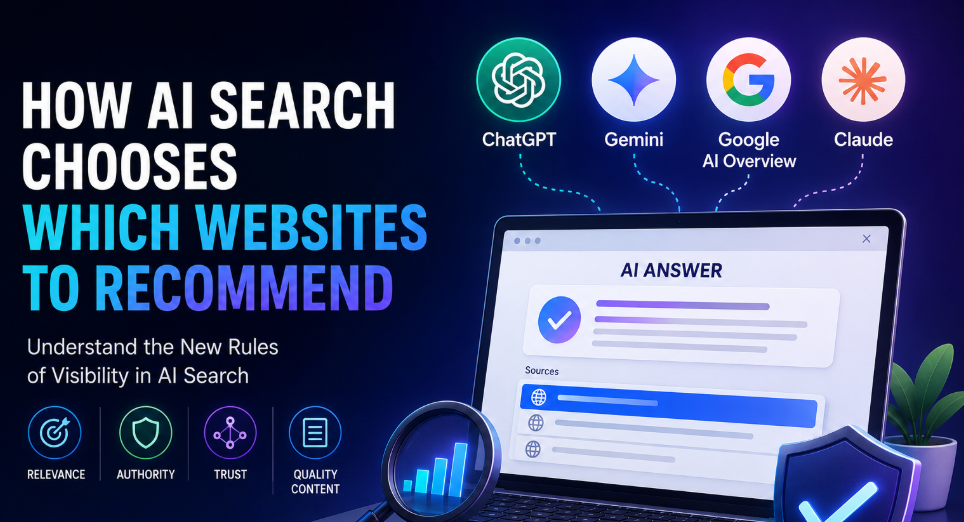
How ChatGPT, Gemini & Google AI Overview Choose Which Websites to Recommend
Search is changing faster than most businesses realize.
For over two decades, websites competed for rankings on traditional search engines by optimizing keywords, building backlinks, and improving technical SEO.
Today, a new layer has emerged.
Millions of users are asking questions directly to:
- ChatGPT
- Google AI Overview
- Gemini
- Claude
- Perplexity
Instead of displaying a list of blue links, these platforms generate direct answers.
The critical question for businesses is no longer:
"How do I rank on Google?"
The new question is:
"How do I become one of the sources AI systems trust and recommend?"
Understanding how AI search engines select information is becoming one of the most important skills in digital marketing.
The Shift From Search Engines to Answer Engines
Traditional search engines focused on retrieving pages.
AI search systems focus on generating answers.
This distinction changes everything.
Google's traditional search model:
- User enters a query
- Google finds matching pages
- User chooses a result
AI search model:
- User asks a question
- AI analyzes multiple sources
- AI synthesizes an answer
- AI cites trusted sources
This means businesses must optimize not only for rankings but also for retrieval and recommendation.
This is where Answer Engine Optimization (AEO) becomes essential.
How AI Search Engines Actually Work
Large Language Models (LLMs) such as GPT, Gemini, and Claude do not simply scan keywords.
They analyze:
- Context
- Meaning
- Relationships
- Authority
- User intent
- Semantic relevance
AI systems use technologies such as:
- Natural Language Processing (NLP)
- Vector Search
- Semantic Retrieval
- Entity Recognition
- Knowledge Graphs
Instead of asking:
"Does this page contain the keyword?"
AI asks:
"Is this page the most reliable source to answer this question?"
This is a fundamental shift in SEO.
Ranking Factor #1: Topical Authority
One of the strongest signals AI systems evaluate is topical authority.
AI platforms prefer websites that consistently publish high-quality content around a specific subject.
For example:
A website with:
- 50 AI SEO articles
- AI marketing guides
- AEO tutorials
- semantic SEO resources
is more likely to be recommended than a website with one generic article on AI.
Topical authority tells AI systems:
"This website deeply understands this topic."
Ranking Factor #2: Semantic Relevance
AI systems understand relationships between concepts.
For example:
If your article discusses:
- AI SEO
- AEO
- entity optimization
- structured data
- Google AI Overview
- semantic search
AI systems recognize that your content covers the topic comprehensively.
This is known as semantic SEO.
Modern search engines reward content that covers topics holistically rather than repeating the same keyword multiple times.
Ranking Factor #3: Entity Recognition
Entities are becoming more important than keywords.
An entity can be:
- A company
- A person
- A brand
- A technology
- A location
Google's Knowledge Graph and AI systems use entities to understand relationships.
For example:
If a brand consistently publishes content about:
- AI marketing
- AI SEO
- automation
- lead generation
AI systems begin associating that brand with those topics.
This increases recommendation potential.
Ranking Factor #4: EEAT Signals
Google emphasizes:
- Experience
- Expertise
- Authority
- Trustworthiness
These signals influence AI recommendations.
AI systems increasingly favor:
- Real-world experience
- Original insights
- Expert opinions
- Research-backed content
Generic AI-generated articles without expertise often struggle to gain long-term visibility.
Ranking Factor #5: Structured Data
Structured data helps search engines understand content more effectively.
Important schema types include:
- Article Schema
- FAQ Schema
- Organization Schema
- Breadcrumb Schema
- LocalBusiness Schema
Schema acts as machine-readable context.
This makes content easier for AI systems to interpret and retrieve.
Why Generic Content Is Losing Visibility
Many businesses are using AI to mass-produce content.
The problem?
Most of it says the same thing.
AI search engines increasingly prioritize:
- Unique insights
- Original frameworks
- Case studies
- Proprietary data
- Expert analysis
The future belongs to businesses that create information rather than simply repeating it.
Mid-Article CTA
Want Your Business to Appear in ChatGPT & Google AI Overview?
Most companies are still optimizing for yesterday's SEO.
Trivro AI helps businesses build AI-ready marketing systems using:
- AI SEO
- AEO
- AI content generation
- AI funnels
- AI lead generation
- Semantic SEO strategies
Start Building Your AI Growth System
👉 Visit www.trivro.in
👉 Explore More AI SEO Guides at blog.trivro.in
Ranking Factor #6: Content Structure
AI systems prefer content that is easy to process.
Best practices include:
- Clear headings
- Short paragraphs
- FAQs
- Bullet points
- Step-by-step explanations
- Logical hierarchy
Content structure significantly affects AI retrieval efficiency.
Ranking Factor #7: Freshness
AI systems prefer current information.
Regularly updated content signals:
- Relevance
- Accuracy
- Reliability
Businesses should revisit and update key articles every few months.
Ranking Factor #8: Brand Authority
AI systems analyze brand credibility across the web.
Important signals include:
- Reviews
- Mentions
- Citations
- Backlinks
- Social proof
- Thought leadership
The stronger your digital reputation, the more likely AI systems are to trust your content.
The Future of SEO Is AEO
Traditional SEO focused on rankings.
The future focuses on answers.
Businesses must optimize for:
- Semantic understanding
- Topic authority
- Entity optimization
- AI retrieval
- Answer generation
This shift is already happening.
The brands that adapt first will dominate future visibility.
Final Thoughts
ChatGPT, Gemini, Claude, and Google AI Overview are changing how information is discovered online.
The winners in this new search landscape will not necessarily be the websites with the most backlinks or keywords.
The winners will be the brands that become:
- Trusted
- Authoritative
- Contextually relevant
- AI-readable
The future of SEO belongs to businesses that optimize for both humans and AI systems.
Frequently Asked Questions
How does ChatGPT choose websites?
ChatGPT prioritizes authoritative, relevant, and trustworthy sources that provide comprehensive information on a topic.
What is AEO?
AEO stands for Answer Engine Optimization and focuses on optimizing content for AI-generated answers.
Does Google AI Overview use SEO?
Yes. Google AI Overview still relies on many traditional SEO signals but increasingly prioritizes semantic relevance, authority, and structured information.
What is semantic SEO?
Semantic SEO focuses on topic relationships and contextual meaning rather than exact keyword matching.
How can businesses appear in AI search results?
Businesses can improve AI visibility through:
- Topical authority
- Structured data
- Entity optimization
- AEO
- Semantic SEO
- Expert content creation