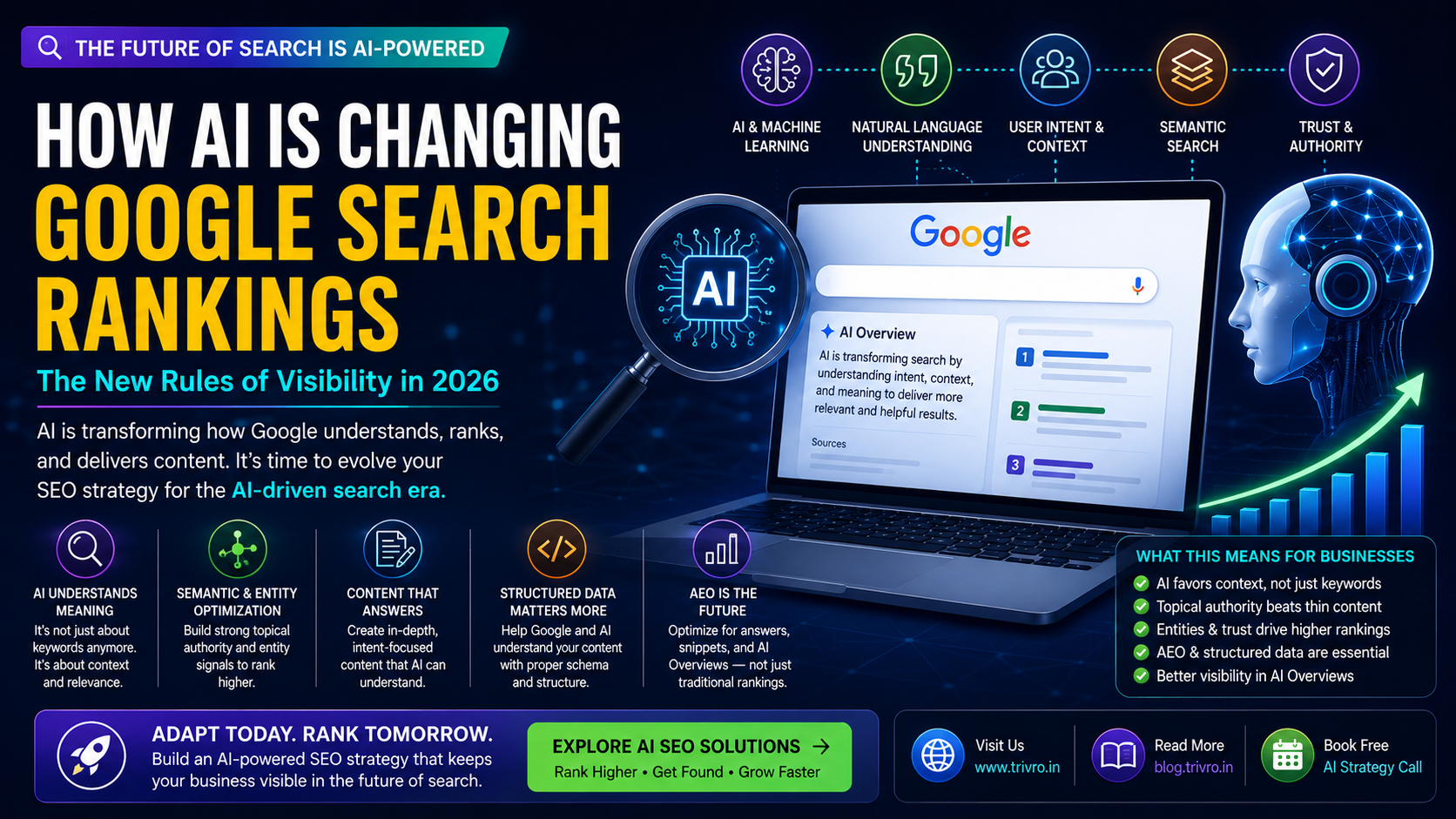
How AI Is Changing Google Search Rankings in 2026
Google Search is undergoing the biggest transformation since its creation.
For nearly two decades, SEO was built around:
- keywords
- backlinks
- page authority
- technical optimization
But today, Artificial Intelligence is fundamentally changing how Google understands, ranks, and delivers content.
The rise of:
- Google AI Overview
- conversational search
- semantic understanding
- AI-generated answers
- multimodal search
is reshaping the entire SEO ecosystem.
This is no longer just a ranking algorithm update.
It is a complete evolution from:
search engine optimization
to:
intelligent answer optimization.
Businesses that continue relying only on outdated SEO tactics may gradually lose visibility in the AI-first search ecosystem.
In this guide, we’ll explore how AI is changing Google search rankings and what businesses must do to stay visible in the future of search.
The Evolution of Google Search
To understand AI-driven rankings, we first need to understand how Google evolved.
Phase 1: Keyword-Based Search
Early Google algorithms heavily relied on:
- keyword matching
- backlinks
- metadata
- anchor text
SEO was relatively mechanical.
Businesses could often manipulate rankings through:
- keyword stuffing
- excessive backlinks
- low-quality content
Google’s understanding of intent was limited.
Phase 2: Semantic Search
Google gradually evolved through updates like:
- Hummingbird
- RankBrain
- BERT
- MUM
These updates introduced:
- Natural Language Processing (NLP)
- contextual understanding
- semantic analysis
- intent recognition
Google began understanding:
- relationships between words
- user intent
- contextual meaning
This was the beginning of AI-powered search.
Phase 3: AI-Generated Search Experiences
Today, Google AI Overview is changing how search works entirely.
Instead of showing only blue links, Google increasingly generates:
- AI summaries
- direct answers
- contextual recommendations
- conversational responses
This significantly changes:
- click behavior
- ranking visibility
- content strategy
- SEO priorities
Google is no longer just indexing pages.
It is synthesizing information.
What Is Google AI Overview?
Google AI Overview is Google’s AI-generated search layer that summarizes information directly within search results.
For example, if a user searches:
“How does AI affect SEO rankings?”
Google may generate:
- summarized explanations
- key insights
- recommended strategies
- source references
without requiring users to visit multiple websites.
This creates a major shift in SEO strategy.
The question is no longer:
“How do I rank?”
The new question is:
“How do I become part of Google’s AI-generated answers?”
Why Traditional SEO Alone Is No Longer Enough
Many businesses still focus heavily on:
- exact-match keywords
- backlinks only
- isolated blog posts
- outdated optimization tactics
But AI search systems evaluate much deeper signals.
Modern ranking systems analyze:
- topical authority
- semantic relevance
- contextual understanding
- content quality
- expertise
- trustworthiness
- entity relationships
- user satisfaction
This means superficial SEO tactics are becoming less effective.
How AI Understands Search Intent
AI-driven search systems process language differently from traditional algorithms.
Large Language Models (LLMs) understand:
- meaning
- relationships
- intent
- context
—not just keywords.
For example:
Traditional SEO query:
“best SEO tools”
AI-powered conversational query:
“Which SEO tools help local businesses rank in Google AI Overview?”
The second query includes:
- context
- intent
- business relevance
- semantic depth
This is why conversational SEO is becoming increasingly important.
The Rise of Semantic SEO
Semantic SEO focuses on:
- topic relationships
- contextual relevance
- comprehensive coverage
- entity optimization
Google now evaluates:
- whether content demonstrates expertise
- how deeply a topic is covered
- how concepts connect semantically
For example, a strong blog about AI SEO should naturally discuss:
- AEO
- entity SEO
- NLP
- AI search
- topical authority
- structured data
- conversational search
AI systems analyze these relationships to evaluate authority.
Entity SEO Is Becoming Critical
Google’s Knowledge Graph relies heavily on entities.
An entity can be:
- a company
- a person
- a technology
- a location
- a product
Google increasingly ranks entities, not just pages.
For example, Trivro AI should consistently be associated with:
- AI SEO
- AI marketing
- AEO
- funnels
- automation
- AI growth systems
This creates semantic brand authority.
Entity optimization is becoming one of the most important ranking strategies in AI-driven search.
AI Search Rewards Topical Authority
One of the biggest changes in SEO is the importance of topical depth.
Google now prefers websites that demonstrate:
- deep expertise
- structured topic coverage
- semantic relationships
- consistent authority
This means:
10 interconnected high-quality articles often outperform 100 random blogs.
Businesses should build:
- topic clusters
- content ecosystems
- semantic relevance networks
instead of isolated SEO pages.
Structured Data Matters More Than Ever
Structured data helps AI systems understand content contextually.
Schema markup improves:
- entity recognition
- AI retrieval
- snippet visibility
- semantic understanding
Important schema types include:
- FAQ Schema
- Article Schema
- Organization Schema
- Breadcrumb Schema
- LocalBusiness Schema
In AI search ecosystems, schema is no longer optional.
It acts as:
machine-readable context.
Mid-Article CTA
Want Your Business to Rank in Google AI Overview & ChatGPT?
Most businesses are still optimizing for outdated SEO systems.
Trivro AI helps businesses build AI-powered visibility systems using:
- AI SEO
- semantic optimization
- AEO workflows
- AI content generation
- AI funnels
- local AI SEO
- marketing automation
Start Future-Proofing Your SEO Strategy Today
👉 Visit Trivro AI
👉 Read More AI SEO Guides
EEAT Is Becoming More Important
Google increasingly prioritizes:
- Experience
- Expertise
- Authority
- Trustworthiness
This is especially important in AI-generated search systems.
AI search engines prefer:
- credible sources
- expert-level content
- trustworthy entities
- real-world insights
Thin AI-generated content without expertise signals may struggle long term.
AI Is Reducing the Impact of Traditional Click Rankings
AI-generated answers create:
- zero-click searches
- instant summaries
- direct recommendations
This means:
traditional ranking positions matter differently now.
Businesses must optimize for:
- visibility inside AI answers
- snippet inclusion
- semantic relevance
- entity authority
The future of SEO is becoming:
answer visibility optimization.
Conversational Search Is Changing Keyword Strategy
People increasingly search conversationally.
Old search behavior:
“best CRM software”
New AI-driven behavior:
“Which CRM software is best for small businesses using AI automation?”
This changes:
- keyword research
- content structure
- heading strategy
- FAQ optimization
Businesses must optimize for:
- natural language
- question-based queries
- intent-focused searches
The Future of Google Rankings
Over the next few years, search will become increasingly:
- AI-driven
- multimodal
- personalized
- conversational
- predictive
Google’s algorithms will rely more heavily on:
- semantic understanding
- user intent
- contextual relationships
- trusted entities
- behavioral satisfaction
The future winners will not be businesses with:
- the most keywords
but businesses with:
- the strongest authority ecosystems.
Common SEO Mistakes Businesses Must Avoid
Publishing Generic AI Content
Low-quality content weakens authority signals.
Ignoring Semantic SEO
Context matters more than keyword repetition.
Weak Internal Linking
Disconnected content reduces topical authority.
No Structured Data
Schema helps AI systems interpret content correctly.
Focusing Only on Backlinks
Authority today involves much more than link quantity.
How Businesses Should Adapt
To remain visible in AI-driven Google rankings, businesses should focus on:
Semantic SEO
Build contextual relevance.
Topic Clusters
Create interconnected expertise.
Entity Optimization
Strengthen brand identity.
Conversational Content
Optimize for natural language queries.
Structured Data
Help AI systems understand your content.
Experience-Based Insights
Publish real expertise, not generic summaries.
Final Thoughts
Artificial Intelligence is fundamentally reshaping Google search rankings.
SEO is evolving from:
- keyword optimization
to:
- semantic authority optimization.
Businesses that understand:
- AI search behavior
- entity SEO
- topical authority
- Answer Engine Optimization
- conversational discovery
will gain massive competitive advantages over the next decade.
The future of search belongs to brands that become:
- trusted
- authoritative
- contextually relevant
- AI-readable
—not just keyword optimized.
Ready to Build an AI-Powered SEO System?
Trivro AI helps businesses optimize for:
- Google AI Overview
- ChatGPT visibility
- semantic SEO
- AI content systems
- local AI rankings
- AI marketing automation
Why Businesses Choose Trivro AI
- 51+ AI Marketing Tools
- AI SEO Optimization
- AEO Workflows
- AI Funnel Builder
- AI Content Systems
- AI Marketing Automation
Start Growing with AI Today
👉 Visit Trivro AI
👉 Read More AI SEO Blogs
👉 Book Your Free AI Strategy Consultation
Frequently Asked Questions (FAQs)
What is Google AI Overview?
Google AI Overview is Google’s AI-generated search experience that summarizes answers directly within search results.
How is AI changing SEO?
AI is shifting SEO from keyword-based optimization toward semantic relevance, topical authority, entity optimization, and Answer Engine Optimization.
What is semantic SEO?
Semantic SEO focuses on contextual meaning and topic relationships instead of exact keyword matching.
What is AEO?
AEO stands for Answer Engine Optimization. It helps businesses optimize content for AI-generated answers and conversational search systems.
Why is AI important for future rankings?
AI systems increasingly determine how search engines understand, rank, summarize, and recommend content across search experiences.