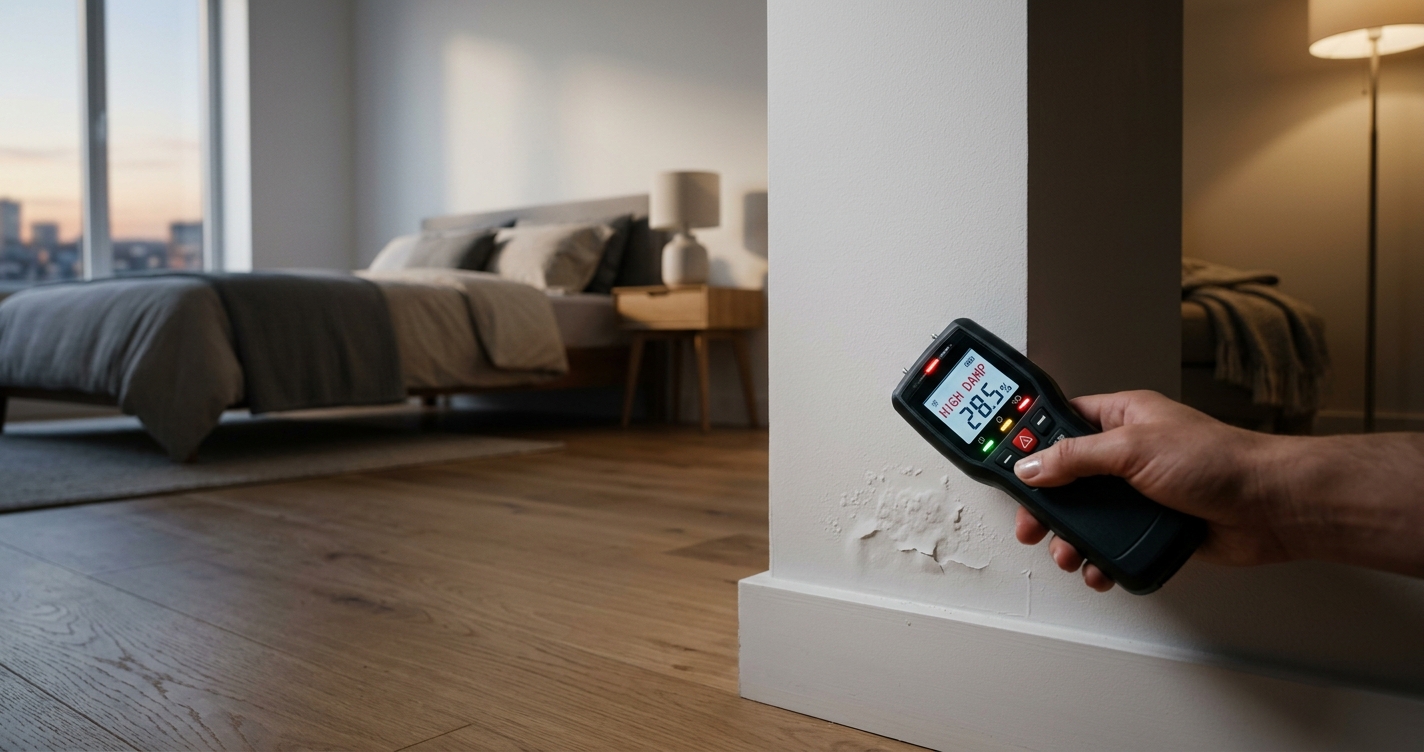
There's a belief that keeps a lot of tenants quiet, and landlords benefit from it enormously: the idea that an apartment has to be visibly falling apart — crumbling walls, a caved ceiling, obvious ruin — before it counts as unsafe or uninhabitable. If the place looks okay, the thinking goes, then it must be okay, and complaining about it would be unreasonable. So tenants in freshly-painted apartments with invisible hazards talk themselves out of their own alarm, because the danger doesn't match the mental picture of "unsafe."
That mental picture is wrong, and the gap between it and reality is exactly where people get hurt. Because the most serious hazards in a home are frequently the ones you can't see. Mold spores drifting through the air you breathe. Faulty wiring behind an intact wall. Contaminated water coming out of a clean-looking tap. Carbon monoxide with no alarm to catch it. Heat that fails again and again in winter. None of these announces itself visually. An apartment can look perfectly fine — even nice — and be genuinely dangerous to live in, and the law that protects tenants is concerned with whether a place is safe, not whether it's pretty.
This article is about closing that gap. Why "looks fine" is a trap rather than a reassurance. How invisible hazards differ from visible neglect and why they can be worse. Why a landlord's one-time "fix" of a recurring problem often isn't a fix at all. And how to build the evidence that proves a danger nobody can see — because the hardest part of an invisible hazard is exactly that: making the unseen provable. Let's take apart the idea that safety is something you can judge by looking.
Start with the trap itself, because it's more deliberate than tenants realize. Appearance and safety are two different things, and a landlord can invest in the first while ignoring the second — sometimes precisely to ignore the second.
A fresh coat of paint, new fixtures, updated cabinets, nice flooring — these are cosmetic, and they're cheap relative to the structural and systemic repairs that actual safety requires. A landlord can make an apartment look renovated and cared-for without touching the wiring, the pipes, the ventilation, the source of the dampness, or the reason the heat keeps failing. And a cosmetic upgrade can do worse than merely coexist with a hazard — it can actively hide it. Fresh paint over a wall that's growing mold underneath. New flooring laid over water damage. A clean, bright surface concealing exactly the problem that makes the place dangerous.
This is why "looks fine" is not the reassurance it feels like. The visible condition of an apartment tells you about the landlord's paint budget, not about whether the air is safe to breathe or the wiring safe to run. In fact, a nicely-finished apartment can be more insidious than an obviously shabby one, because the shabbiness at least warns you, while the fresh paint actively signals "everything's fine" over a hazard it's covering. Tenants trust the surface, and the surface lies.
And the law does not judge by the surface. Habitability protection turns on whether conditions are dangerous, hazardous, or detrimental to health and safety — a standard about danger, not decor. An apartment that looks beautiful and harbors a serious hazard fails that standard exactly as much as one that looks wrecked. The paint is irrelevant to the legal question. What matters is whether the place is safe to live in, and that's a question the eyes alone can't answer.
It helps to draw the distinction sharply, because tenants are primed to recognize visible neglect and primed to miss invisible hazards — which is precisely backwards from how dangerous each tends to be.
Visible neglect is the stuff that matches the mental picture: peeling paint, a cracked tile, a broken cabinet, general shabbiness. Some of it matters and some of it is merely cosmetic, but all of it is at least visible — you can see it, so you can react to it. Invisible hazards are the opposite: serious, sometimes life-threatening, and undetectable by a glance. Consider the roster.
Mold — often growing inside walls, under floors, behind that fresh paint, releasing spores into the air. You may smell it before you see it, or not see it at all, while it aggravates asthma, triggers respiratory illness, and makes sensitive people genuinely sick. Carbon monoxide — completely invisible and odorless, potentially lethal, catchable only by a working alarm, which is why a missing alarm is itself a grave hazard rather than a minor oversight. Electrical defects — faulty or outdated wiring behind intact walls, a fire risk you can't see until it fails, sometimes catastrophically. Contaminated water — lead, bacteria, or other contaminants in water that looks perfectly clear coming out of the tap. Pests behind walls — infestations you hear or find droppings from before you ever see the extent, nesting in the structure. Chronic dampness — persistent moisture that breeds mold and rot and signals something wrong you can't directly observe. And repeated loss of heat — a failure rather than a visible defect, invisible in any single photo, dangerous in its pattern.
Notice what these share: each can be present in an apartment that looks completely fine, and each is potentially serious — some of them deadly. The correlation tenants instinctively assume, that dangerous apartments look dangerous, simply doesn't hold. The most hazardous thing in your home is more likely to be something you can't see than something you can, precisely because the visible problems get noticed and the invisible ones get to keep operating undisturbed. Visible neglect is a warning you can heed. Invisible hazards are dangerous partly because they give no warning — which means you have to look for them deliberately rather than wait for them to become obvious.
There's a specific pattern that matters enormously with these hazards, and landlords exploit it: the difference between actually solving a problem and making it briefly go away. With invisible and recurring hazards, a one-time "fix" is frequently not a fix at all — and the recurrence is the real story.
Watch how this plays out. The heat fails; the landlord gets it running again; two weeks later it fails again. Mold is painted over; it bleeds back through. A leak is patched at the visible spot while the source keeps feeding it. Pests are sprayed; they return, because the nest in the wall was never addressed. In each case there's a "fix" the landlord can point to — I sent someone, I took care of it — and in each case the problem comes back, because the underlying cause was never resolved. The fix treated the symptom, or just reset the clock, and the hazard is still there.
This is why the pattern matters more than any single incident, and why documenting recurrence is so important. A problem that happens once and is genuinely fixed is life; equipment breaks and gets repaired. A problem that keeps returning despite "fixes" is a different thing entirely — it reveals an unresolved hazard and, often, a landlord addressing appearances rather than causes. The landlord will frame each recurrence as a fresh, isolated incident, freshly handled. Your job is to see the through-line: this is the same problem, again, and the repeated "handling" hasn't handled it. Three heat failures in a winter isn't three separate incidents that were each resolved. It's one unresolved hazard that keeps manifesting, and the resolution never actually happened.
So don't let a temporary fix reset your assessment. When a hazard recurs, the recurrence is not a new problem — it's evidence that the old one was never solved, and evidence that "I fixed it" doesn't survive contact with the fact that you're dealing with it again. The history of repetition is frequently the strongest proof that a condition is serious rather than incidental, which makes tracking it over time one of the most valuable things you can do.
Here's the central challenge, and the practical heart of this article: an invisible hazard is, almost by definition, hard to prove, because there's no dramatic visual to point to. So proving it is its own skill — and it's entirely learnable. The goal is to make the unseen undeniable through documentation.
Date-stamped photos and video. Yes, even for "invisible" problems, because a lot of them leave visible traces if you look: the mold when you pull back the furniture or open the wall, the water stain, the corroded wiring, the droppings, the thermometer reading. Capture what evidence exists visually, dated, and repeat it over time so a series shows persistence and spread.
Temperature logs. For heat failures — the invisible-in-a-photo hazard — a log is your proof. Buy a cheap thermometer, and when the heat fails, record the date, the time, the indoor temperature, and the outdoor temperature, photographing the thermometer where you can. In many places there are specific legal minimums; in New York City, for instance, during heat season a home must hit defined indoor temperatures, so a dated log showing you were below them converts "it's cold" from an opinion into a measured fact against a legal standard.
Medical records. This is how you prove the hazard through its effects when the hazard itself is hard to see. If mold or contaminated water or a gas issue is making you sick, your medical records documenting those symptoms — and their timing relative to the conditions — are powerful evidence that something in the apartment is causing harm, created by a professional rather than by you. Tell your doctor about the conditions at home, and let the record capture the connection.
Repair requests. Your written record of reporting the problem, with dates — which establishes that the landlord knew, and when, and (critically for recurring hazards) that you reported it again after each "fix" failed. The repair-request trail is what proves both notice and recurrence at once.
Inspection reports. Third-party proof that doesn't depend on your credibility at all. An official inspection — through a city agency, a housing authority, or an appropriate professional — that documents the hazard is close to unimpeachable, because it's a neutral party confirming the danger. For invisible hazards especially, an expert who can detect what you can't — test the water, assess the wiring, measure what's in the air — is invaluable. Where a hazard is genuinely hidden, getting the right inspector to find and record it can be the single most decisive piece of evidence.
Witness statements. Corroboration from others — neighbors experiencing the same issue, guests who smelled the mold or felt the cold, anyone who can attest to the condition. Other people confirming what you've described turns your account into a corroborated one.
Assembled, these do the thing an invisible hazard resists: they make it visible on paper. The mold you couldn't fully see becomes a dated photo series plus a medical record plus an inspection report. The heat failures that vanish from memory become a temperature log plus a repair-request trail. The recurrence the landlord calls isolated incidents becomes a documented pattern. You're translating a danger that hides from the eye into a record that a landlord, an agency, or a court can plainly see — which is exactly what it takes to act on a hazard whose whole nature is that it doesn't show.
Step back and see the belief this whole thing rests on, the one worth discarding. "It looks fine, so it must be fine" feels like common sense, but it's a category error — it judges safety by appearance, when the two have little to do with each other. A landlord benefits every time a tenant makes that error, because it means the tenant will accept an apartment with an invisible hazard as long as the surface looks acceptable, and will doubt their own alarm whenever the danger fails to look dramatic. The "looks fine" belief is doing the landlord's work: it keeps you from acting on exactly the hazards that are most dangerous because they're hidden.
So replace it with the truer standard. An apartment doesn't have to be collapsing to be unsafe. It has to be dangerous — and danger frequently wears a clean, freshly-painted face. Mold behind the wall, carbon monoxide with no alarm, faulty wiring, contaminated water, heat that keeps failing: none of these will make your apartment look like it's falling apart, and every one of them can make it genuinely unsafe to live in. The question is never "does it look bad enough to complain about." The question is "is it safe," and that's a question you answer by looking past the surface, taking your own senses and symptoms seriously, and documenting what you find.
If something in your home feels wrong even though the place looks okay — the persistent cough that eases when you leave, the musty smell with no visible source, the heat that keeps dying, the water you don't quite trust — don't let the fresh paint talk you out of it. Take date-stamped photos, log the temperatures, save your medical records and repair requests, get an inspection, and gather witnesses. Make the invisible provable. Your apartment doesn't have to fall down around you before you're entitled to a safe place to live — and the danger you can't see is still danger. Find out where you stand.