There's an assumption buried in how most tenants think about Housing Court: that it's the landlord's arena. The landlord is the one who starts cases — files the eviction, brings the nonpayment proceeding, sets the process in motion — so the court, in the tenant's mind, is a place they get summoned to, a battlefield the landlord chooses when to enter. Which means a tenant stuck with unsafe conditions and an unresponsive landlord often feels they can only wait: endure the broken conditions, keep paying rent, and hope that if the landlord ever hauls them to court, they can raise the disrepair as a defense. The landlord, it seems, controls the timeline.
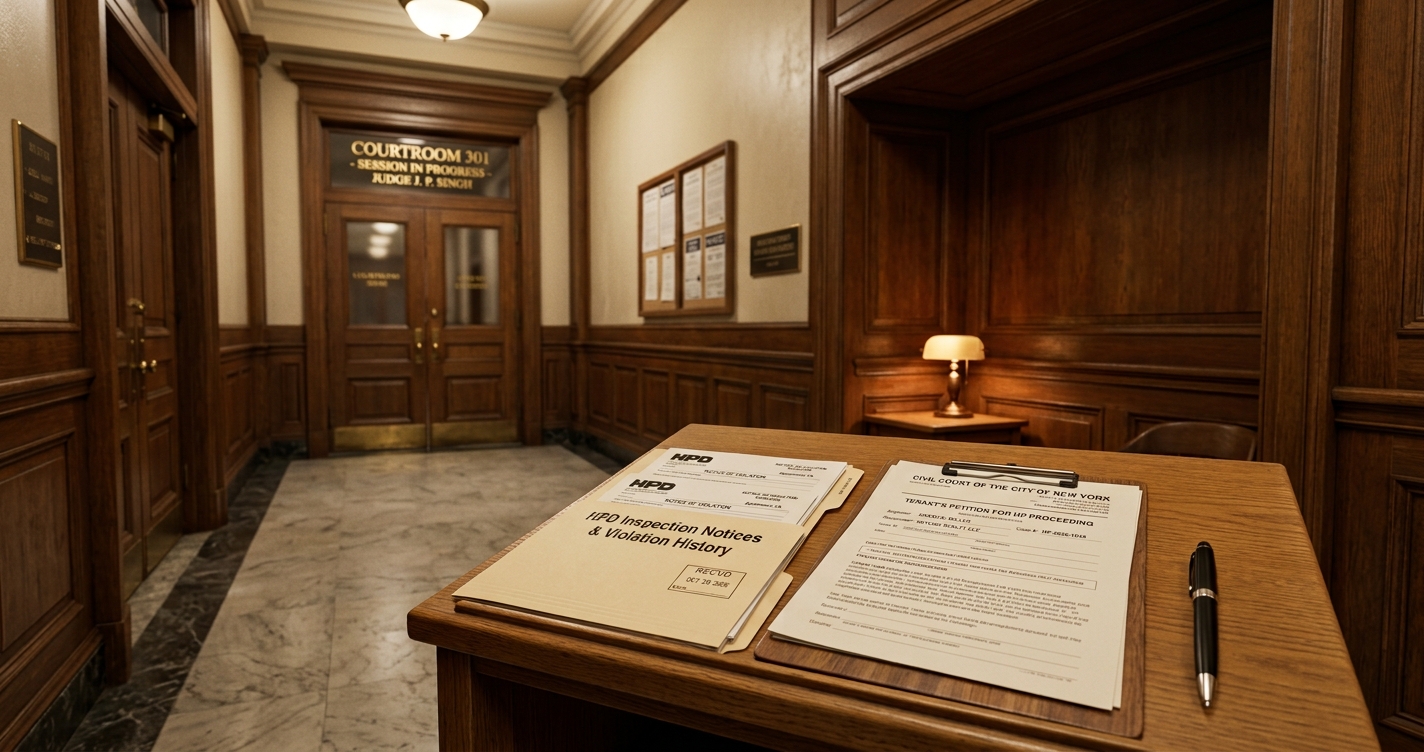
That assumption is wrong, and correcting it opens up a powerful option. In New York City, a tenant does not have to wait for the landlord to start a case in order to use Housing Court. A tenant can initiate their own case — a proceeding commonly called an HP proceeding (or HP action) — specifically to ask the court to order the landlord to correct housing-code violations and repair unsafe conditions. You don't need the landlord to sue you first. You don't need a lawyer to start it. You can be the one who brings the landlord to court, on your own timing, and asks a judge to make them fix the conditions you've been living with. The tenant isn't confined to raising bad conditions defensively if and when the landlord attacks; the tenant can go on offense and affirmatively seek repairs.
This guide is about that repair-focused HP proceeding. It will explain the crucial difference between an HP case (where you ask the court to order repairs) and an eviction or nonpayment case (where you'd only raise conditions as a defense). It will describe what makes an HP case stronger — the documentation and history that give it force. It will explain the remedy realistically — what an HP proceeding can and typically does achieve. It will offer practical cautions, so you understand what an HP case does not do. And it will note that procedures vary outside New York City, pointing tenants elsewhere toward their local resources. This is general information rather than legal advice for your situation, and free help is available to actually do it. But the core message is one that can change a tenant's whole posture toward unsafe conditions: you do not always have to wait for an eviction case — you can start your own case to force the repairs.
The most important distinction to understand is the difference between a repair-focused HP proceeding and an eviction or nonpayment case, because it captures the entire shift in posture this guide is about: the difference between going on offense and only playing defense.
In an eviction or nonpayment case, the landlord is the one who starts the proceeding — they file to evict you or to recover unpaid rent, and you are the respondent, defending. In that posture, unsafe conditions come up only defensively: if the landlord sues you for nonpayment, you might raise the poor conditions (the breach of the warranty of habitability) as a defense, arguing that the bad conditions reduce or offset what you owe. That's a real and valuable defense — but notice its limitations. It only arises if and when the landlord chooses to sue you. It puts you in a reactive position, responding to the landlord's case on the landlord's timing. And its focus is on the rent dispute the landlord initiated, with the conditions serving as your shield — not on actually getting the conditions fixed. You're using the bad conditions to defend against the landlord's claim, but you're not affirmatively asking anyone to make the landlord repair them.
An HP proceeding flips this entirely. You start the case, and its whole purpose is to ask the court to order the landlord to correct the violations and repair the conditions. You're not waiting for the landlord to sue you so you can raise conditions defensively; you're proactively bringing the landlord to court to make them fix the problems. The HP proceeding is affirmative and repair-focused: its goal is an order requiring correction of the conditions, which is precisely what a tenant with unsafe conditions actually wants — the conditions fixed, not merely a defense to hold in reserve for a case the landlord might never bring.
See the profound difference in the two postures. In the defensive posture, you wait — enduring the conditions, hoping the landlord's failure to fix them will help you if they eventually sue you, but doing nothing that actively forces repairs. In the affirmative posture of an HP proceeding, you act — bringing your own case to compel the repairs now, on your timing, without needing the landlord to make the first move. The defensive use of conditions is valuable when a landlord sues, but it doesn't help the tenant whose landlord simply lets conditions fester without ever going to court — which is a very common situation, because a landlord who's collecting rent and ignoring repairs has no reason to start a case at all. For that tenant, waiting for a case to defend is waiting forever; the HP proceeding is how they stop waiting and force the issue.
This is why the HP proceeding is so important: it breaks the assumption that the landlord controls the courthouse. It gives the tenant a way into Housing Court as the initiating party, with the specific goal of getting repairs ordered — rather than leaving the tenant to hope that conditions will someday matter as a defense in a case the landlord may never file. The tenant with unsafe conditions is not limited to enduring and waiting; they have an affirmative tool to compel action. Understanding that HP is offense, not just defense, is the reframe that unlocks it.
It's worth being clear that the two postures aren't mutually exclusive — an HP proceeding doesn't replace the habitability defense; it complements it. If a landlord does bring a nonpayment case, you can still raise the conditions defensively there. But you don't have to wait for that case to address the conditions; you can pursue an HP proceeding to force repairs regardless of whether the landlord ever sues. In fact, the two can reinforce each other: an HP proceeding that documents and establishes the conditions (and produces violations and an order) creates a record that can also strengthen a habitability defense if a nonpayment case arises. So the choice isn't "HP proceeding or habitability defense" — it's that the HP proceeding gives you an affirmative option you didn't know you had, on top of the defensive one you'd have if sued. The tenant who understands both has the full toolkit: the ability to defend if attacked, and the ability to go on offense to force repairs without waiting to be attacked.
There's a deeper reason the affirmative option matters so much for repairs specifically. The defensive posture has a structural flaw when the tenant's actual goal is getting conditions fixed: even a winning habitability defense in a nonpayment case primarily reduces what the tenant owes — it doesn't necessarily compel the repairs. A tenant could successfully defend a nonpayment case on habitability grounds, get a rent abatement, and still be living with the unfixed conditions afterward. The defense addresses the rent consequence of bad conditions; it doesn't reliably force the conditions to be corrected. The HP proceeding is aimed squarely at the thing the defense doesn't guarantee: an order to actually fix the conditions. So for a tenant whose goal is repairs — not just paying less for a broken apartment, but getting the apartment fixed — the HP proceeding isn't merely an alternative to the defense; it's the tool actually designed for their real objective. That's the deepest reason not to just wait: waiting to defend, even successfully, may leave you with a rent reduction and the same broken conditions, whereas the HP proceeding goes after the repairs themselves.
An HP proceeding asks the court to find that violations and unsafe conditions exist and to order their correction — which means the case is much stronger when you can clearly establish the conditions and the landlord's failure to address them. Because the case is about proving conditions and notice, the documentation and history you bring are what give it force. Here's what makes an HP case stronger.
A clear timeline. A well-organized, dated account of the conditions and your efforts to get them fixed — when the problems arose, when you reported them, what happened (or didn't) — gives the case a coherent, provable structure. The timeline shows the court not just that conditions exist but that they've persisted and gone unaddressed despite your efforts, which is the heart of the case.
Written repair requests. Your written requests to the landlord to fix the conditions, with dates, are powerful because they establish the landlord's notice — proof that the landlord knew about the problems and when. A case showing that you repeatedly, documentably asked the landlord to fix conditions and they didn't is far stronger than one resting on your say-so that you complained. Written requests turn "I told them" into provable notice.
311/HPD inspection history. Your record of complaints to 311 and the resulting housing-agency inspections is valuable third-party documentation. Complaints you filed (with their reference numbers and dates) show you reported the conditions through official channels, and inspections that documented the conditions add neutral, government-generated proof. This history both corroborates the conditions and shows the pattern of your reporting.
Outstanding violations. This is especially powerful: if the housing agency has already issued violations for the conditions that remain uncorrected, those outstanding violations are strong evidence for your HP case. They're official findings that the conditions existed and required correction, and their being outstanding (uncorrected) is exactly what the HP proceeding seeks to remedy. A building with open violations for the conditions you're complaining about gives your HP case a solid, documented foundation. (You can look up your building's violations in the housing agency's records.)
Dated photos. Visual documentation of the conditions — clear, dated photos and video — makes the problems concrete and undeniable, and dated images over time show persistence. Photos let the court see the conditions, supplementing the official records with your own visual proof.
Temperature logs. For heat or hot-water problems, a log of temperatures (dates, times, indoor and outdoor readings) documents these conditions against their specific standards, converting a heat complaint into measured proof — valuable in an HP case addressing heat or hot-water violations.
Records showing the landlord was notified. Underlying several of the above, and worth emphasizing on its own: documentation that the landlord knew about the conditions — your written requests, communications, complaints — is central, because the case is strengthened by showing the landlord had notice and failed to act. Notice is a recurring theme because it's a recurring necessity: the more clearly you can show the landlord knew and didn't fix the problems, the stronger your case for an order compelling them to.
Assembled, this evidence does exactly what an HP proceeding requires: it establishes that the conditions exist (photos, inspection history, outstanding violations, temperature logs), that they've persisted (the timeline, dated documentation over time), and that the landlord knew and failed to act (written requests, records of notification). A case built on this foundation — a clear timeline, documented notice, official inspection history and violations, and concrete proof of the conditions — is far stronger and more persuasive than a bare complaint, and it gives the court a solid basis to find violations and order their correction. So before and as you bring an HP case, assemble this material; it's what transforms your complaint into a well-supported request the court can readily act on. And much of it (the 311 history, the violations, the written requests) is documentation you may already have or can readily generate, which is another reason to report and document conditions diligently as they arise.
A particularly useful feature of the HP process is that it can trigger a fresh inspection of the conditions as part of the case. When you bring an HP proceeding, an inspection of the conditions can be arranged through the process, which means the housing agency may document the conditions in connection with your case — generating current, official evidence of the very problems you're asking the court to order fixed. This is valuable because it produces neutral, contemporaneous proof tied directly to your proceeding, rather than relying only on your own documentation and past inspection history. So the HP proceeding isn't just a way to present existing evidence; it can generate new official evidence through an inspection tied to the case. To make the most of this, be prepared for that inspection the way you would any housing inspection — be available to provide access, make sure the inspector can see the full extent of the conditions, and point out everything — because an inspection that thoroughly documents the conditions strengthens your case considerably.
It's also worth noting that you can raise multiple conditions in a single HP proceeding — you're not limited to one problem. If your apartment has several issues (the leak and the mold and the heat failures and a broken lock), you can bring them together, asking the court to order correction of all the violations and conditions. This is efficient and it presents the full picture of the apartment's problems to the court at once. So take stock of all the conditions needing repair and include them, rather than pursuing them piecemeal — a comprehensive HP case addressing everything wrong is generally better than separate efforts for each problem.
It's important to understand what an HP proceeding realistically achieves, because setting accurate expectations helps you use it well and avoid disappointment. The remedy is real and valuable, but it's specific — and understanding what it is (and isn't) matters.
The core goal is an order to correct the violations. The central thing an HP proceeding seeks and can achieve is a court order directing the landlord to correct the housing-code violations and repair the unsafe conditions. That's the remedy: an enforceable order that the landlord must fix the problems. This is exactly what a tenant with unsafe conditions wants — a court telling the landlord, with the force of law, to make the repairs. When an HP proceeding succeeds, the typical result is such an order (often reached by the landlord agreeing to a schedule of corrections, or by the court directing them after a hearing).
Beyond the order itself, the HP process delivers several related benefits worth understanding:
It creates pressure. The mere fact of an HP proceeding — the landlord being brought to court and having to answer for the conditions — creates pressure to fix the problems that simply ignoring the tenant did not. A landlord who could stonewall informal complaints faces a different calculus when there's a court case and a judge involved. The proceeding changes the landlord's incentives, sometimes prompting repairs that months of requests couldn't.
It creates a record. The HP proceeding generates an official court record of the conditions, the violations, and the landlord's obligations — a formal, documented account that exists going forward. This record has value beyond the immediate case, establishing what the conditions were and what the landlord was ordered to do.
It creates a mechanism for monitoring compliance. Importantly, the HP process doesn't necessarily end when an order is issued — it can provide a mechanism for ensuring the landlord actually complies. If the landlord is ordered to make repairs and doesn't, the tenant can generally bring the matter back to the court to enforce the order, and the court has tools to compel compliance and address a landlord's failure to obey. So the HP proceeding isn't just a one-time order that the landlord can ignore; it comes with a path to follow up and enforce, which is part of what gives it teeth. This is a meaningful advantage over informal complaints, which a landlord can ignore with no consequence — a court order carries the weight of the court behind it, and a landlord who defies it faces the court's enforcement powers, which can escalate the consequences for continued non-compliance. So if the landlord agrees to or is ordered to make repairs and then drags their feet or doesn't follow through, the case isn't over and you aren't without recourse; you can return to court to hold them to the order. That follow-up capacity is exactly what distinguishes a court-backed order from a promise a landlord can break at will.
Setting expectations accurately, though, means understanding the remedy's realistic contours. The goal is getting the conditions corrected, through an order and the process's pressure and enforcement mechanisms — which is powerful and is exactly what most tenants with unsafe conditions want. But it's a repair-focused remedy: the HP proceeding is fundamentally about compelling correction of the conditions, not about other things a tenant might also want (which we'll address in the cautions below). Its strength is precisely in what it's designed for — forcing repairs — and understood on those terms, it's a genuinely valuable tool: a way to get a court to order your landlord to fix the conditions, with pressure and a compliance mechanism behind the order. That's a great deal more than waiting and hoping, and it's the realistic, substantial benefit the HP proceeding offers.
To use an HP proceeding wisely, you need to understand its limits as clearly as its power, because misunderstanding what it does can lead to disappointment or missteps. An HP proceeding is a repair-focused tool, and there are several things it does not automatically do. Being clear-eyed about these keeps your expectations accurate and helps you plan.
It does not automatically erase rent arrears. An HP proceeding is about getting repairs ordered; it is not a mechanism for wiping out rent you owe. Bringing an HP case doesn't cancel your rent arrears or resolve a separate rent dispute. If you owe back rent, an HP proceeding to force repairs doesn't, by itself, make that debt disappear. (The bad conditions might be relevant to rent in other contexts — such as a habitability defense in a nonpayment case — but the HP proceeding itself is a repair action, not a rent-elimination tool.) So don't assume that forcing repairs through an HP case resolves any rent issues; those are separate matters.
It does not terminate your lease. An HP proceeding doesn't end your tenancy or free you from your lease. It's a tool to get your current home repaired, not to exit it. If your goal is to break your lease over the conditions, that's a different (and legally complex and risky) matter, not what an HP proceeding accomplishes. The HP case keeps you in your home and makes it habitable; it doesn't release you from it.
It does not award every expense. An HP proceeding is focused on ordering correction of the conditions, and you should not assume it will reimburse you for every cost or loss the conditions caused — damaged property, expenses you incurred, and the like. It's a repair-focused remedy, not a comprehensive damages award. While there can be aspects of relief and consequences for landlords in the process, don't go in expecting the HP proceeding to make you financially whole for all the harm the conditions caused; its central function is compelling repairs, not awarding every expense.
It does not guarantee immediate repairs. Even a successful HP proceeding doesn't guarantee that repairs happen instantly. The process takes some time, an order may give the landlord a schedule or period to comply, and a landlord who's inclined to drag their feet may require follow-up and enforcement (which, as noted, the process allows for). So while the HP proceeding is a powerful way to compel repairs, it's not an instant fix — it's a legal process that produces an order and a compliance mechanism, which is how repairs get forced over the course of the case and its enforcement, not necessarily overnight.
Understanding these limits doesn't diminish the HP proceeding's value; it sharpens your use of it. The HP proceeding is an excellent tool for its actual purpose — compelling the landlord to correct violations and repair unsafe conditions — and understood as that, it's powerful and worth using. The cautions simply clarify that it's a repair tool: it forces repairs (with pressure, a record, and enforcement behind it), but it doesn't erase rent debt, end your lease, reimburse every cost, or fix everything overnight. Knowing this, you can use the HP proceeding for what it does best, pursue other remedies separately for goals it doesn't serve, and go in with accurate expectations — which is exactly how to get the most from it without being blindsided by what it isn't. If you have goals beyond repairs (resolving rent, recovering costs, leaving the tenancy), understand that those require other approaches, and getting advice on the full picture helps you pursue each goal through the right channel.
A brief word on how you actually start one, since the accessibility is part of what makes it worth considering: an HP proceeding is filed at the Housing Court in your borough, and you do not need a lawyer to begin it. The clerk provides the forms, the filing fee is modest (and can be waived if you can't afford it), and after you file you serve the landlord and the housing agency as directed and get a court date. The process is designed to be usable by tenants representing themselves, and there are free tools and help resources specifically to assist with preparing and filing the papers. The point of noting this here is that the HP proceeding isn't some remote, lawyer-only mechanism — it's an accessible process a self-represented tenant can initiate, which is exactly why "you can start your own case" is a realistic option and not just a theoretical one. The barrier to using it is mostly knowing it exists and how to begin, which is what this guide aims to remove.
The HP proceeding as described here is a feature of the New York City Housing Court system, and it's important to be clear about that scope, because tenants elsewhere in New York have different mechanisms — though often the same underlying ability to seek enforcement of housing standards.
The specific HP proceeding — filed in NYC Housing Court, seeking an order to correct housing-code violations — is a New York City tool. Outside New York City, there generally isn't the same Housing Court with the same HP procedure, so tenants elsewhere in New York State need to identify the mechanisms available in their locality for compelling repairs and enforcing housing standards. The good news is that such mechanisms generally exist in some form; they just work differently and go through different bodies. Tenants outside NYC should identify:
Their local code-enforcement office. Many localities have a code-enforcement office or building department responsible for enforcing housing and building codes. Reporting unsafe conditions to local code enforcement can prompt inspection and enforcement action against a landlord who's violating the codes — a route toward getting conditions addressed.
Their municipal or local housing court (or the court that handles these matters). Depending on the locality, there may be a local court that handles housing-related matters, or another court where a tenant can pursue relief regarding conditions. Identifying the right court for housing matters in your area is the equivalent step to knowing about NYC Housing Court.
Their county health department. For certain conditions — particularly health-related hazards — a county health department may have jurisdiction to inspect and require correction. Health departments can be an important avenue for conditions affecting health and sanitation.
A tenant legal-services provider. Perhaps most useful of all: a local tenant legal-services provider, legal aid office, or tenant-rights organization can tell you exactly what mechanisms exist in your area, how to use them, and how to pursue getting your conditions addressed. Because the specifics vary so much by locality, a local tenant-services provider is often the best starting point for a tenant outside NYC, since they know the local landscape.
The reason to lay this out is that the principle behind the HP proceeding — that tenants can affirmatively seek enforcement of housing standards and compel attention to unsafe conditions, rather than only waiting and enduring — applies broadly, even though the specific NYC HP procedure doesn't. A tenant outside New York City generally isn't limited to suffering in silence either; they have avenues (code enforcement, the appropriate court, health departments, legal-services providers) to pursue getting conditions addressed. The specific tool differs, but the empowering idea holds: you can take affirmative action to enforce your right to safe housing, wherever you are. So if you're outside NYC, don't conclude the HP proceeding's lesson doesn't apply to you — instead, identify your local equivalents and use them. The mechanism varies; the principle that you can act rather than merely wait does not.
And as always, because procedures and specifics can vary and evolve, confirming the current mechanisms and getting local guidance is worthwhile wherever you are — but especially outside NYC, where the routes are more varied and a local provider's knowledge is most valuable.
Let's watch the offense-versus-defense difference play out through a tenant with unsafe conditions.
Imagine a tenant whose apartment has serious problems — a persistent leak causing mold, and intermittent heat failures through the winter. They've complained to the landlord repeatedly, but nothing gets fixed. The landlord is content to keep collecting rent and ignoring the repairs. The tenant, believing Housing Court is somewhere the landlord takes them, feels stuck: they keep paying rent (they don't want to risk nonpayment), keep enduring the conditions, and figure their only recourse is to raise the bad conditions as a defense if the landlord ever sues them.
Run it the waiting way. The tenant waits — and waits. The landlord, collecting rent and untroubled, never files any case, so the conditions-as-defense the tenant is holding in reserve never gets used, because there's no case to defend. The mold spreads, the heat keeps failing, and the tenant endures it indefinitely, because they believed their only path to court was through a case the landlord would start — and the landlord, getting exactly what they want (rent without repairs), has no reason to start one. The tenant's willingness to wait is precisely what lets the landlord keep ignoring the problems.
Run it the affirmative way. The tenant learns they don't have to wait — that they can file an HP proceeding to force the repairs. They assemble their case: a clear timeline of the leak, mold, and heat failures; their written repair requests (establishing the landlord's notice); their 311 complaint history and any inspections; a check of the building's outstanding violations; dated photos of the mold; and temperature logs for the heat failures. With that documentation, they file an HP proceeding in Housing Court, asking the court to order the landlord to correct the conditions — and they can do this without a lawyer, with free help available. Now the landlord is the one who has to answer, in court, for the conditions they'd been ignoring. The proceeding creates pressure the informal complaints never did, produces (through agreement or the court's direction) an order to correct the violations, and gives a mechanism to enforce compliance if the landlord drags their feet. The tenant, understanding realistically that this forces repairs (not that it erases any rent issues or happens overnight), has used the HP proceeding for exactly what it does: compelling the repairs they'd been unable to get. They kept paying rent throughout, keeping their position clean, and pursued the repairs affirmatively.
Same tenant, same conditions, same unresponsive landlord. In one version they wait indefinitely for a case that never comes, enduring conditions the landlord has no incentive to fix; in the other, they start their own case and force the repairs. The difference was understanding that they didn't have to wait — that Housing Court was available to them as the initiating party, with a tool designed to compel exactly the repairs they needed.
The repair-focused HP proceeding is an accessible and powerful tool, and help is available, so a few closing notes.
In New York City, you can start an HP proceeding without a lawyer, and free resources exist to help you do it — tools designed to help tenants prepare and file the court papers, help resources at the Housing Court itself for self-represented tenants, and legal aid and tenant-rights organizations that assist with HP cases and repair issues. Many of these are free, and low-income tenants may be eligible for free legal representation. Because an HP case is stronger when well-documented and well-presented, getting help — even just guidance on the process and the papers — can strengthen your case, and it's widely available. Outside NYC, as discussed, a local tenant legal-services provider is the best starting point for identifying and using your area's mechanisms.
A few practical principles. Document diligently as conditions arise — the written repair requests, the 311 complaints, the photos, the temperature logs, the timeline — because this documentation both strengthens an HP case and is easiest to build contemporaneously. Report conditions to the landlord in writing (establishing notice) and to 311 (creating official records and prompting inspections that can generate the violations that bolster an HP case). Understand the remedy realistically — it forces repairs, with pressure and enforcement behind an order, but doesn't erase rent, end your lease, award every cost, or fix things overnight. And keep paying rent you owe while pursuing repairs through an HP case, rather than assuming the conditions let you stop (a fact-specific, risky move to discuss with an advocate, not to improvise). Pursue the repairs affirmatively, but keep your own obligations clean.
A note on scope: the HP proceeding described here is a New York City mechanism, and the specifics — the court, the procedure, the forms, the process — are features of that system. Tenants elsewhere have different routes (local code enforcement, the appropriate local court, county health departments, local legal-services providers), and procedures everywhere can evolve, so confirming current specifics and getting local guidance is worthwhile. The durable principle, applicable broadly, is that tenants can affirmatively seek enforcement of housing standards and compel attention to unsafe conditions — they don't have to only wait and endure.
Step back and hold the reframe. The assumption that keeps many tenants enduring unsafe conditions is that the landlord controls the courthouse — that because landlords start eviction and nonpayment cases, the tenant's only role is to wait, endure, and hope to raise conditions defensively in a case the landlord might bring. That assumption is false in New York City, and its falseness is liberating. A tenant with unsafe conditions doesn't have to wait for the landlord to sue in order to get into Housing Court. They can start their own case — the HP proceeding — and affirmatively ask the court to order the landlord to correct the violations and repair the conditions. That's offense, not defense: not holding conditions in reserve as a shield, but wielding them as the basis for compelling repairs now.
And it's a genuinely powerful tool, used with accurate expectations. An HP proceeding, built on solid documentation — a clear timeline, written repair requests, 311 and inspection history, outstanding violations, dated photos, temperature logs, proof of notice — seeks and can achieve a court order requiring the landlord to fix the conditions, backed by the pressure of the proceeding, an official record, and a mechanism to enforce compliance. It won't erase rent arrears, end your lease, reimburse every expense, or fix everything overnight — it's a repair tool, and understood as that, it does something most tenants don't realize they can do: force an unresponsive landlord, through the court, to make repairs.
So if you're living with unsafe conditions and an unresponsive landlord, and you've been waiting — enduring the problems, hoping the landlord's failure will someday help you defend a case they may never bring — stop waiting. In New York City, document your conditions and your notice to the landlord, and consider filing an HP proceeding to force the repairs, with free help available to do it. Outside NYC, identify your local code-enforcement office, the appropriate court, your county health department, and a tenant legal-services provider, and pursue your area's equivalent avenues. You do not always have to wait for an eviction case; you can start your own case for repairs — and make the landlord fix what they've been ignoring. Find out where you stand.