Most tenants believe the courthouse door only opens for them — that Housing Court is where you go when your landlord drags you there, a place you enter as a defendant, on the landlord's timing, to fight off an eviction. So a tenant being harassed — worn down by refused repairs, constant pressure, phantom inspections, service cutoffs, a campaign to make them leave — often feels trapped in a waiting game: endure it, and hope, and maybe someday defend yourself if the landlord finally files. It doesn't occur to them that they could walk into that same courthouse not as a defendant, but as the person starting the case.
But in New York City, they can. A tenant who believes their landlord is harassing them does not have to wait to be sued. They can go to Housing Court and initiate their own case — commonly called an HP proceeding — asking the court to order the landlord to stop, to correct violations, and to make a formal finding of harassment. You don't need the landlord to file first. You don't need a lawyer to start it. You can be the one who brings the landlord to court, on your timing, to answer for what they've been doing. This is one of the most empowering and least-known tools in tenant law, and most tenants never hear about it.
This guide is about that tool. The central shift it offers is from reactive to proactive: instead of waiting, defensively, for the landlord to make a move, you take the initiative and make the landlord respond to you. This guide will explain that reactive-versus-proactive distinction and why it matters, walk through the filing pathway at the Housing Court clerk (including the specific order-to-show-cause form that seeks correction of violations, a harassment finding, and an order to stop), explain why your petition should tell the whole story rather than treating each incident as isolated, describe the evidence that makes your case clear and persuasive, and note the scope — because this is very NYC-specific. It's general information rather than legal advice for your situation, and free help is available to actually do it, which we'll cover. But the core message is simple and worth absorbing right now: you don't have to wait for the landlord to start the case. You can start it yourself.
The most important idea in this guide is a shift in posture, so let's establish it clearly, because it changes a tenant's entire relationship to a harassment situation. There are two fundamentally different ways a tenant can end up in Housing Court over harassment, and they put the tenant in completely different positions.
The first is reactive. Here, the tenant waits. The landlord harasses them, and the tenant endures it, and the only court involvement comes if and when the landlord decides to file something — an eviction, say — at which point the tenant is a defendant, responding to the landlord's case, on the landlord's timing, in a proceeding the landlord initiated and framed. In this posture, the tenant is perpetually on the back foot: they can raise harassment defensively (for instance, as a counterclaim if the landlord sues, or, in a nonpayment case, harassment-by-failure-to-repair can function as a partial defense), but they're still fundamentally responding to the landlord's move, waiting for the landlord to act before they can. The harassment, meanwhile, continues while they wait, because nothing the tenant is doing forces it to stop.
The second is proactive. Here, the tenant doesn't wait. Believing they're being harassed, the tenant goes to Housing Court and starts their own case — the HP proceeding — asking the court to make the landlord stop. Now the roles are reversed: the tenant is the one who brought the case, on their own timing, framing the issue as the landlord's harassment rather than waiting for the landlord to frame it as something else. The landlord becomes the respondent, the one who has to show up and answer. Instead of enduring the harassment indefinitely while hoping it doesn't escalate, the tenant takes the initiative to make it stop.
The difference between these two postures is enormous, and it's not just psychological — though the psychological shift is real and valuable. Practically, the proactive route means the tenant doesn't have to absorb harassment indefinitely waiting for a landlord who may never file (because harassment often works precisely by pressuring the tenant out without the landlord ever needing to go to court). It means the tenant, not the landlord, sets the timing and the terms of the confrontation. And it means the tenant can seek affirmative relief — an order to stop, a correction of violations, a finding of harassment — rather than merely playing defense. The reactive tenant hopes to survive the landlord's eventual attack; the proactive tenant goes on offense to end the harassment now.
This reframing is genuinely liberating for a harassed tenant, because harassment thrives on the tenant's passivity — on the sense that there's nothing to do but endure and wait. The HP proceeding shatters that. It says: you are not stuck waiting for the landlord's move. You have a move of your own, and it's a powerful one. You can start the case. The rest of this guide is about how.
It's worth being precise about how harassment fits into the different postures, because there's a technical point that actually reinforces why the proactive route is so valuable. When a landlord sues you — say, in an eviction — you can generally raise harassment as a counterclaim, a claim you assert back against the landlord within their case. But harassment is generally not available as a standalone defense to an eviction — meaning you usually can't defeat an eviction simply by saying "but the landlord harassed me." (There's a notable exception: harassment by failure to make repairs or provide services can function as a partial defense in a nonpayment case, because the failure to maintain the apartment can partly excuse withholding rent.) The upshot is that in the reactive posture, harassment is somewhat constrained in how it can be used — often as a counterclaim rather than a case-ending defense, and available only once the landlord has chosen to sue.
The proactive HP proceeding removes those constraints. Instead of waiting to assert harassment as a counterclaim inside a case the landlord initiated, you make harassment the centerpiece of a case you initiate. You're not fitting your harassment claim into the landlord's litigation as a secondary matter; you're bringing a proceeding whose entire purpose is to address the harassment and get it stopped. That's a fundamentally stronger position from which to seek relief for harassment specifically — it puts your harassment claim front and center, on your timing, rather than making it a supporting player in the landlord's eviction case that may never even be filed. So the proactive route isn't just "the same claim, earlier"; it's a better vehicle for a harassment claim than waiting to raise it defensively.
So how does a tenant actually start this case? The pathway is designed to be accessible to ordinary tenants without lawyers, and understanding the steps demystifies it. Here's how an HP proceeding gets filed.
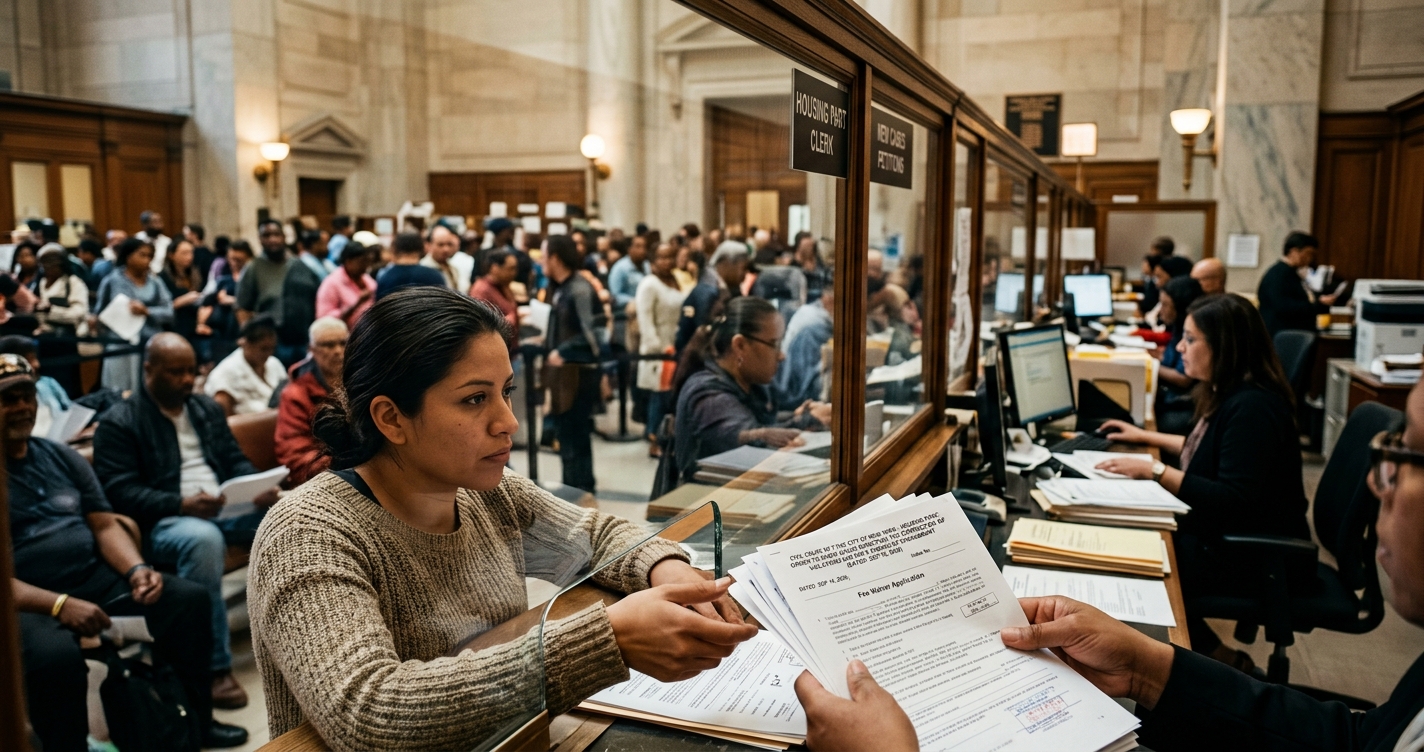
Go to the Housing Court clerk in your borough. The HP proceeding is filed at the Housing Part of the Civil Court — the Housing Court — in the borough where you live. You go to the clerk's office, and — this is worth emphasizing — you do not need a lawyer to start an HP case. The process is built for self-represented tenants, and the clerk's office is where it begins.
Get the forms from the clerk — including the key order to show cause. The clerk will provide the necessary forms to commence the proceeding. The central document is often described as an "Order to Show Cause Directing the Correction of Violations and for a Finding of Harassment" — and it can seek an order directing the landlord to stop the harassing conduct (a form of restraining order). Alongside it is a Verified Petition — a sworn statement in which you tell the court, under oath, what the landlord (or their agent) has done that constitutes harassment and what you're asking the court to do about it. Together, these are the papers that start your case and lay out your request for relief.
Understand what you're asking for. Through these papers, you can ask the court for meaningful relief: an order directing the correction of violations in your apartment and building; a finding of harassment — a formal determination that the landlord harassed you; and an order directing the landlord to stop the harassing conduct. Depending on the circumstances, the court's powers in a harassment case can extend to civil penalties and, notably, money damages paid directly to you, including punitive damages meant to punish the harassment — and in extreme cases, a court's contempt powers can reach even further. The point is that you're not just complaining; you're asking a court for concrete, enforceable relief.
Combine repairs and harassment in one petition. A valuable feature: you can include, in the same HP proceeding, complaints about repairs and services you need — not just the harassment. If your situation involves both a pattern of harassment and conditions the landlord won't fix (which is common, since refusing repairs can itself be part of the harassment), you can address both in one case, and you can also request that the city's housing agency inspect the conditions. This lets the whole picture — the harassment and the neglected conditions — come before the court together.
File, get the judge's signature, and pay the fee (or get it waived). You submit your papers, and if the judge signs the order to show cause, you pay the court fee to get an index number that officially opens your case. The fee is modest — and importantly, if you can't afford it, you can request a fee waiver, so the cost is not a barrier for low-income tenants. (The fee, when charged, is small and payable by certain methods the clerk will specify.)
Serve the papers as the court directs. After your order to show cause is signed, you must deliver ("serve") copies on the landlord and any other required parties — which typically includes the city's housing agency — following the court's instructions carefully, because proper service is essential. The clerk or judge will tell you how and by when to serve, and you'll get a date to return to court.
Attend your court date and present your case. On the return date, you appear, and the case proceeds. The landlord (now the respondent) has to respond. The court may facilitate an agreement — the landlord agreeing to an order to correct conditions and stop the conduct — or, if things are disputed, the judge can issue orders and, where facts are contested, schedule a trial. If the landlord agrees to or is ordered to do things and then doesn't comply, you can bring the case back to court to enforce it.
Laid out this way, the pathway is a series of accessible steps: go to the clerk, get the forms, fill out the petition describing the harassment and any needed repairs, file and get the order to show cause signed, pay or waive the fee, serve the papers, and appear on your date. It's a real legal proceeding with real relief available, and it's designed so that a tenant can start it without a lawyer — though, as we'll discuss, free help is available to make it easier.
A word on the fee, because cost fears stop tenants unnecessarily: the filing fee for an HP case is small — a modest flat amount — and it is fully waivable. If you can't afford it, you submit fee-waiver forms along with your papers, and if the judge grants the waiver, you pay nothing. So the financial barrier to starting an HP proceeding is essentially zero for a tenant who can't afford the fee, which is by design — the proceeding is meant to be genuinely accessible, not gated behind cost. Don't let the existence of a fee deter you from starting; either it's a small amount, or it's waived.
It's also worth being concrete about the relief the proceeding can deliver, because understanding what you can actually get makes clear why it's worth doing. At the accessible end, the court can order the landlord to correct the violations (the repairs and conditions) and to stop the harassing conduct — the core relief most harassed tenants want, an enforceable order to make it end. Beyond that, the court can make a formal finding of harassment, which is significant in itself and can matter for other purposes. The court can impose civil penalties on the landlord. And in harassment cases specifically, the court can award money damages directly to the tenant — including punitive damages meant to punish egregious harassment — so a tenant can come out not only with the harassment stopped but with compensation for it. In the most extreme cases, a court's contempt powers over a landlord who defies its orders can reach remarkably far. The range of relief means an HP proceeding is not a symbolic gesture; it's a route to concrete outcomes, from a simple stop-and-correct order all the way to damages.
There's also a free electronic option worth knowing about at the filing stage: in addition to going to the clerk's office in person, tenants can use a free web-based tool designed to help prepare and file HP court papers, which walks you through the forms. So the entry point isn't only the physical clerk's window — there's a guided, free, online path to preparing the same papers, which many tenants find easier as a starting point. Either way, the forms are the same and the proceeding is the same; the tool just helps you complete them.
When you fill out the petition, there's a crucial mistake to avoid, and understanding why it's a mistake goes to the heart of what makes a harassment case work: describe all the relevant incidents as part of a connected pattern, rather than treating each text, inspection, service interruption, or threat as an unrelated event.
Recall that harassment, under New York City's framework, is fundamentally about a course of conduct — a pattern of acts or omissions aimed at making you leave or give up your rights. This means the strength of your case lies in the aggregate, in the pattern that emerges when all the incidents are seen together. A single text message, one inspection attempt, a service interruption, an isolated threat — each, standing alone, may look minor or explicable. But laid out together, in sequence, they can reveal an unmistakable campaign. The pattern is the case, and the pattern only becomes visible when you present the incidents together.
So when you describe the harassment in your petition, tell the whole story. Include all the relevant incidents — the repeated contact, the entry attempts, the refused repairs, the service cutoffs, the false notices, the buyout pressure, the threats, whatever has happened — with their dates, as a connected series. Don't mentally discard the "small" incidents as not worth mentioning, and don't present the incidents as a scatter of disconnected events. Present them as what they are: a pattern of conduct, unfolding over time, that adds up to harassment. The court needs to see the forest, not just individual trees, because it's the forest — the course of conduct — that constitutes harassment under the law.
This matters for a very practical reason. A petition that describes a single incident invites the response "that's not harassment, that's just one thing." A petition that describes twenty incidents over six months, laid out as a connected pattern aimed at driving you out, tells a story that's much harder to dismiss and much easier for a court to recognize as harassment. The whole-story approach is what lets the pattern-and-purpose nature of harassment come through — and it's what distinguishes a strong petition from a weak one. You're not just listing grievances; you're demonstrating a campaign.
Concretely, this means that when you prepare your petition, you should have already assembled your incidents into a chronology (more on documentation next), so you can describe them in order and show how they connect. Think of the petition as your opportunity to tell the court the coherent story of what your landlord has been doing to you — a story with a through-line (the effort to make you leave or surrender your rights) and many chapters (the individual incidents). Told that way, the petition does the work of making the harassment visible, which is exactly what you need the court to see.
There's a related drafting instinct to resist: the urge to leave out incidents you think are "too small" or that you can't perfectly prove. In a pattern case, the small incidents are load-bearing — they're what establish frequency and relentlessness, which are central to showing a course of conduct. An entry attempt you didn't document as thoroughly as you'd like still belongs in the chronology, because its place in the sequence matters even if your proof of it is thinner than for other incidents. Include everything relevant and let the overall pattern carry the weight; you can note which incidents are strongly documented and which rest more on your own account. The goal is a complete picture, because completeness is what reveals the pattern, and a petition that omits half the incidents to keep only the "big" ones may inadvertently hide the very relentlessness that makes the conduct harassment.
At the same time — and consistent with keeping your credibility — describe each incident factually and accurately, without exaggeration. A petition that tells the whole story in measured, factual terms is far more persuasive than one that overstates, because a court that trusts your account of the documented incidents will more readily credit your account of the pattern as a whole. Completeness and accuracy work together: include everything relevant, describe it truthfully, and let the connected sequence speak for itself.
An HP harassment case is far stronger — and far easier for a court to understand and act on — when it's backed by organized evidence. Because harassment lives in the pattern, the evidence that matters most is the evidence that documents the pattern clearly. Here's what makes your case clear and persuasive.
A dated chronology. The single most valuable thing you can bring is a clear, dated timeline of the incidents — a chronology that lays out, in order, what happened and when. This is the backbone of a harassment case, because it's what makes the pattern visible at a glance. A judge looking at a dated chronology of dozens of incidents sees the course of conduct immediately, in a way that scattered, undated complaints never convey. Build the chronology, and everything else supports it.
Screenshots and messages. Screenshots of texts, emails, and other messages from the landlord or their agents — especially anything showing pressure, threats, buyout contact, or the sheer volume of communication. These are direct documentary evidence of the conduct, in the landlord's own words.
Letters and written communications. Copies of letters, notices, and written communications — the false violation notices, the buyout letters, your own written complaints and the (non)responses, any correspondence that shows the pattern.
Call logs. Records of calls — the frequency and timing of the landlord's contact — which help establish the relentlessness that can be part of harassment, particularly when the volume of contact is itself the problem.
Photos. Photographs documenting relevant conditions — the disrepair the landlord won't fix, the results of service interruptions, anything visual that supports your account.
Repair records. Your record of repair requests and the landlord's failure to act — the dated requests, the follow-ups, the unaddressed conditions — which is essential when refusal to make repairs (harassment by omission) is part of your case.
Inspection reports. Official inspection reports and any violations issued — third-party documentation that conditions were real, which doesn't depend on your credibility and carries significant weight. (Recall you can request an inspection as part of the HP process.)
Witnesses. People who witnessed the conduct or experienced it themselves — neighbors, family, other tenants subjected to the same treatment. Corroboration strengthens your case, and other tenants facing the same campaign is especially powerful.
The unifying principle is that this evidence, organized around your dated chronology, is what transforms your petition from an assertion into a demonstrated case. Harassment can be hard for a court to see if it's presented as a vague complaint of being mistreated; it's easy for a court to see when it's presented as a dated timeline backed by screenshots, records, photos, inspection reports, and witnesses. The evidence makes the pattern concrete and credible. So before and as you file, assemble this material — and keep it organized, because a well-documented HP case is dramatically more effective than one resting on the tenant's word alone. The court can only act on what it can see clearly, and your organized evidence is what lets it see.
It helps to know what to expect once your case is underway, because understanding the arc reduces the intimidation and lets you participate effectively.
After you file and serve, the case comes before the court on your return date. The landlord, now the respondent, has to appear and respond. Frequently, HP cases resolve through an agreement — the landlord agreeing to a court order to correct the conditions and stop the harassing conduct, which becomes an enforceable order of the court. If the parties don't agree, the judge can issue orders directing correction and cessation, and where the facts of the harassment are genuinely disputed, the judge can schedule a trial to hear the evidence and decide. Throughout, the city's housing agency is typically involved (which is why they're served), and an inspection you requested feeds official documentation into the case.
Two features of the aftermath are worth knowing. First, HP orders are enforceable, and the court has teeth: if the landlord agrees to or is ordered to correct conditions and stop harassing you and then fails to comply, you can bring the case back to court to enforce the order, and the court can impose penalties for noncompliance. The order isn't just words; it's backed by the court's enforcement power. Second, in harassment cases specifically, the relief can include not just orders to stop but civil penalties and money damages paid to you — so a successful harassment case can result in the landlord being ordered both to cease the conduct and to pay for having engaged in it, with the possibility of punitive damages in serious cases.
Understanding this arc — file and serve, return date, agreement or orders (or trial if disputed), and enforceable relief with real teeth — makes the proceeding less daunting. It's a structured process with a clear path and meaningful outcomes, designed to get harassment stopped and, where warranted, to make the landlord answer for it. And at every stage, you're the one who set it in motion.
An important caveat runs through this entire guide: the HP harassment proceeding, the specific forms, and the framework behind them are features of New York City law and the New York City Housing Court. This is a city-specific tool, and its precise contours don't necessarily exist in the same form elsewhere.
If you're a tenant in New York City, this proceeding is available to you, and it's a powerful option. If you're a tenant outside New York City, the picture is different: the available agencies, the court procedures, the specific remedies, and even whether a comparable tenant-initiated harassment proceeding exists all can vary. Many jurisdictions have some protections against tenant harassment or landlord retaliation, and some have their own mechanisms for tenants to seek relief, but they may work quite differently from NYC's HP proceeding, go through different bodies, and offer different remedies. So the specific pathway described here — the borough Housing Court clerk, the particular order-to-show-cause form, the HP proceeding itself — should be understood as NYC-specific.
There are also related avenues even within New York for particular situations. Rent-regulated tenants (rent-stabilized or rent-controlled) have an additional route through the state housing agency, which handles harassment complaints for regulated units through its own process and forms. And harassment can, in appropriate circumstances, be raised within an eviction case as a counterclaim. The HP proceeding is the tenant-initiated Housing Court route, and it sits alongside these other options.
The practical takeaway on scope is twofold. First, if you're in New York City, know that this proactive tool exists and is available to you — that's the core message. Second, wherever you are, the underlying principle is worth carrying: tenants are often not limited to waiting and defending; there may be a way to take the initiative and seek relief from harassment affirmatively. The specific mechanism varies by place, and this area of law evolves, so confirm what's available where you live — but don't assume that enduring and waiting is your only option, because in NYC it clearly isn't, and elsewhere there may be affirmative routes too.
It's also worth noting that even within New York City, the HP proceeding isn't the only affirmative route — it sits within a broader enforcement landscape. The city's housing agency has its own anti-harassment enforcement function (reachable through 311), which can investigate and pursue harassment independently, and rent-regulated tenants have the state agency route mentioned above. These aren't mutually exclusive with an HP proceeding; a tenant might report to the city's anti-harassment unit and file an HP case, using every avenue the facts support. The HP proceeding is distinctive because it's the one you personally initiate and control in court, but knowing it sits alongside agency enforcement means you can think about using multiple channels rather than choosing just one. An advocate can help you decide which combination fits your situation.
Let's watch the reactive-versus-proactive difference play out by following a tenant being harassed.
Imagine a tenant whose landlord wants him out of a rent-regulated apartment and is running the quiet playbook: ignoring his repair requests so a leak and a broken heater linger, attempting entry constantly for vague "inspections," sending repeated buyout offers, and serving occasional dubious notices. Months of this. The tenant is stressed, worn down, and increasingly tempted to just leave — but he hasn't been formally evicted or even sued, so he feels there's nothing to do but endure it and wait to see if the landlord ever files something he can fight.
Run it the reactive way. He waits. He keeps enduring the harassment because he believes court is only something that happens when the landlord initiates it. The harassment continues unchecked, because nothing he's doing forces it to stop, and the landlord has no reason to stop — the pressure is working. Eventually, worn down, he considers taking a buyout he never wanted, or simply moving. The landlord's campaign succeeds precisely because the tenant believed his only role was to wait and defend.
Run it the proactive way. He learns he doesn't have to wait — that he can start his own case. He assembles his documentation into a dated chronology: the ignored repair requests, the constant entry attempts, the buyout offers, the notices, all in order, backed by screenshots, his repair records, photos of the conditions, and a note of neighbors who've seen the same. He goes to his borough's Housing Court clerk, gets the forms, and files an HP proceeding — an order to show cause seeking correction of the violations, a finding of harassment, and an order directing the landlord to stop, with a verified petition telling the whole connected story. He can't afford the fee, so he requests a waiver. He serves the landlord and the housing agency as directed, requests an inspection, and gets his court date. Now the landlord is the one who has to show up and answer. The case may resolve in an order requiring the landlord to fix the conditions and cease the harassment — enforceable, with penalties if violated — and possibly damages. Instead of being worn toward the exit, the tenant has taken the initiative and put the landlord on the defensive.
Same tenant, same harassment, same landlord. In one version he endures indefinitely and may lose his home to a campaign he never fought; in the other, he starts the case, forces the landlord to answer, and seeks an order to make it stop. The difference was learning that he didn't have to wait — that he could be the one to walk into court.
You can start an HP proceeding without a lawyer, but help is available and makes it easier, so a few notes on getting support.
Free resources exist specifically to help tenants file HP cases. There are free tools designed to help tenants prepare and file the court papers, and Housing Court itself has help resources — information tables and assistance in the boroughs' housing courts — oriented toward self-represented tenants. Legal aid organizations and tenant-rights groups assist tenants with harassment cases, and low-income tenants and seniors may be eligible for free legal representation. Because an HP harassment case benefits from being well-organized and clearly presented, getting help — whether full representation or just guidance on the forms and the process — can strengthen your case considerably, and much of it is free.
A few practical pointers. Start by organizing your documentation into a dated chronology before you go to the clerk, because it'll make filling out the petition far easier and your case far clearer. Consider reporting the conditions and requesting an inspection (through 311 / the housing agency) as part of building your record. If cost is a concern, remember the fee waiver. And if you're a rent-regulated tenant, know that the state housing agency route is also available for harassment. Whatever support you use, the essential thing is to recognize that the option exists and to take the first step — going to the clerk, or to a free filing tool or a legal-help provider, to begin.
Step back and take in the shift this guide is really about. The reason so many harassed tenants suffer in place is a belief — the belief that Housing Court is a place things happen to you, that your only role is to wait for the landlord to act and then defend yourself, that enduring the harassment is all you can do until the landlord decides to make a move. That belief is false, at least in New York City, and its falseness is genuinely empowering. You are not confined to waiting and defending. You can go on offense. You can walk into Housing Court as the person starting the case, bring your landlord in as the respondent, and ask a court to find that you've been harassed and to order it stopped — on your timing, not the landlord's.
That proactive route — the HP proceeding — is accessible: you file at your borough's Housing Court clerk, you don't need a lawyer, the forms are provided, the fee can be waived, and free help exists to guide you. Its power comes from telling the whole story — presenting the incidents as the connected pattern they are, backed by a dated chronology and organized evidence — so the court can see the course of conduct that constitutes harassment. And its relief is real: correction of violations, a finding of harassment, an order to stop, enforceable with penalties, potentially with damages. It transforms the harassed tenant from someone enduring and waiting into someone taking action to make the harassment end.
So if your landlord is harassing you — refusing repairs, pressuring you, disrupting your home, running the quiet campaign to make you leave — and you've been telling yourself there's nothing to do but wait and hope they don't escalate, reconsider. In New York City, you can start the case. Assemble your chronology, gather your evidence, and go to your borough's Housing Court clerk (or a free filing tool or a legal-help provider) to begin an HP proceeding. You don't have to wait for the landlord's move. You have a move of your own — and it's the one that puts the power back in your hands. Find out where you stand.