You've thought about calling the city. The conditions are bad enough that the idea has crossed your mind more than once — report it, get an inspector out here, make it official. But every time you reach for the phone, a different scenario plays out in your head, and it's never the one where the city shows up and helps. It's the one where they show up and turn on you.
You picture the inspector walking in and, instead of citing the landlord, finding something to pin on you. The roommate who isn't on the lease. The pet you're not supposed to have. A question about your immigration status you don't want to answer. You picture fines you can't pay landing in your lap. You picture them deciding the apartment is so bad they condemn it on the spot and put you out on the sidewalk with nowhere to go. And you picture the landlord, furious that you brought the government into it, retaliating even harder once the inspector's gone. So the phone goes back down. The conditions stay. And you tell yourself that calling the city is a risk you can't afford.
Let's name the fear underneath all those scenarios, because it's a single fear wearing several costumes: If I bring in inspectors or agencies, they'll turn on me instead of the landlord. At its root, this is a fear that the system is not for you — that authority, when it arrives, arrives as a threat to be survived rather than a tool you can use. For a lot of people that's not paranoia; it's a lesson learned somewhere real. So the fear treats the city as a danger to be avoided at all costs, and in doing so, it talks you out of using what may be the single strongest piece of leverage you have.
Here's what this article is going to show you, carefully and specifically: a housing inspection is a citation against your landlord, not an investigation of you. When an inspector finds unsafe conditions, the violation is issued to the property owner — it's the landlord who gets cited, the landlord who faces the fines, the landlord who's legally ordered to fix things. The entire machinery of code enforcement is pointed at the person responsible for the building, which is not you. The official finding that your conditions are unsafe doesn't become a weapon against you. It becomes documented, government-backed proof on your side — the kind of leverage that's genuinely hard to get any other way. The fear has the direction of the whole thing backward. The inspector isn't coming to judge how you live. They're coming to judge whether the building is safe, and to hold the owner accountable if it isn't.
This article will walk through what an inspection actually is and who it targets, address each specific costume the fear wears — the fines, the roommate, the pet, the status question, the condemnation, the retaliation — and show you how tenants use official findings as the powerful protection they actually are. We'll be honest about the few real edges to know. But the core thing to carry in is this: the city's code enforcement exists to hold landlords accountable for unsafe housing. It was built to be used by tenants like you. And using it may be the most protective move available to you.
Let's correct the central misunderstanding first, because every costume the fear wears depends on it. The fear imagines an inspection as a kind of investigation of the tenant — someone from the government coming to scrutinize you and your apartment for things you might be doing wrong. That's not what a housing inspection is. It's almost the opposite.
In New York City, when you report unsafe conditions to 311, the agency that responds is the Department of Housing Preservation and Development — HPD. Its Code Enforcement function exists for one purpose: to enforce the Housing Maintenance Code against building owners. When an HPD inspector comes out and finds a condition that violates the code — no heat, mold, pests, a dangerous defect — they issue a violation. And here is the fact that dissolves the heart of the fear: that violation is issued against the property owner. It's the landlord's name on it. It's posted at the property and mailed to the owner of record. It's the landlord who must correct the condition within a deadline, the landlord who certifies the fix, the landlord who pays the penalty if they don't. Think of it like a ticket — but the ticket goes to the person responsible for the building's condition, which is the owner, not the person living with the consequences of their neglect.
This is not an incidental detail. It's the entire design of the system. Code enforcement was built to solve a specific problem: landlords who don't maintain their buildings. The whole apparatus — the inspectors, the violation classes, the fines, the deadlines, the follow-up inspections — is aimed at one target, and that target is the owner of the property. When you call 311 about a dangerous condition, you are not summoning an authority that will scrutinize you. You are activating a system whose job is to hold your landlord accountable. You're pointing it at the landlord. The fear had you believing you'd be pointing it at yourself.
And notice what the violation actually is, from your perspective: it's an official, government-issued, written finding that your living conditions are unsafe. Stop and consider how valuable that is. One of the hardest things for any tenant is proving that conditions are as bad as they say — that's the whole "am I overreacting, do I have enough proof" struggle. An HPD violation answers that question definitively, with the authority of the city behind it. It's not your word anymore. It's the City of New York's official determination that the condition exists and breaks the law. That finding is precisely the kind of leverage tenants need and rarely have. The fear has been telling you to avoid generating the single most powerful piece of evidence you could possibly obtain.
It's worth knowing, too, that the inspection often works harder in your favor than you'd expect. On every inspection, HPD inspectors are directed to cite certain conditions if they find them — including missing smoke and carbon monoxide detectors, mold, pests, and other safety hazards — even beyond the specific issue you called about. In other words, you report the broken heat, and the inspector, doing their job, may also document the missing carbon monoxide detector and the mold you'd stopped noticing. The system is built to catch the landlord's neglect comprehensively, not narrowly. You're not just getting a citation for the one thing you mentioned; you're getting a professional assessment of the apartment's safety, with every qualifying hazard documented against the owner. That breadth works entirely to your benefit.
So the reframe is total. An inspection is not a risk you take; it's leverage you create. The violation is not a mark against you; it's a citation against your landlord and a finding in your favor. The authority you've been afraid to call isn't coming to turn on you. It's coming to do the one thing you most need done — to officially establish, on the record, that your home is unsafe and your landlord is responsible for fixing it.
The fear is stubborn, though, because it's specific. It's not a vague worry; it's a series of concrete nightmares. So let's take them one at a time, because each one loosens its grip once you look at it directly.
"They'll fine me for the violations." This is the most common version, and it rests entirely on the misunderstanding we just cleared up. The fines attached to housing code violations are assessed against the property owner, not the tenant. When a landlord fails to fix a Class B or Class C violation by the deadline, it's the landlord who faces civil penalties — penalties that can climb into the thousands and that even become liens against the property if unpaid. You don't get the bill for your landlord's failure to maintain the building. The financial consequences of an unsafe apartment fall on the person who let it become unsafe. The fear took the real fact that "violations come with fines" and quietly attached those fines to the wrong person. They land on the landlord.
"They'll find my unauthorized roommate or my pet and come after me." Here's the thing to understand about what an inspector is actually doing: they're there to assess the physical condition of the apartment against the housing code — the heat, the plumbing, the wiring, the presence of mold or pests, the safety devices. They are housing inspectors checking habitability, not lease-enforcement officers auditing your compliance with your rental agreement. An extra person staying with you or a cat you're not technically supposed to have is a matter between you and your landlord under your lease; it is not what the HPD inspector is there to evaluate or cite, and it is not a housing-code violation against you. The fear imagines the inspector as a general-purpose investigator looking for any reason to get you in trouble. They're not. They're focused on whether the building is safe, and a non-lease roommate or a pet has nothing to do with that assessment.
"They'll ask about my immigration status." This fear is heavy and deserves a direct, honest answer: housing code enforcement is about the condition of the building, not the immigration status of the people living in it. An HPD inspector documenting a lack of heat or a dangerous defect is recording facts about the apartment. Your right to safe, habitable housing — the warranty of habitability, the housing maintenance code — protects the tenancy and the dwelling, and it does not come with a status requirement. The protections were written to cover the home and the people in it based on the rental relationship, not on anyone's papers. If this is a specific worry for your situation, it's exactly the kind of thing the tenant legal organizations at the end of this article handle constantly and can advise you on privately before you do anything — but the baseline is that reporting unsafe conditions is about the building, and the system that responds is aimed at your landlord.
"They'll condemn the place and put me out on the street." This is the most frightening costume, so let's be clear about how it actually works. The goal of code enforcement is to get conditions fixed, not to displace tenants. The overwhelming majority of violations result in the landlord being ordered to repair the problem while you stay in your home. In the rare, genuinely severe cases where a condition is so dangerous that a unit can't be safely occupied, the city doesn't simply abandon you — there are processes and protections around emergency situations, including relocation assistance pathways, precisely because the system isn't designed to dump people on the sidewalk. A condition dangerous enough to require vacating was dangerous to you before the inspector named it; the inspection didn't create the danger, it surfaced it, and surfacing it is what activates whatever safety net exists. The fear imagines the inspection causing your homelessness. In reality, the dangerous condition was the threat, and the inspection is what brings in help.
"The landlord will retaliate harder once the city leaves." This is a real concern, and it's the one the law most directly anticipated. Complaining to a government authority about unsafe conditions is a legally protected act in New York. Under the state's anti-retaliation law, if a landlord moves against you — eviction, non-renewal, a substantial change to your tenancy — within a year of your good-faith complaint, retaliation is presumed, and the burden falls on the landlord to prove otherwise. And here's the part that matters most for this specific fear: the 311 complaint and the resulting violation are themselves the dated, official record that makes that protection ironclad. Far from leaving you exposed, calling the city creates the exact documentation that triggers and strengthens your anti-retaliation shield. The thing the fear says will get you retaliated against is, in fact, one of your best defenses against retaliation.
Lay those five costumes side by side and a pattern emerges. Every one of them takes the real power of an inspection — the fines, the official findings, the authority — and imagines it aimed at you. But it's aimed at the landlord. The fines hit the landlord. The findings document the landlord's neglect. The protection covers you. The fear isn't wrong that an inspection is powerful. It's just catastrophically wrong about which direction that power points.
Let's ground all this in an ordinary situation, because the fear lives in vivid imagined scenarios and shrinks when you watch a realistic one play out. Picture a tenant whose apartment has gone months with unreliable heat and a growing patch of mold from a leak the landlord keeps promising to address and never does. The tenant has a roommate who isn't on the lease and is quietly anxious about anyone official coming around. Every time they think about calling 311, the costumes parade through: they'll fine me, they'll find my roommate, they'll condemn the place, the landlord will explode. So they don't call. They text the landlord again, get another vague promise, and the winter grinds on.
Now watch the version where the tenant makes the call. They file a 311 complaint about the heat and the mold. An HPD inspector comes out, looks at the apartment, and documents the conditions. The inspector is checking the radiators, the temperature, the mold, the source of the moisture — assessing the building against the code. The roommate's presence simply isn't part of that assessment; the inspector isn't there to audit the lease. Violations are issued, and they're issued against the property owner: the landlord now has a correction deadline and faces escalating penalties if the conditions aren't fixed. None of the imagined catastrophes occurs. No fine lands on the tenant. The roommate is a non-event. The apartment isn't condemned — the city's aim is to get the heat and the mold fixed, with the tenant staying put.
And look at where the tenant stands afterward. There is now an official, dated city record establishing that the conditions are real and unlawful. The landlord, who could ignore texts forever, cannot ignore an HPD violation with a deadline and a fine attached. If the landlord retaliates — tries a non-renewal, say — the 311 complaint and violation are the dated proof that triggers the presumption of retaliation in the tenant's favor. And the documented violation strengthens any claim for a rent abatement covering those cold, moldy months. The tenant went from a position where the landlord held all the leverage to a position backed by the City of New York. The only thing that changed was the decision to use the system instead of fearing it.
Same tenant, same apartment, same unauthorized roommate, same evasive landlord. One version is an endless winter of broken promises. The other ends with an official finding, a landlord under legal pressure, retaliation protection in place, and a path to compensation. The difference wasn't luck or courage. It was understanding which direction the inspection's power actually points.
Let's spend a moment on the upside, because the fear has kept you so focused on imagined dangers that you've never gotten to see what you'd actually be gaining. An official violation isn't just "not bad for you." It's one of the most useful things a tenant in your situation can possess.
Think about everything a documented HPD violation does for you at once. It establishes, with governmental authority, that the condition is real — ending any argument about whether you're exaggerating. It establishes that the condition violates the law, not just your preferences. It creates a dated public record, which strengthens every other avenue you might pursue. It puts the landlord under a legal deadline to fix the problem, with escalating financial consequences for ignoring it. And it lays the groundwork for further remedies if the landlord still won't act — including tenant-initiated court proceedings to force repairs, and claims for rent reduction based on the documented conditions. That's an enormous amount of leverage flowing from a single free phone call.
Consider how this connects to the money you may be owed. When a landlord breaches the warranty of habitability, you can be entitled to a rent abatement — a reduction in the rent for the period the conditions persisted, on the logic that you paid for a habitable home you didn't fully receive. The strength of that claim depends heavily on proof, and an official HPD violation is about the strongest proof there is. So the inspection you've been afraid to request isn't just a path to getting the conditions fixed. It can be the cornerstone of recovering money — turning the city's finding into a documented basis for the abatement you may be owed. The fear framed calling the city as taking on risk. In reality, it can be the move that both fixes your home and unlocks compensation for what you've already endured.
There's also a quieter form of leverage worth naming: the change in the landlord's incentives. A landlord who could ignore your texts indefinitely cannot ignore an HPD violation with a correction deadline and a fine attached. The official finding converts your request from something the landlord can dismiss into something the city is now requiring, with consequences. You've been negotiating from a position the landlord could wait out. The violation changes that. It brings a third party with real authority into the picture — one whose entire interest is in getting the building brought up to code. Suddenly you're not a lone tenant asking nicely. You're a tenant with the City of New York's enforcement apparatus pointed at your landlord's neglect.
And the leverage doesn't stop at the first violation, which is something landlords who ignore citations learn the hard way. If a landlord falsely certifies that they've corrected a condition when they haven't, the violation stays open and the building can land on the city's watch list for exactly that behavior. Buildings with serious, persistent neglect can be referred to escalated enforcement programs, where the city itself steps in — performing emergency repairs and billing the owner, or in the most severe cases having a court appoint an administrator to take over management of the building. The point is that the system has teeth all the way down. A landlord can't simply outlast a violation the way they outlasted your texts, because behind the first citation stands an entire escalating apparatus, all of it aimed at compelling the owner to make the building safe. When you call the city, you're not just getting one ticket issued. You're plugging your situation into that whole machine — and the machine works for the tenant whose conditions prompted it.
There's an assumption buried in this fear worth surfacing, because it's the deepest root: the belief that the system isn't for you — that code enforcement, inspectors, city agencies are part of some apparatus that, when it notices you, will find you wanting. For people who've had hard experiences with institutions, that belief is understandable. But in the specific case of housing code enforcement, it's backward in a way worth seeing clearly.
HPD's code enforcement exists because of tenants in unsafe housing. The reason the city employs inspectors, maintains a violation system, and responds to 311 complaints is that buildings were being neglected and tenants were being harmed, and someone had to hold owners accountable. The entire function was created to serve the person living with the broken heat and the spreading mold — to give that person a way to compel a fix. The overwhelming majority of housing violations are generated by tenant complaints through 311. The system runs on people exactly like you picking up the phone. You're not an intruder triggering a machine that will turn on you. You're the intended user of a machine built for your protection.
This reframe matters because the fear has positioned you as someone who'd be getting away with something by calling the city — as if you'd be drawing dangerous attention to yourself, sneaking up on an authority that might notice you and retaliate. But there's nothing to get away with. Reporting unsafe conditions is the ordinary, expected, intended use of a public service. Tenants do it constantly. It's how the code gets enforced at all. The inspector who comes to your door is doing the job the city created specifically so that tenants in your situation would have somewhere to turn. You calling them is the system working as designed — not a risk you're sneaking past it.
And here's the thing about leverage you don't use: it isn't leverage at all. The strongest tool available to a tenant facing unsafe conditions — the power to bring in an official authority that cites the landlord, documents the danger, and orders the fix — does nothing for you while it sits unused because the fear has convinced you it's a trap. The landlord, meanwhile, is entirely comfortable with you believing that, because a tenant who won't call the city is a tenant whose conditions the landlord never has to fix. The fear that the system will turn on you serves the landlord perfectly. The moment you see the system as yours to use, that comfort disappears.
It's worth sitting with that alignment for a second, because it's clarifying. Ask who benefits from each belief. If you believe the city is a danger to be avoided, the landlord benefits — they keep collecting full rent on a building they don't have to maintain, with no authority ever compelling them to act. If you believe the city is a tool you're entitled to use, you benefit — you get the documentation, the deadline, the pressure, the protection. The fear, whatever its origins in your life, happens to land in precisely the spot that's most convenient for the person profiting from your unsafe apartment. That doesn't mean the landlord planted it. It means the fear and the landlord's interests are quietly aligned, and recognizing that alignment is part of breaking the fear's hold. Every reason the fear gives you to keep the city out is, functionally, a reason the landlord would love you to accept.
The Knowledgeable Advocate doesn't pretend there are zero things to know, because knowing them is what lets you act with real confidence rather than borrowed reassurance. Here are the honest edges, and notice that none of them changes the core picture.
If a condition was genuinely caused by you — not normal wear, not the landlord's neglect, but actual damage you or a household member or guest caused — that's a different situation, and the protections around complaints work differently when the problem traces back to you. This is not a hurdle for the ordinary case: the heat failing, the building's plumbing backing up, mold from a structural leak, pests in a multi-unit building, dangerous wiring — these are the landlord's responsibility, full stop. The point is simply that the system addresses the building's condition and assigns responsibility based on cause; for the conditions tenants actually call about, that cause is the landlord's to own.
Keep meeting your own obligations, especially rent. The strongest position is the clean one: a tenant who reports unsafe conditions in good faith and stays current on rent gives the landlord no legitimate, non-retaliatory handle to grab. If conditions are severe enough that you're considering withholding rent or a formal court action, that's the one area to get advice first rather than improvising, because those are structured legal strategies with specific rules — and the tenant organizations below exist precisely to guide you through them.
And if your situation has a genuine complication — a real question about immigration status, an informal living arrangement you're worried about, anything that makes you hesitate — the answer is not to stay silent and keep living in danger. The answer is to make one confidential call to a tenant legal organization first, lay out your specific situation, and get advice tailored to it before you file. That's not a reason to avoid the city. It's a reason to get informed before you engage it, which is available to you for free.
See what these edges do. They don't shrink the protection into nothing — they sharpen it. Report real conditions you didn't cause: the system is aimed at your landlord. Keep your rent current: your position stays clean. Get advice first if your situation is complicated: free help exists for exactly that. This isn't a minefield. It's a powerful tool with a few clearly marked edges, and now you know where they are.
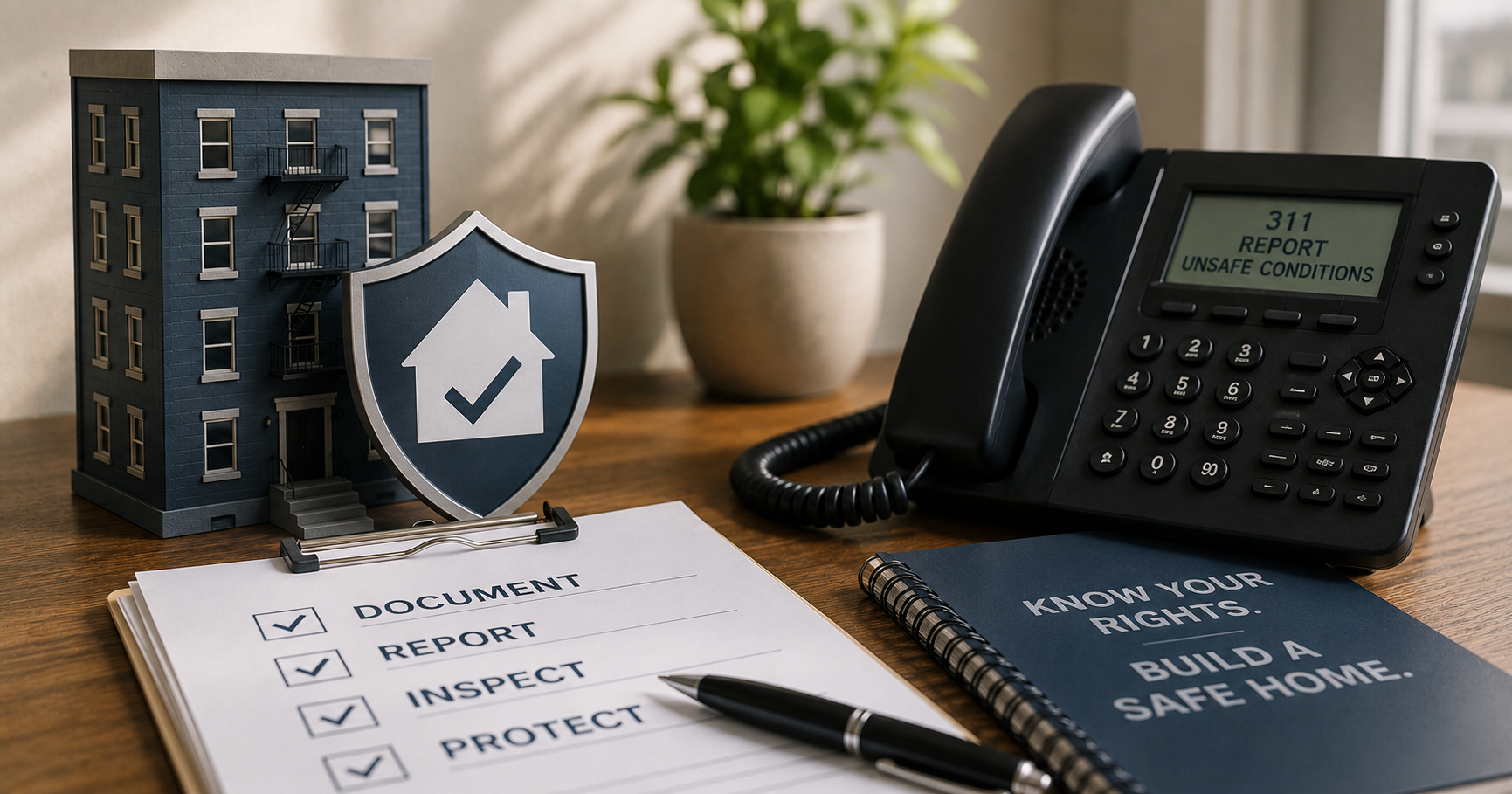
So how do tenants actually turn the city into the protection it's meant to be? With a sequence of small, low-risk steps, each one building the official record that works in your favor. None of these requires courage you don't have or certainty you can't muster. Each is ordinary, and each is something the system was built to receive.
Document the conditions yourself first, with dated photos and a written log. This is your own record, and it does two things: it clarifies for you exactly what's wrong, and it gives you something to point to when you report. You're not building a legal case yet; you're just recording the truth so it exists as fact. A dated photo of the dead radiator or the water-stained ceiling is simply the condition, captured.
Report serious conditions to 311. This is the core move, and it's free, available in many languages, and designed for exactly this. You can call or file online. Describe the conditions plainly — no heat, no hot water, mold, pests, dangerous wiring, plumbing failures. You don't need to be certain a condition rises to a violation; that's the inspector's determination, not yours. Reporting it creates a dated city record immediately and sets the inspection in motion. Remember what you're doing when you make this call: you're pointing the city's enforcement at your landlord's neglect, and you're generating official documentation in your own favor. If you're unsure how to describe a condition, simple and factual is enough — "no heat for the past five days, apartment is around 56 degrees" tells the city everything it needs to dispatch someone.
Notify your landlord in writing too, around the same time. A factual text or email stating the condition and requesting repair — kept as a copy — does its own work: it gives the landlord notice, it's a protected complaint in its own right, and it adds another dated marker to your record. Keep it brief and unapologetic. You're creating a paper trail, not asking a favor.
When the inspector comes, let them see the conditions clearly. Be present if you can, point out the problems, and make sure the issues you reported are visible and accessible. The inspector is there to assess the building's condition against the code; your job is simply to make sure they can see what's wrong. After the inspection, you can look up the resulting violations on HPD's online portal — and that official finding becomes part of your protection.
Keep meeting your own obligations and keep your records organized. Stay current on rent, keep your photos and your log and your 311 confirmation and any violation numbers in one place. This keeps your standing clean and your leverage assembled and ready.
Reach out for free help whenever you want it — before, during, or after. The Legal Aid Society and Legal Services NYC provide free legal assistance to tenants and work constantly with people worried about exactly the things in this article. Housing Court Answers offers guidance on conditions and court processes, including tenant-initiated cases to force repairs. The Met Council on Housing runs a tenants' rights hotline. If anything about your situation makes you hesitant to call the city — status, living arrangements, fear of retaliation — these are the people to talk to first, confidentially, so you can act from knowledge instead of fear.
Look at what this sequence accomplishes. By the end of it you have your own documentation, an official city record, a violation issued against your landlord, notice on the record, clean standing, and a relationship with people who can defend you. Every piece of that is protection, and all of it flows from using — rather than avoiding — the system the fear told you was a trap. The tenant who makes the call isn't more exposed than the one who stays silent. They're dramatically more protected, because they've turned the city's authority from an imagined threat into documented leverage on their side.
Let's return to that moment with the phone in your hand and the scenario playing out where the inspector turns on you instead of the landlord.
That scenario felt real, and the instinct behind it — wariness of authority, the sense that the system isn't on your side — came from somewhere understandable. But look at what we've actually established. A housing inspection is a citation against your landlord, not an investigation of you. The violation goes on the owner's record, the fines fall on the owner, the legal order to fix things binds the owner. The inspector is assessing the building's safety, not auditing your roommate, your pet, or your papers. The official finding that your home is unsafe doesn't become a weapon against you — it becomes government-backed proof in your favor, the strongest leverage you could obtain, and the very record that activates your protection against retaliation. The system you were afraid to call was built specifically so that tenants in unsafe housing would have a way to force a fix. It was built for you.
Look honestly at the trade the fear talked you into. It told you that avoiding the city was protecting yourself. But what avoidance actually protected was the landlord's ability to keep the building unsafe with no consequences — because the one authority that could compel a repair was the one you'd been frightened away from calling. The fear inflated a danger that points at the landlord, not you, and hid the real, ongoing cost of your silence: conditions that stay broken because no one with the power to order them fixed has been told. You weren't choosing between a risky call and safe silence. You were choosing between using your strongest leverage and leaving it on the table while you absorbed the danger yourself.
And the way to pick it up costs almost nothing. A dated photo. A free call to 311. A factual message to your landlord. A confidential call to a tenant organization if your situation is complicated. Small, ordinary steps — each one turning the city's authority into documented protection aimed where it belongs. You don't have to choose between getting help and staying safe from the helpers. That was the false fear at the center of all of this. The helpers are aimed at your landlord. The findings protect you. The system is yours to use.
If there's one idea to carry out of this, let it be the direction of the arrow. The fear pointed the arrow at you: the inspection as scrutiny, the fines as your burden, the authority as your threat. But the arrow points at the landlord, every part of it — the citation, the deadline, the penalty, the escalating enforcement behind it. And the findings that arrow produces don't just leave you unharmed; they hand you the strongest documentation a tenant can hold, the kind that ends arguments about whether your conditions are real, triggers your protection against retaliation, and grounds any claim for the rent you overpaid. Once you see the arrow's real direction, the whole fear reorganizes itself, because there was never a version of this where calling the city about your landlord's neglect was an investigation of you. There was only ever a tool, pointed the right way, that you'd been told not to touch.
You already know the conditions in your home aren't safe. You've known for a while — that's why the phone keeps finding its way into your hand before the fear sets it back down. But you can stop setting it down now. The call you've been afraid to make isn't a risk you're taking. It's the strongest protection available to you, and it's been within reach the entire time.