You've reached the point where you know you need to bring in an outside authority. The landlord won't fix the conditions, you've documented everything, and the next move is to get a government agency involved. And then you hit a surprisingly effective wall: who do I even call?
There's a building department, maybe. A housing agency. A health department. Code enforcement. A 311 line. Some of those might be the same thing; some might not exist where you live; some might handle your problem and some might tell you it's not their department. You picture yourself calling one, waiting on hold, explaining everything, and being told "that's not us, you want a different office" — and then doing it again, and again, bounced from agency to agency while nothing gets fixed. So, facing that prospect, you put it off. The confusion itself becomes the reason nothing happens.
Here's what this article does: it turns "I don't know who handles this" into a short, concrete sequence. Reporting unsafe conditions is not a mystery — it's a matching problem, and the matches are knowable. Once you know which kind of agency handles which kind of problem, what to say when you reach them, and what to have ready, the whole thing becomes a series of manageable steps rather than an intimidating fog. And the preparation is what prevents the bounce-around you're dreading: a tenant who knows what they're reporting and to whom gets routed correctly far more often than one calling blind.
We'll match your problems to the right agencies, build a short script so your calls stay organized, get your evidence ready to hand over, arm you with the specific questions that set realistic expectations, show you what to record from each contact, and cover how to update your landlord afterward and watch for retaliation. By the end, "who do I call?" will have a concrete answer, and so will "what do I say when they pick up?" Let's start with the matching.
The confusion dissolves the moment you understand that different kinds of problems go to different kinds of agencies, and the mapping is fairly consistent. So the first move is simply to match what's wrong in your apartment to the type of agency that handles it.
The mapping breaks down into a few clear categories. Structural problems, heat, hot water, electrical issues, and building code violations generally go to a building or code enforcement department, or a housing department. These are the agencies concerned with whether the building itself meets the required standards — the physical structure, the essential systems, the maintenance obligations. If your problem is no heat, no hot water, a structural crack, faulty wiring, or a general failure to maintain the building, this is usually your agency. In New York City, this is HPD — the Department of Housing Preservation and Development — reached through 311.
Mold, pests, sewage, and other health hazards often go to a health department or an environmental health office. These agencies focus on conditions that threaten health specifically, as opposed to structural integrity. There's overlap — a housing department may also cite mold or pests, and in New York City many of these go through HPD and 311 as well — but where a separate health department exists, health-hazard conditions are squarely within its mandate, and it may be the more effective route for something like a serious pest infestation or a sewage problem.
Violence or threats from neighbors or roommates is a different category entirely, and it splits by urgency. For immediate danger — a threat happening now, a violent situation — that's the police, without hesitation. For chronic problems that aren't immediate emergencies — an ongoing pattern of threatening behavior, a persistently dangerous situation in the building — you'd notify your landlord in writing (they have obligations regarding safety and can take action against a problem tenant), and depending on the situation, involve the police for the pattern as well. Safety threats are handled differently from building conditions, and it's worth being clear with yourself about which kind of problem you have.
Two things about this mapping are worth understanding so it doesn't trip you up. First, some problems legitimately belong to more than one agency, and that's fine — it means you have more than one avenue, not that you have to agonize over the single "correct" one. Mold, for instance, might be handled by a housing department, a health department, or both, depending on where you live. When a problem fits two categories, you can report to either, or both; there's no penalty for a housing agency receiving something a health department also could have handled, and the overlap works in your favor. Second, if you have several distinct problems, they may split across agencies — the heat goes to housing, a serious pest-and-sewage issue might go to health — and that's normal too. You're not looking for one magic office that handles everything; you're matching each problem to a fitting agency, and sometimes that's two calls rather than one. In cities with a central line like 311, even that is simplified, because the single front door distributes your various problems to the right places for you.
So here's your first concrete task: list your main problems, and match each one to a likely agency. Heat and wiring to housing/code enforcement. Mold and pests to health or housing. A threatening neighbor to police or landlord notice. This list is the foundation of everything that follows, because it tells you exactly who to contact for what — and it means that when you do call, you're calling the right place, which is the single biggest thing you can do to avoid being bounced around. In a city like New York where 311 routes many of these, the matching is partly done for you; elsewhere, knowing the category is what gets you to the right office.
Because the abstract categories only get you so far, it helps to see how they map onto real agencies in one place. New York City is a useful example, both because it's where many readers are and because its structure illustrates how these systems generally work.
The workhorse is 311, the city's central complaint line — reachable by phone, online, or app — which is the single front door for the great majority of housing conditions. You don't have to know in advance whether heat is a different department from mold, because 311 routes your complaint to the right city agency for you. That's a genuine relief, and it means that for most conditions in New York City, the answer to "who do I call?" is simply: 311, and let them route it.
Behind 311, the primary agency for apartment conditions is HPD — the Department of Housing Preservation and Development. HPD handles the core habitability conditions: no heat, no hot water, mold, pests, leaks, broken locks, gas, fire safety, structural and maintenance problems. When you file a heat or mold complaint through 311, it's typically HPD that inspects and, if warranted, issues a violation. HPD also runs its own online portal, and you can look up your building's violation history there.
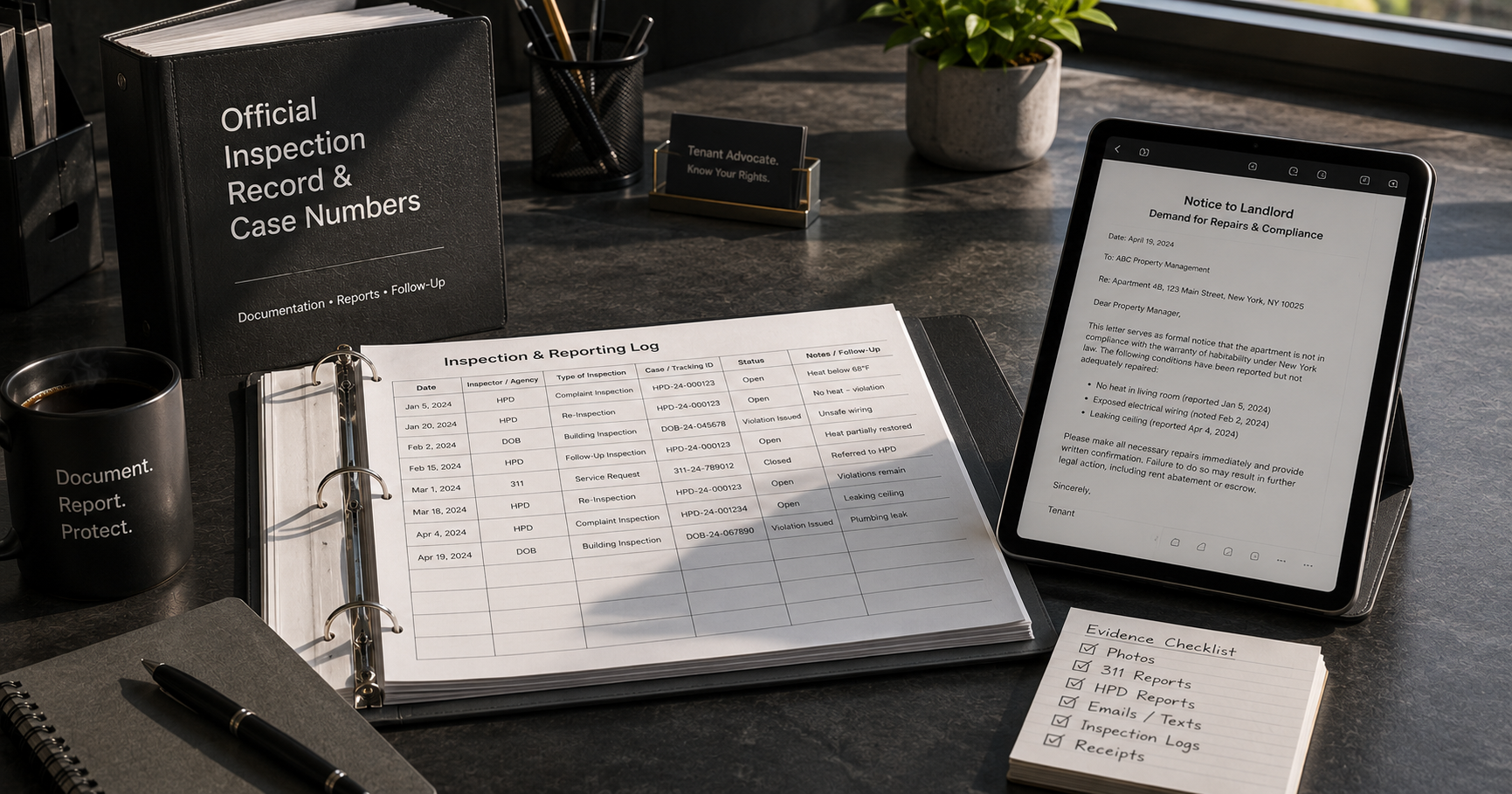
A few practical points about how this actually works, because they affect whether your complaint produces a result. When you file, you'll be given a Service Request (SR) number — save it immediately, because every follow-up call and every later step ties back to it; it's the case number this article keeps telling you to record. Inspections are tiered by danger: emergency conditions like no heat in winter, no water, or a sewage backup typically draw an inspection within about 24 hours, while hazardous-but-not-emergency conditions like leaks, mold, and pests may take a few days to a few weeks. And here's a crucial access point: for a condition inside your apartment, an inspector has to physically enter to record it and issue a violation, which means you need to be reachable and present. You can request that HPD keep your identity confidential from the landlord, and that's worth doing if you're worried about retaliation — but a fully anonymous complaint about an in-unit condition often goes nowhere, because the inspector can't get in. If you file with confidentiality, make sure to provide a callback number (even a Google Voice number the landlord wouldn't recognize) so the inspector can reach you to arrange access. Being home when the inspector comes is the difference between a violation issued and a complaint quietly closed.
A few conditions have their own specialized routes. Serious construction, illegal work, or structural-safety concerns may involve the Department of Buildings (DOB). Certain health-specific hazards can involve the Department of Health. But you generally don't need to memorize this division of labor, because 311 handles the routing — the value of knowing it is mainly so you understand who's likely to show up and what they can do.
Outside New York City, the structure differs but the categories hold: most places have some form of code enforcement or housing office for building conditions, a health department for health hazards, and often a central non-emergency line (sometimes also 311) that helps with routing. The lesson from the New York example is that you rarely need to solve the routing puzzle yourself — you need to find your locality's front door, describe your problem plainly, and let them direct it. Search your city or county name plus "report unsafe housing conditions" or "code enforcement complaint," and the front door usually appears quickly.
The difference between a call that goes well and a call that leaves you flustered and forgetting half of what you meant to say is about ninety seconds of preparation. Before you call or fill out an online form, outline a short script — not a word-for-word speech, just the key points you need to hit, so the conversation stays organized and you don't freeze.
Your script needs four things. First, who you are and where you live — your name, your address, your unit. Second, your main unsafe conditions: pick your top three, and state them in plain language. Not an exhaustive catalogue of every flaw in the apartment, which overwhelms the listener and buries the serious issues, but the three that matter most, clearly stated: "no heat for the past two weeks, mold spreading in the bathroom, and a front door that doesn't lock." Third, how long the problems have lasted and how the landlord responded: "the heat's been out since early December, I reported it in writing three times, and the landlord keeps saying he'll send someone but never does." Fourth, any health impacts: "the mold is affecting my daughter's asthma."
That's the whole script. Four points, a minute to deliver. Write them on a piece of paper or a notes app before you dial, and keep them in front of you during the call.
One refinement makes the script markedly more effective: be specific, not general, in how you describe each condition. Agencies and inspectors respond to concrete detail. "No heat, the thermostat reads 58 degrees at 9 a.m." is far more actionable than "the heat is broken." "Mold covering roughly two square feet of the bathroom ceiling, present since October" beats "there's mold." "The front door deadbolt doesn't engage, the door can be pushed open" beats "the lock is bad." Specificity does two things: it tells the agency exactly what the inspector should look for and verify, and it signals that you're a precise, credible reporter rather than someone with a vague complaint. So when you draft your three conditions, push each one from the general to the specific — add the measurement, the location, the duration, the observable fact. It takes a few extra seconds per item and it materially changes how your report is received.
Understand what this small preparation does for you. It keeps the call focused and efficient, which makes the person on the other end better able to help you and more likely to route you correctly. It ensures you don't leave out something important — the health impact, the fact that you reported it repeatedly — because you got nervous or the conversation went sideways. And it reduces your own anxiety enormously, because calling a government agency about a stressful situation is intimidating, and having your points written down means you're reading from a plan instead of scrambling to remember. The script turns a daunting call into a manageable one. It's the difference between "um, well, there's a lot of stuff wrong, where do I start" and a clear, credible ninety-second account that makes the agency take you seriously.
You've built an evidence file — the photos, the timeline, the copies of your complaints to the landlord. Have it in front of you when you make contact, because being able to reference it, or upload from it, transforms how the agency perceives you and how efficiently the contact goes.
Have three things at hand. Your photos and videos, ready to upload if it's an online form, or ready to describe precisely if it's a call — "I have dated photos of the mold from October through March showing it spreading." A written timeline of the issues and the repair promises, so you can give exact dates rather than vague approximations — "first reported November 4th, landlord promised a roofer November 5th, nothing done as of today." And copies of your written complaints to the landlord, so you can state, with specifics, that you notified them and when.
Having this ready does something beyond convenience: it signals that you're serious and prepared, which changes how you're treated. Agencies field a lot of vague, unsupported complaints, and a caller who can immediately supply dates, specifics, and documentation stands out as credible and organized — the kind of complaint worth prioritizing. When you can say "I first reported this on November 4th, here's the pattern, I have photographs," you're not a person with a vague grievance; you're a person with a documented case, and that distinction affects how seriously your report is taken and how promptly it's acted on.
It also makes the practical mechanics smoother. If it's an online filing, having your photos already saved and your dates already listed means you can complete it in one sitting rather than abandoning it halfway to go hunting for information. If it's a call, having your timeline in front of you means you answer the inspector's questions crisply instead of saying "let me check and call you back," which slows everything down. The evidence file, prepared and at hand, is what lets you move through the reporting process in one confident pass.
And keep the file ready for the inspection itself, not just the initial report — because the inspection is where your documentation does some of its most valuable work. When the inspector arrives, you can show them exactly where the problems are and hand over your dated photos of conditions that may have temporarily improved or that are hard to see on a given day. This matters because an inspector records what they observe in the moment, and some conditions are intermittent — the leak that isn't actively dripping today, the pest problem that's quiet during a daytime visit, the heat that happens to be working the hour they come. Your photo series showing the condition over months fills that gap, giving the inspector evidence of the pattern even when the snapshot of that particular day is incomplete. So be home for the inspection if you possibly can, walk the inspector to each problem, and have your documented history ready to show. A well-documented tenant standing beside the inspector, pointing things out, gets a more thorough inspection than an empty apartment with a note on the door.
When you have someone from the agency on the line, don't just report and hang up — ask specific questions about what they can actually do for you. This does two things at once: it gets you concrete information about your options, and it sets realistic expectations so you're not disappointed later by expecting something the agency was never going to provide.
Ask directly. "Can you inspect my unit or building?" Many housing and health agencies will send an inspector, and knowing whether and when that happens tells you what to expect next. "Can you issue violations or orders to the landlord?" This is the heart of the agency's power — an official violation is a government record that the condition exists, and an order can compel the landlord to fix it, so knowing whether this agency has that authority tells you how much leverage the contact actually gives you. And, in serious cases: "Do you offer relocation help or emergency housing if the unit is condemned?" If your conditions are severe enough that the unit might be deemed unfit for occupancy, you need to know what happens to you — whether there's relocation assistance — before that becomes an emergency.
Asking these questions accomplishes something important beyond the answers themselves: it calibrates your expectations to reality. Different agencies have different powers, and understanding what a given one can and can't do prevents both false hope and premature despair. Maybe this agency inspects and issues violations but doesn't provide housing — good to know, so you can line up another resource for that. Maybe it can order repairs but enforcement is slow — good to know, so you can plan accordingly. You're not just filing a complaint into a void; you're finding out exactly what this particular lever does when you pull it, which lets you use it wisely and combine it with other steps as needed.
The questions also, quietly, mark you as an informed tenant who knows this is a process with specific mechanisms — which, like your prepared evidence, tends to earn you more engaged treatment. A caller who asks "can you issue violations, and what's the timeline for an inspection?" is signaling that they understand how this works and intend to follow through, and that signal changes the interaction.
Two more questions are worth adding, because they protect you against the process stalling. Ask: "What's the expected timeline — when should I expect an inspection, and when should I follow up if I haven't heard anything?" This gives you a concrete date to hold the agency to, and a reason to call back that isn't just impatience. And ask: "What happens if the landlord doesn't comply after a violation is issued?" Agencies have escalation mechanisms — repeat violations, fees, referrals to court, in some cases emergency repairs performed by the city itself — and knowing what the next lever is means you're not stranded if the first one doesn't produce action. The answers tell you how far this road goes, so you can plan the whole route rather than just the first step.
It's also worth asking whether you need to do anything to enable the inspection — most importantly, whether you need to be present, and how they'll reach you to schedule. As we saw, an in-unit condition usually requires the inspector to actually get inside, so confirming how access works, and making sure the agency has a reliable way to contact you, prevents the most common way these complaints fizzle: an inspector who came, couldn't get in, and closed the case.
Every time you contact an agency, capture the details of that contact — because these records keep you oriented, let you follow up effectively, and become part of your evidence file. This is a small habit with outsized value.
After each call or online filing, write down the date and time of the contact. The confirmation number or case number you were given — this is how you'll reference your complaint in any follow-up, and losing it means starting over. And the name of anyone you spoke to, because "I spoke with someone" is far weaker than "I spoke with Inspector Ramirez on March 14th," both for your own follow-up and as a record.
All of this goes into your evidence folder, alongside your photos, timeline, and landlord communications. It belongs there because your agency contacts are now part of the documented history of your situation — proof of when you reported, to whom, and what you were told. If you ever need to demonstrate that you pursued the proper channels, this record is what shows it. And if a complaint stalls, your case number and the name of the person you spoke to are exactly what you need to call back and push it forward rather than filing all over again from scratch.
There's a practical orientation benefit too, and it matters more than it seems. These processes can stretch over weeks, involve multiple contacts, and generate a disorienting sense of not knowing where anything stands. A simple running record — date, case number, name, what was said — means you always know exactly where your complaint is in the pipeline. When you feel lost, you look at the record and you're found. That orientation is what keeps people engaged with a slow process instead of giving up on it, and giving up is often the only way these complaints actually fail.
Your record is also what makes following up effective rather than futile. If the inspection date the agency gave you passes with no inspection, you don't have to start over — you call back, cite your case number, and ask for the status. If a violation was issued but the landlord hasn't complied, your record of the violation is what you point to when you ask the agency about the next enforcement step. Complaints stall for ordinary bureaucratic reasons all the time — a missed inspection, a closed case, a backlog — and the tenant with a case number and a name can revive a stalled complaint with a single call, while the tenant with nothing has to begin the whole process again. Persistence is often what separates a complaint that produces a repair from one that quietly dies, and your record is what makes persistence possible. So treat the case number as precious: it's the thread that lets you pull your complaint back into motion whenever it drifts to a stop.
After you've contacted an agency, send your landlord a short, factual note letting them know. This feels counterintuitive to some tenants — why tell the landlord? — but it's a deliberate, strategic move that works in your favor.
Keep it brief and factual: "On [date], I contacted [agency] about [the conditions]. I'll be available for any inspections, and I'll continue to document the situation." That's it. No accusation, no gloating, no threat — just a calm, informational notice that you've taken this step.
This short message does real work. It shows the landlord that the situation is now being monitored by an outside authority — which often, by itself, prompts action, because a landlord who could ignore your requests cannot so easily ignore the prospect of an agency inspection and violations. The dynamic has changed, and the note makes sure the landlord knows it. It also positions you, once again, as the calm and reasonable party: you're not springing the agency on them vindictively, you're informing them straightforwardly and offering to cooperate with inspections, which is exactly how a reasonable person acts.
And it may discourage retaliation, which is the subtler strategic function. A landlord who knows that an agency is now aware of the conditions — and, importantly, aware of the timeline, since your note is dated — is a landlord who understands that any retaliatory move against you now would be conspicuous and easily connected to your complaint. The note establishes, in writing, that you engaged in protected activity on a specific date, which is precisely the fact that makes subsequent retaliation both provable and legally dangerous for the landlord. You're not threatening anything; you're simply creating a record that quietly raises the cost of retaliation. That's why the timing and the written form matter: this note is both a communication and a piece of evidence.
Send it, and save a copy in your evidence folder with the date. Like everything else in this process, it's doing double duty — informing the landlord and documenting that you did.
After you've reported, pay attention to what happens next, in two directions: whether the conditions improve, and whether the landlord retaliates. Both matter, and both should be tracked.
Watch first for improvement. Does the landlord, now facing agency involvement, finally make the repairs? Does an inspection happen, and do violations get issued? Track the positive developments, because they tell you whether the reporting worked and what, if anything, remains unresolved. If the conditions get fixed, wonderful — your documentation and your report accomplished exactly what they were meant to.
But watch, too, for retaliation, because reporting unsafe conditions is precisely the kind of protected activity that can provoke a landlord inclined to punish it. Does the landlord suddenly start threatening eviction? Talk of non-renewal that wasn't there before? A rent increase that lands right after your complaint? New "lease violations" appearing on your record? These are the signs of retaliation, and they often follow a report closely in time.
If retaliation appears, capture it separately — as its own dated record, distinct from the conditions complaint. This is important, because retaliation is a separate wrong, and often a serious one: retaliating against a tenant for making a good-faith complaint to a housing agency is unlawful, and in many places, including New York, the law presumes retaliation when a landlord takes adverse action within a defined window of a tenant's complaint, shifting the burden to the landlord to justify themselves. Your dated agency-contact record — the one you made in Step Five and referenced in your Step Six note — is exactly what establishes the timeline that makes a retaliation claim provable. So if the landlord retaliates, you're not defenseless; you have handed yourself, through careful documentation, a second and independent claim, which you can raise with the agencies or in any future defense against eviction.
The point is that reporting doesn't end when you hang up the phone. The situation keeps developing, and staying alert to both outcomes — resolution and retaliation — means you're positioned to recognize success when it comes and to respond effectively if the landlord strikes back. Keep watching, and keep documenting, until the conditions are resolved and the dust has settled.
Let's watch someone go from paralyzed to routed correctly.
Imagine a tenant with two serious problems — no reliable heat all winter and a spreading mold problem in the bathroom — plus a landlord who's ignored months of documented requests. She knows she needs to report it. But every time she sits down to do it, she gets stuck on the same question: report it to whom? She searches, finds a confusing list of city offices, isn't sure which handles heat versus mold, imagines being bounced around, and closes the laptop. Weeks pass this way.
Run it stuck. She never quite figures out the right office, or she calls one, gets told it's "not really our department" for part of her problem, gets flustered, and gives up. The confusion wins, the heat stays off, and the mold keeps spreading — not because no agency would help, but because she couldn't find the door.
Now run it with the framework. She lists her two problems and matches them: heat is a housing/code issue, mold is a health-and-housing issue — and in her city, both route through 311 to the housing agency, so the matching is simpler than she feared. She writes a ninety-second script: name and address; top conditions (no heat since December, mold spreading in the bathroom); how long and the landlord's non-response (reported in writing three times, empty promises); health impact (her own worsening cough). She pulls up her evidence file — the dated mold photos, the timeline, the screenshots of her requests — and has it in front of her.
She calls 311 and files. Because she's prepared, the call is crisp: she states her conditions, gives exact dates, references her documentation. She asks her questions — can they inspect, can they issue violations, what happens if the unit is found unfit — and gets real answers. She writes down the case number, the date, and the name of the person she spoke with, and files it all in her evidence folder. Then she sends her landlord a two-line note: "On March 14th I contacted the city about the heat and mold. I'll be available for inspection and will continue documenting."
An inspector comes. Violations are issued. The landlord, now facing the city, schedules the repairs. And when, a week later, the landlord grumbles something about "maybe not renewing difficult tenants," she recognizes it instantly, screenshots it, and logs it as potential retaliation with the date — right next to her dated complaint, which makes the timing impossible to miss.
Same tenant, same heat, same mold. In one version, confusion about which door to knock on keeps her frozen for weeks while nothing improves. In the other, a simple matching exercise and ninety seconds of script-writing get her routed correctly on the first call, the repairs made, and even the landlord's veiled threat converted into evidence. The difference wasn't the conditions or even the agencies. It was knowing who to call and what to say.
Step back and see how small the actual barrier was. You match the problem to the agency type — building and code issues to housing or code enforcement, health hazards to health or housing, immediate danger to police. You write a ninety-second script covering who you are, your top conditions, the history, and the health impact. You keep your evidence file at hand. You ask what the agency can do. You record the case number, the date, and the names. You send your landlord a calm, dated note. And you watch for both improvement and retaliation. That's the whole thing — a sequence of concrete, manageable steps, none of them difficult once you know they're there.
Here's the reframe to carry out of this. The thing that was stopping you — "I don't know who handles this" — felt like a wall, but it was never a wall. It was just a missing piece of information, the kind that dissolves the moment you have it. Reporting unsafe conditions isn't a mysterious ordeal reserved for people who understand bureaucracy; it's a matching problem with knowable answers and a short, repeatable process. The confusion was doing all the work of keeping you stuck, and confusion is the easiest obstacle in the world to remove, because the cure is simply knowing. Now you know.
So do the matching. List your problems, pair each with an agency type, write your ninety-second script, pull your evidence file into view, and make the call — or file the form. Ask what they can do, write down the case number and the name, and send your landlord the two-line note. Then watch what happens, and document it, whichever way it goes. You were never actually helpless here. You were just missing the map. You have it now — so make the call. Find out where you stand.