You're dealing with serious problems in your apartment—no heat in the middle of winter, a severe mold problem, a pest infestation, dangerous electrical issues, or sewage backup—and your landlord either isn't responding to your complaints or is promising repairs that never materialize. You know you need to escalate beyond just asking your landlord, but you're confused about who actually has the authority to inspect your apartment, issue violations, and force your landlord to make repairs. Should you call the police? The fire department? Some city agency? A state office? And if you call the wrong place, will your complaint just get lost in bureaucracy while you continue living in dangerous conditions?
You're looking at various government websites and seeing multiple agencies with overlapping-sounding responsibilities. You think: "Who do I actually call to report unsafe living conditions? Is there one main number or office I should contact, or do I need to figure out which specific agency handles my specific problem? What if I'm not in New York City—do the same rules apply? Will whoever I call actually come inspect my apartment and do something, or will they just take a report and do nothing? How do I make sure my complaint gets to the right people who have power to force my landlord to make repairs?"
Here's the truth: In New York, you typically start by notifying your landlord in writing to document that you gave them opportunity to repair, and when that fails, you escalate to government housing agencies—in NYC, that primarily means calling 311 which routes complaints to HPD (Department of Housing Preservation and Development) for most habitability issues or DOB (Department of Buildings) for structural problems, while outside NYC you contact your local code enforcement or building department, or local health department depending on the issue. These agencies have inspection authority, can issue violations with correction deadlines and penalties, and create official documentation that conditions violate codes. Understanding which agency has jurisdiction over your specific problem and where you're located determines the most effective path to getting inspections, violations, and ultimately forcing repairs.
Let me show you exactly who to contact in New York City for different types of unsafe conditions, who handles housing code enforcement outside NYC throughout the rest of New York State, what these agencies can actually do when you file complaints, what you should do before contacting agencies to strengthen your case, and how to escalate if local enforcement isn't working.
New York City has centralized its complaint and service request system through 311, making it the primary entry point for almost all housing-related complaints.
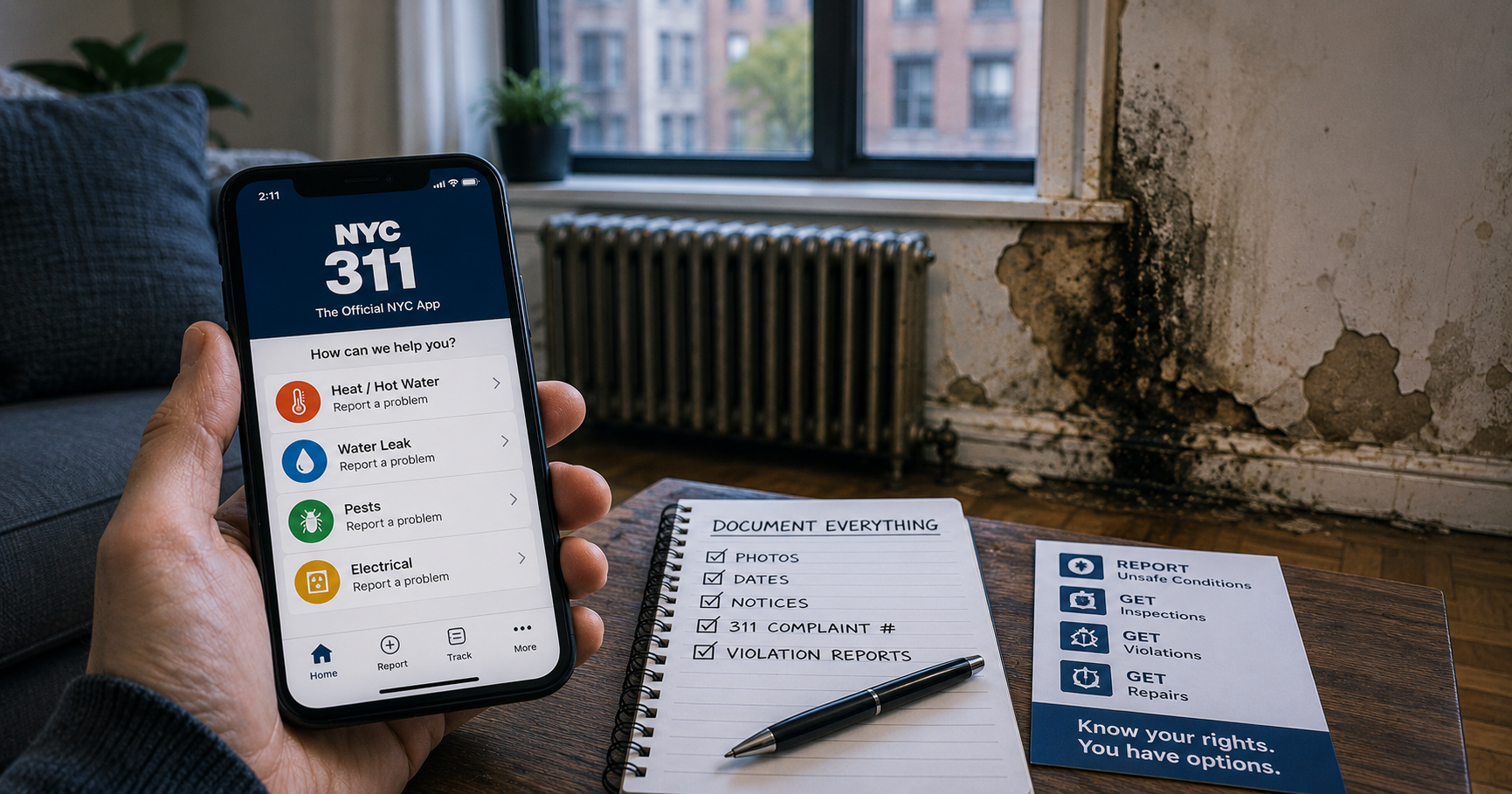
The 311 system is New York City's non-emergency municipal services hotline and complaint system, accessible by phone (dial 311), online (through the NYC.gov website), or mobile app.
When you contact 311 about housing problems, you're not just leaving a message with a call center—you're initiating an official complaint that gets routed to the appropriate city agency with enforcement authority over the issue you're reporting. The 311 system categorizes your complaint based on what you describe and automatically sends it to the right agency for investigation and response.
The genius of the 311 system for tenants is that you don't need to know which specific city agency handles your specific problem. You simply describe the unsafe condition in your apartment, and 311's system routes it appropriately. This eliminates confusion about whether to call the housing department, buildings department, health department, or some other agency—311 makes that determination for you.
311 creates official records of complaints with tracking numbers you can reference, dates of complaint and expected response times, documentation that you reported problems to the city, and ability to follow up on complaint status online or by calling back with your complaint number.
This centralization makes New York City's housing code enforcement relatively accessible compared to jurisdictions where tenants must figure out which of multiple agencies to contact.
For the vast majority of unsafe or unhealthy apartment conditions in New York City, your 311 complaint gets routed to HPD—the Department of Housing Preservation and Development.
HPD's Code Enforcement division is responsible for enforcing the NYC Housing Maintenance Code, which covers all requirements for maintaining residential buildings in safe, sanitary, habitable condition. This is the agency with authority over most tenant habitability complaints.
Conditions HPD handles include inadequate heat or hot water (the most common 311 complaints), pest infestations (roaches, mice, rats, bedbugs), mold and moisture problems, water leaks and water damage, broken or inadequate locks and building security, broken windows, peeling paint and deteriorating surfaces, inadequate lighting in common areas, unsanitary conditions and garbage, sewage problems, inadequate ventilation, non-working smoke or carbon monoxide detectors, and numerous other violations of housing maintenance requirements.
When you call 311 reporting any of these problems, 311 logs your complaint and forwards it to HPD's appropriate unit. HPD's process then typically involves contacting the building owner or management to notify them of the complaint and required correction, scheduling an inspection (often within days for serious complaints), sending a Code Enforcement inspector to your building to verify violations, and if violations are confirmed, issuing violation notices to the landlord.
HPD violations are classified by severity. Class C violations are "immediately hazardous" conditions requiring correction within 24 hours (like no heat or hot water, severe pest infestations, major hazards). Class B violations are "hazardous" conditions requiring correction within 30 days (like mold, leaks, broken locks, moderate violations). Class A violations are "non-hazardous" requiring correction within 90 days (minor issues not threatening health or safety).
The violation notice legally obligates the landlord to correct the problem by the deadline. If landlord doesn't comply, HPD can impose civil penalties (fines that increase for continued non-compliance), place liens on the property for unpaid fines, refer serious cases to other enforcement mechanisms including emergency repair programs where the city makes repairs and bills the landlord, or refer cases to court for more aggressive enforcement.
For tenants, HPD violations serve critical functions beyond just pressuring landlords. The violations are official city determinations that conditions violate code, creating powerful evidence for rent abatement claims, HP proceedings, or other legal actions. They document that problems are serious and code-violating, not just tenant complaints.
HPD also handles harassment complaints, illegal conversions of buildings (like illegal basement apartments), lead paint issues (especially with children under 6), and various other housing-related enforcement beyond simple maintenance violations.
While HPD handles conditions inside apartments and buildings, the Department of Buildings (DOB) has jurisdiction over structural integrity, building safety, and construction-related issues.
When to involve DOB through 311: if you're experiencing major structural problems like large cracks in walls or ceilings suggesting structural failure, unstable facades or exterior building elements at risk of falling, unsafe fire escapes or emergency exits, major construction defects threatening building integrity, unsafe balconies or structural building features, elevator safety issues, or significant structural damage from fires, floods, or other events.
The distinction between HPD and DOB can be blurry. A leak in your ceiling from upstairs neighbor's bathtub is HPD. A ceiling sagging from structural failure threatening collapse is DOB. Mold from moisture is HPD. Major cracks suggesting foundation problems are DOB. When in doubt, call 311 and describe the problem—the system will route it appropriately, and sometimes both agencies get involved.
DOB enforcement similarly involves inspections, violation notices to building owners, and escalating penalties for non-compliance. DOB has authority to issue vacate orders for buildings or units that are structurally unsafe, requiring occupants to leave until serious structural problems are corrected.
NYC DOB's guidance explicitly tells building owners and others to report unsafe building conditions through 311, confirming that the 311 system is the proper channel even for structural safety issues under DOB jurisdiction.
While HPD and DOB handle most housing complaints, 311 can route to other agencies for specific issues.
FDNY (Fire Department) for fire code violations, blocked fire exits, or fire safety concerns.
DOHMH (Department of Health and Mental Hygiene) for certain public health hazards, though many health-related housing issues (mold, pests, sewage) are primarily HPD jurisdiction under housing codes.
DEP (Department of Environmental Protection) for water supply issues, sewer problems, or environmental contamination.
The 311 system determines routing, so tenants don't need to know these jurisdictional nuances—just describe the problem accurately when making your complaint.
When contacting 311 about unsafe conditions, providing clear, specific information improves response.
Describe the problem specifically: Don't say "my apartment is bad." Say "I have no heat, the indoor temperature is 50 degrees, and I've had no heat for three days" or "I have visible mold covering approximately 15 square feet of my bathroom ceiling and bedroom wall, and I'm experiencing respiratory symptoms" or "I have a severe roach infestation, seeing 10-20 roaches daily in my kitchen and bathroom."
Provide complete address information: Your building address and apartment number. If you're reporting common area issues, specify the location within the building.
Mention if you've reported to landlord: Tell the 311 operator that you notified your landlord on specific date(s) and landlord hasn't made adequate repairs. This establishes that landlord had notice and opportunity.
Reference any emergencies or health impacts: If conditions are creating immediate health or safety risks, mention this to potentially expedite inspection.
Get your complaint number and reference information so you can track the complaint and follow up if needed.
Follow up if necessary: You can check complaint status online or call 311 again referencing your complaint number to ask about inspection scheduling or outcomes.
The rest of New York State doesn't have the centralized 311 system, so tenants must identify and contact the appropriate local agency directly.
Most cities, towns, and villages throughout New York have building departments or code enforcement offices responsible for enforcing the New York State Uniform Fire Prevention and Building Code and local housing codes.
These departments handle building code violations, fire safety violations, structural problems, unsafe conditions, and many habitability issues similar to what HPD handles in NYC. The specific scope varies by municipality, but generally includes serious habitability violations, unsafe structural conditions, electrical and plumbing code violations, fire safety issues, and sanitation problems.
Finding your local code enforcement: Search online for "[your city/town name] code enforcement" or "[your city/town name] building department." Check your municipal government website under departments or services. Call your city or town hall and ask to be directed to the code enforcement or building department.
Examples cited in tenant resources: Rochester, Yonkers, Schenectady, Niagara Falls, and other cities throughout New York State all have local code enforcement that tenants should contact for unsafe housing conditions. The names vary—some are called "Building Department," some "Code Enforcement," some "Department of Community Development"—but the function is similar.
When you contact local code enforcement, explain that you're a tenant reporting code violations and unsafe conditions in your rental unit. Provide your address, describe the specific problems, mention that you've notified the landlord who hasn't made repairs, and request inspection.
Local inspectors will schedule inspections, issue violation notices if code violations are found, and follow up on compliance. The classification systems and timeframes may differ from NYC's HPD system, but the basic enforcement mechanism—inspect, issue violations, require correction, impose penalties for non-compliance—is similar.
Some municipalities have more robust enforcement than others. Larger cities tend to have more resources and active code enforcement programs. Smaller towns might have less frequent inspection or fewer inspectors, but they still have authority to enforce codes and issue violations when violations are found.
County and municipal health departments handle public health hazards, and many have jurisdiction over health-related housing issues.
Health departments often handle: sewage and septic problems (particularly in areas with septic systems rather than municipal sewers), sanitation violations, some mold situations (particularly when tied to sanitary conditions), vermin and pest infestations affecting public health, water quality and contamination issues, and generally, conditions creating health hazards not adequately addressed by building code enforcement.
The division of responsibility between building/code enforcement and health departments varies by locality. In some areas, building departments handle most housing issues and only defer to health for specific sanitation or public health matters. In other areas, health departments take more active roles in housing habitability enforcement.
When in doubt, contact both. If you call code enforcement and they say "that's really a health department issue," they'll usually tell you. Same if you call health department first. You won't be penalized for calling the "wrong" agency initially—they'll redirect you.
Health department enforcement similarly involves inspections, findings of health code violations, orders to correct violations, and potential penalties for non-compliance. Health departments can issue emergency orders for serious health hazards requiring immediate correction.
Above the local level, the New York State Department of State oversees local code enforcement through its Division of Building Standards and Codes.
This state office administers the state Uniform Code, trains and certifies code enforcement officials, provides guidance on code interpretation and enforcement, and can receive complaints about local code enforcement failures.
When to contact state enforcement: If you believe your local building department or code enforcement is completely ignoring code violations, failing to enforce the code at all, or is corrupt or complicit with landlords in allowing dangerous conditions to persist despite complaints.
This is an escalation mechanism for situations where local enforcement has failed, not your first call. Try local code enforcement first. If they refuse to inspect, dismiss serious violations without justification, or appear to be not enforcing codes, you can complain to the state Division of Building Standards and Codes about the local enforcement failure.
The state can investigate local enforcement practices and require corrective action if local officials aren't fulfilling their code enforcement responsibilities.
For tenants outside NYC unsure where to start:
Check your municipality's website for departments and services. Look for code enforcement, building department, or housing.
Call your town or city hall main number and ask: "I'm a tenant and I need to report unsafe conditions and code violations in my rental apartment. Which department should I contact?"
County government may have code enforcement if your town is very small or unincorporated areas.
LawHelpNY.org and Legal Aid websites for your region often list local code enforcement contacts for major cities in different regions of the state.
Once you've made contact once, save the phone number and contact information for future reference.
Understanding what powers housing code enforcement agencies have helps you know what to expect when you file complaints and how these agencies can help you.
Housing code enforcement agencies have legal authority to inspect rental properties to verify code compliance, usually without needing landlord permission.
When you file complaint, agencies schedule inspections. Inspectors will contact you to arrange access to your apartment, or in some cases, inspect common areas and exterior without entering your unit. You generally must provide access for inspection (though you can request reasonable scheduling).
Inspectors look for code violations matching your complaint plus any other visible violations they observe. They document conditions through notes, photos (sometimes), and inspection reports.
After inspection, inspectors determine whether violations exist and what severity level they are. This professional assessment by a government inspector is official determination that your complaints are legitimate code violations, not just personal preferences or tenant exaggeration.
The primary enforcement tool is issuing violation notices to building owners.
Violation notices legally document specific code violations found, classify violations by severity (systems vary but generally distinguish immediately hazardous, hazardous, and non-hazardous violations), set deadlines for correction based on severity (24 hours to 90 days depending on classification), and impose legal obligation on landlord to correct violations by deadlines.
Landlords must respond by making required corrections, filing certifications of correction with the agency, allowing re-inspection to verify corrections, or facing escalating penalties for non-compliance.
For tenants, violation notices serve dual purposes. They pressure landlords to make repairs (violation notices have teeth through fines and escalating enforcement). And they provide official documentation for your legal claims (violations are admissible evidence in court for rent abatement, HP proceedings, or other actions).
When landlords don't correct violations by deadlines, agencies impose civil penalties.
Fines typically increase the longer violations remain uncorrected. Initial fines of hundreds of dollars can escalate to thousands for continued non-compliance. Serious or persistent violations can result in very substantial penalties.
Fines create financial pressure on landlords to make repairs. While some neglectful landlords ignore initial violations, accumulating fines and penalties eventually become painful enough to compel action.
Liens on property may be placed for unpaid fines, meaning when property is sold or refinanced, the liens must be satisfied.
For serious violations that landlords won't correct despite violations and fines, agencies have additional enforcement mechanisms.
Emergency repair programs (in some jurisdictions including NYC) allow agencies to directly arrange necessary repairs and bill landlords for the costs plus penalties. This ensures critical health and safety repairs are made even when landlords refuse to act.
Court referrals bring enforcement cases before judges who can issue court orders compelling repairs, impose additional penalties, appoint receivers to manage properties and make repairs, or in extreme cases, pursue criminal charges against landlords for endangering tenants.
Vacate orders for buildings or units that are dangerous and uninhabitable can force closure until serious violations are corrected, protecting tenants from remaining in hazardous conditions.
These escalated enforcement mechanisms show that agencies have real power beyond just issuing paper violation notices—they can ultimately compel repairs or remove property from occupancy.
To maximize effectiveness of your agency complaints and protect your legal position, follow these steps.
Before calling government agencies, notify your landlord in writing about problems and request repairs.
Email, text, or letter to landlord describing specific unsafe conditions, requesting prompt repair, and setting reasonable deadlines based on severity.
Why this matters: Demonstrates you gave landlord opportunity to correct problems before involving authorities. Creates documentation that landlord had notice (important for legal claims). Shows good faith on your part. And provides timeline proving landlord's failure to respond.
NYC tenant resources and LawHelpNY materials consistently emphasize: contact your property owner or manager first, then call 311 or local code enforcement if they don't respond or adequately address problems.
How long to wait before escalating to agencies depends on severity. For emergencies like no heat in freezing weather, give landlord a day then call agencies immediately if still not fixed. For serious hazards, a week to ten days is reasonable. For moderate violations, a couple weeks to a month. You're not required to wait indefinitely—reasonable time based on severity is sufficient.
Save copies of your repair requests to landlord as evidence.
Visual and written documentation strengthens both your agency complaint and any later legal actions.
Photograph and video: All unsafe conditions you're reporting. Multiple angles and views. Include something showing scale or dates. Take photos over time showing persistence or worsening.
Keep a log: Dates when problems started or were discovered. Dates when you reported problems to landlord. Dates and descriptions of incidents or worsening conditions. Health impacts if any.
This documentation helps agency inspectors understand what they're looking for (you can share photos when making complaint or when inspector visits), and provides evidence for rent abatement claims, HP proceedings, or other legal actions if violations aren't adequately addressed.
When filing complaints with 311 or local code enforcement, specific details improve response.
Describe problems clearly and specifically: Not "apartment is in bad shape" but "no heat for 4 days, indoor temperature 48 degrees" or "severe mold covering 20+ square feet of bedroom walls and ceiling, causing respiratory symptoms."
Mention prior notice to landlord: "I notified landlord about this problem on [date] and [date] but repairs haven't been made."
Note any emergencies or vulnerable populations: If conditions are immediately dangerous, if children, elderly, or disabled people are affected, or if you're experiencing health impacts, mention this.
Provide contact information so inspectors can reach you to schedule access to your apartment.
The more specific and detailed your complaint, the better agencies can prioritize and respond appropriately.
When agency schedules inspection, cooperate fully.
Provide access on scheduled inspection date. If you need to reschedule, communicate promptly.
Point out problems to inspector when they visit. Show them all conditions you complained about and any other violations you've noticed.
Provide your documentation if helpful—give inspector copies of photos, communications with landlord, or other evidence supporting your complaint.
Get inspector's information and any case or complaint reference numbers for following up.
Ask about next steps: When will violation notices be issued if violations found? What's the timeline for required corrections? How can you check status?
Professional, cooperative interaction with inspectors ensures they have complete information to document violations thoroughly.
Once violations are issued, obtain copies and use them strategically.
Request copies of violation notices. In NYC, violations are public record and searchable online. Elsewhere, request copies from the issuing agency.
Provide copies to landlord if they claim ignorance or dispute that problems exist—official violations are powerful evidence conditions are serious.
Keep copies for your records as evidence for any legal proceedings.
Reference violations in any further communications with landlord or in court proceedings: "As documented by HPD violation #123456 issued on [date], the mold in my apartment violates housing code and must be remediated."
Official violations shift the narrative from "tenant complains about conditions" to "government inspector found code violations."
In New York, you typically start by notifying your landlord in writing, and when that fails, escalate to government housing agencies that have inspection and enforcement authority.
In NYC: Call 311 (phone, online, or app) to report unsafe conditions. 311 routes your complaint to the right agency—usually HPD for most habitability issues (heat, hot water, mold, pests, leaks, locks, sanitation, etc.) or DOB for structural and building safety issues. 311 is the single entry point for almost all housing complaints.
Outside NYC: Contact your local code enforcement or building department for most housing code violations and unsafe conditions. Contact your local health department for sanitation, sewage, and health-related issues. If local enforcement fails completely, escalate to NYS Division of Building Standards and Codes.
What agencies can do: Schedule inspections, issue violation notices with correction deadlines, impose fines and penalties for non-compliance, arrange emergency repairs in serious cases, refer to court for escalated enforcement, create official documentation you can use in legal proceedings.
Before calling agencies: Notify landlord in writing first to give them opportunity to repair and create documentation. Document conditions with photos, videos, and logs. Provide specific, detailed information when filing complaints.
Official violations from HPD, DOB, local code enforcement, or health departments are powerful evidence—third-party government determinations that conditions violate codes, not just tenant opinions. Use violations to pressure landlords and support legal claims.
In NYC, 311 makes it simple—one number handles routing to appropriate agency. Outside NYC, identify your local code enforcement and health department contacts and save them for when needed.
Don't wait indefinitely for landlords to fix serious problems. Once you've given reasonable notice and time, escalate to agencies with enforcement power.
Find out if you have a case in 30 seconds →