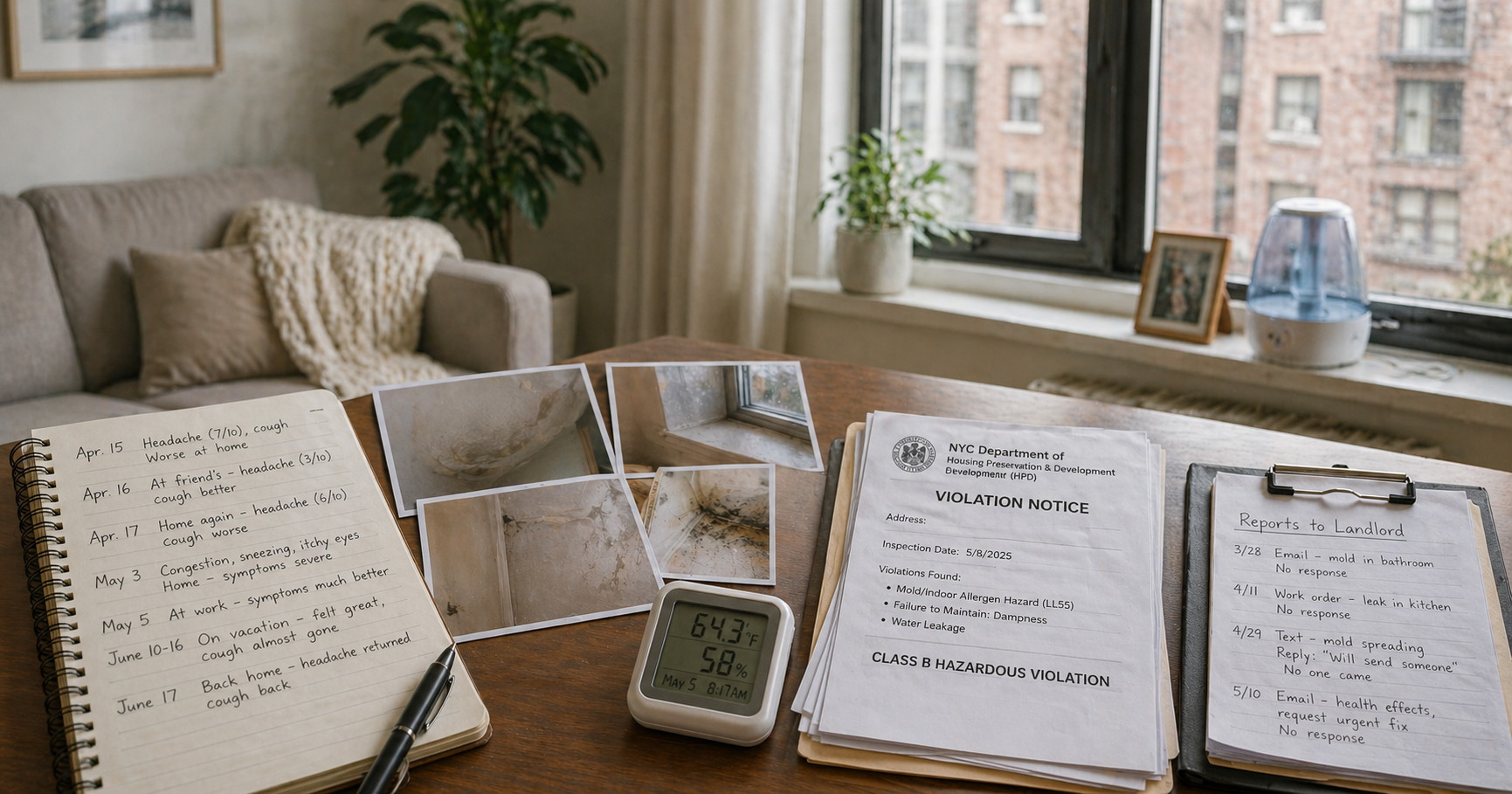
You've been feeling terrible for months. You have persistent headaches that won't go away. You're coughing constantly, dealing with recurring sinus infections, experiencing chest tightness and wheezing, feeling exhausted even after sleeping, or suffering from skin rashes that appeared out of nowhere. You've seen doctors, tried medications, but nothing seems to fully resolve the problems. Then you start noticing a pattern: your symptoms seem worse when you're home, particularly at night or on weekends when you spend extended time in your apartment. When you're at work, visiting friends, or traveling, you feel noticeably better. When you return home, the symptoms come roaring back.
You look around your apartment and see potential culprits. There's visible mold growing on the bathroom ceiling and bedroom walls. The place has a persistent musty smell. You've reported leaks to the landlord multiple times, but they've never been properly fixed. There's dampness, condensation on windows, water stains on ceilings. You suspect your apartment is making you sick, but you're not sure how to prove it.
You think: "How do I establish that my health problems are actually caused by my apartment? What evidence do I need to show the connection between my symptoms and the conditions in my home? Will doctors take me seriously if I say my apartment is making me sick? How can I document this in a way that will hold up legally if I need to sue my landlord, get a rent reduction, or break my lease? What exactly constitutes proof of the connection between housing conditions and health effects?"
Here's the truth: You prove the connection between your apartment and your health problems by building a comprehensive evidentiary case linking three elements—documented symptoms that correlate with time spent in the apartment, medical records from healthcare providers noting the environmental connection, and environmental evidence showing hazardous conditions in your dwelling. When your symptom diary shows health problems spiking at home and improving away, when doctors document suspicions that your home environment is causing or exacerbating your conditions, and when inspectors or testing confirm hazards like mold or dampness in your apartment, these three evidence streams together establish the causal link between your housing and your health.
Let me show you exactly how to systematically document your health symptoms in relation to your apartment occupancy, how to work with medical providers to get documentation linking your conditions to your home environment, how to thoroughly document apartment conditions creating health hazards, how to obtain official inspections and environmental testing, and how to connect all these pieces of evidence into a legally compelling case.
Before documenting your specific situation, understand how and why certain housing conditions create genuine health risks.
Certain conditions in rental housing are medically recognized as health hazards that can cause or worsen specific symptoms and conditions.
Mold and dampness are among the most common and well-documented housing health hazards. Medical research and public health authorities including the CDC, EPA, and New York City Department of Health have established clear connections between mold/dampness exposure and health effects. Mold exposure can trigger or worsen asthma, causing increased attacks, wheezing, chest tightness, and difficulty breathing. Mold acts as an allergen for many people, producing allergic reactions including stuffy or runny nose, sneezing, itchy or watery eyes, throat irritation, and skin rashes. Even people without asthma or mold allergies can experience respiratory irritation, coughing, and sinus problems from mold exposure. Chronic headaches and fatigue are also associated with living in moldy, damp environments.
Poor indoor air quality from inadequate ventilation, off-gassing from materials, combustion product accumulation, or other sources can cause headaches, fatigue, difficulty concentrating, respiratory irritation, and exacerbation of respiratory conditions.
Pest infestations create health hazards through allergens (cockroach and rodent allergens triggering asthma and allergies), disease transmission, and psychological stress. Children exposed to cockroach allergen have higher rates of asthma and allergic disease.
Lead paint exposure from deteriorating paint in pre-1978 housing causes serious neurological damage, particularly in children, but can also affect adults causing headaches, fatigue, abdominal pain, and cognitive effects.
Carbon monoxide from faulty heating systems or appliances causes headaches, dizziness, nausea, confusion, and at high levels, death. Symptoms that improve when away from home and return when back are classic carbon monoxide poisoning patterns.
Cold temperatures from inadequate heat can exacerbate respiratory conditions, cardiovascular conditions, and arthritis, and increase susceptibility to infections.
Understanding these established health connections helps you recognize when your symptoms fit patterns consistent with housing-related illness.
Certain symptom patterns strongly suggest environmental causes, making them critical to document.
The home-versus-away pattern is the most telling indicator of environmental illness. When symptoms consistently worsen during time spent in a specific environment (your apartment) and improve when you're away from that environment (at work, visiting others, on vacation), this correlation strongly suggests something in that environment is causing or triggering your symptoms. Random illness or chronic conditions typically don't correlate so precisely with physical location—the fact that your health tracks with presence in or absence from your apartment points to environmental causation.
Symptom onset timing is also significant. If you moved into an apartment and shortly afterward developed new symptoms you didn't have previously, or if you had mild pre-existing conditions (like occasional allergies or mild asthma) that suddenly worsened after moving in, the timing suggests something in the new environment triggered the change.
Recurrent infections or exacerbations following a pattern tied to home occupancy—getting sinus infections repeatedly when spending extended time at home, asthma attacks occurring at night or on weekends when home more—suggests environmental triggers operating in your dwelling.
Multiple household members affected strengthens environmental causation. If you, your partner, and your children all develop respiratory symptoms, allergies, or other health complaints after moving in or since a problem like mold appeared, the common denominator is the shared environment.
These patterns don't appear with typical viral illnesses, chronic diseases without environmental triggers, or random health events—they're characteristic of environmental illness and critical to document.
The foundation of proving the connection between your health and your apartment is creating a detailed record of when symptoms occur in relation to where you are.
A systematic symptom diary creates the timeline demonstrating correlation between apartment occupancy and health effects.
What to record in your diary:
Date and time of each entry. Make daily entries or at minimum, entries whenever you experience symptoms or notice symptom changes. The more detailed the record, the stronger the pattern evidence.
Symptoms experienced described specifically. Don't just write "felt bad"—detail what you experienced: headache (location, severity), cough (dry or productive, frequency), wheezing, chest tightness, difficulty breathing, nasal congestion, sneezing, itchy or watery eyes, skin rash (location, appearance), fatigue, nausea, dizziness, sinus pain or pressure. The more specific the symptom descriptions, the better doctors can correlate them with known effects of housing hazards.
Location when symptoms occurred or were most severe. Note whether you were in the apartment, at work, visiting friends or family, traveling, or elsewhere. Specify if symptoms started while home, improved after leaving, worsened upon returning, or varied based on which room you were in (if certain rooms like bathrooms or bedrooms with mold are worse).
Activities and exposures relevant to symptoms. Note if you were sleeping in the bedroom, showering in the moldy bathroom, spending time in a damp basement, or being in areas with visible mold or musty smells.
Symptom severity on a simple scale (mild, moderate, severe, or 1-10 rating) helps track whether symptoms are worsening over time or correlate with increased or decreased time at home.
Medications or treatments used and whether they provided relief or not. This shows you're actively trying to address symptoms and documents what works or doesn't.
Environmental conditions observed concurrent with symptoms. Note if the apartment smelled particularly musty, if you saw new mold growth, if there was active leaking, if condensation was heavy—connecting environmental observations to symptom occurrences strengthens the causal link.
Well-documented diary entries that capture the home-versus-away pattern might look like:
Example 1: "April 15, 2025 – Stayed home all day (rainy, worked from home). Musty smell very strong throughout apartment. By evening developed throbbing headache (7/10 severity) and dry, persistent cough. Took ibuprofen, minimal relief. Cough kept me awake. April 16 – Went to friend's apartment for the day. Headache improved significantly by afternoon (3/10), cough less frequent. April 17 – Back home. Headache returned within hours of being in apartment (6/10). Cough worse again overnight."
This entry establishes: symptoms developed while home, improved when away, returned when back home—the classic pattern.
Example 2: "May 3, 2025 – Weekend at home. Bedroom mold (corner by window) seems to have spread—larger area than last week. Woke up with severe nasal congestion, couldn't breathe through nose, face felt swollen. Sneezing fits throughout morning. Eyes itchy and watery. Symptoms worst in bedroom. May 4 – Still home, symptoms continued. May 5 (Monday) – At work all day. By afternoon, congestion clearing, sneezing stopped, eyes less irritated. May 6 – Worked from home. Symptoms returned—congestion severe again by evening."
This establishes: symptoms correlate with extended time home and in moldy bedroom, improve during workday away, return when home again.
Example 3: "June 10-16, 2025 – Vacation, away from apartment entire week. Cough that's been constant for 2 months almost completely resolved by day 3. No headaches all week (had been having daily headaches at home). Slept well, felt energized. June 17 – Returned home. Within 4 hours of being in apartment, headache started. By bedtime, coughing resumed. June 18 – Headache persistent, cough bad again."
This powerful entry shows: dramatic improvement during week-long absence, rapid return of symptoms upon coming home—strong evidence of environmental causation.
Keep the diary regularly and consistently—daily entries or at minimum several times per week provide better pattern evidence than sporadic recording. The more complete the record, the harder it is to dismiss as coincidence or exaggeration.
Be honest and accurate. Don't embellish or claim symptoms you didn't experience—credibility matters. Record good days as well as bad days. If you had a day when symptoms were mild or absent despite being home, note that too. Honest documentation showing the pattern amid natural variation is more credible than claims of constant, unrelieved suffering.
Maintain the diary over extended periods—weeks or months if possible. Short-term records might be dismissed as temporary or coincidental. Records spanning months showing consistent correlation between home occupancy and symptoms provide compelling pattern evidence.
Keep digital and physical copies of your symptom diary—photos of written journals, backed-up digital files. This evidence is too important to risk losing.
Healthcare provider documentation that your symptoms may be environmentally caused is critical evidence supporting the apartment-health connection.
When seeing doctors about health problems you believe are related to your apartment, clear communication ensures they understand and document the environmental connection.
Describe both symptoms and home conditions. Don't just report "I have a cough and headaches"—provide context: "I've had a persistent cough and daily headaches for three months. They started after mold appeared in my bathroom and bedroom. The apartment has a strong musty smell. I've noticed the symptoms are much worse when I'm home and improve when I'm away from the apartment for extended periods."
This contextual information helps doctors consider environmental causes and prompts them to inquire further about your housing conditions and the symptom-location correlation.
Be specific about environmental hazards in your home:
Detailed descriptions of conditions help doctors understand the potential exposures and health risks.
Explain the symptom-location pattern:
This pattern information is medically significant—doctors trained in environmental health or allergies recognize home-versus-away correlation as diagnostic of environmental triggers.
Ask doctors to document environmental suspicions in medical records. You can explicitly request: "Can you note in my chart that you suspect my apartment's mold and dampness may be causing or contributing to these symptoms?" Most doctors will document reasonable clinical suspicions, especially when symptom patterns support environmental causation.
Different forms of medical documentation serve different purposes in proving the apartment-health connection.
Clinical notes documenting environmental suspicions are foundational. When doctors write in progress notes, visit summaries, or letters statements like "Patient reports worsening cough and headaches in damp, moldy apartment; symptoms appear consistent with mold exposure and improve when away from home environment," this creates medical record evidence that a healthcare professional considered your housing a health factor.
Even more valuable are notes stating: "Suspect environmental allergens/irritants in patient's home contributing to respiratory symptoms" or "Patient's symptom pattern (worse at home, better away) suggests environmental trigger; advised mold remediation" or "Asthma exacerbations likely triggered by mold exposure in patient's apartment."
These medical opinions connecting your symptoms to your housing become powerful evidence in legal proceedings, rent reduction claims, or constructive eviction cases.
Diagnostic testing results can support environmental causation:
Allergy testing (skin or blood tests) showing sensitivity to mold, dust mites, cockroach allergen, or other common indoor allergens supports that you're susceptible to environmental triggers likely present in your apartment. If you test positive for mold sensitivity and your apartment has visible mold, the connection becomes medically supported.
Pulmonary function tests showing decreased lung function, asthma, or other respiratory impairment in context of environmental exposure document the severity of health effects. Serial tests showing worsening function over time in the apartment or improved function after remediation strengthen causation.
Imaging like chest X-rays showing chronic sinus infections or lung changes can document health effects, though they don't prove causation alone.
Letters or reports from specialists carry particular weight. A pulmonologist (lung specialist) stating "Patient's asthma has worsened significantly coinciding with mold exposure in her apartment; environmental remediation is medically necessary," or an allergist writing "Patient's allergic rhinitis and asthma exacerbations are likely caused by mold and dampness in his residence; recommend immediate mold remediation and patient relocation if remediation is delayed"—these specialist opinions provide expert medical support for causation.
Referrals or recommendations for environmental assessment show doctors take environmental causation seriously. If a doctor recommends mold inspection of your apartment, suggests you relocate temporarily, or advises environmental remediation, these recommendations imply medical belief that your housing is affecting your health.
Some healthcare providers may be dismissive of environmental health concerns or reluctant to document connections they view as speculative. Strategies for working with skeptical doctors:
Provide your symptom diary showing the home-versus-away pattern. Objective data is more persuasive than subjective complaints. When doctors see documented correlation over weeks or months, the pattern becomes harder to dismiss.
Bring photos of apartment conditions—visible mold, water damage, pest infestations. Seeing the hazards helps doctors understand the exposures aren't hypothetical.
Reference medical literature or public health guidance on mold and dampness health effects (CDC, EPA, NYC Health Department resources). You can respectfully note "The NYC Health Department states that mold exposure can trigger asthma and allergies, which matches my symptom pattern."
Seek second opinions if your primary care provider won't engage with environmental concerns. Allergists, pulmonologists, environmental medicine specialists, or occupational health physicians may have more expertise and openness to environmental causation.
Request objective testing (allergy tests, pulmonary function tests) that might reveal environmental susceptibilities or health effects, giving doctors concrete findings to document beyond subjective symptom reports.
Don't be deterred if one doctor is dismissive—persist in seeking providers who will seriously consider and document environmental health factors.
Medical documentation of symptoms must be paired with environmental documentation showing hazards in your apartment that could plausibly cause those symptoms.
Visual evidence of apartment conditions is critical for proving hazards exist and their severity.
Photograph all hazardous conditions comprehensively:
Mold should be photographed from multiple angles showing extent, location, and progression:
Water damage and leaks require documentation showing:
Pests should be photographed when possible:
Other hazards:
Best practices for photographic documentation:
Include timestamps either from camera metadata, or photograph a clock or newspaper showing date in the same frame as the hazard, or email photos to yourself immediately creating dated records.
Take many photos from different angles—overcollect rather than undercollect. You can always choose the best later.
Update photos regularly to show progression, persistence, or spreading of problems over time. A single photo might be dismissed as isolated, but monthly photos showing mold spreading from 1 square foot to 10 square feet over six months proves it's worsening and the landlord isn't addressing it.
Video can capture conditions photos can't—like the extent of musty smell throughout an apartment (walk through describing the smell in each room), water actively dripping from a leak, or the pervasiveness of pest activity.
Supplement photos with written records tracking environmental problems.
Moisture and odor logs noting:
Temperature logs when heat is inadequate:
Pest sighting logs:
These logs create contemporaneous records strengthening your evidence that conditions were persistent and severe.
Documenting your reports to the landlord and their responses (or lack thereof) proves landlord knowledge and failure to act.
Save all communications:
These communications establish:
If you haven't yet reported problems in writing, do so immediately and save copies. Written notice to landlord is legally important and creates documentary evidence.
Independent third-party verification of hazards—from government inspectors or environmental professionals—provides objective, authoritative evidence.
Official inspections by housing code enforcement agencies carry significant weight because they're unbiased, use established standards, and result in legal violation notices.
In New York City, call 311 to request HPD (Department of Housing Preservation and Development) inspection for mold and indoor allergen hazards. NYC's Local Law 55 specifically targets mold as an "indoor allergen hazard" and gives HPD authority to inspect and issue violations.
When calling 311:
HPD inspectors will:
HPD violation notices are powerful evidence because:
Outside NYC, contact:
Request inspections for mold, dampness, sanitation hazards, inadequate heat, or other code violations. Ask for written inspection reports and violation notices.
Official government documentation of housing code violations specifically finding hazards in your apartment provides objective, legally significant evidence that conditions exist potentially affecting health.
While not always necessary, professional environmental assessment and testing can provide scientific documentation of hazards and their severity.
Mold inspection and testing by certified mold inspectors involves:
Why professional mold testing can be valuable:
Other environmental testing:
Costs and considerations:
In litigation contexts, especially serious health damage claims or toxic mold cases, courts often expect professional environmental testing showing exactly what contamination existed, at what levels, and expert opinions on causation and health risks.
Proving the apartment-health connection for legal purposes requires assembling all evidence into a coherent narrative demonstrating causation.
Lawyers building housing-related health claims typically structure evidence in three complementary streams that together establish causation:
Timeline evidence creating the chronological story:
This timeline establishes temporal correlation between exposure to hazards and health effects.
Medical evidence providing expert opinions on causation:
Medical evidence shows that qualified professionals believe the apartment is affecting your health based on clinical presentation and symptom patterns.
Environmental evidence proving hazards exist and landlord responsibility:
Environmental evidence establishes that hazards exist in the dwelling, they're substantial and persistent, and the landlord knew but failed to correct them.
The evidence must tell a coherent story connecting apartment conditions to health effects:
The basic narrative structure:
"I moved into [apartment] on [date]. Initially [conditions were fine / I had no health problems / mild pre-existing condition]. Starting around [date], I noticed [mold growth / persistent leaks / musty smell / pests / other hazard]. Around the same time or shortly after, I developed [specific symptoms]. I reported the conditions to my landlord on [dates], but they [ignored / provided inadequate response / failed to fix underlying problems].
My symptoms have [worsened over time / persisted despite medical treatment]. I've noticed a clear pattern: when I'm in the apartment, especially [in certain rooms / at night / for extended periods], my symptoms are [severe / unbearable]. When I'm away from the apartment [at work / visiting family / on vacation], my symptoms [improve significantly / almost completely resolve]. When I return home, symptoms [come back quickly / worsen again].
I've seen [multiple doctors / specialists] who have documented that my symptoms are consistent with exposure to [mold / dampness / allergens] and that the home-versus-away pattern suggests environmental causation. [Doctor names] have specifically noted in my medical records that my apartment conditions are likely contributing to my health problems.
[Government inspectors / Professional mold inspector] confirmed the presence of [specific hazards] and found [violations / significant contamination]. Despite being aware of these hazards for [time period], my landlord has [failed to remediate / provided only superficial fixes that don't address root causes].
The combination of my symptom diary showing the location-based pattern, medical documentation connecting my health issues to my home environment, and objective evidence of serious hazards in my apartment all point to the conclusion that my apartment is causing my health problems."
You don't need absolute scientific certainty to prove apartment-health causation in most legal contexts. The standard is typically "preponderance of evidence" (more likely than not) or "reasonable medical probability" rather than "beyond reasonable doubt" or "scientific certainty."
Strong cases have:
The more elements you can document, the stronger the case. Perfect alignment of all evidence is ideal but not always required—substantial evidence across the three streams (timeline, medical, environmental) usually suffices.
Even if you don't have every piece, some evidence is much better than none. A symptom diary alone has value. Medical notes alone help. Photos alone document conditions. But combining multiple evidence types creates much more compelling causation arguments.
The apartment-health connection evidence you've built serves multiple potential legal uses:
Rent reduction (abatement) claims: Evidence showing the apartment is unsafe/unhealthy and affecting your health supports arguments for reduced rent reflecting the dwelling's diminished value and uninhabitability. Courts consider health impacts when determining appropriate rent reductions.
Constructive eviction claims: If conditions are so severe they make the apartment uninhabitable and you must leave to protect your health, evidence proving the apartment was harming you justifies breaking the lease without penalty and potentially recovering relocation costs.
Damage claims: If you sue the landlord for health harm caused by apartment conditions, the three-stream evidence structure (timeline, medical, environmental) forms the basis of proving causation—that the landlord's negligent maintenance caused your health problems.
HPD proceedings or housing court: Evidence compels judges to order repairs, supports emergency relief requests, and strengthens arguments for contempt or penalties if landlords don't comply.
Disability accommodation requests: If apartment conditions exacerbated a disability (like asthma), evidence supports requests for accommodations (like temporary relocation during remediation) or modifications.
Breaking lease without penalty: Documentation that staying in the apartment poses health risks can support negotiating lease termination or defending against landlord claims you improperly broke the lease.
You establish the connection between your apartment and your health by systematically documenting three evidence streams: symptom patterns correlated with time in apartment, medical documentation of environmental causation, and objective evidence of hazards in the dwelling.
Symptom diaries showing health problems worse at home and better away create powerful pattern evidence of environmental causation.
Medical records where doctors note that symptoms appear consistent with mold/dampness/allergen exposure and improve when away from home provide expert support for the connection.
Photographs, videos, logs, and official inspections documenting mold, leaks, dampness, pests, or other hazards prove dangerous conditions exist.
Communications showing landlord was notified but failed to remediate establish landlord knowledge and negligence.
Professional environmental testing can provide scientific verification of hazards and their severity in complex or high-stakes cases.
The evidence doesn't need to be perfect or scientifically certain—preponderance of evidence showing the apartment is more likely than not causing health problems is usually sufficient for legal purposes.
Start documenting immediately: symptom diary, medical visits explaining home conditions, photos of hazards, reports to landlord, official inspections.
The more comprehensive and consistent your documentation across all three evidence streams, the stronger your case for rent reduction, repairs, lease termination, or damages.
Your health matters. If your apartment is making you sick, document it methodically and assert your right to healthy housing.
Find out if you have a case in 30 seconds →