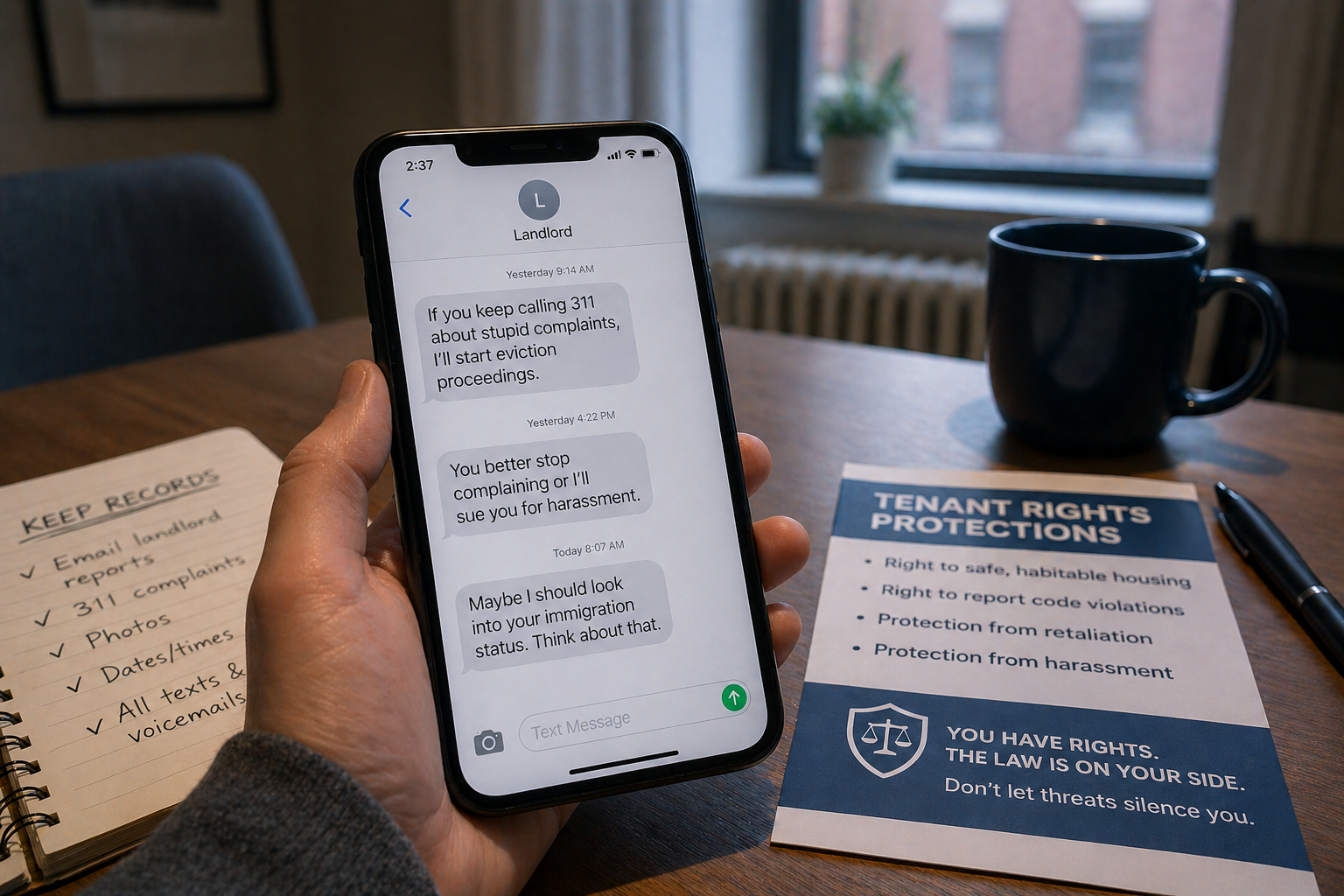
You reported serious problems in your apartment—no heat, a persistent leak causing mold, a roach infestation, or unsafe electrical issues—and instead of making repairs, your landlord responded with threats. Maybe they sent you an angry text saying "If you keep calling 311, I'll start eviction proceedings." Or perhaps they left a voicemail warning "You better stop complaining or I'll sue you for harassment." Or they made comments suggesting they'll "look into your immigration status" if you don't drop your repair requests. The message is clear: stop complaining about unsafe conditions or face serious consequences.
You're scared and unsure what to do. The threats feel real and powerful, especially if you're worried about losing your home, facing a lawsuit you can't afford to defend, or having immigration authorities contacted. You think: "Can my landlord really evict me for complaining about repairs? Are these threats legal? If I keep reporting problems, will they follow through? Should I just stop complaining to avoid the consequences? What if they actually do call ICE or file eviction papers? Do I have any protection, or am I powerless against these threats?"
Here's the truth: Threatening to evict you, sue you, or report you to immigration authorities because you complain about unsafe housing conditions is exactly the kind of landlord harassment and illegal retaliation that New York law explicitly prohibits and punishes. New York's anti-retaliation statutes, harassment provisions, and tenant protection laws make it illegal for landlords to threaten, intimidate, or take adverse action against tenants who assert their legal rights to safe, habitable housing by making repair complaints, calling 311, reporting code violations, or contacting housing authorities. Not only can these threats not legally silence you—they can actually strengthen your legal position by providing evidence of landlord retaliation and harassment that supports rent reductions, defenses against eviction, and independent harassment claims.
Let me show you exactly what New York law says about landlord retaliation and harassment, why eviction and lawsuit threats in response to complaints are illegal, why immigration-based threats violate multiple laws, how courts and agencies identify and prove retaliation, what you should document when landlords make threats, and what legal protections and remedies you have when landlords try to intimidate you into silence.
Before addressing specific threats, understand the comprehensive legal protections New York provides against landlord retaliation.
New York Real Property Law § 223-b is the state's primary anti-retaliation statute protecting tenants who assert their housing rights.
The law prohibits landlords from retaliating against tenants who have in good faith: complained to the landlord about conditions affecting health or safety, complained to a governmental authority about violations of health, safety, or building codes, or participated in tenant organizations or sought legal assistance regarding their tenancy rights.
Prohibited retaliatory actions under the statute include attempting to evict or evicting a tenant, substantially decreasing services to the tenant, or substantially increasing rent. When a landlord takes these actions within six months of the tenant's protected complaint or activity, New York law presumes the landlord's action was retaliatory, shifting the burden to the landlord to prove their actions were not motivated by the tenant's complaint.
The six-month presumption is powerful protection. If you call 311 about no heat in January and your landlord serves eviction papers in March, the law presumes that eviction attempt is illegal retaliation. The landlord must then prove they had legitimate, non-retaliatory reasons for the eviction that would have occurred regardless of your complaint—a difficult burden when timing clearly connects complaint and adverse action.
This protection is broad. It covers complaints to landlords, complaints to any governmental authority (HPD, code enforcement, health departments, 311, housing agencies), participation in tenant organizations, and seeking legal help. Essentially, asserting any housing right triggers retaliation protection.
New York City has gone beyond state law by creating specific anti-harassment protections in the Administrative Code and through agency enforcement.
NYC Administrative Code § 27-2004(a)(48) defines harassment broadly to include any act or omission by a landlord that is intended to cause a tenant to vacate or surrender rights, creates conditions that are dangerous or unhealthy, or interferes with tenant comfort or enjoyment of the dwelling.
HPD's harassment guidance identifies specific harassment tactics including threats of eviction or legal action without basis, threats related to immigration status, verbal or written threats designed to intimidate, late-night or excessive unwanted communications, and withholding essential services or allowing dangerous conditions to persist to pressure tenants.
The harassment framework recognizes that landlords use various intimidation tactics beyond formal eviction to push tenants out or silence complaints. Threats alone—even if never carried out—constitute harassment when intended to coerce tenants.
Harassment violations can result in civil penalties, Stop Work Orders on buildings, denial of permits for alterations or conversions, and civil lawsuits by tenants seeking damages and injunctive relief. Harassment is taken seriously by enforcement agencies and courts.
Understanding what activities are legally protected helps you recognize when landlord responses constitute illegal retaliation.
Making repair requests to your landlord—emails, calls, letters asking for repairs of any condition affecting habitability—is protected activity. Landlords cannot punish you for asking them to fulfill their legal maintenance obligations.
Calling 311 or reporting to housing authorities is explicitly protected. When you report code violations, request HPD inspections, file complaints with health departments or code enforcement, you're engaging in protected conduct. Retaliation for these government complaints is illegal.
Filing HP proceedings or participating in housing court is protected. Tenants who sue landlords to compel repairs or defend against eviction by raising habitability cannot be retaliated against for using courts.
Organizing with other tenants or joining tenant associations is protected under both state anti-retaliation law and federal labor law analogies.
Seeking legal assistance from legal aid, tenant attorneys, or advocacy organizations is protected activity.
The principle is that tenants have legal rights to safe housing and legal mechanisms to enforce those rights. Landlords cannot punish tenants for using those rights and mechanisms—doing so undermines the entire habitability enforcement system.
When landlords threaten eviction or lawsuits in response to complaints, they're usually bluffing—and even if they follow through, the threats themselves and the actions are likely illegal.
Landlords threatening "I'll evict you" often rely on tenants not understanding that eviction is a formal legal process with strict requirements, not something landlords can do unilaterally.
Landlords cannot evict tenants without court orders. In New York, eviction (called "ejectment" or "holdover/nonpayment proceedings") requires the landlord to file a case in court, properly serve the tenant with notice and summons, allow the tenant to appear and defend, obtain a court judgment in their favor, get a warrant of eviction, and have a marshal or sheriff physically remove the tenant only after all legal procedures are followed.
Self-help eviction is illegal. Landlords cannot change locks, remove tenant belongings, shut off utilities, or physically force tenants out without court orders. Doing so is illegal lockout subject to criminal and civil penalties including treble damages.
"I'll evict you" is therefore usually a hollow threat meant to scare tenants who don't know the law. The landlord cannot actually evict you tomorrow, next week, or next month without going through lengthy court proceedings where you have rights to defend yourself.
Even if landlords file eviction cases, tenants have powerful defenses—particularly retaliation. If an eviction case is filed within six months of your protected complaint, you can raise retaliation as an affirmative defense, shifting the burden to the landlord to prove the eviction is justified and not retaliatory. Many retaliatory eviction cases are dismissed when courts find the timing and circumstances prove retaliation.
Evicting or attempting to evict a tenant because they complained about habitability violations is illegal under RPL § 223-b and NYC harassment provisions.
The retaliatory eviction scenario typically looks like: tenant complains about serious problems (no heat, mold, pests, leaks), landlord ignores complaints or provides inadequate response, tenant escalates by calling 311 or filing HP proceeding, landlord suddenly serves termination notice or eviction papers claiming lease violation, non-renewal, or seeking to evict.
The temporal connection between complaint and eviction attempt is the smoking gun. When eviction papers arrive days, weeks, or a few months after tenant filed complaints—especially when tenant has no history of lease violations and pays rent on time—the inference of retaliation is strong.
Courts scrutinize landlord-claimed reasons for eviction when retaliation is raised. If landlord claims eviction is for lease violations that are minor, technical, or selectively enforced (other tenants violate same rules without consequence), courts often conclude the claimed reason is pretextual and the real motive is retaliation.
Tenant defenses in retaliatory eviction cases include raising RPL § 223-b's presumption of retaliation, presenting evidence of the complaint-to-eviction timeline, demonstrating landlord's motive to silence complaints, showing pretextual or weak landlord justifications, and seeking dismissal of eviction case or rent reduction as remedy.
Even eviction threats without filing actual cases can constitute harassment. NYC harassment provisions explicitly identify threats of eviction without valid basis, especially when made to silence complaints, as actionable harassment.
Some landlords threaten to sue tenants for defamation, harassment, or other claims if tenants continue complaining.
These threats are usually baseless. Making truthful complaints about actual housing conditions to landlords or housing authorities is not defamation (truth is absolute defense to defamation). Reporting code violations to 311 or HPD is not harassment—it's using legal channels for their intended purpose.
Landlords rarely follow through on lawsuit threats because they lack legal merit and could expose landlords to counterclaims and anti-SLAPP (Strategic Lawsuit Against Public Participation) protections that sanction plaintiffs who sue to silence legitimate complaints.
The purpose of lawsuit threats is intimidation, not actual litigation. Landlords know many tenants fear lawsuits and hope threats alone will silence complaints without landlords having to actually file (and lose) meritless cases.
If landlords do file frivolous lawsuits against tenants for complaining, tenants can move to dismiss for failure to state a claim, assert anti-retaliation protections, counterclaim for harassment and retaliation, and potentially recover attorney fees and sanctions against the landlord.
Document lawsuit threats just as you would eviction threats—they're evidence of harassment and retaliatory intent even if no lawsuit is filed.
Landlords threatening immigration-related consequences for tenant complaints violate overlapping federal, state, and local protections.
New York City has unequivocally banned immigration-based threats as tenant harassment.
NYC's official harassment guidance from HPD explicitly lists "threats or discrimination based on immigration status" as tenant harassment tactics. This isn't ambiguous—the city has clearly stated that using immigration status to threaten or intimidate tenants violates harassment prohibitions.
The Administrative Code anti-harassment provisions prohibit landlord conduct intended to cause tenants to vacate or surrender rights. Threatening immigration consequences clearly falls under conduct intended to cause vacatur—the entire point of such threats is to scare tenants into moving or staying silent.
HPD enforces against immigration-based harassment by investigating complaints, issuing harassment violations, imposing civil penalties, and referring cases for prosecution where appropriate.
The policy rationale is that immigration-based threats severely undermine housing code enforcement. If undocumented tenants or those with uncertain immigration status fear reporting habitability violations will trigger immigration consequences, they'll live in dangerous conditions silently, allowing landlords to maintain substandard housing with impunity. Prohibiting immigration threats is necessary for effective housing code enforcement.
Beyond harassment prohibitions, immigration status protections exist in discrimination law.
New York State Human Rights Law prohibits discrimination based on immigration or citizenship status in housing. Threatening immigration consequences because a tenant complains is discrimination based on immigration status—treating immigrant tenants differently (threatening immigration action) than citizen tenants would be treated.
NYC's human rights law similarly prohibits immigration status discrimination and protects undocumented immigrants from discrimination and harassment based on their status.
Federal fair housing law arguments also exist. While immigration status isn't a specifically enumerated protected class under the Fair Housing Act, courts have found that immigration-based discrimination often constitutes national origin discrimination (a protected class), particularly when landlords target specific ethnic or national origin groups with immigration threats.
The overlap of harassment prohibitions, state/city anti-discrimination law, and federal fair housing creates multiple legal theories under which immigration threats are actionable.
Immigration-based threats exploit vulnerability and fear in ways that make them especially harmful and legally condemned.
The power imbalance is extreme. Undocumented immigrants or those with uncertain status face potential deportation, family separation, and life-altering consequences from immigration enforcement—threats landlords know create terror.
The chilling effect on reporting housing violations is severe. Fear of immigration consequences silences not just individual threatened tenants but entire communities of immigrant tenants, allowing landlords to maintain widespread dangerous conditions.
The discriminatory nature is often clear. Landlords making immigration threats typically target tenants based on perceived immigration status correlated with race, ethnicity, national origin, accent, or language—making these threats both harassment and discrimination.
Legal and advocacy communities therefore treat immigration-based threats as particularly serious violations warranting strong enforcement responses.
Related to threats, some landlords demand immigration documents or proof of status as supposed screening requirements or in response to complaints.
Landlords have no right to demand immigration documents beyond basic identification for lease signing and standard employment/income verification documents (which don't inherently require immigration status disclosure).
Demanding immigration documents in response to complaints or as condition of maintaining tenancy is harassment and discrimination. If a landlord never asked for such documents before but suddenly demands them after you complain about repairs, that's retaliatory harassment.
You can refuse demands for immigration documents. Landlords cannot evict you for refusing to provide documents they have no legal right to demand.
Immigration status is irrelevant to housing rights. Regardless of immigration status, all tenants have rights to habitable housing, protection from harassment and retaliation, and access to courts and housing agencies to enforce those rights. New York courts and agencies consistently hold that housing rights aren't conditioned on immigration status.
Understanding how legal authorities assess retaliation claims helps you recognize and prove it when it's happening to you.
The most obvious indicator of retaliation is temporal proximity between protected activity and adverse landlord action.
Close temporal connection creates strong inference of retaliation. Complaint Monday, eviction threat or notice Wednesday—the timing speaks for itself. Complaint in January, eviction filing in February—presumption of retaliation under the six-month rule.
The burden-shifting framework means once you show you engaged in protected activity and landlord took adverse action within six months (or sometimes less), the law presumes retaliation and landlord must prove their actions were for legitimate, non-retaliatory reasons that would have occurred anyway.
Courts look for pretexts. If a landlord claims they're evicting for lease violations but those violations are minor, were never enforced before, or other tenants commit same violations without consequence, courts conclude the claimed reason is pretextual cover for retaliation.
Sudden changes after complaints signal retaliation. Tenant lives peacefully for years, complains about mold, suddenly landlord claims tenant is violating previously-ignored lease terms—that change in landlord behavior post-complaint is evidence of retaliatory motive.
How landlords respond to complaints themselves can indicate retaliatory intent.
Ignoring or dismissing complaints followed by threats suggests landlord priority is silencing tenant, not addressing conditions. If landlord doesn't engage with repair issues but immediately pivots to threats, the focus on silencing rather than fixing is apparent.
Escalating hostility after complaints indicates retaliation. Landlord was cordial before complaints, becomes hostile and threatening after—the changed relationship correlates with complaint activity.
Explicit connections landlords sometimes make between complaints and threats remove all doubt. Text saying "If you call 311 again, you're out" explicitly ties adverse action (eviction threat) to protected activity (calling 311)—that's admission of retaliatory intent.
Withholding services or allowing conditions to deteriorate after complaints can itself be retaliation. If heat worked fine until you complained about other issues and then heat mysteriously starts failing, that service withdrawal may be retaliatory.
How landlords treat other tenants compared to complainants helps prove retaliation.
Selective enforcement is strong evidence. If only tenants who complain get cited for lease violations while non-complaining tenants with same issues are ignored, the selective enforcement proves retaliatory motive.
Disparate treatment post-complaint shows retaliation. Complaining tenant gets harassment and threats; non-complaining tenants get lease renewals and cordial treatment—the difference is the complaint activity.
Building-wide vs. individual issues also matter. If you complain about building-wide problem (no heat in winter affecting everyone) and only you face retaliation while other tenants who didn't complain are fine, that targeting proves retaliation.
Thorough documentation of threats and retaliation is critical for proving your case and protecting yourself.
Every threat, however delivered, should be documented and preserved.
Written threats are easiest to preserve:
Never delete threatening communications—they're evidence. Even if threats are crude, vulgar, or frightening, preserve them exactly as sent.
Verbal threats require contemporaneous documentation:
Document the pattern:
Date | Threat Type | Content/Quote | Method | Witnesses |
| 3/12 | Eviction | "Keep calling 311 and you're out" | Text message | N/A |
| 3/15 | Lawsuit | "I'll sue you for harassment" | Voicemail | N/A |
| 3/18 | Immigration | "Maybe ICE would be interested in you" | In-person | Neighbor heard |
This log creates clear record of harassment campaign.
Prove you were engaged in legitimate protected complaints, not bad-faith actions.
Keep copies of all repair requests:
Document official complaints:
This establishes that you were asserting legal rights to habitable housing—you weren't frivolously complaining or acting in bad faith, you were reporting genuine violations through proper channels. This defeats any landlord claim that threats were justified responses to tenant misconduct.
The temporal connection between complaint and threat is crucial evidence.
Build clear timeline:
February 15: Email landlord reporting mold in bathroom, requesting remediation February 20: Called 311, HPD inspection scheduled February 28: HPD inspector visits, issues mold violation March 3: Landlord texts "You cost me a fine with HPD. I won't forget this." March 5: Landlord serves 30-day termination notice
This timeline visually demonstrates retaliation—complaint led to inspection, inspection led to violation, violation triggered landlord anger and retaliatory eviction notice.
The closer together complaint and adverse action, the stronger the retaliation inference. Days or weeks connecting them creates nearly irrebuttable presumption of retaliation.
Show how landlord treatment of you changed after complaints.
Before complaints: Landlord was responsive, cordial, renewed lease without issue, made repairs when asked
After complaints: Landlord became hostile, stopped responding to communications, began making threats, suddenly claimed lease violations
This contrast demonstrates the complaint was the inflection point changing landlord behavior—strong evidence of retaliatory motive.
When facing landlord intimidation, strategic response protects you and builds your legal case.
The worst thing you can do is let threats work. If you stop complaining or reporting violations because of threats, the landlord wins and you remain in unsafe housing.
Your housing rights don't disappear because landlord threatens you. You still have the right to habitable housing, the right to report violations, the right to use courts and agencies to enforce your rights.
Threats cannot change the law. Landlord saying "I'll evict you if you call 311" doesn't make calling 311 illegal or give landlord valid grounds for eviction. The threat is just words trying to scare you into abandoning legal rights.
Continue reporting violations, calling 311, requesting repairs, pursuing HP proceedings, contacting housing authorities. Exercise your rights despite threats—in fact, continuing to exercise rights after threats strengthens retaliation claims by showing the threats were attempts to suppress protected activity.
Landlord threats and harassment are independent violations you should report.
In NYC, call 311 and report tenant harassment. Specifically state: "My landlord is harassing and retaliating against me for reporting housing violations. They've threatened [eviction/lawsuit/immigration consequences] because I [called 311/requested repairs/filed HP case]."
HPD's Tenant Harassment Prevention Task Force investigates harassment complaints, can issue harassment violations, impose civil penalties, and refer cases for criminal prosecution in egregious cases.
Provide documentation when reporting harassment:
Outside NYC, report to:
Official harassment complaints create records, trigger enforcement, and document that retaliation is occurring—strengthening any defense you need if landlord follows through on threats.
Legal representation is critical when facing landlord threats and retaliation.
Contact legal services:
Why legal help matters:
Many legal services for tenants are free or low-cost based on income. Don't assume you can't afford help—contact organizations and explain your situation.
Early legal intervention often stops harassment before it escalates. Letter from attorney citing anti-retaliation laws and threatening counterclaims frequently ends landlord intimidation.
Counterintuitively, landlord threats help you. While frightening when received, threats provide powerful evidence of landlord's retaliatory motive and bad faith.
In eviction defense: If landlord actually files eviction after threatening eviction for complaints, present the threats as evidence proving retaliation. "Your Honor, here is landlord's text threatening eviction if I continued calling 311, followed three days later by this eviction notice—this is clearly retaliatory eviction prohibited by RPL § 223-b."
In HP or harassment proceedings: Landlord threats show landlord's motive is to silence complaints, not to maintain property or enforce legitimate lease terms. "Landlord isn't seeking eviction because of lease violations but because I reported code violations, as proven by these threats."
In damages claims: Threats constitute harassment causing emotional distress and interference with your housing rights. The threats themselves—even if not carried out—are actionable wrongs for which you can seek damages.
In settlement negotiations: Documented threats put landlords in weak positions. Landlords threatening illegal retaliation know they're exposed legally and often settle favorably to avoid formal proceedings where threats become public record.
Don't hide or downplay threats—weaponize them as evidence of landlord misconduct strengthening your legal position.
Landlord threats to evict you, sue you, or report you to immigration because you complain about unsafe housing are illegal harassment and retaliation prohibited by New York law.
New York RPL § 223-b prohibits retaliating against tenants who make good faith complaints about housing conditions. Eviction attempts within six months of complaints are presumed retaliatory.
NYC harassment provisions explicitly prohibit eviction threats without basis, immigration-based threats, and intimidation designed to silence complaints or force tenants out.
Landlords cannot evict without going to court and getting judgments—eviction threats are usually hollow intimidation, and even if filed, retaliatory evictions can be defended against and dismissed.
Immigration threats violate harassment prohibitions, anti-discrimination laws, and public policy. Your immigration status doesn't affect your housing rights—all tenants can report violations and enforce habitability regardless of status.
Document everything: Save all threat communications, create timelines connecting complaints to threats, preserve evidence of your protected activity, document changed landlord behavior post-complaint.
Don't be silenced—continue exercising your rights to report violations, call 311, pursue repairs. Letting threats work means living in unsafe conditions.
Report harassment to 311 (NYC) or housing agencies, Attorney General. Get legal help immediately—free legal services available. Use threats as evidence in your favor in eviction defense or affirmative harassment claims.
Landlord threats actually strengthen your legal position by providing evidence of retaliation and bad faith. Assert your rights—the law protects you.