You're navigating the rental market and encountering all kinds of landlord preferences, restrictions, and screening criteria. One listing says "adults only, quiet professionals preferred." Another states "no Section 8 vouchers accepted." A third mentions "English-speaking tenants only." You see requirements about income levels, employment status, smoking habits, dietary preferences, and lifestyle choices. Some of these restrictions feel discriminatory, but you're not sure which ones are actually illegal versus which are just preferences landlords are allowed to have.
You wonder: "What exactly can landlords discriminate based on, and what can't they? I keep hearing about 'protected classes' or 'protected characteristics'—what does that mean? Which personal traits are protected by law, and which aren't? Can a landlord refuse me because I'm a student, or because I have pets, or because I'm a vegetarian? What's the difference between illegal discrimination and legal tenant selection?"
Understanding this distinction is critical because it determines whether you have legal recourse when you're rejected for housing, and it helps you identify real discrimination when it occurs.
Here's the truth: New York housing discrimination law protects specific characteristics called "protected classes"—traits like race, religion, disability, family status, and source of income that landlords cannot use as bases for refusing to rent, setting different terms, or treating tenants differently. However, many other personal characteristics, preferences, and lifestyle choices are not legally protected, meaning landlords can impose requirements or preferences based on those traits without violating anti-discrimination law. The key is understanding which characteristics receive legal protection at the federal, state, and local levels, and recognizing when seemingly neutral preferences might be pretexts for discriminating against protected groups.
Let me show you exactly which characteristics are protected under federal Fair Housing Act, New York State Human Rights Law, and NYC Human Rights Law; what illegal discrimination looks like when it targets protected classes; which traits and preferences are not protected and why; when neutral criteria can still be discriminatory if used as pretexts; and how to identify real discrimination versus lawful landlord preferences.
Before listing which characteristics are protected, let's understand what "protected class" means and why this framework exists.
A protected class (also called a protected characteristic or protected category) is a personal trait or status that anti-discrimination law specifically shields from being used as a basis for differential treatment in housing, employment, public accommodations, or other contexts.
The concept emerged from civil rights law's recognition that certain groups have historically faced discrimination, exclusion, and unequal treatment based on immutable or fundamental characteristics. Rather than prohibiting all discrimination in all contexts (which would be impossible and unworkable—landlords must discriminate among applicants somehow), civil rights law identifies specific characteristics that cannot be used as decision-making factors because discrimination based on those traits perpetuates historical injustice, denies equal opportunity, and violates fundamental fairness.
In housing specifically, protected class status means landlords cannot refuse to rent to you, charge you different rent, impose different terms, provide inferior services, or treat you worse because you have that protected characteristic. Your race, religion, disability status, family composition, or other protected traits must be irrelevant to housing decisions. Landlords must evaluate you based on legitimate, non-discriminatory criteria like ability to pay rent, rental history, and creditworthiness—not on protected characteristics.
The practical implication is binary: if a personal trait is a protected class, discrimination based on it is illegal and you have legal recourse through complaints to enforcement agencies or lawsuits. If a trait is not a protected class, landlords generally have discretion to consider or prefer it, and you don't have anti-discrimination law on your side (though other legal protections might still apply).
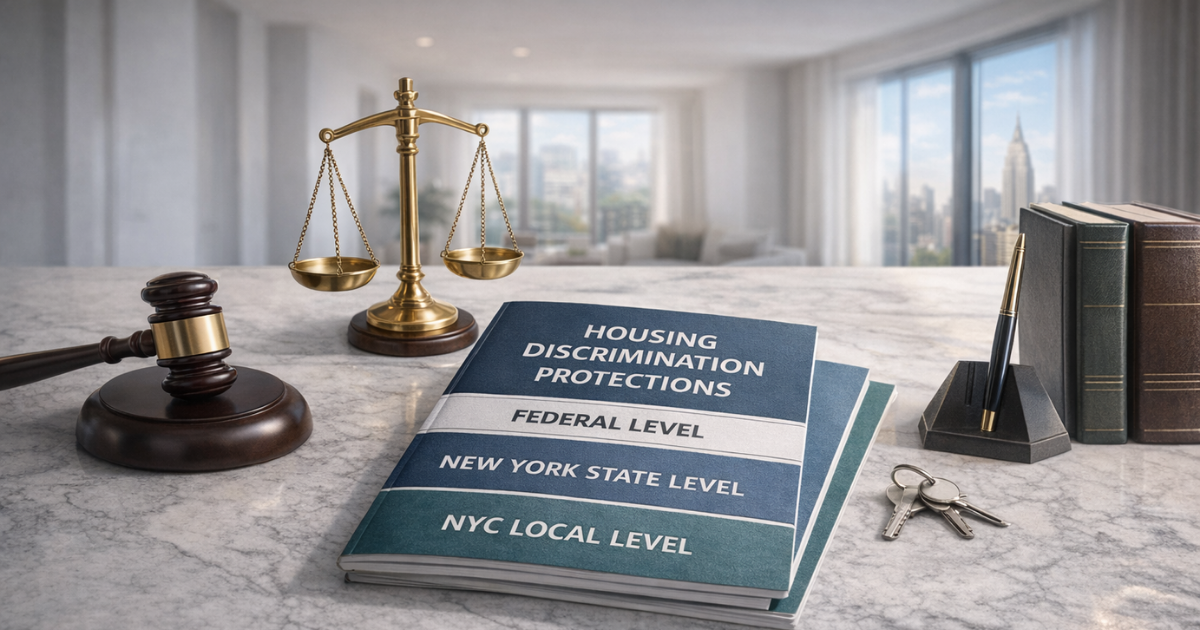
Protected class status isn't uniform nationwide or even statewide—different levels of law provide different protections, creating layers of rights.
Federal law establishes a baseline of protections that apply everywhere in the United States, including all of New York. The federal Fair Housing Act sets a floor of protected classes that states and localities cannot go below but can expand upon. Federal protections are the minimum—every jurisdiction must honor them.
State law can add protected classes beyond federal minimums. New York State has chosen to protect additional characteristics beyond what federal law requires, creating broader protections for all New Yorkers statewide. State protections apply throughout New York from New York City to Buffalo to rural counties.
Local law can further expand protections within specific jurisdictions. New York City, for example, has added protected classes beyond federal and state lists, creating the most comprehensive protections in the nation for housing within the five boroughs. Other New York localities might also have expanded protections through local ordinances or human rights laws.
The cumulative effect means New Yorkers enjoy protections at all three levels simultaneously. Federal law provides the base, state law adds more, and in NYC specifically, city law adds even more. You're protected by whichever level provides the strongest shield—and often you can pursue complaints or lawsuits under multiple levels of law simultaneously for the same discriminatory conduct.
Let's start with the federal Fair Housing Act, which establishes protections that apply throughout New York and the entire United States.
Race and color were among the original protected classes in the 1968 Fair Housing Act, and discrimination based on race remains one of the most serious and commonly prosecuted violations.
Race discrimination includes refusing to rent to people because of their race (Black, white, Asian, Native American, multiracial, or any other racial identity), steering people of certain races to specific neighborhoods or buildings, charging different rent to different races, providing inferior services to tenants of certain races, or any other differential treatment based on racial identity.
Color discrimination, while often overlapping with race, is separately protected and can involve discrimination based on skin tone within racial groups (colorism). Both explicit race-based refusals ("I don't rent to Black people") and more subtle race-based disparate treatment (showing fewer units, being less responsive, imposing stricter screening) are illegal.
Race discrimination persists as a major problem in housing despite decades of legal prohibition. Testing by fair housing organizations consistently reveals landlords treating white testers better than Black, Latinx, Asian, or other testers of color with identical qualifications. This ongoing discrimination makes race protection critically important.
National origin protection prohibits discrimination based on the country you're from, your ancestry, or your ethnicity.
This means landlords cannot refuse to rent to immigrants, discriminate against people based on which country they emigrated from, treat people differently because of ethnic heritage (Italian, Irish, Mexican, Chinese, Nigerian, etc.), or make housing decisions based on accent or language. Discrimination based on national origin includes both direct refusals ("no immigrants") and subtler practices like requiring higher deposits from people with accents or non-English names.
National origin discrimination often intersects with other forms of bias like language discrimination (requiring "English only" can be national origin discrimination if it excludes people based on country of origin) and immigration status discrimination (though immigration status itself has complicated protection depending on jurisdiction).
Religious discrimination in housing means treating people differently based on their faith or religious practice.
Protected religious beliefs and practices include all religions—Christianity, Judaism, Islam, Hinduism, Buddhism, Sikhism, and any other faith tradition—as well as atheism and agnosticism. Landlords cannot refuse housing to Muslims, Jews, evangelical Christians, Jehovah's Witnesses, or adherents of any faith, and cannot impose different terms based on religious identity.
Religious discrimination can be explicit ("I only rent to Christians" or "no Muslims") or operate through proxies like discrimination against people who wear religious garments (hijabs, yarmulkes, turbans), discrimination against people who request religious accommodations (Sabbath observance, religious dietary practices, prayer space), or stereotyping based on religion (assuming members of certain faiths will be difficult or unsuitable tenants).
Sex discrimination protection has evolved significantly and now encompasses broader protections for LGBTQ+ people under federal interpretation.
Traditional sex discrimination includes refusing to rent to women, charging women different rent than men, sexual harassment of tenants, and any other differential treatment based on being male or female. Pregnancy discrimination falls under sex discrimination and is also protected separately as familial status.
Sexual orientation and gender identity are now understood to be protected under the federal Fair Housing Act's sex discrimination prohibition, based on Supreme Court precedent and federal agency interpretations. This means discrimination against gay, lesbian, bisexual, queer, transgender, non-binary, and other LGBTQ+ people violates federal sex discrimination protections in housing. Refusing to rent to same-sex couples, discriminating against transgender tenants, or treating LGBTQ+ people worse based on their sexual orientation or gender identity is illegal sex discrimination.
Familial status protection specifically prohibits discrimination against families with children and pregnant people.
"Familial status" legally means having children under 18 living with you (whether biological, adopted, foster, or with legal custody), being pregnant, or being in the process of securing legal custody of children. This protection was added to federal fair housing law in 1988 to combat widespread "adults only" policies and other discrimination against families.
Landlords cannot refuse to rent to families with children, advertise "no kids" or "adults only," steer families to certain buildings or units, impose occupancy standards stricter than necessary to exclude families, or treat families worse than childless tenants. Discrimination against pregnant people is similarly prohibited—landlords cannot refuse housing because someone is pregnant or impose different terms based on pregnancy.
Very narrow exceptions exist for qualifying senior housing (62+ or strict 55+ meeting federal requirements), but these don't apply to typical rental housing. For nearly all rental situations, familial status protection means children are welcome and cannot be a basis for refusal or differential treatment.
Disability protection is particularly robust because it includes not just prohibition on discrimination but affirmative obligations to provide reasonable accommodations and permit reasonable modifications.
Disability under federal law includes any physical or mental impairment substantially limiting one or more major life activities, having a record of such impairment, or being regarded as having such impairment. This broad definition protects people with mobility disabilities, sensory disabilities, chronic illnesses, mental health conditions, intellectual or developmental disabilities, substance use disorders in recovery, and many other conditions.
Landlords cannot refuse to rent based on disability, charge disabled people more, provide inferior services, refuse reasonable accommodations (like allowing service animals or emotional support animals despite no-pet policies), refuse to permit reasonable modifications (like installing grab bars), or discriminate based on disability in any way. Disability discrimination is unique in requiring landlords to actively adjust their practices to accommodate disabled tenants' needs.
New York State Human Rights Law expands upon federal protections with additional protected classes applying throughout the state.
Age discrimination protection in New York State prohibits housing discrimination based on how old or young someone is, with some complexity.
The state law protects against age discrimination broadly, meaning landlords cannot refuse to rent to older adults or younger adults based on age alone. "No seniors" and "no young people" are both potentially discriminatory under state age protections. However, age protection has nuances regarding senior housing exceptions and minimum age requirements for tenant capacity.
The addition of age to protected classes means that outside the narrow senior housing exemption, landlords cannot make housing decisions based on whether you're 25, 45, 65, or any other age. Your age must be irrelevant to whether you get housing on equal terms.
Marital status protection prohibits discrimination based on whether you're married, single, divorced, widowed, or in a domestic partnership.
Landlords cannot prefer married couples over unmarried couples, refuse to rent to divorced people, charge single people different rent than married people, or make housing decisions based on marital status. This protection ensures that family structure and relationship status don't determine housing access.
Marital status protection is particularly important for unmarried couples (both opposite-sex and same-sex) who historically faced discrimination from landlords preferring married tenants. State law makes clear that marital status cannot be used to deny or burden housing access.
Military status protection prohibits discrimination based on service in the armed forces.
This means landlords cannot refuse to rent to active-duty service members, veterans, reservists, or members of the National Guard, nor can they impose different terms based on military service. Military status protection ensures those who serve don't face housing discrimination because of their service.
While federal law now interprets sex discrimination to include sexual orientation and gender identity, New York State law has explicitly protected these characteristics separately, providing clear and strong protections.
Sexual orientation protection prohibits discrimination based on being gay, lesbian, bisexual, or heterosexual. Landlords cannot refuse housing, impose different terms, or treat tenants worse because of sexual orientation.
Gender identity and expression protection prohibits discrimination based on transgender status, gender identity, gender expression, or being gender non-conforming. Landlords cannot discriminate against transgender tenants, must respect gender identity (including in housing assignments and facility access), and cannot impose different terms based on gender identity or expression.
New York's explicit inclusion of these protections predated federal interpretation and provides particularly strong, unambiguous rights for LGBTQ+ New Yorkers.
One of New York's most significant additions to protected classes is lawful source of income, explicitly protecting people who pay rent with government benefits, housing vouchers, or other lawful income sources.
Source of income protection means landlords cannot discriminate based on how you pay rent—whether from employment wages, Social Security, disability benefits (SSI/SSDI), unemployment insurance, veterans' benefits, child support, alimony, public assistance, or housing vouchers like Section 8. As long as your total income meets the landlord's stated requirements and comes from lawful sources, the landlord cannot prefer employment income over benefits or refuse vouchers.
This protection is critical for voucher holders, seniors, people with disabilities receiving benefits, and others whose income comes from sources landlords historically discriminated against. "No Section 8" or "no vouchers" violates state source of income protection (with complications from recent case law discussed elsewhere).
New York State protects victims and survivors of domestic violence from housing discrimination.
This protection prohibits landlords from refusing housing, evicting, or imposing different terms based on someone being a victim or survivor of domestic violence. Landlords cannot penalize people for experiencing domestic violence or use victim status as a basis for housing decisions.
This protection recognizes that housing stability is critical for domestic violence survivors and ensures they don't face additional discrimination because of violence they've experienced.
New York City Human Rights Law provides the most comprehensive housing discrimination protections in the United States, adding several categories beyond federal and state law.
First, recognize that NYC protects all the federal and state classes already discussed—race, color, national origin, religion, sex, sexual orientation, gender identity, familial status, disability, age, marital status, military status, source of income, and domestic violence survivor status. The city enforces these protections aggressively through the NYC Commission on Human Rights, often more vigorously than federal or state enforcement.
NYC uniquely protects against discrimination based on lawful occupation, meaning landlords cannot refuse to rent based on what job you have (as long as it's legal).
This means landlords cannot refuse to rent to lawyers, musicians, artists, home health aides, construction workers, or people in any other lawful profession. "No lawyers" or "we don't rent to home health aides" violates NYC's lawful occupation protection.
The protection prevents stereotyping and discrimination based on profession and ensures housing access isn't determined by what you do for work.
NYC has nuanced protections regarding criminal history through Fair Chance for Housing law, which limits when and how landlords can consider criminal records.
Most NYC landlords cannot inquire about criminal history before making a conditional offer of housing. After conditional offer, they can only consider certain convictions (recent felonies within 5 years, recent misdemeanors within 3 years), must conduct individualized assessment, and must provide notice and opportunity to respond before denying based on criminal history.
This protection is particularly significant given racially disparate impacts of the criminal legal system. Limiting criminal history screening reduces discrimination and expands housing access for people with records.
NYC explicitly protects against discrimination based on citizenship status or immigration status.
Landlords cannot refuse to rent to non-citizens, discriminate against immigrants (documented or undocumented), require proof of citizenship, or impose different terms based on immigration status. This protection is particularly important in New York City's diverse, immigrant-heavy population.
Uniquely, NYC protects against discrimination based on height and weight, prohibiting landlords from refusing housing or imposing different terms based on physical size.
This protection prevents discrimination against people based on body size, whether unusually tall, short, heavy, or thin. While not frequently litigated, it reflects NYC's commitment to broad anti-discrimination principles.
NYC law makes clear that you're protected if discrimination is based on what the landlord thinks your protected characteristic is (even if they're wrong) or because you're associated with someone in a protected class.
Perceived characteristic protection means if a landlord discriminates against you because they think you're Muslim (even if you're not), or think you're disabled (even if you're not), or perceive you as being in any protected class, that's illegal discrimination even if their perception is incorrect.
Association protection means discrimination based on your relationship with someone in a protected class is illegal. If a landlord refuses to rent to you because your spouse is disabled, or your child is of a different race, or your partner is transgender, that discrimination based on association with protected class members violates NYC law.
Understanding protected classes is one thing—recognizing what discrimination based on those classes looks like in practice is another.
The most direct form of discrimination is refusing to rent to someone because of their protected characteristic.
Explicit refusals are rare but do occur: "I don't rent to Black people," "No Muslims," "No families with children," "We don't accept disabled tenants," "No one on Section 8." These overt statements admitting protected class-based refusal are smoking-gun evidence of illegal discrimination.
Pretextual refusals are far more common. After learning about an applicant's protected characteristic (seeing their race in person, learning they have children, discovering they use a voucher), the landlord suddenly claims the unit is "no longer available," "we've decided to go with someone else," or makes up disqualifying reasons. The timing—interest before protected characteristic disclosure, rejection immediately after—suggests pretext.
Lying about availability to certain protected groups while telling others the unit is available constitutes illegal discrimination. Testing by fair housing organizations (sending matched testers of different races, family statuses, etc.) often reveals this practice—one tester told unit is available, another told it's rented.
Publishing or making statements expressing discriminatory preferences violates fair housing law even if no one is actually refused housing.
Illegal advertising language includes "no kids," "adults only," "mature tenants preferred," "no Section 8," "no vouchers," "English speakers only," "Christian building," "perfect for young professionals" (suggesting age/family status preference), "we don't accommodate disabilities," or any other language indicating preference against or exclusion of protected groups.
These advertisements are illegal on their face—they violate fair housing law by expressing discriminatory intent and discouraging protected groups from applying, even if the landlord ultimately rented to someone in a protected class.
Discrimination includes not just refusal but offering housing on worse terms to protected groups.
Charging different rent to protected groups (higher rent to families with children, higher deposits for people using vouchers, different pricing based on race) is economic discrimination violating fair housing law.
Imposing different rules or restrictions based on protected status constitutes discriminatory terms. Stricter occupancy standards for families, special inspections only for disabled tenants or voucher holders, different guest policies for certain races or national origins, or any other differential rules create discriminatory conditions of tenancy.
Providing inferior services like slower repairs, reduced access to amenities, or less responsive management for tenants in protected groups constitutes discrimination in privileges of housing.
Steering means directing people of certain protected groups to specific units, buildings, or neighborhoods while showing others different options.
Examples include showing white applicants units in "better" buildings while steering Black applicants to other properties, directing families with children to ground floors while offering other floors to childless tenants, or channeling disabled applicants to accessible units even if they prefer and qualify for non-accessible units.
Steering denies equal access and choice, perpetuates segregation, and violates fair housing law's mandate of equal opportunity.
Discrimination operates not just at the point of rental but throughout tenancy.
Selective enforcement of rules against protected groups (strictly enforcing lease provisions against families while ignoring violations by childless tenants, intensively monitoring voucher holders while leaving market-rate tenants alone) creates discriminatory double standards.
Harassment based on protected characteristics (racial slurs, unwanted sexual attention, disability-based mockery, anti-family hostility) creates hostile housing environments violating fair housing law.
While New York has extensive protected classes, many personal characteristics and preferences remain unprotected, meaning landlords can legally consider them.
Being a student versus non-student is not a protected class in New York (though age, which may correlate with student status, is protected).
Landlords can advertise "no students" or prefer non-student tenants without violating fair housing law, as long as the preference isn't a pretext for discriminating against age, race, national origin, or other protected classes. If "no students" really means "no young people" (age discrimination) or "no international students" (national origin discrimination), it's illegal. But genuine student-status preference doesn't violate protected class law.
Vegetarianism, veganism, eating meat, or any other dietary practice is not a protected characteristic.
Landlords can require vegetarian-only tenants, prohibit cooking meat in units, or impose other dietary restrictions without violating fair housing law. While unusual, these dietary requirements don't discriminate based on protected classes.
The caveat: if dietary restrictions are pretexts for religious or national origin discrimination (using "no meat cooking" to exclude Muslims or Jews who prepare halal/kosher meat), the neutral dietary rule becomes illegal discrimination. If applied selectively based on race or national origin, dietary restrictions can violate fair housing law through discriminatory application.
Being a smoker is not a protected class in New York.
Landlords can create smoke-free buildings, require non-smoking tenants, and refuse to rent to smokers without violating fair housing law. Smoking restrictions are considered legitimate health and property-protection measures rather than discrimination against a protected group.
Exception: if someone uses medical marijuana for a disability and smoking is the medically necessary consumption method, disability accommodation law might require some flexibility. But general smoking-status discrimination is permissible.
Having pets as a lifestyle choice (not disability-related assistance animals) is not protected.
Landlords can prohibit pets, charge pet deposits and fees, restrict pet types or sizes, and refuse to rent to people with pets without violating fair housing law. Pet ownership is a choice unconnected to protected status.
Critical distinction: assistance animals (service animals, emotional support animals) are disability accommodations, not pets. Refusing disability-related assistance animals IS illegal disability discrimination. The protection is for the disability accommodation, not for pet ownership generally.
How much money you earn is generally not protected (except in a few jurisdictions with explicit income-level protections New York doesn't have statewide). What's protected is source of income—where your money comes from.
Landlords can set minimum income requirements ("household income must be 40x monthly rent") and refuse applicants who don't meet those requirements, as long as the standards are applied consistently and aren't pretexts for discrimination. "You don't earn enough" is legal if true and consistently applied.
What's illegal is "you earn enough total, but we don't count your voucher/disability benefits/child support" (source of income discrimination) or setting income requirements so high they disproportionately exclude protected groups without business justification (disparate impact).
General personality preferences like "quiet people," "no partiers," "responsible tenants," "mature individuals" are not protected classes.
Landlords can express preferences for quiet, responsible, stable tenants and can screen for these traits through interviews, references, and rental history without violating fair housing law.
The danger: these neutral-seeming preferences often become discriminatory in application. "Quiet building, no parties" applied only to young people or people of color becomes age or race discrimination. "Mature, responsible tenants" used to exclude families with children becomes familial status discrimination. Neutral language concealing discriminatory targeting violates fair housing law.
Just because something isn't a protected class doesn't mean landlords have absolute freedom to discriminate based on it—neutral preferences can still be illegal if they're pretexts or have disparate impact.
Landlords sometimes use non-protected characteristics as covers for discriminating against protected groups.
"Vegetarian only" masking familial status discrimination: A landlord advertises "vegetarian building, quiet professionals, not suitable for families who might not respect these values." The vegetarian preference (not protected) is being used to justify excluding families with children (protected). The neutral dietary preference is a pretext for illegal familial status discrimination.
"No students" masking race/national origin discrimination: A landlord refuses students, but only enforces this against international students or students of color while accepting white American students. The "no students" preference (legal facially) is being applied discriminatorily based on race and national origin (protected), making it illegal.
"Income requirement" masking source of income discrimination: A landlord sets income requirements but only strictly enforces them against voucher holders while flexibly applying them to employment-income applicants. The facially neutral income standard becomes illegal source of income discrimination through disparate application.
The legal test: courts look beyond stated neutral reasons to see if they're pretexts for protected class discrimination. Inconsistent application, pairing with discriminatory language, or timing that suggests protected class animus can prove pretext.
Even genuinely neutral policies consistently applied can be illegal if they have unjustified discriminatory disparate impact on protected groups.
Disparate impact doctrine holds that policies disproportionately excluding or burdening protected groups violate fair housing law unless they serve substantial, legitimate, non-discriminatory purposes that can't be achieved through less discriminatory alternatives.
Example: occupancy standards. A landlord imposes "no more than two persons per bedroom" occupancy limit. This standard is stricter than New York health and safety requirements allow and has disparate impact on larger families, which are disproportionately families of color and immigrant families. Unless the landlord can show this strict occupancy standard is necessary (not just preferred) for compelling reasons with no less discriminatory alternative, it's illegal despite being facially neutral.
Example: credit score cutoffs. Setting very high credit score requirements can have disparate impact on people of color due to systemic economic inequality, credit reporting bias, and wealth gaps. If the high credit threshold isn't justified by actual prediction of tenancy success and less discriminatory screening methods exist, it may violate fair housing law through disparate impact.
Example: criminal history screening. Blanket refusal of anyone with criminal records has severe disparate impact on Black and Latinx applicants due to racially disparate incarceration. Even if applied to everyone, this policy likely violates fair housing law unless narrowly tailored and justified (which is why NYC enacted Fair Chance for Housing).
New York protects extensive characteristics from housing discrimination: race, color, national origin, religion, sex, sexual orientation, gender identity, familial status, disability, age, marital status, military status, source of income, domestic violence survivor status—and in NYC, lawful occupation, criminal history limitations, citizenship status, height, and weight.
Many other traits aren't protected: student status, dietary preferences, smoking status, pet ownership (except disability-related animals), income level, personality traits.
Protected class discrimination is illegal whether explicit or through pretext, disparate treatment, or unjustified disparate impact.
Non-protected traits can still be illegal bases for decisions if used as pretexts for protected class discrimination or having discriminatory disparate impact.
Know your protected characteristics. Recognize discrimination. Document it. Assert your rights. File complaints with enforcement agencies.
Housing should be available based on ability to pay and be a good tenant—not based on who you are in protected classes.