You're staring at eviction papers, and your mind is racing through every imperfect moment of your tenancy. That time you paid rent three days late. The noise complaint from a neighbor. The small crack in the bathroom tile you never reported. The guest who stayed two weeks last summer. Your brain is cataloging every mistake, every minor violation, every way you weren't a perfect tenant, and concluding: "I did something wrong. I probably deserve this. I don't have a case."
This limiting belief—that any imperfection in your tenancy invalidates your rights and justifies eviction—keeps thousands of New York tenants from defending against wrongful evictions they could easily win. The belief stems from shame and self-blame, fueled by the idea that only perfect tenants deserve legal protection, and any mistake forfeits your rights.
You imagine there's a bright line: perfect tenants who followed every rule have cases; imperfect tenants who made mistakes don't. You know you weren't perfect, so you must not have a case. Fighting back would be dishonest because you know you did something wrong, even if what your landlord is claiming isn't exactly accurate.
This belief is morally wrong and legally wrong. Being an imperfect tenant doesn't mean you deserve an illegal eviction. Your minor mistakes don't waive your legal rights. And most importantly: eviction cases aren't about whether you were a perfect tenant—they're about whether your landlord followed the law. Even tenants who genuinely violated leases or paid rent late have strong cases if their landlords violated legal procedures.
You probably have a case not because you're perfect, but because your landlord almost certainly violated legal requirements. Let me show you why your imperfections are irrelevant and why you likely have multiple strong defenses.
This self-blame doesn't come from nowhere. It's built on psychological patterns and social conditioning that make you internalize fault:
Your mental process: "I paid rent late once → I'm a bad tenant → I violated my lease → I deserve eviction → I have no right to fight this"
This is catastrophic thinking: taking a minor imperfection and escalating it to justify extreme consequences.
The reality: Paying rent late once doesn't make you a bad tenant, doesn't justify eviction, and doesn't eliminate your legal rights. New York law doesn't say "tenants who were ever late on rent forfeit all protections." It says landlords must follow specific procedures to evict even tenants who are seriously behind on rent.
Your single late payment is irrelevant if:
Your imperfection doesn't create their legal right to evict you improperly.
Many landlords deliberately cultivate tenant guilt to prevent resistance.
Common landlord tactics:
These statements are designed to make you feel:
This is manipulation. Your landlord wants you to feel guilty because guilty tenants don't defend themselves.
You're confusing two different questions:
Question 1 (moral): "Have I been a perfect tenant who followed every rule flawlessly?"
Question 2 (legal): "Did my landlord follow legal requirements to evict me?"
You're focused on Question 1 (where you know the answer is "no, I wasn't perfect") and assuming it determines Question 2.
But Question 1 is irrelevant to your legal case. Eviction cases turn on whether your landlord followed the law, not whether you were perfect.
Even genuinely bad tenants who violated leases win eviction cases if their landlords violated procedures. The law doesn't say "procedural requirements apply only to good tenants." It says "landlords must follow these procedures for ALL evictions."
Societal conditioning teaches:
This conditioning makes you assume: "If my landlord is evicting me, I must have done something to deserve it. Landlords don't just evict people for no reason. I must be at fault."
This is learned powerlessness and internalized classism. You've been conditioned to assume you're wrong when authority acts against you.
The reality: Landlords evict tenants wrongfully ALL THE TIME. For illegal reasons (retaliation, discrimination), for fabricated reasons (false claims of violations), for procedural convenience (it's easier to evict than to follow rules). Your landlord filing eviction doesn't mean you deserved it—it means your landlord filed papers.
If you're struggling financially and that's part of why you're facing eviction:
You might feel:
This financial shame makes you blame yourself instead of recognizing that:
Being poor or struggling financially doesn't make you a bad person or invalidate your legal rights.
Beneath all these patterns is a deeper belief: "I'm not good enough to deserve legal protection. Protection is for people who did everything right. I made mistakes, so I don't qualify."
This is a lie that serves your landlord and harms you.
Legal rights aren't a reward for perfection. They're protections that apply to everyone, including imperfect people. Especially imperfect people, because perfect people rarely need legal protection.
The law exists precisely because humans are imperfect. It regulates behavior, provides procedures, and protects rights KNOWING that everyone makes mistakes.
Let's examine common tenant "mistakes" and why they don't eliminate your case:
What you think: "I paid late, I violated my lease, I have no case."
Legal reality:
Paying late doesn't automatically justify eviction. In Good Cause buildings, landlords must:
Even if you paid late multiple times:
In nonpayment cases specifically:
Your late payments are mostly irrelevant if:
Real case example: Tenant paid rent 5-7 days late for 6 months straight. Landlord always accepted late payments without objection, charged late fees, and deposited checks. Landlord then filed eviction claiming "habitual late payment" violates lease. Court: Landlord waived timely payment requirement by consistently accepting late payments over extended period. To enforce timely payment going forward, landlord must notify tenant of need for timely payment and give reasonable period to comply. Case dismissed.
What you think: "My lease says no guests over 2 weeks and my cousin stayed for a month. I violated the lease. I have no case."
Legal reality:
Guest provisions are among the most over-enforced and hardest for landlords to prove violations of.
Legal standards:
Even if you technically violated a guest policy:
Courts are skeptical of unauthorized occupant claims because:
Real case example: Landlord claimed tenant had unauthorized occupant (tenant's sister). Tenant explained sister stayed 6 weeks helping with childcare after tenant's surgery. Discovery revealed landlord's property manager knew about sister (tenant told them when asked), made no objection at the time, and only raised it as eviction ground after tenant filed HPD complaint about mold. Court found: guest was temporary (already left), landlord knew and didn't object (waiver), eviction filing timing suggests retaliation. Case dismissed.
What you think: "I cracked a tile and didn't report it. Now landlord is using that as grounds. It's my fault. I have no case."
Legal reality:
Minor damage that you didn't report doesn't justify eviction unless:
Most unreported minor damage claims fail because:
Even if you caused damage and didn't report it:
Warranty of habitability runs both ways: While landlords must maintain premises, tenants aren't required to report every minor issue immediately. Failure to report minor damage isn't a lease violation justifying eviction.
Real case example: Landlord claimed tenant caused and concealed damage (broken cabinet door, cracked window). Tenant admitted cabinet door broke (caught it with grocery bag) but denied cracking window. Tenant wasn't sure if they needed to report cabinet door and was planning to fix it themselves. Landlord filed eviction for "concealing damage." Court: Cabinet door is minor damage that tenant was willing to repair, not material lease violation. Window crack—landlord can't prove tenant caused it rather than pre-existing or external cause. Case dismissed.
What you think: "Neighbor complained about noise. I was too loud. I violated lease quiet enjoyment clause. I have no case."
Legal reality:
Noise complaints are extremely hard for landlords to prove as lease violations justifying eviction because:
Standards are subjective: What's unreasonably loud? Courts require substantial, persistent noise that materially disrupts neighbors.
Evidence is usually weak: Landlords typically have neighbor statements (often exaggerated), not objective evidence like recordings, police reports, or violations.
Normal living sounds aren't violations: Walking, children playing, conversation, cooking, TV at reasonable volume—all normal and protected.
Cure opportunity required: Even if noise was excessive, did landlord give you written notice and opportunity to reduce noise?
Even if you were occasionally loud:
Courts rarely evict for noise unless it's extreme and documented.
Real case example: Landlord claimed tenant violated lease through excessive noise. Neighbor statements claimed "loud music late at night frequently." Tenant countered: occasionally hosted small gatherings that ended by 11pm, never received noise complaints from landlord until eviction filing, other units in building have parties too. Tenant requested production of contemporaneous complaint records. Landlord produced two emails from one neighbor (out of 8 units) from months prior, no noise violations from police or city. Court: Insufficient evidence of persistent, material noise violations. Landlord didn't provide notice/opportunity to cure. Selective enforcement. Case dismissed.
What you think: "My lease says no grills on balcony and I had a small grill last summer. I broke the rule. I have no case."
Legal reality:
Minor lease rule violations don't justify eviction unless:
Most minor lease rules are:
Even if you technically violated a lease rule:
Good Cause law especially protects against minor violation evictions: Landlords must prove violation is substantial enough to justify eviction.
Real case example: Lease prohibited "unauthorized alterations" to apartment. Tenant installed removable adhesive hooks on walls to hang pictures (no nails, no permanent damage). Landlord claimed this violated no-alterations clause and filed eviction. Tenant showed lease provision was intended to prevent structural changes (removing walls, changing plumbing), not minor household customization. Tenant also showed landlord's property manager had seen hooks during maintenance visit months prior and didn't object (waiver). Court: Removable hooks aren't "alterations" under reasonable lease interpretation. Even if they were, landlord waived objection by not enforcing when they knew about hooks. Case dismissed.
Here's the paradox: tenants who feel guilty about "mistakes" usually have the STRONGEST cases because landlords who file evictions based on exaggerated or pretextual minor violations typically also violate legal procedures.
Landlords who file bogus evictions based on minor tenant imperfections usually also:
Fail to follow procedural requirements:
Engage in retaliation:
Fabricate or exaggerate claims:
This means: When you examine your case closely, you'll often discover that while you did have one minor imperfection, your landlord:
Your one "mistake" becomes irrelevant when your landlord has five legal violations.
Tenant's self-assessment: "I'm definitely in the wrong. I paid rent 4 days late in March. Landlord is right to evict me."
Attorney's investigation revealed:
Tenant "mistakes":
Landlord violations:
Tenant's defenses:
Outcome: Landlord faced $6,000 counterclaim while claiming (falsely) that tenant owed $4,500. Landlord's lawyer advised withdrawal. Landlord withdrew eviction petition. Tenant stayed. Landlord settled counterclaim for $5,000.
Tenant who felt "guilty" about paying late once ended up MAKING $5,000 and keeping their home because the "guilty" tenant with a lawyer actually had the strongest case.
The question in eviction cases isn't "was tenant perfect?" It's "did landlord follow the law?"
Regardless of whether you violated your lease, landlord must:
If landlord didn't do this, case gets dismissed EVEN IF:
The law doesn't say "landlords can skip notice requirements if tenant really did something wrong." It says "landlords MUST serve proper notice. Period."
For lease violation cases in Good Cause buildings:
If landlord didn't give you cure opportunity, case gets dismissed EVEN IF:
The law requires cure opportunity. Your guilt doesn't waive that requirement.
Landlords cannot evict in retaliation for protected activity:
If you made HPD/311 complaints or took protected actions within 6 months before eviction filing:
The law says retaliatory evictions are illegal EVEN IF the stated grounds are technically valid.
In Good Cause buildings, landlords must prove good cause to evict:
Minor violations, personality conflicts, wanting a different tenant—NOT good cause.
If landlord can't prove good cause, eviction is illegal EVEN IF you did violate lease in some minor way.
Legal requirements focus on landlord conduct, not tenant perfection.
The question is never "did tenant do something wrong?"
The question is always "did landlord follow legal requirements?"
And most landlords don't follow requirements, which is why tenants who feel guilty often have the strongest cases.
Beyond preventing you from defending yourself, self-blame creates multiple harms:
When you blame yourself:
Landlords count on your guilt. They file weak evictions hoping you'll feel too guilty to fight back.
Self-blame prevents you from:
You focus on your imperfections and ignore your landlord's violations.
Constantly blaming yourself teaches you:
This learned helplessness extends beyond housing to other life areas.
When guilty tenants don't fight back:
Your self-blame perpetuates the system you're victimized by.
Moral question: "Was I a perfect tenant?" Answer: Probably not. No one is.
Legal question: "Did my landlord follow legal requirements to evict me?" Answer: Probably not. Most don't.
These are SEPARATE questions. The legal question determines your case. The moral question is irrelevant.
Stop judging yourself morally and start analyzing your landlord's legal compliance.
You're thinking: "I made mistakes, so I don't deserve legal protection."
The law says: "Everyone has legal rights regardless of whether they made mistakes. Rights aren't rewards for perfection."
Even tenants who seriously violated leases have rights:
Your mistakes don't eliminate these rights.
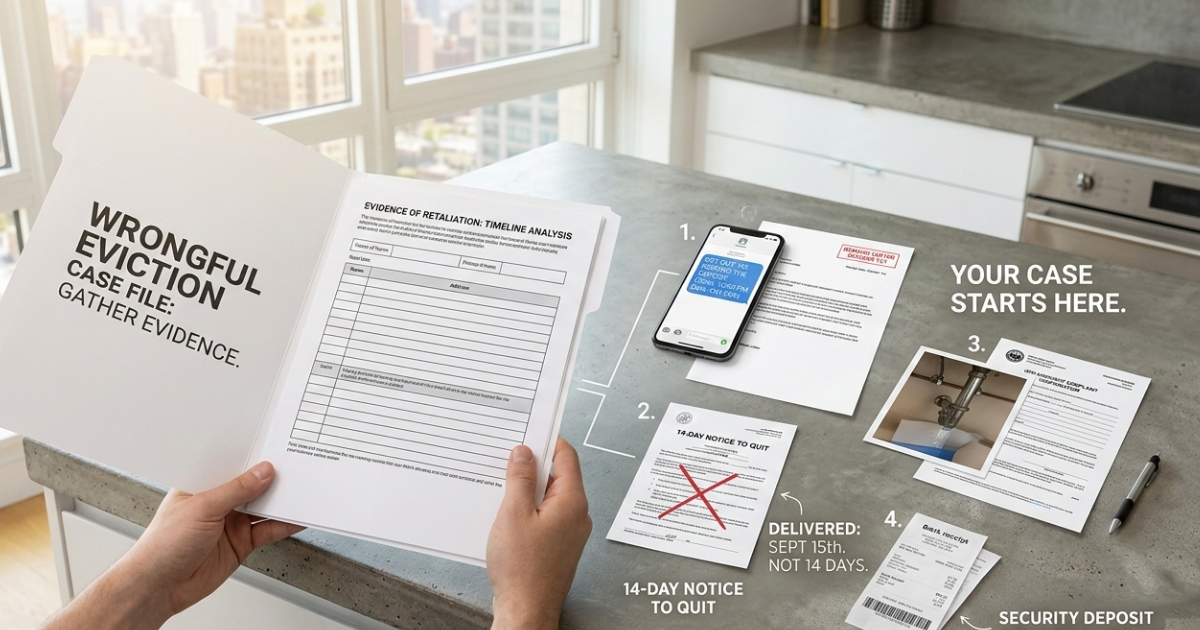
Make a list with two columns:
Column 1 - My imperfections:
Column 2 - Landlord's legal violations:
Which column is longer? Which column matters legally?
Stop fixating on Column 1. Focus on Column 2. That's your case.
When your landlord says: "You know what you did. Don't make this harder than it needs to be."
Translate to: "I'm manipulating you with guilt so you won't raise legal defenses that would expose my violations."
When landlord says: "After everything I've done for you, this is how you repay me?"
Translate to: "I'm framing this as personal betrayal instead of legal procedure so you'll feel too guilty to assert your rights."
Recognize guilt-tripping as the manipulation tactic it is.
You think: "Fighting this eviction is dishonest because I know I did something wrong."
Reality: Fighting the eviction is making your landlord prove they followed the law. That's not dishonest—that's how the legal system works.
Landlords must prove their case. Making them prove it isn't dishonest—it's requiring them to meet their legal burden.
You're not lying by raising defenses. You're asserting legal rights and making landlord follow legal procedures.
List everything you feel guilty about:
Be honest with yourself about your imperfections.
Investigate and list:
Be thorough. Most landlords have multiple violations.
Ask yourself:
Answer: Your landlord's violations matter. Your imperfections mostly don't.
Contact legal services:
Tell the intake person: "I received eviction papers. I feel like I might have done some things wrong, but I'm not sure if I have a case. Can someone review my situation?"
Lawyers will tell you if you have defenses. They'll focus on your landlord's violations, not your imperfections.
You'll probably be surprised how strong your case is.
Stop worrying about whether you "deserve" to raise defenses.
List every defense that might apply:
You're not being dishonest—you're preserving your legal rights.
Every time you think "I don't deserve to fight this because I did X wrong":
Remind yourself:
Refuse to let self-blame sabotage your case.
Every tenant is imperfect. Everyone pays late occasionally. Everyone makes noise sometimes. Everyone has guests. Everyone breaks minor rules.
Landlords are even more imperfect. They violate legal procedures constantly. They retaliate. They lie about amounts owed. They fabricate violations. They discriminate.
The question isn't "who's perfect?" Nobody is.
The question is "did landlord follow legal requirements to evict?" Usually: no.
You probably have a case not because you're perfect, but because your landlord almost certainly violated multiple legal requirements.
Stop blaming yourself. Start defending yourself.
Your imperfections are normal and mostly irrelevant. Your landlord's violations are illegal and entirely relevant.
You deserve legal protection not because you're perfect, but because you're human and the law protects human rights.
Fight back. You have a case.