When a home is making someone sick, watch how quickly the conversation gets steered away from that fact. The tenant says the mold is triggering their child's asthma, and the response comes back: Are you current on rent? What does your lease say? Did you give proper notice? This is a landlord-tenant matter. The framing slides, almost automatically, from a person being harmed to a contractual dispute between two parties — and in that slide, something important gets lost. The urgent question, the human question, is not "did you pay rent." It's "why is this person still being exposed to something that's hurting them?"
That reframing is the whole point of this article, because the framing is not neutral — it shapes what feels urgent and what feels like it can wait. Call it a lease dispute and it becomes a slow, procedural, adversarial thing where both sides have positions and the tenant's illness is just one factor to be weighed. Call it what it often actually is — a health emergency, someone being made sick by the place they live — and the urgency changes completely, because you don't tell a person being harmed to work it out through the proper contractual channels while the harm continues. Unsafe housing is a health issue wearing the costume of a legal one, and the costume serves the people who'd rather the harm be treated as negotiable.
So let's take the costume off. How unsafe conditions actually affect health and daily functioning. The proof gap tenants face in linking their illness to their housing, and how to close it. Why some tenants — children, older adults, people with disabilities and respiratory conditions — are hit far harder. And how to turn "my apartment is making me sick" from a vague complaint into a clear evidence timeline that doctors, inspectors, and advocates can actually act on. This is about insisting that the health question comes first, because it should.
Start with the harm itself, in concrete terms, because "unsafe housing" can sound abstract until you look at what these conditions actually do to the people living in them day after day.
Mold and chronic dampness affect the air you breathe continuously, and are commonly associated with respiratory symptoms — coughing, wheezing, congestion, worsened asthma — along with the general misery of never quite being able to breathe clean air in your own home. Lack of heat in cold weather isn't just uncomfortable; sustained cold is hard on the body, dangerous for vulnerable people, and corrosive to sleep and basic functioning. Pests bring contamination, allergens, bites, and — not trivially — a psychological toll, the stress and disgust and hypervigilance of sharing your home with them. Sewage odors and unsafe air mean breathing contaminated air in the place you're supposed to rest and recover. Each of these is a physical insult, delivered not once but continuously, in the environment where a person spends the most hours of their life.
And the effects ripple outward from the physical into everything else. Sleep goes first, often — you can't sleep well in a freezing apartment, or one where pests are active at night, or when you can't breathe. And degraded sleep degrades everything downstream: focus, mood, immune function, the ability to work and parent and cope. Daily functioning erodes — it's hard to hold a job, care for a family, or manage your life when your home is actively working against your health. Respiratory symptoms persist and worsen, sometimes developing into chronic conditions. And mental health takes a real and often-overlooked hit: living somewhere that's making you sick, that you can't seem to fix, that feels unsafe, produces genuine anxiety, depression, and chronic stress. The home is supposed to be the place you recover from the world. When it's the thing harming you, there's nowhere to recover to, and that has profound effects on a person's wellbeing.
The point of spelling this out is to insist on the scale of it. This is not a minor inconvenience to be weighed against lease technicalities. It's continuous harm to a person's body and mind, in their own home, which is exactly why treating it as a mere contractual matter misses what's actually at stake. When you lay out what these conditions do, "health emergency" stops sounding like an exaggeration and starts sounding like an accurate description.
A necessary note: if your home is making you sick, the first and most important step is to seek actual medical care. This article is about recognizing the harm and building the record — but your health comes first, and a doctor, not a document, is who addresses it. Get seen, and tell them about the conditions at home.
Here's the practical trap tenants fall into: they know their home is making them sick, but knowing it and proving it are two different things, and the gap between them is where these claims fall apart. A tenant says "my apartment is making me sick," which is a genuine, felt truth — and also, as stated, unprovable. Closing that gap is the central skill, and it's entirely learnable.
The gap exists because a health-and-housing claim has two halves that have to be connected. There's the health half — you're experiencing symptoms — and the environmental half — there are unsafe conditions in your home. Each is documentable on its own, but the power is in linking them, in showing that the symptoms track the conditions. That link is what turns two separate facts into a single claim, and it's exactly what a vague complaint lacks.
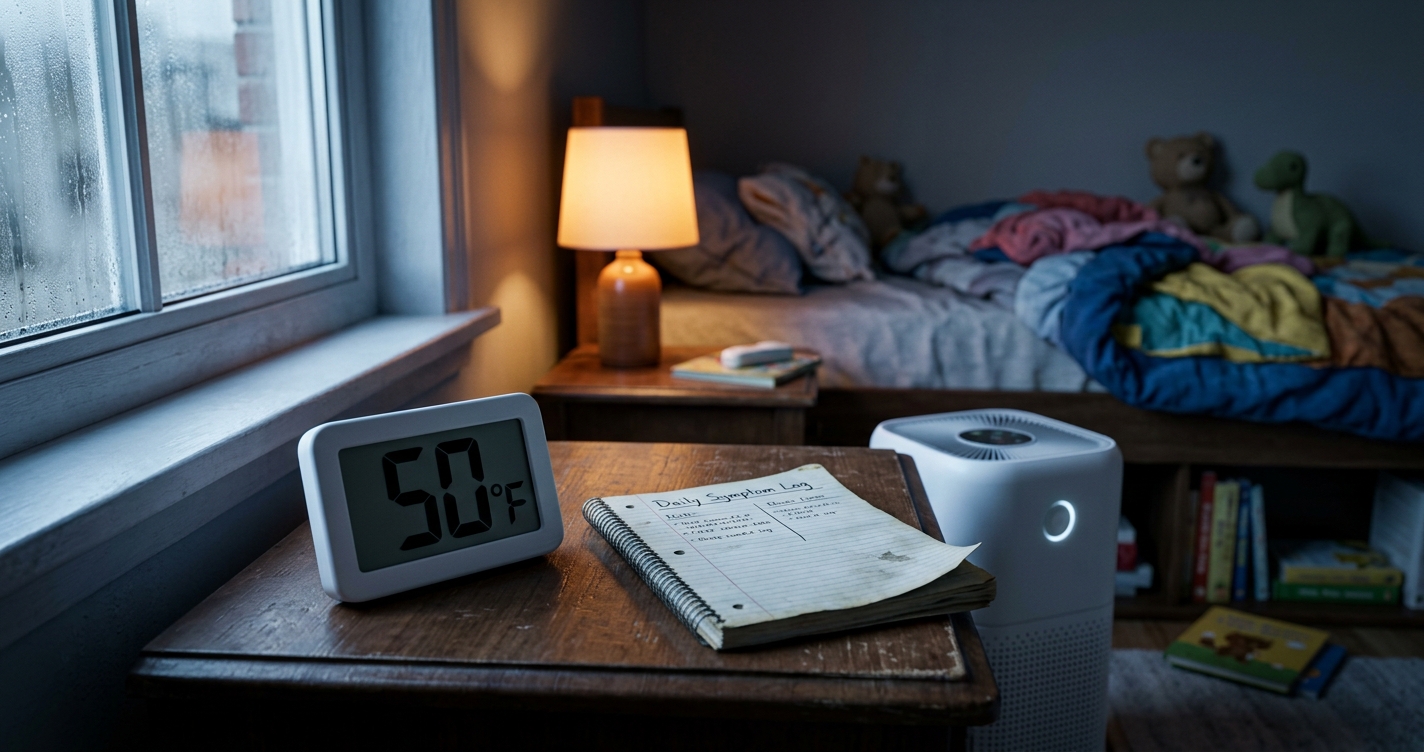
So document both halves, deliberately, and connect them. On the health side: keep a symptom record — what you're experiencing, when, how severe — and, crucially, get medical care and let your symptoms be documented by a professional, because a doctor's record of your condition, created contemporaneously, is far stronger than your own account alone. Tell your doctor about the housing conditions so the connection can appear in a medical record made by someone with no stake in your dispute. On the environmental side: document the conditions themselves — the mold, the cold, the pests, the sewage — with dated photos, temperature logs, inspection reports, all the habitability evidence.
Then build the link, and the single most powerful tool for it is timing. Does the symptom track the condition? When the mold is worst, are the symptoms worst? And the most revealing test of all: what happens when you leave? If your cough clears up during a week away and returns within a day of coming home, and that pattern repeats, you've demonstrated something a single symptom never could — that the home is the variable. Note every time you're away and how you feel; that away-and-back comparison is often the most persuasive evidence of causation you can produce, because it isolates the apartment as the cause in a way nothing else does.
Be honest in the linking, because honesty is what makes the record credible: document what you actually know and don't overstate causation you can't support. "Congestion that consistently improves when I'm away from the apartment" is a strong, honest observation. Let the doctors make the medical judgments and let the timeline speak. A carefully honest record that shows a real pattern is far more powerful than an overreaching one, and it's what closes the proof gap legitimately.
There's a dimension of this that deserves particular attention, because it's both a matter of basic fairness and often central to how serious a situation actually is: the same unsafe conditions do not harm everyone equally. Some tenants face dramatically higher risk, and they're frequently the people least able to escape it.
Children are especially vulnerable — their bodies are still developing, they breathe faster relative to their size, and exposures like mold and cold and contaminants can affect them more severely and with longer-lasting consequences than they would a healthy adult. A mold problem that gives an adult a cough can be genuinely serious for a child with developing lungs. Older adults are more vulnerable to temperature extremes, to respiratory insults, to the cascading effects of poor conditions on already-taxed systems. People with disabilities may be more susceptible to harm and less able to mitigate or escape it, depending on their condition. And people with respiratory conditions — asthma, COPD, allergies — are hit directly where they're weakest by exactly the airborne hazards these conditions produce; mold and poor air can turn a managed condition into a crisis.
This uneven distribution matters for two reasons. First, simply as a matter of stakes: when a vulnerable person is the one being exposed, the situation is more urgent and the potential harm more severe, which makes the "why is this person still being exposed" question more pressing, not less. A cold apartment is a hardship for a healthy adult and a genuine danger for an infant or a frail elderly person. Second, it matters for how the situation should be understood and documented — the presence of a vulnerable occupant, and the specific harm to them, is a central fact, not a footnote. Harm to a child in particular tends to be taken very seriously by every body that touches these situations, and rightly so.
The deeper point is that "is this condition really that bad?" is not a question with a single answer, because it depends enormously on who's living in it. The landlord who waves off a hazard as tolerable is often ignoring that the person actually being exposed — the asthmatic, the baby, the grandmother — is precisely the person for whom it's least tolerable. The vulnerability of the occupant is part of what makes the condition an emergency, and it belongs at the center of how the situation is framed and documented.
Everything above comes together in a single practical product: an evidence timeline that converts your vague, true, unprovable complaint into something doctors, inspectors, and legal advocates can actually use. This is the deliverable, and building it is what moves you from stuck to equipped.
A timeline weaves the two halves together chronologically — the conditions and the health effects, side by side, over time, so the relationship between them becomes visible. Assemble it from the pieces: dated documentation of the conditions (the photos, the temperature logs, the inspection reports), dated documentation of the symptoms (your record and, importantly, your medical records), dated records of when you reported the conditions to the landlord, and the away-and-back observations that isolate the home as the cause. Laid out in order, these stop being scattered complaints and become a narrative: the mold appeared here, the symptoms began here, I reported it here, it worsened here, I was away here and improved, I returned here and it came back, the doctor documented it here.
Understand why the timeline is so much more powerful than the complaint it replaces. "My apartment is making me sick" gives a doctor, an inspector, or an advocate nothing to act on — it's an assertion with no structure. A dated timeline gives each of them exactly what they need. The doctor can see the pattern and the environmental context, which sharpens their assessment and care. The inspector can see the documented conditions and go verify them. The legal advocate can see a coherent, evidenced claim with causation, notice, and harm all laid out — the raw material of a real case. The same underlying reality, organized into a timeline, becomes usable by every professional whose help you need, none of whom can do much with a vague complaint.
So build it deliberately, and keep it current. Every dated entry — a new symptom, a doctor visit, a worsening of the mold, a report to the landlord, a week away and how you felt — is another point on the line that connects your health to your housing. The timeline is the bridge across the proof gap, and it's the single most useful thing you can create, because it's the form in which your experience becomes actionable to the people who can actually help.
Step back and see what the reframe accomplishes. Calling unsafe housing a "lease dispute" isn't just inaccurate — it's a way of setting the priorities wrong, of putting the contract before the person and the procedure before the harm. It makes the tenant's illness one negotiable factor among many, to be handled at the pace of an adversarial process, while the exposure continues. And it quietly serves whoever benefits from the harm being treated as tolerable, because "lease dispute" carries none of the urgency that "someone is being made sick in their home" carries. The framing is doing work, and the work is minimizing.
So insist on the right frame, and the right first question. When a home is making someone sick, the conversation should not begin with "did you pay rent" — it should begin with "why is this person still being exposed, and how do we stop it?" That's not a denial of the legal dimension; the lease and the law absolutely matter, and they're how you ultimately force change. It's an insistence that the health comes first in urgency and in framing — that a person being harmed in their home is an emergency to be addressed, not merely a dispute to be processed.
If your home is making you or your family sick, take it as seriously as you'd take any threat to your health, because that's what it is. Get medical care first. Then close the proof gap: document the conditions and the symptoms, link them with timing and the away-and-back test, take special account of anyone vulnerable in the household, and build the evidence timeline that turns "my apartment is making me sick" into something a doctor, an inspector, and an advocate can act on. You are not a party to a mere contractual squabble. You are a person whose home may be harming you — and that deserves to be treated as the emergency it is. Find out where you stand.