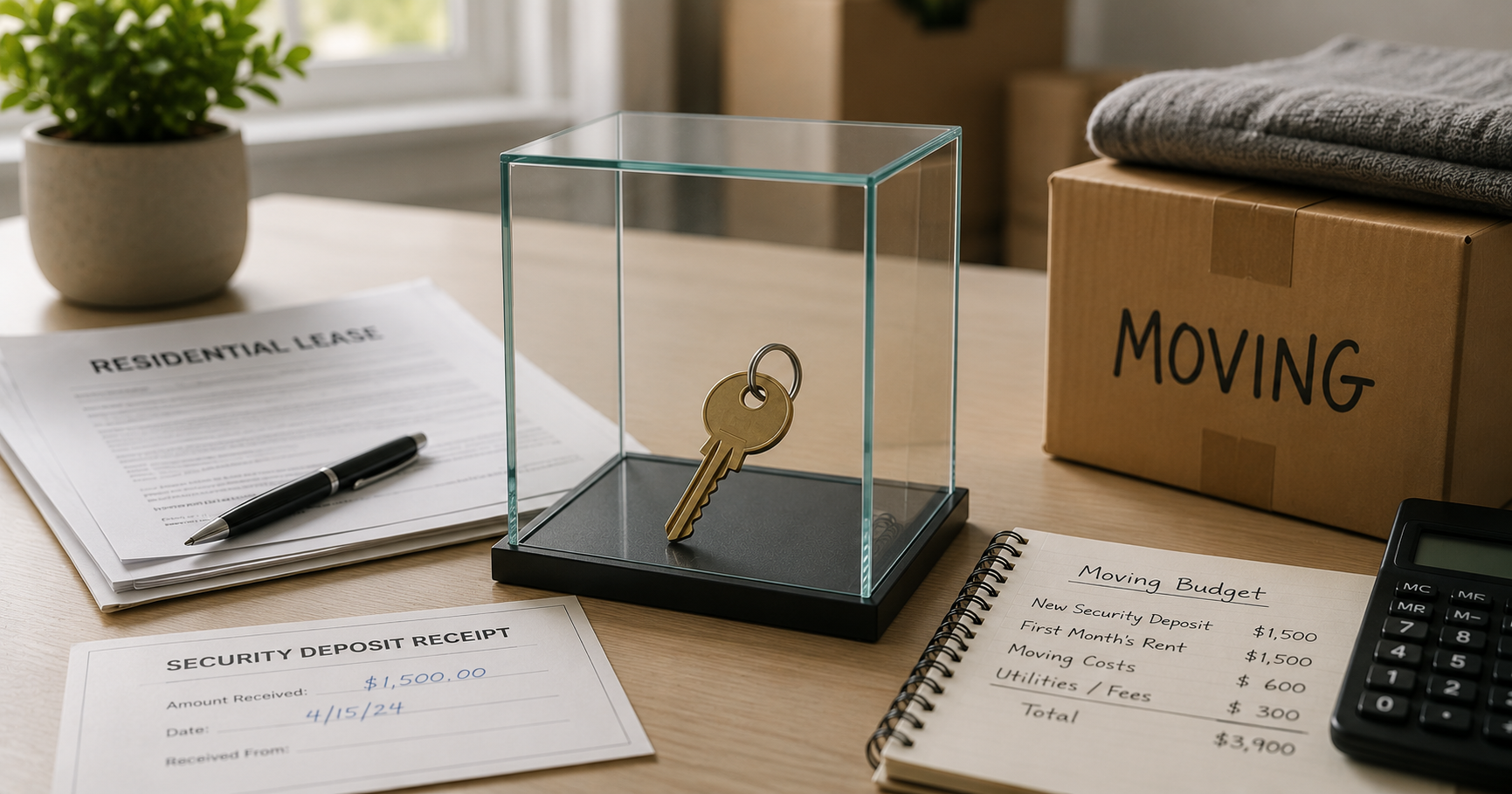
There's a particular math that runs in the back of your mind every time you think about leaving. It goes something like this: the apartment isn't safe, but moving means a new security deposit you don't have, plus first month's rent, plus moving costs, plus whatever this landlord decides to keep from the deposit you're counting on. And the moment you add it all up, the answer always comes out the same — I can't afford to leave. So you stay. Not because the conditions are acceptable, but because the exit appears to cost more money than you have, and that wall of numbers feels more immovable than the danger itself.
For a lot of tenants, the security deposit is the centerpiece of this trap. It's the money you're banking on for the next place — and you're almost certain that if you complain about the conditions, or move because of them, this landlord will keep it. Out of spite, or as punishment, or just because they can. And it gets worse in the picturing: you imagine the landlord not just keeping the deposit but coming after you for back rent, for "damages" you can't prove you didn't cause, for fees that materialize out of nowhere. You see yourself leaving with nothing, owing money, and unable to scrape together a deposit for anywhere else. So you don't leave. The financial anxiety keeps you in a hazardous home far longer than you'd ever tolerate if money weren't so tight.
Let's name the fear running this, plainly: If I leave this unsafe place, I'll be financially wiped out and stuck with nowhere realistic to go. That's the engine. Not that the apartment is fine — you know it isn't — but that escaping it would destroy you financially, and being broke with nowhere to go feels scarier than staying somewhere dangerous. So the deposit becomes a chain, and you stay chained to a home that may be hurting you.
Here is what this article is going to take apart: the security deposit is not a chip your landlord gets to keep on a whim, and the financial trap you're picturing is built largely on rules that don't actually apply the way the fear assumes. New York law tightly controls what a landlord can do with your deposit — they can't just keep it out of spite, they face hard deadlines, the burden is on them to justify any deduction, and if they wrongfully withhold it they can owe you substantially more than the deposit itself. Meanwhile the other half of the nightmare — owing endless back rent, getting buried in unprovable damages — runs into other laws that limit a landlord's reach far more than you've been told. The wall of numbers that's been trapping you is real-feeling but largely fictional in its details, and once you see the actual rules, the exit stops looking impossible.
This is the most money-driven fear in this series, so we're going to deal in money — in the actual legal rules about deposits, deductions, back rent, and what you might be owed rather than what you fear owing. We'll be honest about real costs, because moving does cost something and pretending otherwise would help no one. But the goal is to replace a paralyzing, exaggerated picture of financial ruin with an accurate one — because when you can see the real numbers and the real rules, the trap you thought was holding you may turn out to have a door.
Start with the belief at the center of the trap: that your landlord can keep your security deposit more or less at will, especially if you've made yourself inconvenient by complaining or leaving over conditions. This belief feels true because the deposit is in their hands, and possession feels like power. But legally, that deposit is still your money, held by the landlord under strict rules — and "out of spite" is precisely what those rules exist to prevent.
Here's how New York's deposit law actually works, under General Obligations Law § 7-108, as strengthened by the Housing Stability and Tenant Protection Act of 2019. After you move out, the landlord has fourteen days to return your deposit — and if they're keeping any part of it, they must give you an itemized written statement explaining exactly what they're deducting and why, within that same fourteen-day window. Not a vague "deducted for damages." An itemized statement, specifying the basis for each amount. This is a hard deadline with real teeth, which we'll get to.
Now notice what that already does to the fear. The fear imagines the landlord simply pocketing your deposit and offering some hand-wave about damages or spite. The law does not permit that. A landlord who wants to keep any of your deposit has to document specific, legitimate deductions in writing, on a deadline. And the categories they're even allowed to deduct for are limited: unpaid rent, the cost of repairing damage you caused beyond normal wear and tear, unpaid utilities you owed under the lease, and the cost of moving and storing your belongings. That's essentially it. They cannot deduct for normal wear and tear — the ordinary aging of a lived-in apartment. They cannot deduct for damage a previous tenant caused. And critically, they cannot deduct for the unsafe conditions they failed to fix, because those were never your responsibility to begin with.
So the picture inverts. You've been imagining a landlord with broad discretion to keep your money as punishment. The reality is a landlord operating under tight constraints: a short deadline, a written-itemization requirement, and a narrow list of permissible deductions. The deposit isn't a discretionary chip they hold over you. It's your money, held in trust under rules designed specifically to stop the spite-keeping you've been afraid of.
The point about unsafe conditions deserves its own emphasis, because it closes a door the fear leaves open. You may worry that the very conditions driving you out — the mold, the damage, the deterioration — will be turned around and charged against your deposit as if you caused them. The law doesn't work that way. A landlord can only deduct for damage you caused beyond normal wear and tear. Conditions that resulted from the landlord's own failure to maintain the building — the leak they never fixed that grew the mold, the deferred repairs that let something deteriorate — are not your damage, and charging your deposit for them would be improper. In fact, those conditions are the landlord's breach, not yours; they're the basis for your potential claims, not the landlord's. So the fear that you'll be billed for the apartment's unsafe conditions has it exactly inverted: those conditions are evidence of the landlord's failure to uphold their end, which strengthens your position and weakens any attempt to raid your deposit over them. The worse the conditions the landlord ignored, the worse their footing for keeping your money.
It gets considerably better for you, because the law doesn't just set rules — it puts consequences behind them that fall on the landlord, hard. This is the part the fear never mentions, and it flips the entire power dynamic of the deposit.
First, the fourteen-day deadline is not a suggestion. If a landlord fails to provide that itemized statement and return the appropriate portion within fourteen days of your moving out, they forfeit the right to keep any of it. Read that again: miss the deadline, lose the ability to withhold anything. The landlord who tries to drag their feet, who figures they'll just sit on your deposit and deal with it whenever, isn't being clever — they're blowing past a deadline that, once missed, means they owe you the entire deposit back regardless of what they thought they could deduct. The law put the time pressure on them, not you.
Second — and this is the one that should reframe everything — the burden of proof is on the landlord. In any dispute about how much of the deposit was kept, New York law puts the burden on the landlord to prove the deductions were reasonable. This demolishes one of the fear's central nightmares: the terror that you'll be stuck with "damages you can't prove you don't owe." You read that correctly as a fear, but the law reads it backward from how you've been imagining it. You don't have to prove you didn't cause the damage. The landlord has to prove you did, and that the cost was reasonable. The "I can't prove my innocence" panic is aimed at a burden that legally isn't yours to carry.
Third, wrongful withholding is expensive for the landlord. Under the strengthened law, a landlord who willfully violates the deposit rules can be liable for punitive damages of up to twice the amount of the deposit, on top of returning what they wrongfully kept. Think about what that means in practice. A landlord who keeps your deposit out of spite isn't executing a costless act of revenge — they're exposing themselves to owing you potentially three times the deposit in total: the wrongfully withheld amount back, plus up to double that as a penalty. The spiteful move the fear is built around is, in reality, one of the more financially reckless things a landlord could do. The law turned your deposit from something they can safely steal into something that can cost them dearly to mishandle.
Put those three together and the deposit stops looking like a chip the landlord controls and starts looking like what it is: your money, returnable on a strict deadline, with the burden on the landlord to justify any deduction, and serious penalties if they keep it wrongfully. The fear told you the landlord holds all the power over that money. The law tells a very different story — one where a landlord who keeps your deposit out of spite has handed you a potential claim worth more than the deposit itself.
It's worth pausing on the spite scenario specifically, because it's the emotional core of this fear — the image of a vindictive landlord keeping your money just to punish you for complaining or leaving. Here's the irony the law creates: spite is exactly the motive that turns a deposit retention into a willful violation, which is what triggers the punitive damages. A landlord who keeps your deposit because they're genuinely (if wrongly) convinced you damaged the place is in one kind of trouble. A landlord who keeps it to punish you, with no legitimate basis, is in far worse trouble, because that's the willful, bad-faith conduct the enhanced penalties were written for. The very spitefulness you're afraid of is the thing that would make the landlord's position weakest and your potential recovery largest. The fear imagines spite as the landlord's weapon. The law treats it as the landlord's liability. And a landlord who understands the law knows this — which is itself a reason most won't actually do the thing you're most afraid of, because doing it out of spite is the most expensive version of all.
The law gives you something else most tenants don't know about: a way to protect your deposit before you move out, which directly attacks the fear of surprise deductions appearing after you're gone.
Under the deposit law, you have the right to request a walk-through inspection before your tenancy ends. If you ask for it, the landlord must inspect the apartment with you within a defined window before move-out — and afterward, give you an itemized statement of anything they're proposing to deduct, so that you have the chance to fix those things yourself before you leave. This is a powerful and underused protection. It means the deductions can't simply ambush you after you've vacated; you get advance notice of what the landlord intends to claim, and an opportunity to cure it — to clean the thing, fix the small thing — so it can't be charged against your deposit.
See what this does to the surprise-charges fear. You've been picturing yourself moving out, then weeks later getting hit with a list of mysterious damages you have no way to contest. The pre-move-out inspection turns that on its head. You can force the conversation about deductions to happen before you leave, in person, with the apartment in front of both of you, and with a written list you can act on. The landlord who wanted to invent charges after the fact has a much harder time when you've exercised your right to an inspection and addressed everything on their list while you still had the keys.
And this connects directly to documentation, which is your other deposit shield. Photograph and video the apartment's condition thoroughly when you move out — every room, the existing wear, the condition you're leaving it in. Dated move-out photos are how you answer any later claim of damage. Combined with your move-in documentation if you have it, this evidence makes it very hard for a landlord to manufacture deductions, and it directly supports you if the burden-of-proof fight ever happens — though remember, that burden is the landlord's to carry, not yours. The inspection right plus your own documentation means the deposit deductions you've been dreading are far more controllable than the fear suggests.
The deposit is only part of the financial trap. The other part is the fear of what you'll owe — back rent stretching to the end of the lease, fees, the sense that leaving early means an open-ended bill you can never escape. This fear deserves direct treatment, because it's also built on an outdated picture.
If you're leaving because of genuinely severe, unsafe conditions, the legal landscape is very different from "you broke the lease, so you owe everything." As covered elsewhere in this series, severe unsafe conditions the landlord won't fix can, in the right circumstances, support a constructive-eviction position — where the landlord's failure to maintain a habitable home is treated as effectively forcing you out, potentially releasing you from rent obligations going forward. And separately, when a landlord has breached the warranty of habitability, you may be entitled to a rent abatement — a reduction in what you owed for the period the conditions were bad — which can offset or eliminate amounts the landlord claims against you. The "back rent" the fear assumes you'll owe may be reduced, or may not be owed at all, precisely because the conditions were unsafe.
And even in the ordinary case — even if you simply leave before the lease ends — New York no longer lets a landlord run up an endless bill against you. Under Real Property Law § 227-e, landlords have a duty to mitigate damages: they cannot let the apartment sit empty and bill you for all the remaining rent. They must make reasonable efforts to re-rent it, and once they do, your liability ends. The burden is on the landlord to prove they made those efforts if they want to recover anything. So the "endless back rent" nightmare runs into a wall the law built in 2019. Your realistic exposure for leaving early is typically the gap until the unit is or could reasonably be re-rented — not the crushing open-ended sum the fear imagines.
Stack these together and the owing-money side of the trap shrinks dramatically. If your conditions are severe, you may owe little or nothing and may even be owed money. And even if they're not, the duty to mitigate caps your exposure far below the catastrophe you've been picturing. The fear assembled a worst-case bill out of rules that either don't apply to unsafe-conditions departures or were changed years ago. The actual number, in most real situations, is a fraction of what the fear quoted you.
Here's a reframe the fear never allows, because it only ever runs the numbers in one direction — money you'll lose. But in a situation involving unsafe conditions, money may actually be flowing toward you, and it's worth tallying that side of the ledger, because it can change the entire calculation of whether you can afford to leave.
Consider what you may be entitled to recover. If your landlord breached the warranty of habitability by failing to maintain safe conditions, you may have a claim for a rent abatement covering the months you lived with those conditions — potentially a significant sum if the problems were serious and prolonged. If your landlord wrongfully withholds your deposit, you may be entitled to that deposit back plus up to twice its amount in penalties. If there was retaliation, or other violations, there may be further damages. None of this is guaranteed, and the specifics depend on your situation — but the point is that the financial picture of leaving an unsafe apartment is not purely a column of costs. There's a second column, and the fear has been hiding it from you entirely.
This matters enormously for the trap, because the trap runs on the belief that leaving is all outflow — deposit gone, new deposit needed, moving costs, back rent owed. But if you're potentially owed an abatement for past conditions, and potentially owed your deposit plus penalties, and potentially not on the hook for much back rent because of the duty to mitigate or a constructive-eviction position, then the real net cost of leaving may be far lower than the gross cost the fear calculated — and in some cases, the ledger may even tilt in your favor. The tenant who only sees the outflow stays trapped. The tenant who sees both columns can make an actual decision based on real numbers.
There's a deeper point here about how the fear operates. A one-sided ledger isn't just incomplete — it's actively misleading, because a decision made by looking at only the costs of an action and none of its benefits will almost always counsel inaction, no matter how good the action actually is. That's the trap's mechanism in a sentence: by showing you only what leaving costs and never what it returns or what staying costs you, the fear guarantees that "stay" always wins the math. The fix isn't optimism; it's completeness. Put every real figure on the table — costs and recoveries, the price of going and the price of staying — and let the honest total decide. The fear was never giving you a calculation. It was giving you half of one and calling it a conclusion.
To be clear and honest: realizing money you're owed often takes effort — documentation, sometimes a small claims case or a habitability claim, sometimes the help of a tenant attorney. It's not automatic, and it's not instant. But it's real, it's recoverable, and it belongs on the scale. The fear presented leaving as financial suicide by showing you only the costs. An honest accounting includes what you may get back, and that accounting looks very different.
The fear deals in vague dread, so let's do the one thing it never does — put actual numbers on the table and add them up both ways. Imagine a tenant paying $2,000 a month, with a $2,000 security deposit, in an apartment that's gone through a winter with unreliable heat and a persistent mold problem the landlord was told about repeatedly and never fixed. They want to leave but are frozen by the math: "I'll lose my $2,000 deposit, I'll owe rent, I can't afford a new place."
Run the fear's version of the ledger first, the one keeping them stuck. Lost deposit: $2,000. New deposit: $2,000. First month somewhere new: $2,000. Moving costs: say $1,000. Plus a dreaded unknown of "back rent and damages" they imagine could be many thousands more. Total in the fear's head: somewhere north of $7,000 and climbing, an impossible sum. So they stay.
Now run it against the actual rules. The old $2,000 deposit isn't lost — it's protected, returnable within fourteen days, with the burden on the landlord to justify any deduction; realistically most or all of it comes back, and if the landlord keeps it out of spite, they risk owing up to twice that on top. The new deposit is capped by law at one month's rent — $2,000, not more — and it's largely funded by the returned old deposit. The "back rent and damages" the fear inflated to thousands? If the conditions support a constructive-eviction position, it may be little or nothing; even if not, the duty to mitigate caps it at the gap until re-rental, not the whole lease. And on the other side of the ledger — the side the fear hid entirely — there's a potential rent abatement for the months of unreliable heat and unaddressed mold, which for a serious, prolonged breach could be a meaningful share of the rent paid during that period, plausibly running into the thousands in the tenant's favor.
Add up the honest version and the picture is almost unrecognizable. The real out-of-pocket cost of leaving is closer to the moving expenses plus the timing gap between getting the old deposit back and funding the new one — a finite, manageable number, not a $7,000 catastrophe. And once you net in a possible abatement and a possibly wrongfully-withheld-deposit claim, the tenant may come out close to even, or even ahead. Same tenant, same apartment, same deposit. One version of the math keeps them in a home with no reliable heat and spreading mold; the other reveals an exit they can actually afford. The only thing that changed was running the numbers against the real rules instead of the fear's.
The Knowledgeable Advocate doesn't pretend moving is free, because it isn't, and you'd see through that instantly. Let's be straight about the real costs and then size them honestly against the fear, because an accurate number is what breaks paralysis, not false cheerfulness.
Moving does cost money: potentially a new deposit (though New York now caps security deposits at one month's rent, which limits how large that number can be), possibly first month's rent, and moving expenses. These are real. But notice how the fear inflates even these. The new deposit is capped at one month's rent by law — it can't be the open-ended number you might fear. Your old deposit, as we've established, is not the landlord's to keep on a whim and is returnable on a strict deadline, so it's likely available to you for the next place rather than lost. And the costs that are real are often one-time and finite, not the bottomless financial ruin the fear describes.
It's worth separating two things the fear blends together: the total cost of moving and the cash-flow timing of it. Part of what makes moving feel impossible is the worry that you need all the money at once, up front, before any of the old deposit comes back. That's a real logistical challenge — but it's a timing problem, not a permanent-loss problem, and timing problems have solutions the fear never considers. The old deposit returns within fourteen days. Some tenants bridge the gap with a short overlap, a payment arrangement, or help from the very resources that exist for exactly this. The fear collapses "I might need to manage some cash flow for a few weeks" into "I'll be financially wiped out forever," and those are completely different problems. One is a logistics puzzle with ordinary solutions; the other is the catastrophe the fear invented. Recognizing which one you're actually facing is itself part of breaking free of the trap.
Now weigh those real, finite costs against what the fear never puts on the other side of the scale: the cost of staying. Living in an unsafe apartment has its own price, and it's not only emotional. There's the rent you keep paying — possibly in full — for a home that isn't delivering the habitability you're paying for, money a rent abatement might recover but that you lose entirely by staying silent and staying put. There's the potential cost to your health and your family's health, which can carry real medical and human expense. And there's the opportunity cost of every month you remain stuck instead of housed somewhere safe. The fear obsesses over the finite, one-time cost of moving while ignoring the recurring, compounding cost of not moving. Every month of silence quietly bills you for both, and unlike a move, that bill never stops arriving.
This is the honest comparison the fear won't let you make: a real but finite and partly recoverable cost to leave, versus an ongoing and compounding cost to stay in a hazardous home. When you put accurate numbers on both sides — capped new deposit, recoverable old deposit, limited back-rent exposure, possible abatement owed to you, against full rent for an unsafe home plus health costs plus being stuck — the math the fear sold you stops holding up. Moving isn't free. But it's very often far more affordable than the fear calculated, and staying is far more expensive than the fear admits.
So how does a tenant actually move out of an unsafe apartment while protecting their money, instead of getting financially burned the way the fear predicts? With a careful sequence that protects your deposit, documents your position, and clarifies what you might owe or be owed before you make any irreversible move. As with anything involving leaving a lease over conditions, getting tenant legal advice before you go is the step that ties it all together.
Document the unsafe conditions thoroughly, with dates, before you do anything else. Photos, video, a written log, written complaints to the landlord, any 311 reports and resulting violations. This record is the foundation for everything on the money side: it supports a habitability/abatement claim, it grounds any constructive-eviction position, and it establishes that the conditions — not you — were the reason for leaving. The stronger this record, the stronger your financial position.
Request a pre-move-out inspection in writing. Exercise your right to the walk-through before your tenancy ends, so you get advance, itemized notice of any deductions the landlord intends to make and the chance to cure them before you leave. This is one of your best tools against surprise charges, and most tenants never use it.
Document the apartment's condition at move-out, exhaustively. Photograph and video every room as you leave it. This is your evidence against any manufactured damage claim — and while the burden of proving deductions is the landlord's, your documentation makes their wrongful deductions nearly impossible to sustain and your potential treble-damages claim stronger if they try.
Give proper written notice and keep every record. Put your notice and the reasons in writing, keep copies of everything, and provide the landlord your forwarding address so the deposit and any itemized statement can reach you within the fourteen-day window. Keep paying rent you legitimately owe until you have a clear plan, to keep your position clean.
Know the deadlines and your remedies. Mark the fourteen-day clock from your move-out. If the landlord misses it, they forfeit the right to keep any of the deposit. If they keep it wrongfully, you may have a claim for the deposit plus penalties — often pursuable in small claims court without a lawyer, which exists precisely for disputes like this. Small claims is worth understanding as a tool, because it directly dissolves a piece of the fear: you don't need to hire an expensive attorney to fight a wrongfully withheld deposit. Small claims court in New York is designed for ordinary people to bring exactly these cases for a modest filing fee, presenting their own photos, their lease, and their records. The landlord who assumed you'd never pursue a withheld deposit because going to court seemed impossible is counting on a barrier that, for deposit disputes, is far lower than you think. Your documentation is the case, and you're allowed to bring it yourself.
Get tenant legal advice before you leave — this ties it together. Take your documented record to a free tenant organization and have them assess your specific financial picture: what you might owe, what you might be owed, whether your conditions support constructive eviction or an abatement, and how to protect your deposit. The Legal Aid Society and Legal Services NYC provide free legal help to tenants. Housing Court Answers offers guidance on conditions, deposits, and court processes. The Met Council on Housing runs a tenants' rights hotline. A single conversation can replace a paralyzing fog of financial worst-cases with an actual read on your numbers — and that read is almost always less frightening than the fear's version.
Look at the shape of this sequence. The early steps cost almost nothing and build your protection — documentation, an inspection request, written notice. They make your deposit far harder to wrongfully withhold and your financial position far stronger. And the final step replaces guesswork with a real assessment before you commit. This is the difference between leaving an unsafe apartment and getting "financially wiped out" and leaving it with your deposit protected, your exposure clarified, and any money you're owed identified. The fear told you the exit was financial ruin. Done carefully, it's a managed, documented, defensible move — and a far cheaper one than the fear claimed.
Let's come back to that math in the back of your mind — the wall of numbers that always added up to "I can't afford to leave."
That wall felt solid, and the fear behind it was understandable: being financially wiped out with nowhere to go is a genuinely frightening prospect, and money being tight makes every risk loom larger. But look at what we've actually found. Your security deposit isn't a chip the landlord can keep out of spite — it's your money, returnable within fourteen days, with the burden on the landlord to justify any deduction and penalties of up to twice the deposit if they keep it wrongfully. The surprise-damages nightmare runs into a burden of proof that's the landlord's to carry, not yours, and a pre-move-out inspection right that lets you head off deductions before you go. The endless-back-rent fear runs into the duty to mitigate and, where conditions are severe, into constructive eviction and abatement — meaning you may owe far less than you think, or nothing, or may even be owed money. And the real costs of moving are capped and partly recoverable, not the bottomless ruin you pictured.
So look honestly at the trade the fear talked you into. It told you that staying was the financially responsible choice — that leaving would destroy you. But "staying" meant continuing to pay, often in full, for an unsafe home that may have been breaching its own obligations to you, while sitting on a deposit that's legally protected, a possible abatement claim you weren't pursuing, and an exit that was more affordable than the fear's arithmetic suggested. The fear inflated every cost of leaving and hid every protection and every potential recovery. It built a wall out of rules that were exaggerated, outdated, or simply backward — the spiteful deposit-keeping the law punishes, the unprovable damages the landlord actually has to prove, the endless rent the duty to mitigate caps. You weren't trapped by the real numbers. You were trapped by the fear's version of them.
And the way out is careful, not reckless — which is the whole point. You document the conditions, you request your inspection, you photograph your move-out, you give proper notice, you learn your deadlines, and you get a real assessment of your numbers before you commit. Small, protective, money-preserving steps, each one shrinking the trap a little more. That's not financial suicide. It's the opposite: it's finding out what leaving actually costs, with accurate numbers and the law's protections in hand, instead of staying stuck behind a wall of figures that were never real.
You already know the apartment isn't safe. You've known for a while — and the only thing keeping you there has been a math problem that turns out to have been calculated wrong. The deposit you were afraid of losing is protected. The money you feared owing may be far less than you thought, or may be owed to you. The exit you were sure you couldn't afford may be a great deal more affordable than the fear ever let you see. You don't have to keep paying the price of staying just because the fear miscounted the price of leaving. Run the real numbers. You may not be as trapped as the math told you.