You're staring at your landlord's text claiming they're keeping your entire $2,400 security deposit for "damages and cleaning," and your first thought isn't anger—it's defeat. You didn't take move-out photos. You can't find your lease. You never got anything in writing about the apartment's condition. You assume this means you have no case, no leverage, no chance of getting your money back.
That assumption—that single limiting belief—is why your landlord sent that text in the first place. They're counting on you to think "I probably don't have a strong case" and give up before you even start. And if you believe that, you're handing them your money without a fight.
Here's what most New York tenants don't understand: having a "strong case" for getting your security deposit back has almost nothing to do with whether you documented everything perfectly. The strength of your case depends on whether your landlord followed the law—and New York's security deposit law is so strictly tenant-protective that most landlords violate it without even realizing they did.
"I probably don't have a strong case" is the most expensive thought a New York tenant can have about their security deposit. It translates roughly to: "I didn't do everything perfectly, so I'll lose."
This belief comes from a fundamental misunderstanding of how security deposit law actually works. You think the question is: "Can I prove the apartment was clean when I left?" or "Can I prove I didn't cause damage?"
But the real question—the one that determines whether you win—is usually: "Did my landlord follow New York's strict procedural requirements for keeping my deposit?"
And the answer to that question is almost always "no."
When you believe you don't have a case because you lack evidence, you're assuming the dispute works like this:
Your landlord claims: "Tenant caused $1,500 in damage."
You must prove: "No, the apartment was in perfect condition when I left."
Winner: Whoever has better photos, documentation, and evidence of condition.
Under this framework, if you don't have move-out photos showing pristine condition, you lose. If you can't produce your lease showing what condition was expected, you lose. If you didn't get written confirmation from your landlord that everything looked fine, you lose.
This framework makes you feel powerless because you know you didn't document everything perfectly. Nobody does. So you conclude you have no case.
The actual legal framework is completely different:
State law requires: Landlord must provide itemized deductions and return remaining balance within 14 days of tenant vacating.
If landlord fails: Landlord automatically forfeits the right to keep any portion of the deposit, regardless of apartment condition or actual damage.
Winner: Whoever can prove the 14-day timeline—did the landlord comply or not?
Under this framework, your landlord's compliance with procedural deadlines matters far more than whether you have photos. Your ability to prove when you moved out and when your landlord sent (or didn't send) an itemized statement matters more than your ability to prove apartment condition.
This is a timing case, not a condition case. And timing is provable through things you definitely have: your lease end date, the date you returned keys, the date (if any) you received communication from your landlord, postmarks on envelopes.
You have evidence of timing even if you have zero evidence of apartment condition.
The reason you probably have a stronger case than you think comes down to how New York's security deposit statute is structured. It's deliberately tenant-protective, with strict requirements on landlords and harsh penalties for non-compliance.
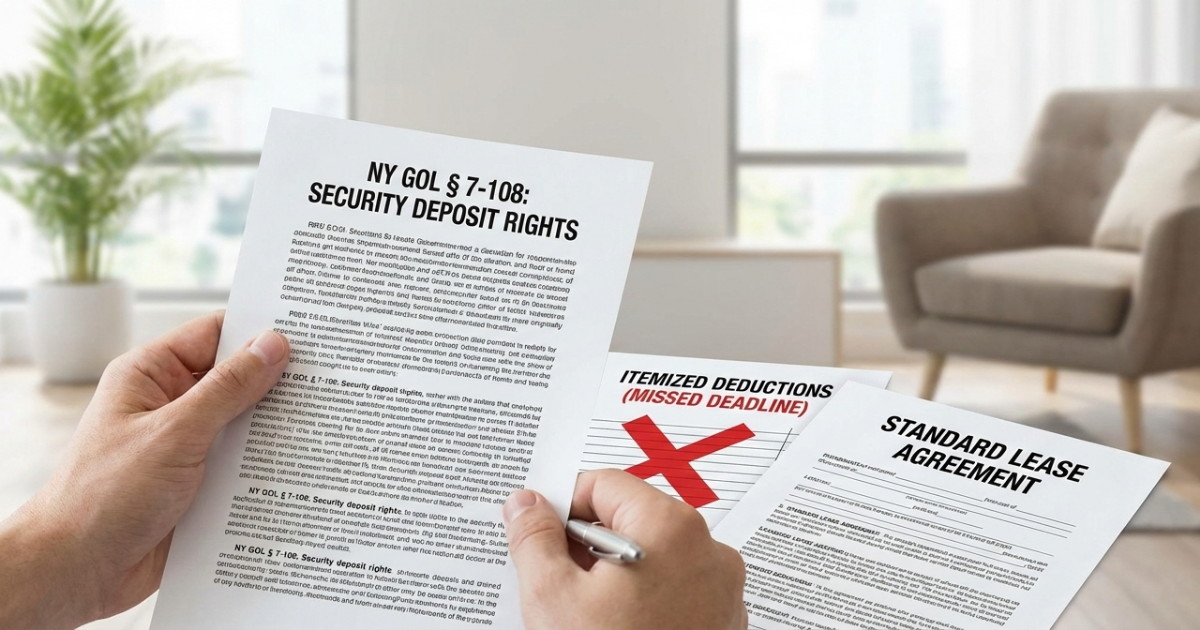
General Obligations Law § 7-108(1-e) requires landlords to provide an itemized written statement of deductions and return any remaining deposit balance within 14 days after you vacate. Not 15 days. Not "as soon as we get around to it." Exactly 14 days.
Miss that deadline by even one day, and the landlord legally forfeits the right to keep any portion of your deposit. Courts have held that a landlord who sent itemization six days late—on day 20 instead of day 14—cannot recover deductions.
Think about what this means: your landlord could have $5,000 in legitimate, documented, receipted damage. But if they send you the itemized list on day 15 instead of day 14, they get nothing. The law doesn't care about their excuse. They had 14 days. They missed it. They forfeited.
This strict deadline exists precisely to protect tenants who don't have perfect documentation. The legislature recognized that landlords control the rental property after tenants leave, have easier access to documentation, and have financial incentives to delay and obfuscate. So the law imposed an absolute deadline with automatic consequences for missing it.
Even if your landlord sends something within 14 days, it must be properly "itemized"—meaning specific, detailed accounting of each deduction with supporting costs.
These don't qualify as itemized:
These do qualify:
The difference? Specificity. What was damaged, what work was done, what did it cost, where's the proof?
If your landlord sends you a vague statement within 14 days, you can argue it doesn't satisfy the itemization requirement—meaning they still didn't comply with the statute and still forfeited deduction rights.
Many landlords think they complied by sending something, anything, within 14 days. But vague, general descriptions don't meet the legal standard. You can challenge inadequate itemization even if you have no photos of apartment condition.
In security deposit disputes, your landlord must prove:
You don't have to prove the apartment was perfect. You don't have to prove you didn't cause damage. You only have to prove your landlord failed on any one of those five requirements, and you win.
This burden allocation means lack of evidence hurts your landlord more than it hurts you. If neither of you has photos, your landlord can't meet their burden of proving damage existed. If you don't have your lease but your landlord also can't produce records showing proper notice and timeline compliance, they fail their burden.
The default outcome when neither party has strong evidence isn't "landlord keeps the deposit." It's "landlord must return the deposit because they can't meet their burden of proving they're entitled to keep it."
When you say "I don't have any evidence," you're usually wrong. You have evidence; you just don't recognize it as evidence because you're looking for the wrong things.
Your lease or rent payment history shows when your lease ended. Even if you lost your physical lease, you have bank statements or Venmo history showing monthly rent payments that stopped on a specific date. That date proves when your tenancy ended.
Text or email confirming you were leaving. Almost every tenant sends at least one message to their landlord saying "I'm moving out on [date]" or "Here are my keys." That message is evidence of your move-out date, which starts the 14-day clock.
Your own calendar or moving records. You know when you moved. You probably hired movers, or borrowed a friend's truck, or had utilities shut off on a specific date. Those records corroborate your move-out timeline.
Postmarks and email dates. If your landlord ever sent you anything about the deposit—a letter, an email, a text—the date it was sent is evidence. If they sent an itemized list, the postmark or email timestamp shows whether they met the 14-day deadline.
The absence of communication. If your landlord never sent you anything, that absence is itself evidence. You moved out on [date]. Today is 60 days later. You received nothing. That proves non-compliance with the 14-day rule.
You don't need photos to prove these facts. You need dates, and you have dates.
Bank statements showing the deposit check clearing, or the debit for the deposit amount, or the Venmo/Zelle transfer. Even if you lost your lease stating the deposit amount, your bank records prove what you paid.
Any text, email, or document mentioning the deposit amount. Your landlord probably acknowledged the deposit amount at some point: "Your $2,400 deposit is being held at [bank]" or "When you move out, your deposit will be returned minus any damages." Those communications prove the amount.
Rent amount on bank statements. If your deposit was equal to one or two months' rent (common practice), your monthly rent payment amounts on bank statements help prove deposit amount. "I paid $1,800/month rent. My deposit was two months' rent, so $3,600" is logical and provable even without a receipt.
Move-in photos that are just "first day in new apartment" photos. You might not have taken formal move-in documentation, but did you take any photos when you first moved in? Photos showing your furniture in the apartment, even if incidental, can establish what the apartment looked like at move-in.
Social media posts or casual photos. Did you ever post apartment photos on Instagram or Facebook? Share a photo of your living room setup with friends? Send a picture of your kitchen to family? These casual photos, even from the middle of your tenancy, can show apartment condition and whether damage your landlord claims existed was actually pre-existing or caused by you.
Witnesses who saw the apartment. Friends who helped you move out saw the condition. Family who visited saw the space. Anyone who was ever in your apartment can testify about general condition. Their testimony is evidence even without photos.
Repair requests you sent. If you ever texted your landlord "the bathroom tiles are cracked" or emailed "there's a stain on the carpet that was here when I moved in," those messages prove damage was pre-existing. You don't need photos if you have contemporaneous complaints.
Late or missing communication. Every day after the 14-day deadline that passes without your landlord sending proper itemization is evidence in your favor. Their delay proves their violation.
Vague or shifting explanations. If your landlord first says they're keeping the deposit for "cleaning," then later claims "damage," then later says "unpaid rent," those shifting stories hurt their credibility and help your case. Inconsistency is evidence of pretextual claims.
Admissions in texts or emails. When your landlord writes "the apartment looked fine when you left" or "I know you cleaned thoroughly," those admissions contradict later damage claims. Their own words become your evidence.
Failure to provide documents. If you request your lease, rent ledger, or deposit information and your landlord refuses or claims they don't have records, that failure hurts them more than you. Judges don't look favorably on landlords who can't or won't provide basic documentation.
Let's look at how cases actually play out when tenants think they have no evidence but pursue their deposits anyway:
Tenant situation: Moved out April 1. No move-in photos. No move-out photos. Landlord sends itemization on April 25 claiming $1,800 in damages. Tenant has no evidence to contradict damage claims.
Tenant assumes: "I have no photos proving the damage didn't exist, so I'll lose."
What actually happens: Tenant sends demand letter: "You sent itemization on April 25, which is 24 days after I moved out. Under GOL § 7-108, you had 14 days. You missed the deadline by 10 days. You forfeited the right to make any deductions. Return my full $2,400 deposit immediately."
Outcome: Landlord realizes they violated the statute and can't defend it. They return the full deposit rather than lose in small claims court where they'd also pay penalties and court costs.
The tenant's lack of photos was irrelevant. The case turned on a timeline the tenant could easily prove: move-out date (April 1) and itemization date (April 25, per postmark on envelope).
Tenant situation: Lost the lease. Landlord claims tenant violated lease terms by causing unauthorized alterations. Landlord sent itemization within 14 days. Tenant has no photos but has text messages.
Tenant assumes: "Without my lease, I can't prove what was allowed versus unauthorized. I'll lose."
What actually happens: Tenant requests copy of lease from landlord. Landlord provides it. Tenant reviews and realizes the "alterations" landlord claims (painting an accent wall) were actually permitted under lease clause allowing "cosmetic changes with advance notice." Tenant finds text sent two months before painting: "Planning to paint the bedroom wall blue, letting you know per our lease." Landlord's response: "Ok thanks for letting me know."
Outcome: Tenant shows judge that landlord approved the painting, defeating the "unauthorized" claim. Tenant also shows lease allowing cosmetic changes, proving no violation occurred.
The tenant got the evidence they needed (the lease) from the landlord during the dispute. The lack of initial documentation wasn't fatal because documents could be obtained and the tenant's contemporaneous text proved authorization.
Tenant situation: Apartment flooded during move-out, damaging paperwork. Tenant lost lease, deposit receipt, all records. Landlord claims $3,000 in damages and keeps full deposit. No itemization ever sent.
Tenant assumes: "I have nothing. No lease, no receipt, no proof of anything. I definitely can't win."
What actually happens: Tenant reconstructs timeline from bank records: "My last rent payment cleared on March 1. My moving company receipt shows I moved on March 15. My utilities shut-off confirmation is March 16. Today is May 1—46 days later. I've received nothing from my landlord about my deposit."
Tenant sends demand: "I moved out March 15. You had until March 29 to send itemization. You sent nothing. It's now May 1. You forfeited all deduction rights. Additionally, I have bank records proving I paid a $2,800 deposit (Venmo transfer on lease signing date)."
Outcome: Landlord can't dispute the timeline—tenant's move-out date is provable through multiple sources, and landlord's failure to send anything is obvious. Landlord has no defense to the 14-day violation. Court orders full deposit return plus penalties.
The tenant won with reconstructed evidence from bank records and third-party confirmations (movers, utilities). Perfect contemporaneous documentation wasn't necessary.
Given that timing violations are the strongest path to winning, here's what you actually need to have a viable case:
Proof you paid a security deposit and the amount: Bank statement showing the payment, Venmo screenshot, money order stub, or any document from landlord acknowledging deposit amount.
Proof of when you moved out: Lease end date, text/email confirming move-out, moving receipts, utility shutoff confirmations, or your own credible testimony about the date.
Proof of when (if at all) you received itemization: Envelope with postmark, email with timestamp, text with date, or statement that you received nothing.
Ability to calculate 14 days: Move-out date + 14 days = deadline. Did landlord meet it? Yes or no.
That's it. Those four elements give you a winnable case if your landlord missed the deadline or sent inadequate itemization.
Everything else strengthens your case but isn't required for a basic timeline violation claim:
These help if your landlord complied with the 14-day deadline and you're fighting about whether damage existed or whether deductions are reasonable. But most landlords don't comply with the deadline, so you often win before getting to condition disputes.
For deposit amount: Check bank records from around lease signing date. Request rent ledger from landlord (they have to track payments). Ask if landlord provided written notice of bank where deposit is held—that notice states deposit amount.
For move-out date: Check calendar, moving company records, utility final bills, mail forwarding date, or just know the date yourself and state it. Landlord will have to dispute it if they disagree, and they usually can't.
For timeline compliance: Count days. Move-out date is provable. Current date is obvious. If landlord sent something, the postmark or email date is visible. If they sent nothing, that's provable by your lack of receipt.
For lease terms: Request a copy from landlord. They're required to provide it. If they refuse, that refusal itself is evidence—judges don't favor landlords who won't provide tenants with their own leases.
You can reconstruct enough evidence to pursue your case even if you lost original documents.
The mental reframe you need is simple but powerful:
Stop asking: "Can I prove the apartment was clean and undamaged?"
Start asking: "Did my landlord follow the legal procedures required to keep my deposit?"
That second question has answers you can determine:
Each "no" is a point in your favor. You don't need to prove perfection on your end. You need to prove imperfection on their end. And landlords are almost never perfect about deposit procedures.
One of the best ways to discover you have a case is to demand documents from your landlord:
"Please provide:
Landlords who actually complied with the law can provide these easily. Landlords who violated procedures suddenly get very quiet or produce documents that prove their violations:
Simply asking for documentation often reveals that your landlord's case is weaker than yours.
Here's what to do right now if you're stuck in "I don't have a case" paralysis:
Pull up your calendar and bank records. Answer these questions:
If the answer to question 4 is "after the date in question 3" or "never," you have a case. Period.
Don't focus on what you lack. Focus on what you have:
You have more than you think. Write down what you have instead of lamenting what you don't.
Even with imperfect evidence, send a demand letter citing the statute:
"I vacated [address] on [date]. Under New York General Obligations Law § 7-108(1-e), you had 14 days to provide an itemized statement of deductions and return remaining deposit. As of today, [X] days have passed. [You sent itemization on [late date], which was [X] days late / You sent no itemization at all]. You have forfeited the right to retain any portion of my $[amount] deposit. I demand immediate return of the full amount to [address]. If I do not receive payment within 7 days, I will file in small claims court seeking the deposit plus statutory penalties."
Send via certified mail. This letter works with minimal evidence because it relies on the legal violation, not on apartment condition.
If your landlord doesn't respond or refuses to pay, prepare your small claims filing:
You don't need a lawyer for small claims. You don't need perfect evidence. You need the basic timeline facts proving your landlord violated the 14-day rule.
In small claims court, your argument is:
"Judge, I moved out on [date]. The law required my landlord to send itemization within 14 days—by [date]. [They sent it on [late date], which was [X] days late / They never sent anything]. By missing this deadline, they forfeited the right to keep any portion of my deposit. I'm asking for return of the full $[amount] I paid, which I can prove with [evidence]. I also request statutory penalties because this violation was willful—they knew about the deadline and chose not to comply."
That's your case. You stated the law, the violation, the proof, and the remedy. You don't need to prove anything else.
Your landlord's text claiming they're keeping your deposit isn't just about the money—it's psychological warfare. They want you to believe you're powerless, that fighting back is pointless, that you don't have what it takes to win.
They send vague, confident-sounding messages ("We're keeping the deposit due to damages") hoping you'll accept it as legitimate without questioning whether they followed the law.
They ignore your requests for itemization, hoping your silence means surrender.
They might even gaslight you: "You left the place a mess, you know you're not getting anything back" even though they have no photos and missed every procedural deadline.
All of this is designed to trigger the limiting belief: "I probably don't have a case."
But here's the truth they don't want you to know: the vast majority of landlords who keep security deposits violated New York's 14-day rule. They missed the deadline, sent vague itemization, or never sent anything at all. They're counting on you not knowing the law and not pursuing your rights.
When you do pursue your rights—when you send that demand letter citing GOL § 7-108, when you file in small claims court, when you show up with your timeline evidence—landlords suddenly get much more cooperative. Because they know they violated the law, and they know you can prove it.
Stop evaluating your case based on your documentation. Start evaluating it based on your landlord's compliance:
Did they send itemization within 14 days? If no, you win on timeline violation alone.
Was the itemization adequately detailed? If no, you win on inadequate compliance.
Can they prove damage existed and you caused it? If no, you win on lack of evidence.
Are their claimed costs reasonable and supported? If no, you win on inflated charges.
Your landlord has to be perfect on all four. You just need them to fail on one.
Those aren't bad odds, especially when most landlords fail on the first question (14-day timeline) and never even get to the other three.
The limiting belief "I don't have a case" is exactly that—limiting. It limits you from pursuing money you're legally entitled to. It limits you from holding your landlord accountable for breaking the law. It limits you from discovering that you actually have a stronger case than your landlord does.
The truth is simpler: New York security deposit law is tenant-protective, strictly enforced, and violations are extremely common. Your landlord probably violated it. You probably can prove the violation with evidence you already have or can easily obtain. You probably can win.
Stop thinking about what you lack. Start thinking about what the law requires and whether your landlord met those requirements.
Send the demand letter. File the small claims case. Show up and state your timeline. Get your money back.
You have a case. You just didn't know it until now.