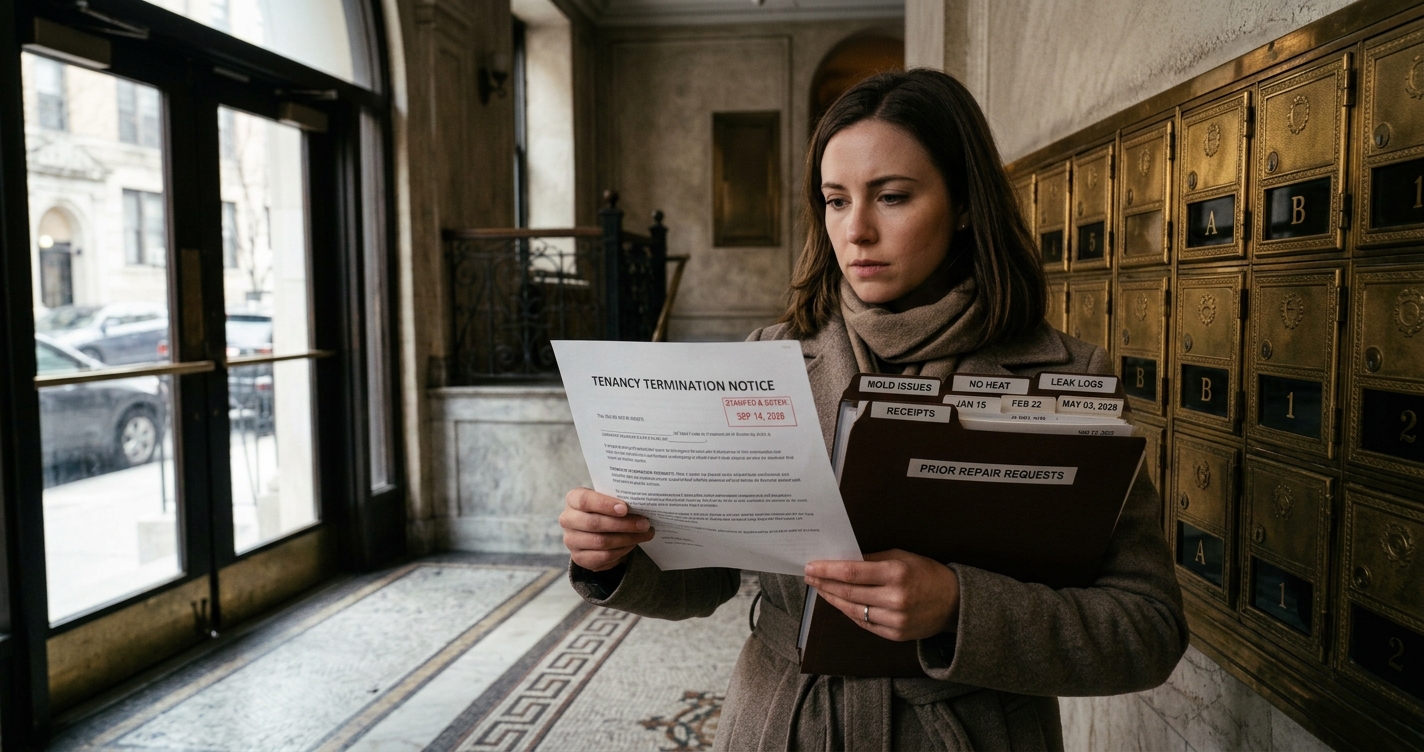
Most tenants who suspect they're being retaliated against run into the same wall: how do I prove it? You complained about the mold, or the broken heat, or the code violations — and then came the termination notice, or the refusal to renew, or the sudden rent hike. You're certain the two are connected. But the landlord will never admit it, and proving what's in someone's head feels impossible. So you assume you can't win, and you don't fight.
Here's what changes that calculation entirely, and what most tenants have no idea exists: under New York's retaliation law, you often don't have to prove the landlord's motive at all. If the landlord took an adverse action against you within one year after you made a qualifying good-faith complaint, the law can create a rebuttable presumption of retaliation — which means the law presumes the action was retaliatory, and shifts the burden onto the landlord to prove it wasn't. You establish the timing; the law supplies the inference. Instead of you struggling to prove retaliation, the landlord is suddenly the one struggling to prove a legitimate, non-retaliatory reason for what they did.
That one-year clock is one of the most powerful and least-understood tools a tenant has, and this guide is about using it. The entire mechanism turns on timing — on the relationship between when you engaged in protected activity and when the landlord moved against you — which means the single most valuable thing you can do is understand the clock and build a timeline around it. This guide will define exactly what counts as protected activity (and why your first written complaint usually starts the clock, not the day you call 311), identify the adverse actions that trigger the presumption, teach you to build the one-year timeline that establishes it, explain honestly what a "rebuttable presumption" does and doesn't get you, and give you a visual checklist of the sequence to document. It's general information rather than legal advice for your situation — a tenant attorney or legal aid can advise on the specifics and help you raise it. But if you've complained and then been punished, the clock may already be running in your favor, and knowing it is the first step to using it.
Let's start with the mechanism itself, because everything else in this guide serves it, and understanding precisely how it works is what makes the rest usable. New York's retaliation statute — Real Property Law § 223-b — does something unusual and powerful: it uses timing to shift the burden of proof.
Here's the structure. Normally, if you claimed your landlord acted out of retaliation, you'd bear the burden of proving that retaliatory motive — a nearly impossible task, since motive lives in the landlord's head and landlords don't confess. But § 223-b changes this. It provides that if a landlord takes certain adverse actions against a tenant within one year after the tenant has engaged in a protected activity — like making a good-faith complaint about conditions — then retaliation is presumed. The law looks at the timing, sees an adverse action following closely on the heels of protected activity, and draws the inference for you: it presumes the landlord acted in retaliation.
And because retaliation is now presumed, the burden flips. It's no longer your job to prove the landlord retaliated; it becomes the landlord's job to prove they didn't — to come forward with a legitimate, non-retaliatory reason for the adverse action and to establish that this legitimate reason, not retaliation, was the actual basis for what they did. If the landlord can't rebut the presumption with a credible, non-retaliatory explanation, the presumption stands, and the retaliation is established. You've won the point not by proving motive, but by establishing timing and letting the law do the rest.
Think about how completely this reverses the usual dynamic. Without the presumption, the tenant is stuck trying to prove the unprovable. With it, the tenant only has to establish something concrete and documentable — that a protected complaint was made, and that an adverse action followed within a year — and then it's the landlord who's stuck, having to prove a negative (that they weren't motivated by the thing the timing strongly suggests). The presumption takes the hardest part of a retaliation claim off the tenant's shoulders and puts an equally hard part on the landlord's. That's why timing is everything here: the temporal proximity between your complaint and the landlord's action isn't just suggestive evidence, it's the legal trigger that shifts the burden.
This is also why the clock is worth understanding with precision. The presumption doesn't arise from any adverse action at any time — it arises when the adverse action falls within one year of the protected activity. That one-year window is the zone in which timing does its work. An adverse action inside the window triggers the presumption; the further outside the window, the weaker the timing inference becomes. So the whole game is understanding when your clock started, when the landlord acted, and whether the second falls within a year of the first — which is what the rest of this guide equips you to figure out and document.
It's worth pausing on why the law is built this way, because understanding the purpose helps you use the tool with confidence rather than feeling like you're relying on a technicality. Retaliation is real and common — landlords do punish tenants for complaining, because a tenant who complains is, from a bad landlord's perspective, a nuisance to be removed. But retaliation is also almost impossible to prove by direct evidence, because no landlord writes "I'm evicting you because you called the inspector." If the law required tenants to prove the landlord's actual motive, the protection against retaliation would be nearly worthless in practice — a right with no realistic remedy. The legislature understood this, and the one-year presumption is the solution: rather than demand the impossible (direct proof of motive), the law uses the one thing that is observable and provable — timing — as a proxy. When punishment follows protected activity closely enough in time, the law treats that proximity as sufficient reason to presume retaliation and make the landlord explain themselves. The presumption exists precisely because it's the only way to make the anti-retaliation right enforceable in the real world, where motive is hidden but timing is not.
Seen that way, invoking the presumption isn't exploiting a loophole — it's using the protection exactly as designed. The law wants tenants to be able to point to suspicious timing and shift the burden, because that's the mechanism it chose to protect the underlying right to complain without fear of reprisal. A tenant who establishes the timing and lets the presumption work is doing precisely what the statute contemplates. That's worth internalizing, because tenants sometimes hesitate to rely on the presumption, feeling they should have "real" proof of motive — but the timing is the proof the law asks for, and it's enough to shift the burden.
The clock starts when you engage in protected activity, so the first thing to understand is exactly what counts — because the range is broader than most tenants realize, and pinning down your earliest protected activity is what maximizes your window.
Under § 223-b, protected activity falls into a few categories. The first and most common is making a good-faith complaint about conditions — and importantly, the complaint is protected whether you make it to the landlord, to the landlord's managing agent, or to a government agency. This is a crucial point that tenants routinely miss: you don't have to have called the city or triggered an official inspection for your complaint to count. A good-faith complaint directly to your landlord or their management — about a health or safety issue, about the warranty of habitability, about the landlord's failure to make repairs — is protected activity that starts your clock. The complaint to a government authority (like calling 311 or filing with a housing agency) is also protected, but it's not the only thing that counts, and it's often not the first thing that counts.
The second category is the tenant's good-faith effort to secure or enforce rights under the lease, under the warranty of habitability, or under other housing laws. Asserting your legal rights as a tenant — pressing the landlord to honor the lease, invoking the protections the law gives you — is itself protected. And a related, recognized form of protected activity is tenant organizing: participating in or forming a tenants' association or organization to address conditions or advocate collectively is protected activity as well.
So the protected zone is wide: complaining about conditions (to the landlord, to management, or to the government), enforcing your rights under the lease or the law, and organizing with other tenants. Any of these can be the protected activity that starts your one-year clock.
Here's the practical insight that flows from this breadth, and it's one of the most important points in this guide: your clock usually starts with your first written complaint to the landlord — not with the later day you called 311 or got an inspection. Because a complaint directly to the landlord or management counts as protected activity, the protected activity often begins well before any government involvement. Tenants tend to think the clock starts when officialdom gets involved — the 311 call, the inspection, the violation notice — but by then, they may have already been making protected complaints directly to the landlord for weeks or months. Every one of those earlier direct complaints was protected activity, and the earliest one is what starts your clock.
Why does this matter so much? Because the earlier your clock starts, the more of the landlord's subsequent conduct falls within the one-year window. If you count your clock only from the 311 call, you might think an adverse action that came thirteen months after your first complaint (but only two months after the 311 call) is inside the window — or you might undercount and think an action is outside the window when, measured from your true first protected complaint, it's within it. Identifying your earliest protected activity — typically your first written complaint to the landlord — is what accurately fixes the start of your clock and maximizes the period during which the presumption can be triggered. So when you reconstruct your timeline, go back to the very first time you complained in a documentable way, not just to the moment the government got involved.
There's a subtlety here worth getting right, though, which is the "good faith" requirement. The complaint that starts your clock has to be a good-faith complaint — a genuine complaint about a real concern, not a sham manufactured just to set up a retaliation claim. For the ordinary tenant with an actual problem — real mold, real broken heat, a real code issue — this is no obstacle at all; it's simply why documenting the underlying condition matters, because your photos and records show your complaint was exactly what the law protects: a sincere report of a genuine problem. The good-faith requirement exists to exclude bad actors gaming the system, not to trip up tenants with legitimate grievances. But it's a reason to make sure your first complaint is a real, substantive one about an actual condition, and to preserve the evidence that it was genuine — because that first genuine complaint is the anchor of everything.
It also helps to make your complaints documentable from the start, precisely because the clock starts with your first one. A verbal complaint to the landlord can count as protected activity, but a verbal complaint is hard to prove and hard to date later. A written complaint — an email, a text, a letter, a message through a tenant portal — is protected activity and self-documenting, fixing both the fact and the date of your protected activity in a form you can produce later. So the practical advice is: complain in writing whenever you can, from the very first time, because doing so both engages the protection and creates the dated record that lets you establish when your clock started. The tenant who complained only verbally for months and then put it in writing has protected activity going back to the verbal complaints, but can most easily prove it from the first written one — which is another reason the first written complaint is so often the practical start of the clock.
The clock is only meaningful if the landlord takes an action that the law recognizes as potentially retaliatory, so let's be clear about which landlord actions trigger the presumption when they fall within the one-year window. The statute reaches a specific but broad set of adverse actions.
The core covered actions are: serving a notice to quit or a termination notice (moving to end your tenancy); commencing an eviction proceeding (filing a case to recover possession); and attempting to substantially alter the terms of the tenancy. That last category is important and expansive — "substantially altering the terms of the tenancy" is understood to reach actions like refusing to renew a lease and imposing an unreasonable rent increase. So the set of adverse actions that can trigger the presumption includes:
Notice that these cover the full range of ways a landlord might punish a complaining tenant, not just outright eviction. The tenant who complained and then got a non-renewal, or a sudden unreasonable rent increase, is protected by the presumption just as much as the tenant who got served with eviction papers. The law recognized that retaliation doesn't always look like a formal eviction — it can look like quietly declining to renew, or pricing the tenant out with an unreasonable increase — and it swept those in.
So when you're assessing whether the presumption applies to your situation, ask: did the landlord, within a year of my protected activity, take one of these actions? A termination notice, a refusal to renew, an eviction filing, an unreasonable rent increase, or another substantial adverse change to my tenancy? If so, and it fell within the one-year window after your protected activity, the presumption of retaliation may well apply — and the burden may already have shifted to the landlord.
One clarification worth making: the "unreasonable" qualifier on rent increases matters. Not every rent increase is retaliatory — landlords can raise rent for legitimate market reasons. But an increase that's unreasonable, especially one that lands suspiciously soon after your protected activity, is the kind of substantial adverse change the presumption can reach. The timing and the unreasonableness together are what make a rent increase look retaliatory, and the presumption is what makes the landlord explain it.
Because the entire mechanism turns on timing, the single most valuable thing you can do is build a clear one-year timeline — a documented sequence showing your protected activity and the landlord's adverse action, with dates, so the temporal proximity that triggers the presumption is established and provable. This is the practical heart of using the clock. Here's how to build it.
Start at your earliest protected activity — your first written complaint. As emphasized above, go back to the very first time you engaged in protected activity, which is usually your first written complaint to the landlord or management about conditions — not the later 311 call. Fix that date as the start of your clock, because it's the earliest point and it maximizes your window. Find the email, the text, the letter, the message — whatever documents that first complaint — and anchor your timeline there.
Record every subsequent protected activity, in order. After that first complaint, log each further protected act with its date: follow-up complaints, additional written requests, the escalation to a government agency (the 311 call, the agency filing), the inspection, any assertion of your rights, any tenant-organizing activity. Each of these is protected activity, and together they show a continuing course of protected conduct. This matters because it means the protected activity isn't a single point but a span, and adverse action following any of it — especially the pattern of it — supports the presumption.
Record the landlord's adverse action, precisely. Log the date and nature of the adverse action: the termination notice, the non-renewal, the eviction filing, the rent increase, the substantial change — whatever the landlord did, and exactly when. This is the other anchor of your timeline, and its date, measured against your protected-activity dates, is what establishes whether the action fell within the one-year window.
Do the math: is the adverse action within one year of the protected activity? With both anchors dated, check the interval. If the adverse action came within one year after your protected activity — and measuring from your earliest protected complaint gives you the most generous window — the presumption may apply. Laying it out with dates makes this a simple, provable calculation rather than a vague sense that "this happened after I complained."
Preserve the documentation behind every entry. A timeline is only as good as the proof behind it, so keep the underlying documents: the written complaints (emails, texts, letters), the agency complaint records and numbers, the inspection reports, the landlord's responses, and the adverse-action documents (the notice, the rent-increase letter, the court papers). Each dated entry on your timeline should be backed by a document you can produce.
Built this way, your timeline does exactly what the law responds to: it shows, with dates and proof, that you engaged in protected activity and that the landlord took an adverse action within a year of it — which is precisely the showing that triggers the presumption and shifts the burden. The timeline transforms "I think this was retaliation" into "here is the documented sequence that the law presumes is retaliation." It is the single most important thing you can prepare.
It's essential to be honest and precise about what the presumption does and doesn't get you, because "rebuttable presumption" is a term that's easy to over- or under-read, and understanding it accurately is what lets you use it well. The presumption is powerful leverage — but it is not an automatic win, and treating it as either magic or meaningless would be a mistake.
Here's what "rebuttable presumption" means. A presumption is a legal inference the law draws once you establish certain facts — here, that an adverse action followed protected activity within a year. Once the presumption arises, the law treats retaliation as established unless the other side rebuts it. That's the powerful part: you don't have to prove motive; the presumption presumes it, and shifts to the landlord the burden of disproving it. The landlord now has to come forward with evidence of a legitimate, non-retaliatory reason for the adverse action.
But "rebuttable" means exactly that — the landlord can rebut it, by producing a credible, legitimate, non-retaliatory reason for what they did. If the landlord shows a genuine, non-retaliatory basis — a real and substantial lease violation unrelated to your complaint, a legitimate business reason that holds up, a non-retaliatory ground supported by evidence — the presumption can be overcome, and then the question becomes whether that explanation is genuine or pretextual. So the presumption doesn't end the case automatically in your favor; it shifts the burden and puts the landlord on the defensive, but the landlord gets to try to meet that burden.
This has two practical implications you should hold together. First, the presumption is genuinely powerful leverage. Shifting the burden to the landlord is a big deal: it's much harder for a landlord to prove a convincing non-retaliatory reason for an action that landed suspiciously soon after your complaint than it would be for you to prove their hidden motive. Many retaliatory actions can't survive this scrutiny, because the honest explanation is the forbidden one and any offered alternative is a pretext that falls apart. The presumption frequently wins cases, and even before court, it's strong leverage — a landlord facing it has real reason to back down.
Second, you still need organized proof, because the presumption is a starting advantage, not a finish line. You have to actually establish the facts that trigger it (the protected activity, the timing) with documentation — which is why the timeline matters. And you should be ready to counter the landlord's attempted rebuttal: if the landlord claims a legitimate reason, your evidence that the reason is pretextual (that the "lease violation" was never enforced before and appeared only after your complaint, that the "business reason" doesn't hold up, that the timing is too neat) is what defeats the rebuttal. The presumption gets you a powerful head start; your organized proof is what carries it across the line. Tenants who understand this — who treat the presumption as strong leverage to be backed by solid documentation, rather than as an automatic win requiring no effort — are the ones who actually prevail.
The honest bottom line: the one-year presumption is one of the strongest tools in tenant law, because it takes the hardest thing (proving motive) off your plate and puts a hard thing on the landlord's. But it rewards preparation. Establish the trigger with a solid dated timeline, be ready to expose a pretextual rebuttal, and the presumption becomes what it's designed to be — the thing that turns a retaliation claim from unwinnable into winnable.
It's worth understanding what a landlord's rebuttal attempt typically looks like, so you can anticipate and counter it. The most common move is for the landlord to assert a lease violation — often one you've never heard about before, or one that was tolerated for years and suddenly matters now. This is where your timeline becomes a weapon a second time: a "violation" that surfaced only after your protected activity, and was never enforced before, looks exactly like a pretext invented to rebut the presumption, and its suspicious timing undercuts the landlord's explanation rather than saving it. Another common rebuttal is a claimed "business reason" — the landlord says the non-renewal or rent increase was just ordinary business. Here, your evidence that the timing is too neat, that comparable tenants weren't treated the same way, or that the stated reason doesn't hold up is what exposes the rebuttal as pretextual. The point is that the landlord's rebuttal isn't the end of the story; it opens a new question — is the offered reason genuine or a cover? — and your documentation is what answers it in your favor.
This is also why you shouldn't be discouraged if the landlord has some reason to point to. Landlords almost always have a reason; the question the presumption forces is whether that reason is the real one or a pretext dressed up to survive scrutiny. A landlord who has to manufacture or inflate a reason to rebut the presumption is a landlord whose rebuttal is vulnerable, and the timing that triggered the presumption in the first place is often the very thing that exposes the rebuttal as pretextual. The presumption doesn't just shift the burden once; it frames the entire fight around the landlord's credibility, which — when the real motive was retaliation — is exactly where you want the fight to be.
To make this concrete and usable, here's the sequence of events to document — a checklist of the typical retaliation timeline, in order, so you can see what to capture and how the pieces build toward the presumption. Think of this as the path your timeline should trace:
1. Repair request / first complaint. Your initial good-faith complaint about conditions — ideally in writing to the landlord or management. This usually starts your clock. Capture the date and keep the document.
2. Follow-up(s). Your subsequent complaints and written follow-ups when the issue isn't resolved — each one further protected activity, extending and reinforcing the record. Capture dates and keep the messages.
3. Agency complaint / escalation. Your escalation to a government authority — the 311 call, the housing-agency filing, the request for an inspection — and the resulting inspection or violation records. Protected activity, and third-party-documented. Capture the complaint number, dates, and any reports.
4. Landlord's adverse action — threats, notice, or rent increase. The turn: the landlord's termination notice, non-renewal, unreasonable rent increase, threatening messages, or other substantial adverse change. This is the action the presumption tests. Capture the date and the document, and note how soon it followed your protected activity.
5. Court papers. If it escalates to an eviction filing, the petition and court papers. Capture these and their dates.
The power of laying it out this way is that the sequence tells the story the presumption responds to: you complained (1), kept complaining (2), escalated (3), and then — within a year, often within weeks or months — the landlord punished you (4, 5). Each step is dated and documented, and the proximity between the protected activity (1–3) and the adverse action (4–5) is what triggers the burden shift. Work through this checklist for your own situation, capturing each step you experienced, and you'll have built exactly the timeline that establishes the presumption.
Two reminders as you use the checklist. First, don't skip step 1 in favor of step 3 — remember that your first written complaint to the landlord usually starts the clock, so anchor the timeline there, not at the agency complaint. Second, keep the documentation behind every step, because the checklist is the skeleton and the documents are what give it force. A dated, documented sequence following this path is the single most persuasive thing you can bring to a retaliation claim.
And use the checklist proactively, not just in hindsight. If you're currently in a dispute with your landlord over conditions — at step 1 or 2, complaining and following up, before any adverse action has happened — this checklist tells you what to be doing right now: complain in writing, keep every message, escalate in a documented way, and preserve it all. A tenant who documents contemporaneously, as each step happens, ends up with a far stronger timeline than one reconstructing it after an eviction notice arrives. The checklist is both a diagnostic for a situation that already unfolded and a playbook for one still in progress — and the tenant who follows it in real time builds, almost automatically, the exact record the presumption rewards.
Let's watch the clock work by following a tenant through the sequence.
Imagine a tenant who, in February, emails his landlord about a persistent leak and resulting mold — a clear, written, good-faith complaint about a habitability issue. He follows up in March when nothing happens, and again in April. Still nothing, so in May he calls 311, which generates a complaint and an inspection that turns up violations. In September — seven months after his first complaint, four months after the 311 call — the landlord serves him with a notice declining to renew his lease and announcing a steep rent increase for any new term.
Run it the way an uninformed tenant would. He sees the non-renewal and rent increase, suspects they're punishment for the mold complaints, but assumes he'd have to prove the landlord's motive, which feels impossible. He doesn't know about the presumption, doesn't think of the timing as legally significant, and doesn't connect his February emails to the September notice as a legal matter. He starts apartment hunting, treating the retaliation he senses as something he can't do anything about.
Now run it informed. He understands the one-year clock. He knows his protected activity started with his first written complaint in February — not the May 311 call — which means his clock started in February, and the landlord's September adverse action falls comfortably within one year of it. He also knows that a non-renewal and an unreasonable rent increase are exactly the kinds of adverse actions the presumption reaches. So he builds his timeline: the February email, the March and April follow-ups, the May 311 complaint and inspection with violations, and the September non-renewal and rent increase — each dated, each documented. Laid out, it shows protected activity beginning in February and punitive action following well within the year. He recognizes that this timing triggers a rebuttable presumption of retaliation, shifting the burden to the landlord to show a legitimate, non-retaliatory reason for the non-renewal and increase. He takes his timeline to a legal aid office. Now, rather than him trying to prove the landlord's hidden motive, the landlord is the one who'll have to explain why he declined to renew and hiked the rent on a tenant who'd been documenting habitability complaints for months — and the landlord's problem is that the honest answer is the forbidden one.
Same tenant, same complaints, same non-renewal and increase. In one version he treats the retaliation as unprovable and walks away; in the other, he recognizes that the timing shifted the burden, builds the timeline that establishes it, and turns an "unprovable" claim into one where the landlord is on the defensive. The difference was understanding the clock — including that it started in February, not May.
The one-year presumption is powerful, but it rewards preparation and is time-sensitive, so a few practical notes to close.
A local tenant-rights organization, legal aid office, or housing help desk can help you determine whether the presumption applies to your situation, build and present your timeline, and raise retaliation properly — as an affirmative defense in an eviction proceeding, or otherwise as your circumstances require. Many of these resources are free, and in some places tenants facing eviction have a right to free counsel. Because establishing the presumption and countering a landlord's attempted rebuttal benefit from experience, getting help is genuinely valuable here.
Act promptly and preserve everything, because timing cuts both ways. The documentation that builds your timeline is easiest to preserve as it happens — so save your complaints, responses, and records from the very first complaint onward, rather than trying to reconstruct them later. Deadlines matter too: if you're facing an eviction, the window to respond and raise retaliation as a defense is short, so don't delay. And remember that one important limit runs through all of this: the retaliation protection generally still requires you to meet your own obligations, particularly paying the rent you actually owe — the presumption is a shield against being punished for complaining, not a license to stop paying, and withholding rent you owe can hand the landlord the very non-retaliatory reason that rebuts the presumption. Keep your own side clean, and let the timing work for you.
Step back and see what the one-year clock really offers. The reason retaliation feels unwinnable — that you can't prove what's in the landlord's head — is exactly the problem the presumption solves. New York's law decided that when a landlord punishes a tenant soon after the tenant exercises protected rights, the timing itself is suspicious enough to flip the burden: instead of the tenant proving the landlord's motive, the landlord must prove a legitimate reason for the punishment. You don't win by reading the landlord's mind; you win by establishing the timing, and letting the presumption do the work that would otherwise be impossible.
Which means the whole game is understanding and documenting the clock. Know what starts it — your protected activity, which usually begins with your first written complaint to the landlord, not the later 311 call. Know what triggers the presumption — a termination notice, non-renewal, eviction filing, unreasonable rent increase, or substantial adverse change, falling within one year of that protected activity. Build the dated, documented timeline that establishes the sequence. Understand that the resulting presumption is powerful leverage but not an automatic win, so back it with organized proof and be ready to expose a pretextual rebuttal. And follow the sequence — complaint, follow-up, agency complaint, landlord's adverse action, court papers — capturing each step.
So if you complained about your home and then found yourself hit with a notice, a non-renewal, a rent hike, or an eviction filing, don't assume you can't prove retaliation and give up. Look at the calendar. Find your first written complaint, mark the date of the landlord's adverse action, and see whether the second falls within a year of the first. If it does, the timing may already have shifted the burden to your landlord — and your job isn't to prove the unprovable, but to document the sequence that makes the law presume what you already know. Let the clock work for you. Find out where you stand.