"Inspection" might be the most abused word in rental housing.
It has a respectable sound to it. A landlord has a legitimate right to enter a rental unit for real reasons — to make repairs, to inspect for genuine maintenance needs, to handle an emergency. That right is real, and no honest article would tell you otherwise. But watch what happens when a landlord who wants to unsettle you discovers that the word "inspection" opens your door. Suddenly there are inspections constantly. Inspections that reveal nothing and fix nothing. Inspections announced with almost no notice, or none. Inspections that seem timed to catch you off guard, that recur for no discernible reason, that leave you feeling watched in the one place you're supposed to feel safe. The legitimate right has become a key — one the landlord can turn whenever he wants to remind you that your home is not entirely yours.
That's the loophole: a genuine legal right, stretched and repeated and weaponized until "maintenance" stops being about maintenance and becomes about control. And because entry for inspection is legitimate in principle, tenants struggle to name what's wrong when it's abused in practice. You can't quite object to an inspection — he's allowed to inspect, isn't he? So you let him in, again, and again, and the intrusion that's eating at your privacy hides behind a word you feel you can't argue with.
This article is about telling the difference between real maintenance and maintenance-as-intimidation — and about the fact, which many tenants don't know, that a landlord's right to enter is not unlimited, that "I own the building" does not mean "I can come in whenever I please," and that entry abused into harassment is something the law actually recognizes and restrains. Let's take the loophole apart.
The confusion clears up considerably once you can distinguish the legitimate reasons for entry from the suspicious ones, so start there.
A genuine repair is entry with a real, specific purpose: something is broken, you or the landlord identified it, and someone is coming to fix that specific thing. It has a subject. It resolves in work actually being done. You can tell it's real because afterward, the thing is fixed.
A routine inspection is a periodic, legitimate check — an annual safety inspection, a check of smoke detectors, a look at a known issue. The key word is routine: it happens on a normal, predictable cadence, for a stated and sensible reason, not constantly and not at random.
An emergency is the one situation where a landlord can enter without notice and without your consent — a fire, a gas leak, a burst pipe, a flood threatening the building. Genuine emergencies are immediate threats to health or property, and they're rare. The emergency exception is narrow, and it exists for actual emergencies, not for a landlord's convenience or curiosity.
And then there's the suspicious recurring visit — the one that doesn't fit any of the above. It has no specific subject, or a vague one that keeps shifting. It recurs far more often than any real maintenance need would justify. Nothing ever actually gets fixed, because there was never really anything to fix. It comes with little or no notice, or at odd times. And it leaves you feeling not maintained but surveilled. This is the category the loophole runs on, and the tell is simple: after a genuine repair, something is repaired; after a suspicious inspection, nothing has changed except that the landlord was in your home again.
Learn to sort entries into these four buckets, because the sorting is where clarity begins. One or two real repairs and a routine annual inspection is normal life. A steady stream of subject-less "inspections" that fix nothing and recur every couple of weeks is not maintenance. It's a pattern wearing maintenance as a disguise.
It's worth being explicit about the harm here, because tenants tend to minimize it — he only stopped by, what's the big deal — and the minimizing is part of how the abuse survives.
Your home is where you're supposed to be able to exhale. It's where you sleep, work, raise children, recover, and simply exist without being observed or evaluated. Repeated entry — or even the repeated threat of entry, the sense that the landlord might appear at any time — poisons exactly that. If you work from home, unpredictable inspections shatter your ability to concentrate and to hold professional calls without a landlord wandering through. If you work nights and sleep days, daytime entries wreck your sleep on a schedule the landlord knows and ignores. If you're a caregiver — for a child, an elder, someone ill — a stranger's intrusion disrupts fragile routines and the privacy that care requires. If you've ever had reason to fear for your safety, a person entering your space at will is not a minor inconvenience; it's a violation of the one place that's supposed to be secure.
And underneath all the specific disruptions is a general one: the erosion of your sense of safety at home. A person who might enter at any time is a person in whose building you are always slightly on guard, never fully private, never entirely at rest. That low, constant vigilance is exhausting in a way that's hard to convey to someone who hasn't lived it — and it's frequently the actual goal of the abuse. A landlord who wants you unsettled, compliant, or gone has found, in the inspection, a way to keep you permanently uneasy while never once doing anything he can't describe as legitimate property management. The harm is real even though each visit is "just an inspection." In fact, the harm is the point, and the inspection is the cover.
Here is the fact the whole loophole depends on you not knowing: a landlord's ownership of the building does not give them the right to enter your home whenever they want. Ownership is not a master key. The right to enter is real, but it is limited — hedged by requirements of purpose, notice, and timing that exist precisely to protect your privacy and possession of your home.
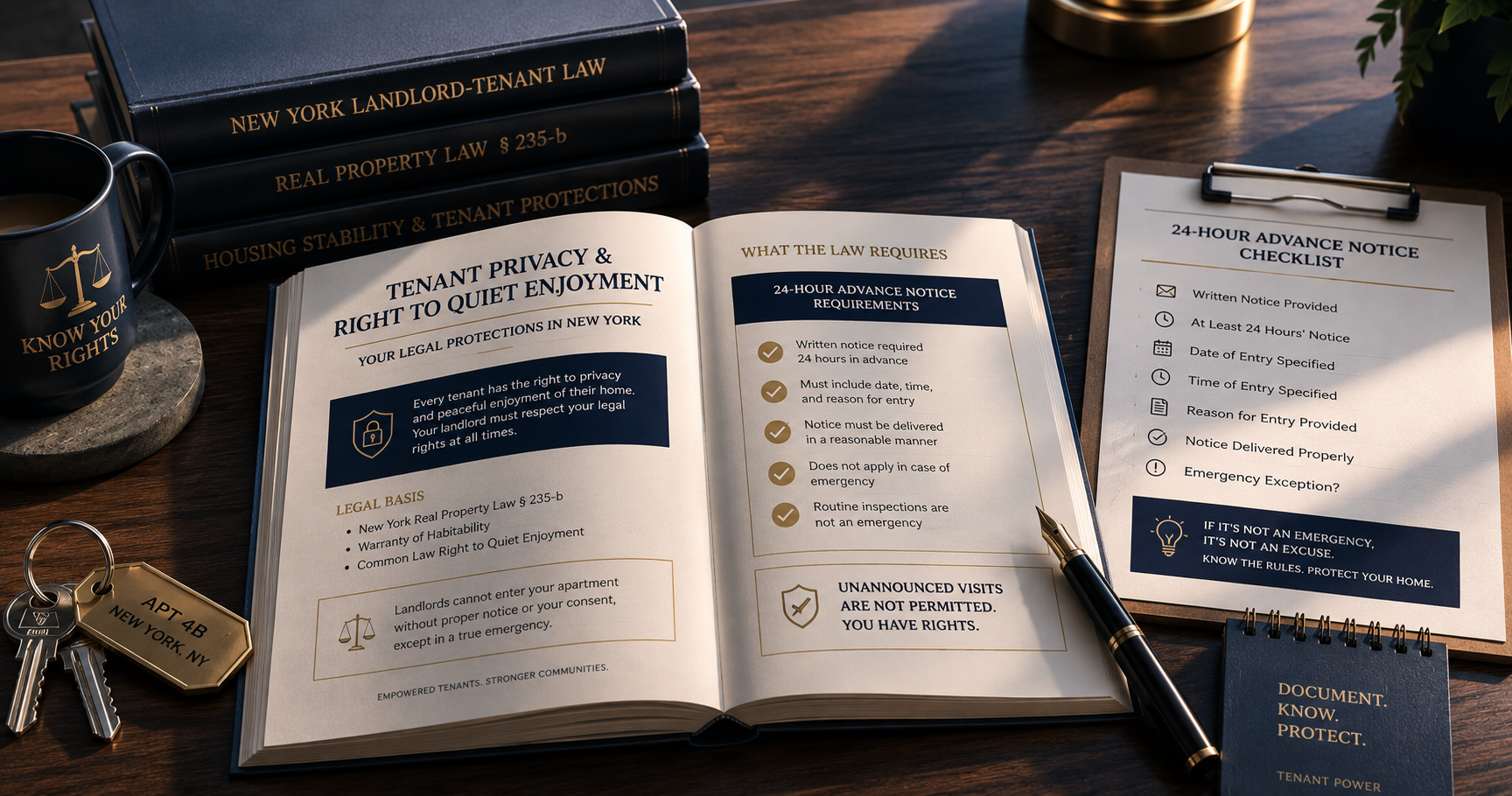
The specifics vary by place, but the shape is remarkably consistent, and New York illustrates it well. A landlord generally may enter only for a legitimate purpose — a real repair, a genuine inspection, a showing, an emergency — not simply because they feel like it. For non-emergencies, they generally must give reasonable advance notice; in New York, the Attorney General's office has interpreted "reasonable" as around 24 hours' notice for an inspection and roughly a week's notice for repairs, and that notice should state the reason for entry. Entry must happen at a reasonable time — generally normal business hours, not 11 p.m. on a Saturday because the landlord was "in the neighborhood." And only a true emergency dissolves the notice requirement.
Sit with what that means against the abuse pattern. The landlord staging constant surprise inspections with no notice is very likely violating the notice requirement. The one showing up at odd hours is violating the reasonable-time requirement. The one whose "inspections" have no real subject and fix nothing may be failing the legitimate-purpose requirement entirely. The behavior that felt unchallengeable — because "he's allowed to inspect" — is, in its actual execution, frequently outside what the law permits. He's allowed to inspect. He is not allowed to inspect this way.
And there's a further layer that matters most when entry crosses into a campaign. The law doesn't only regulate individual entries; it protects your right to the peaceful enjoyment of your home. In New York, a landlord who willfully and intentionally interferes with a tenant's quiet enjoyment of the premises is committing a violation, and a landlord cannot use the right of entry as a tool to harass. That's the crucial recognition: entry weaponized into intimidation isn't a gray area the landlord is cleverly exploiting. Past a certain point it's harassment, and harassment is independently unlawful. The loophole isn't as airtight as the landlord is counting on. It only holds if you don't know where its edges are.
Because each entry can be dressed up as legitimate, the way you defeat the loophole is the same way you defeat every plausible-deniability tactic: you document, until the pattern the landlord is hiding becomes a record anyone can see. A single "inspection" is deniable. A logged year of them is not.
For every entry or entry request, capture the specifics. The notice — when it came, how, and how much warning it gave, or that none was given at all. The stated reason — what the landlord claimed the entry was for, in their own words, which matters enormously when the "reason" keeps shifting or evaporating. Who entered — the landlord, a worker, someone unidentified. When and how long — the date, the time, and the duration, because a five-minute walk-through that fixes nothing tells a different story than an actual repair. Whether repairs actually happened — this is the single most revealing data point, because a pattern of "maintenance" visits that never maintain anything is the clearest possible evidence that maintenance was never the purpose. And photos, where appropriate — of the condition before and after, which either shows real work was done or shows that nothing was.
Keep it all in one running log, entry by entry. What emerges over time is the thing the loophole cannot survive: a timeline. "He inspects a lot" is a feeling the landlord can wave away. "Eleven entries in three months, notice given twice, stated reasons vague and inconsistent, zero repairs actually completed" is a documented pattern that speaks for itself — and speaks the language that a tenant-rights organization, a housing agency, or a court understands. The whole power of the inspection loophole is that each entry looks isolated and defensible. Your log dissolves that by assembling the entries into the pattern they actually form.
Two more moves strengthen the trail. Set a boundary in writing — a calm message noting that you're happy to accommodate entry for genuine repairs and inspections with proper notice, but that you'd ask for the notice the law requires and for entries to be limited to actual, stated purposes. This is fair, it's reasonable, and it does double duty: it may curb the behavior, and if it doesn't, it proves you asked and were ignored, which converts "persistent maintenance" into knowing disregard. And note the impact — a brief record of how the entries are affecting your work, sleep, caregiving, or peace of mind, written as it happens, because when entry crosses into harassment, the effect on you is part of what makes it so.
Step back and see the whole shape of the loophole. It works by borrowing the legitimacy of a real right — the landlord's genuine ability to enter for genuine reasons — and stretching that legitimacy over behavior that has nothing to do with maintenance and everything to do with control. It survives on your belief that because entry can be legitimate, this entry must be, and that because he owns the building, he can come in as he likes. Both of those beliefs are false, and they are the only things holding the loophole together.
So take them apart. "He's allowed to inspect" is true and beside the point; the question is whether this, done this way, this often, with this little notice and this little purpose, is a legitimate inspection or a pattern of intimidation wearing the word. "He owns the building" is true and also beside the point; ownership is not a master key, entry is limited by purpose and notice and timing, and entry abused into harassment is something the law names and restrains. You are not powerless against a landlord who has turned "maintenance" into a method of pressure — you are, in fact, holding rights he's betting you won't invoke.
You don't have to refuse a single legitimate repair to reclaim your ground. You just have to stop treating the word "inspection" as a spell that suspends your rights, start sorting real entries from the suspicious ones, and keep the log that turns a stream of deniable visits into an undeniable pattern. Your home is where your life happens. The right of entry was never meant to take that from you, and used as a weapon, it may be crossing lines the law drew precisely to stop it. Find out where you stand.