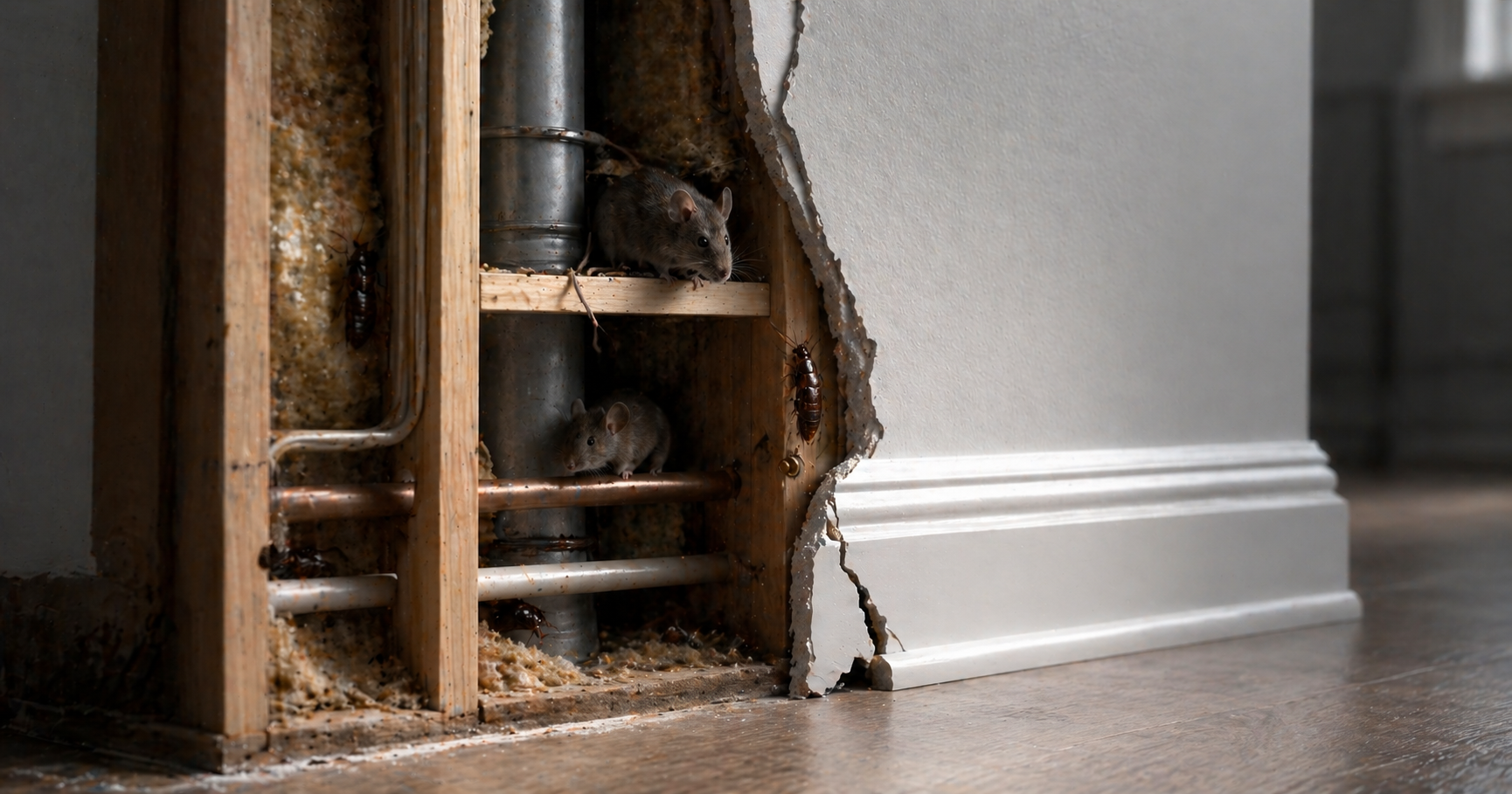
You've been dealing with pests in your apartment, and you're trying to figure out when this crosses from "unpleasant reality of city living" to "serious legal violation my landlord must fix." Maybe you've seen a few roaches here and there over the past months—occasionally one scurrying across the kitchen counter at night, sometimes spotting them in the bathroom. Or perhaps you've heard scratching sounds in your walls at night and found mouse droppings in your kitchen cabinets, along with chewed-through food packages and evidence that mice are nesting somewhere in your apartment. Or maybe you're waking up with itchy welts and finding small blood spots on your sheets, and you've discovered bedbugs hiding in your mattress seams and furniture.
You've mentioned the problem to your landlord. Maybe they sent an exterminator once, but the pests came back within weeks. Or perhaps they told you to keep your apartment cleaner and dismissed your concerns. Or they've done nothing at all, ignoring your complaints. The pest problem is getting worse—you're seeing roaches daily now, or finding fresh mouse droppings every morning, or the bedbug bites are spreading to multiple household members. You're anxious, disgusted, losing sleep, and in the case of bedbugs, potentially facing social isolation because you're afraid to have visitors or go places where you might spread the infestation.
You think: "When does a pest problem become serious enough to be a legal violation? How many roaches is too many? If I see one mouse, is that an infestation, or does it have to be multiple mice? Are bedbugs automatically a landlord's responsibility? Can I do anything legally about this, or do I just have to keep complaining and hope the landlord eventually addresses it properly? At what point does this become uninhabitable?"
Here's the truth: In New York, pest problems transition from unpleasant nuisances to legal habitability violations when they constitute actual infestations—ongoing, pervasive pest presence that the landlord fails to promptly and effectively address through proper extermination and elimination of conditions enabling pest proliferation. Particularly for roaches, mice, rats, and bedbugs, New York law (including NYC's Local Law 55 specifically targeting pest infestations) treats persistent pest problems as serious health and safety violations requiring immediate landlord remediation. The key factors are the severity and persistence of the infestation, evidence that it's a building-wide or structural problem rather than tenant-caused, landlord knowledge and failure to adequately respond, and health or safety impacts on tenants.
Let me show you exactly what New York law requires regarding pest control, when pest sightings cross into legally actionable infestations, how specific pests like roaches, mice, rats, and bedbugs are treated under housing codes, what documentation you need to prove a pest infestation exists, and what legal remedies you can pursue when landlords fail to address serious pest problems.
Before identifying when specific pest problems violate habitability, understand the legal framework governing landlord pest control obligations.
New York's warranty of habitability—requiring all residential rentals to be safe, sanitary, and fit for human habitation—explicitly encompasses freedom from pest infestations as a core habitability requirement.
Pest infestations violate the "safe and sanitary" standard because pests create health hazards, contaminate living spaces, damage property, and make housing unsuitable for healthy occupation. Cockroaches, mice, rats, and bedbugs all carry diseases, trigger allergies and asthma, contaminate food and surfaces, create psychological distress, and in the case of bedbugs, cause physical harm through bites. These aren't mere aesthetic problems—they're genuine health and sanitation hazards.
Courts and housing agencies consistently recognize serious pest infestations as habitability violations. Case law treating cockroach infestations, rodent infestations, and bedbug infestations as breaches of the warranty of habitability is well-established. Landlords cannot claim pests are normal, acceptable, or tenant responsibility when infestations are building-related problems requiring professional extermination and structural repairs.
The landlord's obligation is both reactive and preventive. Landlords must respond to pest complaints by arranging professional extermination, addressing conditions that enable pest entry and proliferation (sealing holes and cracks, fixing plumbing leaks, addressing trash storage issues), and taking building-wide coordinated approaches when pests affect multiple units. Landlords cannot simply tell tenants to clean better or deal with pests themselves—professional pest control is a landlord responsibility under habitability law.
New York City has gone beyond general habitability requirements by enacting specific legislation targeting pest infestations.
Local Law 55, which took effect in 2018, addresses indoor allergen hazards including pest infestations. The law explicitly names mice, rats, and cockroaches as indoor allergen hazards that landlords of buildings with three or more dwelling units must prevent, investigate, and remediate.
Under Local Law 55, landlords must:
The law recognizes pests as allergen sources triggering asthma and allergies, particularly in children. Cockroach allergen is a major asthma trigger, and rodent allergens similarly affect respiratory health. By classifying pests as allergen hazards requiring landlord action, Local Law 55 provides specific legal requirements beyond general habitability principles.
HPD enforces Local Law 55 through inspections, violations, and fines. Landlords found to have pest infestations face violations with correction deadlines and penalties for non-compliance. The law gives NYC tenants particularly strong legal grounds to demand pest remediation backed by specific statutory obligations.
Understanding how housing agencies classify pest violations helps gauge the severity with which authorities treat these problems.
HPD in NYC classifies mice, rats, or cockroaches in dwelling units or common areas as Class C (immediately hazardous) violations. This classification places pest infestations among the most serious housing code violations, requiring correction within 24 hours for immediately hazardous designation or 30 days for other pest-related violations.
The "immediately hazardous" classification reflects official recognition that pest infestations create acute health and safety risks, not minor inconveniences. Pests are treated with the same seriousness as other immediate hazards like no heat in winter or exposed electrical wiring.
Bedbug violations are similarly classified as serious health hazards requiring prompt landlord remediation. While bedbugs aren't listed in Local Law 55 like roaches and rodents, they're still treated as habitability violations under general housing codes and warranty of habitability.
Violation notices establish:
The legal trend is toward even stronger pest-related protections.
A pending New York State bill would write into state law that any pest infestation constitutes a condition "dangerous to health" and automatically breaches the warranty of habitability. While current law already treats serious infestations as habitability violations, explicit statutory language would eliminate any ambiguity and strengthen tenant protections statewide.
This legislative movement reflects growing recognition of pest infestations as serious public health issues, particularly given connections to asthma, allergies, disease transmission, and psychological harm. The direction of law is toward treating pest problems more seriously and imposing stricter landlord obligations, not toward relaxing protections.
Understanding the difference between isolated pest sightings and infestations helps assess whether your situation rises to habitability violation.
Isolated pest sightings might occur in any building and don't necessarily indicate infestation or habitability violations if promptly addressed.
Seeing one roach once over several months, especially if you live in an urban area where roaches can enter from outside or neighboring units, might not constitute infestation. Catching a single mouse once, if it appears to be an isolated entry and is quickly trapped without evidence of more, similarly might not reach infestation level.
These isolated incidents still warrant:
However, by themselves, rare isolated sightings probably don't support major legal claims if landlord responds appropriately.
Infestation indicators include:
Regular, repeated sightings. Seeing roaches multiple times per week or daily, observing mice frequently or hearing them regularly in walls, or finding bedbugs repeatedly indicate established populations, not isolated incidents.
Multiple pests. Seeing several roaches at once, catching multiple mice, or finding numerous bedbugs suggests significant population requiring professional intervention.
Evidence of nesting and reproduction. Finding cockroach egg cases, discovering mouse nests with babies, identifying bedbug eggs and nymphs along with adults—these prove pests are living and breeding in your dwelling, not just passing through.
Droppings and damage. Mouse droppings accumulating in cabinets or along walls, roach feces appearing as dark spots or smears, bedbug fecal spots on bedding—these physical traces indicate ongoing presence. Gnawed food packaging, chewed wires or materials, damaged clothing or belongings point to rodent or insect activity.
Widespread distribution. Finding pests in multiple rooms, discovering evidence throughout the unit rather than confined to one area, or knowing neighbors also have problems suggests building-wide infestation requiring comprehensive treatment.
Health impacts. Experiencing allergic reactions, asthma exacerbations triggered by cockroach or rodent allergens, bedbug bites affecting sleep and wellbeing—these health effects demonstrate the infestation is affecting your safety and habitability.
Persistence despite landlord attempts. If landlord sent an exterminator once but pests returned within days or weeks, or if multiple treatments haven't eliminated the problem, this proves infestation is serious and requires more comprehensive remediation than initial attempts provided.
Different pests have different indicators of when problems become legal violations.
Cockroaches: These pests reproduce rapidly, and visible roaches often indicate much larger hidden populations (for every roach you see, many more are hidden). Seeing roaches regularly, finding them in multiple areas, discovering egg cases, or observing them during daytime (suggesting overcrowding forcing them into the open) all indicate serious infestation. Even a few roaches can indicate a problem requiring professional treatment because they multiply quickly if not addressed.
Mice and rats: Rodent infestations are indicated by droppings (small dark pellets from mice, larger from rats), gnaw marks on food packaging or structural materials, scratching or squeaking sounds in walls or ceilings, visible rodents (especially more than one or sightings in living areas rather than just basements/storage), holes in walls or baseboards where rodents enter, and nesting materials (shredded paper, fabric, insulation). Finding even one mouse warrants investigation because mice rarely travel alone—where there's one, there are usually more.
Bedbugs: Any bedbug presence is serious. Unlike roaches or mice where single sightings might be isolated, bedbugs don't randomly appear—they're brought in through infested furniture, luggage, or spread from neighboring units. Finding even one bedbug or experiencing bites suggests potential infestation requiring immediate professional inspection and treatment. Signs include bites (often in lines or clusters, itchy welts), live bugs (small brown insects), bedbug fecal spots (tiny dark spots on bedding, mattresses, furniture), shed skins from molting bedbugs, and blood spots on sheets. Bedbugs are difficult to eliminate, and even small populations require professional heat treatment or chemical treatment.
Beyond the type and number of pests, the pattern of occurrence and persistence despite landlord action determine legal significance.
Recurring problems even after extermination demonstrate the infestation hasn't been adequately addressed. If roaches return within a week of spraying, if mice reappear after trapping, if bedbugs survive initial treatment—these patterns prove that underlying conditions enabling pest presence haven't been corrected and more comprehensive approaches are needed.
Long-term persistence where you've been dealing with pests for months despite multiple complaints shows the landlord isn't fulfilling habitability obligations. Living with ongoing pest problems for extended periods creates the cumulative impact making housing uninhabitable even if any single day's pest sighting might seem tolerable.
Escalation over time—pest problems getting worse despite landlord awareness and supposed intervention—demonstrates landlord failure. If you went from occasional roaches to daily sightings, from hearing one mouse to finding droppings everywhere, from a few bedbug bites to household members covered in bites—this progression proves habitability is deteriorating, not being maintained.
Pest infestations aren't just aesthetic problems—they create genuine health hazards and safety issues that justify legal intervention.
Different pests create different health threats, all supporting habitability violation claims.
Cockroaches carry pathogens causing food poisoning, dysentery, and other gastrointestinal illnesses. They contaminate food preparation surfaces, eating utensils, and stored food with bacteria from sewers and garbage. Cockroach allergen from feces, saliva, and shed body parts is a major trigger for asthma and allergies, particularly in children. Studies link cockroach exposure to increased asthma rates, emergency room visits, and respiratory health problems. Cockroach allergen in homes contributes to the childhood asthma epidemic, making roach infestations a serious public health issue.
Mice and rats carry numerous diseases transmissible to humans through droppings, urine, saliva, and bites. Hantavirus from rodent waste can cause severe respiratory disease. Salmonella and other foodborne pathogens spread through contaminated surfaces. Leptospirosis from rodent urine can cause serious illness. Rat-bite fever and other infections can occur from bites or scratches. Beyond direct disease transmission, rodent allergens trigger asthma and allergies. Rodent presence creates constant contamination of living spaces with disease-carrying waste.
Bedbugs cause physical harm through bites resulting in itchy welts, skin irritation, potential secondary infections from scratching, and allergic reactions ranging from mild to severe. Beyond physical effects, bedbugs create serious psychological impacts including anxiety, insomnia (fear of being bitten preventing sleep), social isolation (avoiding having visitors or going places where bedbugs might spread), and significant emotional distress from living with parasitic insects feeding on you. The difficulty of eliminating bedbugs and their rapid spread creates ongoing trauma for affected residents.
Pests damage property and contaminate living spaces in ways that support habitability violations.
Food contamination from roaches and rodents renders food unsafe. Finding roach droppings in your pantry, discovering gnawed food packages with mouse waste, or knowing roaches have walked across dishes means you must discard food and thoroughly clean surfaces. The ongoing cost of replacing contaminated food and the inability to safely store food in your own home constitute habitability issues.
Surface contamination means counters, tables, utensils, and eating areas are fouled with pest waste, requiring constant cleaning and never being truly sanitary while infestation continues.
Property damage from rodents gnawing through belongings, bedbugs destroying mattresses and furniture that must be discarded, roaches damaging books, papers, and electronics—these economic losses are consequences of habitability violations.
Psychological uninhabitability must not be dismissed. Living in constant fear of pests, feeling invaded in your own home, losing sleep from bedbug bites or mouse sounds in walls, experiencing disgust and distress from roach encounters—these psychological impacts make housing genuinely uninhabitable even if physical health isn't directly endangered. Courts recognize that habitability encompasses not just physical safety but ability to peacefully use and enjoy housing, which serious pest infestations destroy.
If you're experiencing a serious pest infestation, strategic documentation and action can compel landlord remediation.
Evidence is critical for proving infestations exist and landlord has failed to adequately address them.
Photograph and video pests and evidence:
Include context and scale in photos—show the room and location where pests appear, include something for size reference, date-stamp images.
Keep a pest sighting log:
Date | Pest Type | Location | Number/Description | Photos? |
| 3/5 | Roaches | Kitchen counter | 2 adult roaches | Yes |
| 3/7 | Mouse droppings | Under sink | ~20 droppings | Yes |
| 3/8 | Bedbugs | Mattress seam | Found 3 live bugs | Yes |
| 3/10 | Roaches | Bathroom | 1 roach | Yes |
This log demonstrates:
Document health impacts:
Save contaminated food or damaged items if possible (or photograph before disposal) showing economic impacts.
Formal written notice is legally essential and creates records of landlord knowledge and failure to act.
Initial notice when problem begins:
"This email notifies you of a pest infestation at [address, unit]. I have been seeing [roaches/mice/bedbugs] regularly in my apartment. [Describe specific evidence: locations, frequency, droppings, bites, etc.] I have attached photographs documenting the infestation.
This pest infestation violates New York's warranty of habitability and [NYC Local Law 55 / state housing codes]. Pests create health hazards and make the apartment unsanitary and unsafe.
I request immediate action:
Please respond within 3 days confirming when exterminator will be scheduled and what comprehensive measures will be taken."
Follow-up notices after inadequate response:
"This is my [second/third] notice regarding the ongoing pest infestation. Despite my report on [date] and [mention any landlord actions: exterminator visit on X date], the infestation persists. [Describe current status: pests still appearing, problem worsening, treatment was inadequate.]
The continued infestation violates habitability. I have documented [number] pest sightings since last treatment. The failure to adequately remediate is unacceptable.
I demand comprehensive professional pest control including [specific needs: sealing entry points, building-wide treatment, heat treatment for bedbugs, etc.]. If this infestation is not resolved within [reasonable deadline], I will pursue legal remedies including reporting to HPD, seeking rent abatement, and [other remedies]."
Save all landlord responses including promises to send exterminators, excuses, or dismissals of the problem. These communications prove landlord knowledge and document their response or lack thereof.
Official inspections create powerful leverage and evidence.
In NYC, call 311 to report pest infestations:
HPD will:
Fire Department or Health Department in some cases may also have jurisdiction over pest issues affecting health and sanitation.
Outside NYC, contact:
Official violations:
When landlords fail to adequately address infestations despite notice and violations, legal action becomes necessary.
Rent abatement claims seek rent reduction to reflect the dwelling's diminished value during infestation. Serious pest problems can support substantial rent reductions—living with bedbugs, pervasive roaches, or rodent infestations significantly reduces the value of housing, potentially justifying 20-50% or more rent reductions depending on severity.
HP (Housing Part) proceedings in NYC allow you to bring landlord to court to compel pest remediation. Courts can order specific extermination and remediation measures, impose deadlines, appoint administrators to arrange treatment if landlord won't, and reduce rent until violations are corrected.
Constructive eviction in severe cases where infestation is so pervasive and persistent that the apartment is effectively uninhabitable can justify breaking your lease without penalty. Requirements include serious, ongoing infestation, landlord knowledge and failure to adequately remediate, conditions making dwelling unlivable, and actually vacating within reasonable time.
Damages claims for harm suffered can seek compensation for: medical expenses from pest-related health problems, cost of replacing contaminated food and damaged belongings, cost of temporary housing during severe infestations, pest control costs if you hired your own exterminator (potentially recoverable), and emotional distress from living with serious infestations.
Legal services and help:
Pest problems cross from nuisance to legal habitability violations when they constitute actual infestations—regular sightings, evidence of nesting and reproduction, persistence despite landlord notification, and failure of landlord to provide adequate professional remediation.
New York's warranty of habitability and NYC Local Law 55 explicitly require landlords to keep apartments free of roaches, mice, rats, and bedbugs, and to fix conditions enabling pest presence.
HPD classifies pest infestations as Class C (immediately hazardous) violations requiring urgent correction—this is how seriously authorities treat pest problems.
Infestations are indicated by: regular/frequent pest sightings, multiple pests or widespread distribution, droppings and physical evidence, health impacts, and persistence despite treatment.
Isolated rare sightings with prompt landlord response probably don't yet constitute uninhabitable conditions, but document them in case they develop into patterns.
Document everything: Photos of pests and evidence, pest sighting logs with dates/locations/descriptions, photos of bites or damage, health records if affected.
Notify landlord in writing demanding professional extermination, building-wide treatment if needed, and repair of entry points and pest-enabling conditions.
Call 311 (NYC) or local code enforcement to trigger official inspections and violations.
Escalate if problems persist: Pursue rent abatement, HP proceedings for court-ordered remediation, constructive eviction for severe cases, damages for harm suffered.
You have the right to pest-free housing. Serious infestations are habitability violations you can fight legally.