You did the responsible thing. The heat wasn't working, or the mold was spreading, or something in the apartment was genuinely unsafe — so you spoke up. You asked for the repair, or you reported the violation to the city, or you called an inspector. And then, not long after, something shifted. A rent increase appeared. A non-renewal notice arrived. Suddenly you were getting written up for lease "violations" that had never been an issue before, or hearing veiled threats about eviction. And a cold thought settled in: is this happening because I complained?
If you're asking that question, there's a good chance the answer is yes — and there's something important you need to know: what you're describing has a name, it's illegal, and there are specific things you can do about it. When a landlord takes a negative action against you because you exercised a legal right — reporting a violation, requesting a repair, organizing with other tenants — that's retaliation, and retaliation is prohibited. The law specifically protects tenants who speak up about conditions, precisely because lawmakers understood that without such protection, tenants would be too afraid to report the problems that keep housing safe. You are not powerless here, and you are not wrong to connect the dots between your complaint and the landlord's response. Connecting those dots is exactly what the law asks you to do.
This is a roadmap for recognizing retaliation and responding to it effectively. We'll identify the protected activities that trigger these protections, help you spot the retaliatory actions and — critically — the timing that reveals them, walk you through building a simple retaliation timeline that becomes the backbone of any complaint or defense, give you a template for a retaliation objection letter, and lay out your next steps if the situation escalates. The throughline is that retaliation is not just a wrong you have to endure — it's a recognized legal violation with a clear response, and the same act that made you a target (speaking up) is the protected activity that gives you power. Let's start by naming what you did that the law protects.
Before the roadmap, it's worth understanding how retaliation actually operates on you, because seeing the mechanism is what breaks its hold. Retaliation isn't only about punishing one tenant for one complaint. Its deeper function — whether the landlord consciously intends it or not — is to teach a lesson: speaking up costs you. And that lesson, once learned, does the landlord's work far beyond the single incident, because a tenant who's been burned for complaining goes quiet, and so do the neighbors who watched it happen.
This is what lawyers and lawmakers call the "chilling effect," and it's precisely what retaliation law exists to prevent. Think about why. Safe housing depends on tenants being willing to report dangerous conditions — the broken heat, the gas leak, the mold, the wiring. If landlords could freely punish tenants for reporting, tenants would learn to stay silent, dangerous conditions would go unreported, and everyone would be less safe. So the law protects tenants who speak up not as a favor to them, but because tenant reporting is a mechanism that keeps housing habitable for everyone. When you reported that violation, you weren't just helping yourself; you were doing exactly what the system needs people to do, and the law protects you for it.
Understanding this reframes the self-blame that retaliation is designed to produce. When the reprisal comes, the natural feeling is regret — I shouldn't have said anything, I brought this on myself, complaining was a mistake. That feeling is the chilling effect working on you in real time. But it's built on a false premise. You didn't make a mistake by exercising a protected right; the landlord made a mistake by retaliating against a protected act. The regret is pointing at the wrong party. Once you see that your complaint was legitimate and valuable, and that the retaliation — not the complaint — is what crossed a legal line, the self-blame loses its grip, and you can respond from a position of being in the right, which is exactly where you are.
The foundation of any retaliation claim is that you engaged in a protected activity — an action the law specifically shields from landlord reprisal. So the first step is to identify clearly what you did, because naming it is what establishes that you were exercising a right rather than doing anything wrong. And the range of protected activities is broader than many tenants realize.
The clearest category is reporting code or safety violations to a city or state agency. When you contact a housing agency, a code enforcement office, or any government body about conditions in your apartment or building, you're exercising a protected right. The same is true when you call in health or housing inspectors — bringing in an official to document conditions is squarely protected activity. These reports are exactly what the law wants tenants to be able to make without fear, because they're how dangerous conditions get identified and fixed.
But protected activity extends further. Asking your landlord directly for repairs — even without going to an agency — is generally protected in many places, including New York, where complaints made directly to the landlord count. Joining or organizing a tenant union is protected; collective tenant action is something the law specifically shields, because landlords have historically targeted organizers. Filing a formal complaint of any kind about your housing is protected. Even speaking to the media about conditions can be protected activity. The common thread is that these are all ways of asserting your rights or advocating for habitable conditions — and the law protects the whole range, not just the narrow act of calling a city inspector.
Understanding the breadth here matters, because you may have engaged in protected activity without fully realizing it "counted." Maybe you didn't file a formal agency complaint — you just emailed your landlord repeatedly about the broken heat. That's likely still protected. Maybe you didn't join a formal union — you just talked with neighbors about a shared problem and signed a group letter. That may well be protected too. So as you think back over what you did before the landlord's negative action, cast a wide net. List every way you asserted your rights or raised concerns about conditions: the agency reports, the inspector calls, the repair requests to the landlord, the organizing, the complaints. Each of these is a potential protected activity, and each one is a foundation stone for recognizing the landlord's response as retaliation. The more completely you can identify what you did, the clearer it becomes that you were simply exercising rights the law guarantees you — which is exactly what makes the landlord's reprisal unlawful.
One qualifier is worth knowing: the protection generally attaches to complaints made in good faith — meaning you genuinely believed there was a condition or problem worth reporting, which is almost always the case when a tenant reports something. You don't have to have been ultimately correct that every condition violated the code; you have to have complained in good faith about a real concern. This is a low bar, and it's easily met by any tenant who reported an actual problem they were experiencing, which is to say nearly everyone in this situation. The good-faith requirement exists to exclude bad-actor tenants who file knowingly false complaints purely to manufacture a retaliation shield — not to trip up ordinary tenants reporting real problems. So if you reported the broken heat because the heat was actually broken, or asked for a repair because something genuinely needed repairing, your complaint was in good faith, and the protection is yours. Don't let any worry about whether your complaint was "valid enough" undercut your confidence; if it was a sincere report of a real concern, it qualifies.
Once you've named your protected activity, the next step is to identify the landlord's negative response — the retaliatory action itself — and, above all, its timing, because timing is the single most revealing element of a retaliation case. The law recognizes retaliation largely through the sequence: you exercised a right, and then the landlord moved against you.
So write down every negative action the landlord took after your protected activity. A rent increase — especially a sharp or unexpected one — is a classic retaliatory move. A non-renewal notice, telling you your lease won't be continued, is another. Sudden violation notices or "write-ups" for lease infractions that were never a problem before are a common form, because they manufacture a pretextual paper trail against you. Threats about eviction or lease termination, whether explicit or veiled, count too. Any of these, arriving in the wake of your protected activity, may be retaliation dressed up as ordinary landlord business.
It's worth recognizing why landlords reach for these particular forms, because understanding the logic helps you spot them. Each one is a way of applying pressure that has a plausible innocent explanation — which is exactly what makes it useful as retaliation. A rent hike can always be framed as economics. A non-renewal can be framed as the landlord's prerogative. Write-ups can be framed as legitimate enforcement. Threats can be framed as clarifying the lease terms. The landlord who wants to punish you for complaining, but knows retaliation is illegal, gravitates toward actions that hurt you while offering cover. But notice the flip side: because these actions all followed your protected activity, and because the law looks hard at that timing, the very cover stories that make them attractive to the landlord also make them vulnerable to being exposed as pretext. The more of these adverse actions you can identify, and the more tightly they cluster after your protected activity, the clearer the retaliatory pattern becomes — because a single adverse action might be coincidence, but a cluster of them following your complaint is a pattern that's hard to explain away.
Now do the thing that makes the pattern visible: mark when each action occurred, and compare the timing against your protected activity. This is where retaliation reveals itself. Note the date of each negative action and measure it against the date of your complaint, your inspector call, your repair request. When you can say "the rent increase came three days after the inspection visit," or "the non-renewal arrived two weeks after I reported the violations to the city," you've captured exactly the kind of tight timing that signals retaliation. A negative action that follows closely on the heels of protected activity is the core of a retaliation claim, because the sequence itself suggests the motive — the landlord moved against you right after you exercised your right, which points to the exercise of that right as the reason.
This timing analysis is powerful for a reason worth understanding: in many places, the law doesn't just treat close timing as suggestive — it treats it as a presumption. In New York, for example, if a landlord takes certain adverse actions within a year of your good-faith complaint, the law presumes the action was retaliatory, and shifts the burden onto the landlord to prove it wasn't. Think about what that means for your situation. You don't necessarily have to prove what was in the landlord's head; if the timing falls within that window, the law may presume the retaliation and require the landlord to come up with a legitimate, non-retaliatory explanation. Your job is to establish the timing — the protected activity on one date, the adverse action within the window on another — and the timing does much of the work. This is exactly why marking the dates precisely matters so much: those dates may be what trigger a legal presumption that puts the landlord on the defensive.
Be alert, too, to retaliation that comes disguised as something legitimate, because landlords who know the rules rarely announce "I'm doing this because you complained." Instead, the retaliation arrives wearing a neutral cover story. The rent increase is framed as a routine market adjustment. The non-renewal is presented as the landlord simply choosing not to continue. The sudden violation notices are dressed up as genuine lease-enforcement — you're written up for the clutter on your balcony, or a noise complaint, or a pet the landlord tolerated for years, suddenly enforced now that you've become inconvenient. This is where the timing and the pattern do their most important work, because they expose the pretext. A lease rule that went unenforced for two years and gets enforced the week after you called an inspector isn't really about the rule; it's about the inspector. A "market" rent increase that lands only on you, right after your complaint, while other units stay flat, isn't really about the market. The cover story is meant to give the retaliation a legitimate face — and your dated timeline is what strips that face away, by showing that the "routine" action arrived suspiciously, precisely on the heels of your protected activity. When you document the timing, you're not just recording dates; you're building the thing that unmasks disguised retaliation for what it is.
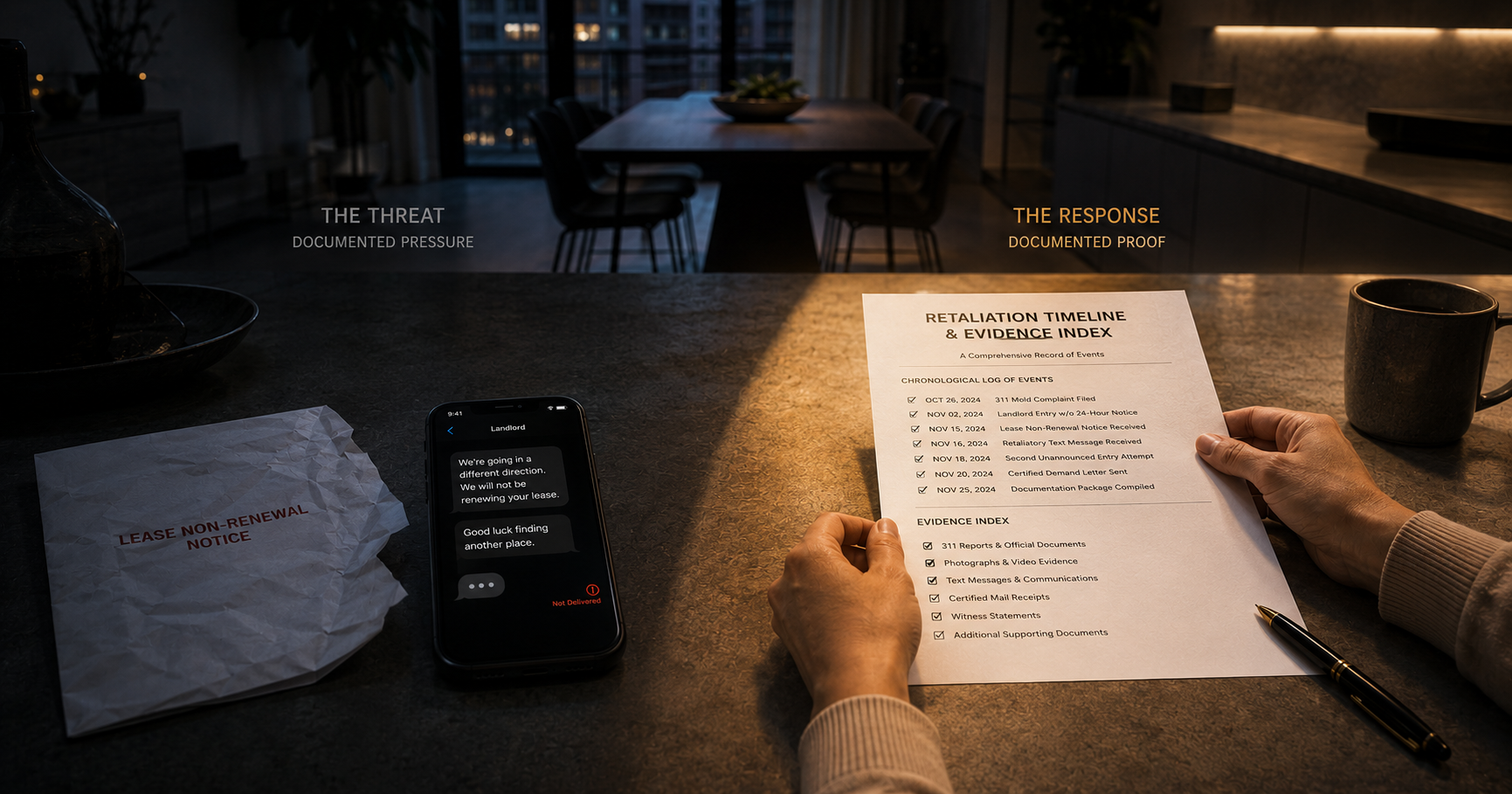
Everything you've gathered — the protected activities, the retaliatory actions, the dates — now comes together into a single, powerful document: a retaliation timeline. This one-page chronology is the backbone of any complaint you file or any defense you raise, because it lays out the whole story in the clearest, most persuasive form possible: a sequence of dated events that speaks for itself.
Build it as a simple chronology, in order, with the key events and their dates. The date you made your complaint or report. The date of any agency inspection or contact that followed. The date of the landlord's retaliatory action — the rent increase, the non-renewal, the threats. Laid out in sequence, these dates tell the story at a glance: here's when I exercised my right, here's what happened in response, and here's how little time passed between them. A timeline that reads "March 3: reported no heat to city; March 10: HPD inspected and issued violations; March 18: received non-renewal notice" makes the retaliation almost visible on the page, because the causal sequence is right there in the dates.
The power of the timeline is that it converts a diffuse, hard-to-articulate sense of "I think my landlord is retaliating against me" into a concrete, ordered set of facts. Anyone reading it — an agency investigator, a mediator, a judge, an attorney — can see the sequence immediately and grasp the retaliation claim without needing you to explain it. That clarity is enormously valuable, because retaliation cases turn on exactly this kind of demonstrated sequence, and a tenant who can hand over a clean, dated timeline is far more compelling than one describing a vague pattern from memory. It also does something for you personally: the act of laying the events out in order often clarifies your own thinking, replacing the anxious, swirling suspicion that something is wrong with the steadying clarity of seeing exactly what happened and when. Many tenants find that building the timeline is the moment the situation stops feeling like a fog of unease and starts feeling like a case they can actually make.
Keep the timeline factual and tight — dates and events, stated plainly, without editorializing. Its persuasive force comes precisely from its restraint: you're not arguing that it's retaliation, you're laying out the facts and letting the sequence make the argument for you. Back each entry with your underlying documentation — the complaint records, the inspection reports, the notices you received — so that every date on the timeline can be substantiated. This one-page document, simple as it is, becomes the centerpiece of everything that follows: it's what you'll attach to a complaint, what you'll hand to an attorney, what you'll rely on if you have to defend against an eviction. Build it carefully, because it's the single most useful thing you can create.
A few practical touches make the timeline stronger. Note the source of each date alongside the event — "March 3: reported no heat to city (311 confirmation #)," "March 10: HPD inspection (violation #)," "March 18: non-renewal notice received (copy attached)" — so that each entry points to the proof behind it. This turns the timeline from a bare list into an index of your evidence, where every line can be immediately backed up. Include the gaps of time explicitly where they're short, because the shortness is the point: writing "8 days later" or "2 weeks after" next to the adverse action draws the eye to exactly the tight timing that signals retaliation. And keep it genuinely to one page if you can, because a one-page chronology is something a busy investigator, mediator, or judge can absorb in seconds, whereas a sprawling narrative buries the sequence that makes your case. The discipline of fitting it on a page forces you to include only what matters — the protected activity, the adverse action, and the dates that connect them — which is also exactly what makes it persuasive.
With your timeline in hand, the next move is often to send the landlord a retaliation objection letter — a calm, firm, written notice that names the retaliation, objects to it, and requests that the retaliatory action be reversed. Like every written objection in a tenant dispute, this does double duty: it can prompt the landlord to back down, and it creates a dated record that you identified and objected to the retaliation, which strengthens your position if the matter escalates. Here's how to structure it.
Start by identifying the protected activity, with its date. State plainly what you did and when — "On [date], I contacted [the agency] about code violations in my apartment," or "On [date], I requested repairs to the heating system." This establishes, right at the top, that you were exercising a protected right, and anchors the whole letter in that fact.
Then describe the landlord's subsequent actions. Lay out what the landlord did after your protected activity — the rent hike, the non-renewal, the write-ups, the threats — with their dates. You're presenting the sequence from your timeline in prose: here's the protected activity, and here's what followed. Then connect them explicitly: explain that the timing and pattern suggest retaliation. You don't need to prove it beyond doubt in the letter; you're pointing out that the close timing between your protected activity and the landlord's adverse action indicates a retaliatory motive — which is a reasonable, grounded observation, not an overreach.
Then make your request and note your documentation. Ask specifically for the retaliatory action to be reversed — the withdrawal of the non-renewal notice, the rescinding of the rent increase, whatever applies. Be concrete about what you want undone. And state that you are documenting this situation for any future proceedings. That closing note is important: phrased calmly and factually, it signals that you understand your rights and are keeping a record, which often gives a landlord real pause, because they realize they're now dealing with a tenant who recognizes the retaliation for what it is and is prepared to act on it. Keep the entire letter neutral and business-like — no insults, no threats, just a clear, dated, factual objection. Send it in writing, by email or another traceable method, and save a copy with the date in your records, so the objection letter itself becomes another entry in your documented timeline.
To show how the pieces fit, here's a complete version you can adapt to your own situation:
"Hi [Landlord's name],
I'm writing about a concern I need to raise directly.
On [date], I reported code violations in my apartment to [the agency] — specifically, [the lack of heat / the mold / the condition]. Shortly afterward, on [date], I received [a non-renewal notice / a rent increase / a lease violation write-up] from you.
Given how closely this action followed my report, and the absence of any prior issue of this kind, the timing and pattern suggest that this action is a response to my having reported those conditions. Retaliation against a tenant for reporting violations or requesting repairs is prohibited under [applicable law].
I'm asking that you [withdraw the non-renewal notice / rescind the rent increase / withdraw the write-up]. I want to resolve this directly and keep our relationship straightforward. Please note that I am documenting this situation, including the dates and this correspondence, for any future proceedings that may become necessary.
I'd appreciate your response by [date], and I'm hopeful we can put this right.
[Your name]"
Notice how that letter operates. It states the protected activity and its date, describes the adverse action and its date, and draws the connection between them plainly — without hysteria or accusation, just a reasonable observation about timing. It cites the fact that retaliation is prohibited, grounding the objection in law rather than grievance. It makes a specific, concrete request for reversal. And it notes the documentation calmly, which signals seriousness without threatening. Read it imagining an investigator or judge seeing it later: it makes the sender look measured, informed, and reasonable — exactly the impression that helps you. Adapt the bracketed details to your situation, but keep the structure: protected activity with date, adverse action with date, the retaliation connection, the specific request, the calm documentation note.
If the objection letter doesn't resolve things — or if the retaliation is serious enough that you want to act more forcefully — you have real options, and knowing them is part of what dissolves the feeling of powerlessness. Retaliation isn't something you simply have to absorb; there are bodies and remedies designed for exactly this.
One path is to file a retaliation complaint with the relevant housing or code enforcement body. Many jurisdictions have agencies that accept and investigate complaints of landlord retaliation, and filing one puts your case in front of an authority that can act on it. When you file, attach your timeline and your objection letter — the timeline shows the retaliatory sequence at a glance, and the letter shows you already identified and objected to the conduct. A complaint backed by that documentation arrives far stronger than a bare allegation, and it demonstrates that you've been methodical and reasonable throughout.
Filing such a complaint carries a benefit beyond the possibility of the agency acting: it adds another layer to your documented record and can itself apply pressure. A landlord who learns that a tenant has filed a formal retaliation complaint with an enforcement body — rather than merely grumbling — often recalculates, because the situation has moved beyond their control into a forum where their conduct will be examined. And the complaint filing is itself a dated event you can add to your record, further establishing that you responded to the retaliation promptly and through proper channels. Even where a given agency's process is slow or its powers limited, the act of filing strengthens your overall position and your credibility as someone who pursued every legitimate avenue. It also means that if the matter later reaches a court, you can show you raised the retaliation formally and early, rather than inventing the claim only once you were facing eviction — which makes the retaliation claim considerably more credible.
Another path — especially if the retaliation takes the form of an eviction or non-renewal that's escalating — is to consult a tenant-rights group or an attorney about raising retaliation as a defense. This is crucial to understand: retaliation isn't only something you complain about; it can be a shield. If a landlord moves to evict you or refuses to renew your lease in retaliation for your protected activity, you can often raise that retaliation as a defense in the proceeding, and where the law provides a presumption of retaliation based on timing, that defense can be powerful. A tenant-rights organization or lawyer can assess your timeline, tell you how strong your retaliation defense is, and help you raise it properly. In New York, groups like the Legal Aid Society, Legal Services NYC, Housing Court Answers, and the Met Council on Housing tenants' rights hotline handle exactly these situations, and many will assess a retaliation claim at no cost.
There's one honest caveat worth understanding, because it keeps your position clean and credible: a retaliation claim doesn't erase rent you genuinely owe. If the landlord's adverse action is a nonpayment case and you actually didn't pay rent you owed, retaliation doesn't excuse the underlying debt — the strongest posture is to keep current on rent you legitimately owe and assert the retaliation, rather than treating the retaliation as a reason to stop paying. This matters strategically as well as honestly, because a tenant who stops paying hands the landlord a clean, non-retaliatory reason for the adverse action — genuine nonpayment — which can rebut the retaliation presumption. A tenant who keeps paying and raises a well-documented retaliation claim gives the landlord no such cover. So if part of what's going on involves rent, be scrupulous about paying what you actually owe; it protects the retaliation claim rather than undermining it. And if conditions are bad enough that you're considering withholding rent or pursuing a repair-and-deduct remedy, treat that as a question for the tenant-rights help above rather than something to improvise, because done wrong it can weaken the very claim you're building.
Throughout all of this, keep documenting. Continue logging every interaction, keep your timeline updated, preserve every notice and message. The retaliation may continue or evolve, and each new adverse action that follows your protected activity is another entry that strengthens your case. The documentation habit that started with your timeline should carry all the way through, because in a retaliation matter, the record is your power — it's what converts your account into a demonstrable pattern.
And hold onto the core truth that runs under all of these options: you're not powerless. Retaliation rules exist precisely to protect tenants who speak up — they were written because lawmakers recognized that tenants who report problems are doing something socially valuable and must be shielded from reprisal. The very fact that you're facing retaliation means you exercised a protected right, and that protected right is the foundation of your defense. The law anticipated exactly this situation and built protections for it. Your job is to recognize the retaliation, document it, and use the tools the law provides — and none of that requires you to face it alone.
Let's follow one tenant through this, because watching retaliation get recognized and answered is what turns the roadmap from abstract into usable. Imagine someone whose apartment lost heat during a cold stretch. They asked the landlord to fix it; nothing happened. So they called 311 and reported it, an inspector came out, and the city issued violations against the building. Two weeks later, a notice arrived: their lease would not be renewed. The tenant felt the connection instantly — and then, just as instantly, the self-doubt: maybe he just doesn't want to renew, maybe I'm imagining the link, maybe complaining really was a mistake.
Run it the way that self-doubt dictates. The tenant treats the non-renewal as unconnected bad luck, or half-believes they brought it on themselves by complaining, and starts quietly preparing to move — never naming the retaliation, never objecting, never documenting the sequence. The landlord's reprisal works exactly as intended: the tenant is punished for reporting the violation and, worse, absorbs the lesson that speaking up backfires. If it ever reached a courtroom, there'd be no timeline, no objection letter, nothing to show the non-renewal followed the complaint — just a tenant who moved out.
Now run it through the roadmap. The tenant names the protected activity: they reported code violations to the city, which is squarely protected. They identify the retaliatory action and its timing: a non-renewal, arriving two weeks after the report. They build a one-page timeline — heat reported to landlord on one date, 311 complaint on another, HPD inspection and violations on another, non-renewal notice two weeks after the complaint — and it reads, at a glance, like exactly what it is. They recognize that in New York, an adverse action within a year of a good-faith complaint raises a presumption of retaliation, and here the gap is two weeks. They send a calm objection letter naming the protected activity, describing the non-renewal, drawing the connection, and requesting that the non-renewal be withdrawn — and they save it with the date. When the landlord doesn't back down, they take their timeline and letter to a tenant-rights group, which confirms the retaliation defense is strong and helps them raise it.
Same tenant, same non-renewal. In the first version, the retaliation succeeds and a tenant who did the right thing pays for it. In the second, the retaliation is named, documented, and turned into a defense — with a presumption on the tenant's side and the burden shifted to the landlord to justify a non-renewal that followed a complaint by two weeks. The difference wasn't a different landlord or a different set of facts. It was a tenant who recognized the retaliation instead of doubting themselves, and documented the sequence instead of absorbing the blame.
Step back and look at what you now have instead of that uneasy, powerless feeling. You can identify the protected activities you engaged in — the reports, the repair requests, the organizing — and recognize them as rights the law shields. You can spot the retaliatory actions and, crucially, the timing that reveals them. You can build a one-page timeline that lays out the retaliatory sequence so clearly it almost argues itself. You can send a calm, firm objection letter that names the retaliation and requests its reversal. And you know your next steps — the retaliation complaint, the retaliation defense, the tenant-rights help — if the situation escalates.
Here's the reframe to carry out of all this. When retaliation starts, it's designed to make you feel like speaking up was a mistake — like you brought this on yourself, like you should have kept quiet, like your complaint backfired and now you're paying for it. But that framing is exactly backwards. Speaking up was your right, and exercising it was not a mistake — it was precisely what the law protects. The mistake belongs to the landlord, who responded to your protected activity with an illegal reprisal. Retaliating against you wasn't a show of their power; it was a violation, one that hands you a recognized legal claim. The thing that was meant to punish you for speaking up is itself unlawful, and it's the landlord, not you, who has stepped over a line.
So don't let the retaliation silence you or convince you that you erred by asserting your rights. Name your protected activity. Identify the retaliatory action and its timing. Build the timeline. Send the objection letter. And escalate — to a complaint, to a retaliation defense, to tenant-rights help — if you need to, with your documented record in hand. The law protects tenants who speak up because speaking up matters, and you did the right thing. Now the same right that made you a target is the one that protects you.
And consider what your responding well does beyond your own case. Every tenant who recognizes retaliation and pushes back — who documents it, objects to it, and holds the landlord accountable — makes it a little less profitable for landlords to retaliate, which protects the next tenant who needs to report a dangerous condition. The chilling effect works in reverse, too: just as retaliation teaches tenants to stay silent, tenants who refuse to be silenced teach landlords that reprisal carries a cost. You didn't ask to be put in this position. But having been put here, responding to the retaliation isn't only how you protect yourself — it's part of how the whole system of tenant protection actually holds, one documented, answered reprisal at a time. You spoke up about a problem because it needed to be addressed, and if you respond to the retaliation with the same resolve, you'll have done the right thing twice. Find out where you stand.