You're living with serious problems in your apartment—mold, leaks, pest infestations, no heat, broken locks, or other habitability violations—and you're trying to figure out what evidence you need to prove these conditions exist and that your landlord should be held accountable. Maybe you're planning to file an HP proceeding to compel repairs, or you're defending against a landlord's eviction attempt and want to raise habitability as a defense, or you're seeking rent reduction for the months you've lived in terrible conditions, or you're considering breaking your lease based on constructive eviction. Whatever your goal, you know you need proof, but you're unsure exactly what kind of evidence matters legally and how to gather and organize it effectively.
You've taken some random photos on your phone over the past months, and you've sent a few texts to your landlord complaining, but you don't have any organized system. You're worried that when you get to court or try to make your case to a housing agency, your evidence will be too scattered, incomplete, or unconvincing to prove what you've been experiencing. You think: "What specific evidence do I need to prove my apartment is uninhabitable? Will judges or agencies believe my testimony alone, or do I need documentation? What should I photograph and how should I photograph it? Do emails and texts count as evidence, or do I need formal letters? How important are official inspection reports and violations? How do I organize all this evidence so it's compelling and credible?"
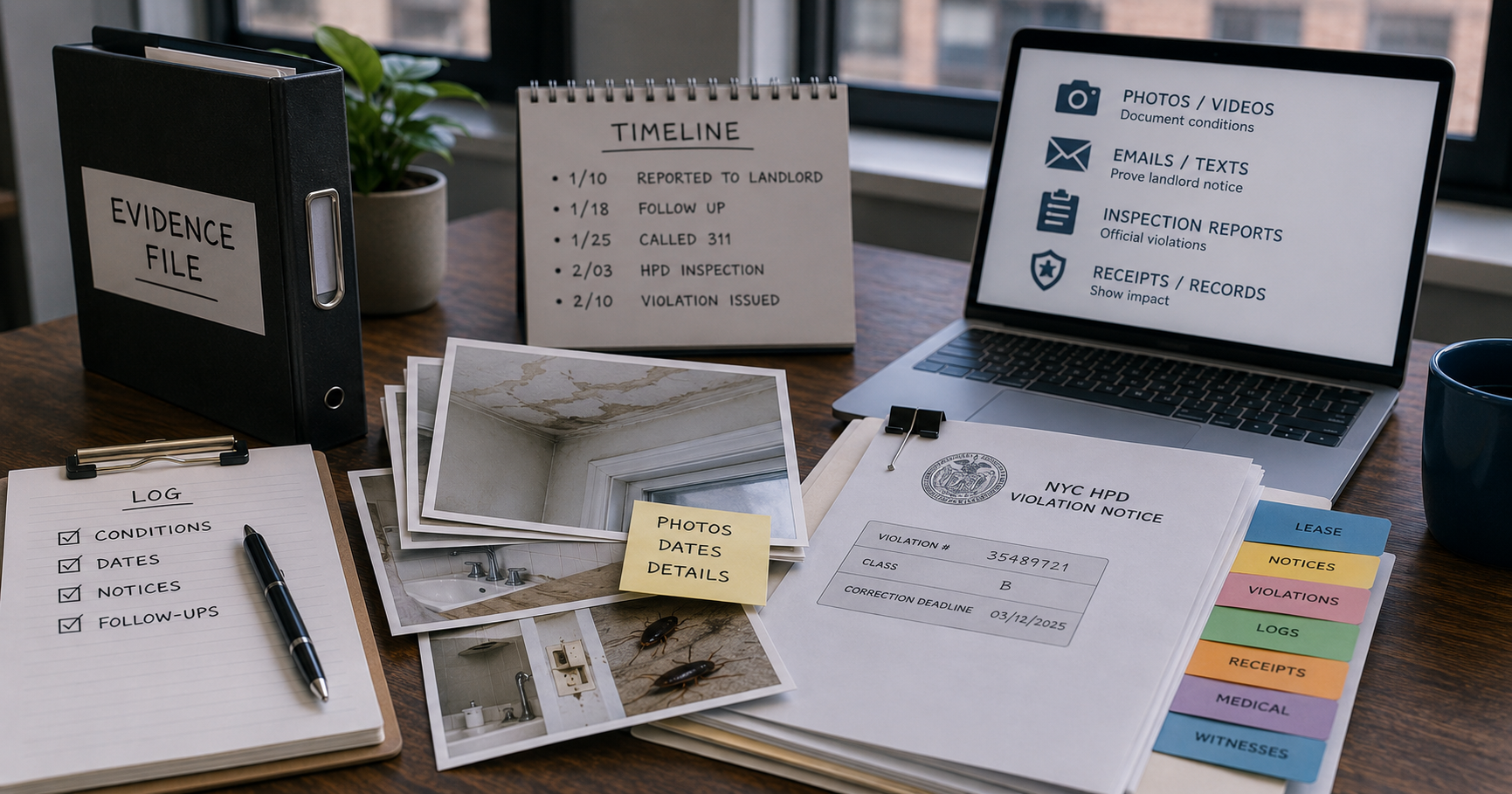
Here's the truth: Protecting yourself as a tenant dealing with habitability violations requires building a clear, dated, comprehensive evidentiary record proving three critical elements—what's wrong with your apartment (the actual conditions), how long conditions have existed and persisted (the timeline), and that your landlord knew about the problems and failed to fix them (landlord notice and inaction). The evidence that accomplishes this includes photographs and videos showing conditions in detail with dates, written logs documenting when problems occurred and your communications with landlord, paper and digital documents including your lease, all repair requests, agency complaints and violation notices, and receipts, and optionally but powerfully, impact evidence like medical records, damage receipts, and witness statements showing how conditions affected you. Courts and housing agencies specifically look for this combination of tenant testimony supported by visual evidence, proof of landlord notice, and official public records confirming violations.
Let me show you exactly what to photograph and video and how to do it effectively, what written logs to keep and what information they should contain, what paper and digital documents to preserve and organize, what optional impact evidence strengthens cases, and how all these pieces of evidence work together to prove your case in court or agency proceedings.
Visual evidence is perhaps the most powerful and immediate way to prove what conditions actually look like in your apartment and common areas.
Comprehensive visual documentation means photographing every habitability violation you're experiencing or claiming.
Mold, water damage, and moisture problems require thorough documentation. Photograph all visible mold growth on walls, ceilings, floors, in bathrooms, bedrooms, kitchens, closets, or anywhere else it appears. Capture water stains on ceilings or walls showing past or ongoing leaks. Document peeling paint or wallpaper from moisture. Show warped, buckling, or water-damaged floors. Photograph bubbling or deteriorating drywall indicating water intrusion. Document condensation problems—windows constantly fogged or wet, visible dampness on walls.
The goal is proving mold and water damage isn't isolated tiny spots but significant contamination affecting habitability. Wide shots showing large areas affected plus close-ups showing detail and texture of mold accomplish this.
Pest infestations and evidence must be documented both through live pests and the traces they leave. Photograph live roaches, mice, rats, bedbugs, or other pests whenever you see them (even blurry photos of fleeing roaches are better than nothing). Document pest droppings—mouse or rat droppings in cabinets, along walls, or in living spaces; cockroach feces appearing as dark spots or smears. Photograph pest damage—chewed food packaging, gnawed wires or materials, holes in walls where rodents enter. Show nesting materials if you find them. Document bedbug evidence—actual bugs in mattress seams or furniture, bedbug fecal spots (tiny dark dots) on bedding or furniture, shed bedbug skins, blood spots on sheets.
The cumulative visual evidence of frequent sightings, widespread droppings, multiple locations affected, and signs of reproduction proves infestation, not just occasional isolated pest sightings.
Broken, missing, or inadequate safety and security features need documentation. Photograph broken or missing locks on entry doors, apartment doors, or windows. Show broken or missing windows creating security risks and weather exposure. Document broken doors that won't close, lock, or provide security. Photograph missing or non-working smoke detectors or carbon monoxide detectors. Show broken railings on stairs creating fall hazards. Document damaged or unsafe stairs, floors, or walkways. Photograph inadequate or broken lighting in common areas creating safety risks.
These safety violations directly threaten tenant wellbeing and security, making them particularly serious habitability violations worth thoroughly documenting.
Electrical hazards and dangers require careful documentation (while being safe yourself). Photograph exposed electrical wiring—wires hanging from walls or ceilings, wiring outside proper enclosures, outlets or switches with exposed internal wiring. Document broken outlets or switches, scorch marks around electrical fixtures, frequently tripping breakers indicating overload, sparking or smoking from electrical elements (if you can safely capture it).
Electrical hazards create fire and shock risks making them serious violations, and visual evidence proves the danger exists.
Structural damage and deterioration affecting building integrity or creating hazards needs documentation. Photograph cracks in walls or ceilings—large cracks suggesting structural movement, crack patterns indicating serious problems. Show sagging or bowing ceilings, walls, or floors. Document ceiling areas that appear ready to collapse or have partially collapsed. Photograph unstable structural elements, deteriorating building components threatening to fail.
Structural problems can progress from concerning to catastrophic, so dated photos showing progression are particularly valuable.
Common area problems including sanitation and safety issues should be documented. Photograph overflowing trash in hallways, stairwells, or trash rooms. Show sewage problems—sewage backups, sewage odors (harder to photograph but document the source areas), standing water that appears contaminated. Document unsanitary conditions in common areas. Photograph blocked fire exits or emergency egress paths. Show dangerous conditions in hallways, stairwells, basements, or other common spaces.
Common area violations affect all residents and demonstrate building-wide neglect, strengthening your habitability claims.
Temperature and utility problems benefit from specific documentation approaches. For heat issues, photograph thermometers showing indoor temperature (include the thermometer in your apartment showing low temperature along with something indicating date). For hot water issues, photograph or video faucets with hot water handle fully open but water running cold, or video showing water never getting hot. Document space heaters you've had to use because building heat is inadequate. Show frozen or burst pipes if that occurs.
Temperature readings and visual proof of utility failures document violations that otherwise might be "he said, she said" disputes.
The quality and methodology of your photography significantly affects how convincing your evidence is.
Take both wide shots and close-ups for each problem. Wide-angle shots establish context—which room, where in the room, how much area is affected, relationship to other features. These overview shots show the scope and location of problems. Close-up shots capture detail—the texture of mold, the severity of damage, specific defects or hazards. Detail shots prove the nature and seriousness of conditions.
Together, wide and close-up shots provide complete picture. A wide shot showing a bedroom corner with mold, plus close-ups showing the mold is thick, fuzzy, covering multiple square feet, creates much stronger evidence than just one photo type alone.
Include scale references where helpful. Photograph rulers or measuring tape next to mold patches to show size. Include common objects (coins, pens, hands) near problems to give viewers sense of scale. This is particularly important for meeting legal thresholds—NYC Local Law 55 triggers certain requirements when mold exceeds 10 square feet, so documenting size matters.
Date evidence is critical. The best approach is using cameras or phones that embed date/time metadata in photo files. If your device doesn't do this or you want visible dates, include something dated in photos—hold up newspaper showing date, place phone or clock showing date and time in frame, or write the date on paper and photograph it with the condition.
Dating photos proves when conditions existed, how long they've persisted, and creates timeline showing progression or landlord's failure to repair over time.
Take multiple photos over time showing persistence, recurrence, or worsening. Initial photos when you discover a problem, plus follow-up photos days, weeks, or months later showing problem continues or has worsened despite your complaints prove ongoing violations and landlord's failure to address them.
For example: Mold photos taken January 15 showing small patch, February 10 showing spread to larger area, March 5 showing even more extensive coverage despite your January and February complaints to landlord—this progression powerfully demonstrates persistent, worsening violation and landlord inaction.
Video can capture what photos cannot. Walk through your apartment or building narrating conditions: "This is March 15, 2025, I'm showing the mold in my bedroom that's been here since December and has spread despite my complaints" while filming affected areas. Video the musty smell by walking through describing the odor in each room (smell doesn't photograph but you can document your descriptions). Capture sounds—dripping water, rodents in walls, malfunctioning systems. Show the extent of problems through video walkthroughs.
Video evidence feels more immediate and harder to dispute than still photos, though both are valuable.
Photograph in good lighting when possible so conditions are clearly visible. Use flash or additional lighting in dark areas. Make sure photos are in focus and clearly show what you're documenting.
Take more photos than you think you need. Storage is cheap, and having multiple angles, multiple dates, and comprehensive coverage is far better than having too little documentation. You can always choose the best photos later; you can't recreate conditions that have been repaired or no longer exist.
Systematic written records supplement visual evidence by creating detailed timelines and documenting communications.
A condition log is a running written record of every habitability problem you experience, when it occurred, and relevant details.
For each condition or incident, note:
Date and time the problem occurred, was discovered, or was at its worst. "January 15, 2025, 7:00 AM" or "Week of February 10-16" depending on specificity.
What you observed directly—what you saw, smelled, felt, heard, or measured. Be specific and factual: "Saw 6 cockroaches on kitchen counter and 4 more in bathroom" not just "lots of roaches." "Indoor temperature 52°F on thermometer" not just "apartment was cold." "Strong sewage odor in hallway near apartment door" not just "bad smell." "Visible black mold covering approximately 3 feet by 4 feet area on bedroom ceiling" not just "mold in bedroom."
Duration or frequency if applicable. "No heat for 3 days, January 15-17." "Sewage smell has been present daily for 2 weeks." "See mice droppings every morning." "Water leaks from ceiling every time it rains."
Impacts the condition created if relevant. "Apartment temperature 48°F, household members wearing coats indoors." "Spoiled food in refrigerator due to power outage." "Unable to sleep in bedroom due to mold and smell."
Any immediate actions you took. "Reported to landlord by phone." "Called 311." "Placed bucket under leak."
Example condition log entries:
"January 10, 2025: Discovered mold on bathroom ceiling approximately 2ft x 2ft area. Black/green discoloration. Strong musty smell. Took photos. Emailed landlord requesting inspection and remediation."
"January 17, 2025: No heat for past 48 hours. Indoor temp this morning 50°F. All household members cold, child complaining of discomfort. Called landlord, no answer, left voicemail."
"January 22, 2025: Mold has spread to larger area, now approximately 3ft x 3ft, extending to bedroom wall corner. Musty smell stronger. Experiencing stuffy nose and headache that improve when away from home. Sent second email to landlord. No response to first email."
This detailed log creates timeline, documents your contemporaneous observations, and proves persistent problems and landlord's failure to act.
Maintain the log regularly—ideally daily or at least weekly. Writing entries close to when events occur ensures accuracy and creates credible contemporaneous records rather than trying to reconstruct months of events from memory later.
Keep logs simple but thorough. You don't need fancy formatting—a notebook, document file, or spreadsheet with dated entries works fine. The content matters more than the format.
A communication log tracks every time you contacted your landlord about problems, their responses (or lack thereof), and promises made.
For each communication, record:
Date and time of the communication.
Method: phone call, text message, email, in-person conversation, letter, portal message, conversation with superintendent or property manager.
Who you communicated with: landlord's name, property manager, superintendent, maintenance staff.
What you told them: specific problems you reported. "Reported mold in bathroom and bedroom, requested remediation."
Their response: what they said, promised, or did. "Said would send someone to look at it within a week." "Promised heat would be fixed by end of day." "No response received." "Super said not their problem."
Follow-up: whether promised actions occurred. "No one came to inspect as promised." "Heat temporarily restored but failed again 2 days later." "Mold not addressed, no contact from landlord."
Example communication log entries:
"January 10, 2025, 3:00 PM: Called landlord (555-1234) and left voicemail reporting mold in bathroom/bedroom. Described size and requested inspection and remediation."
"January 10, 2025, 4:30 PM: Sent email to [[email protected]] with photos of mold, requesting remediation. (Saved copy of email.)"
"January 15, 2025, 10:00 AM: Landlord called back. Said he would 'look into it' but gave no timeline. Asked for written response, he said he'd get back to me. No written response received."
"January 18, 2025, 2:00 PM: Sent follow-up email noting no response to first email, mold persists, requesting immediate action. (Saved copy.)"
"January 25, 2025: Still no response from landlord to any communications about mold."
This communication log proves you gave landlord notice, when you gave notice, that landlord had opportunity to repair, and that landlord failed to respond adequately.
The combination of condition logs and communication logs creates complete timeline: problem exists → tenant reports problem → landlord doesn't fix → problem persists or worsens → tenant reports again → landlord continues failing to fix. This timeline is the factual backbone of habitability claims.
New York Housing Court and legal aid resources explicitly tell tenants to keep "lists of the dates on which you talked with the landlord or super and what you said" for precisely this reason—courts need to see that you gave landlord notice and opportunity before seeking legal remedies.
Beyond logs you create yourself, preserve all official documents and communications related to your tenancy and the habitability violations.
Keep complete copies of your lease agreement and all amendments, renewals, or modifications.
The lease establishes the landlord-tenant relationship, proves you're a lawful tenant with rights (not a squatter or guest), shows what rent you agreed to pay (relevant for rent abatement calculations), may contain provisions about repairs and maintenance (establishing landlord's obligations), and provides move-in date and lease terms.
If you signed a renewal or lease extension, keep those documents too.
Any addenda or modifications to the lease should be preserved.
These foundational documents prove your legal status and the terms of your tenancy, which courts need to see before addressing habitability disputes.
Save every written communication you send to landlord about repairs or conditions.
Emails reporting problems and requesting repairs should be saved in a dedicated folder. Include both your sent messages and any responses from landlord. If you use email search or filters, save all emails with relevant keywords (repair, mold, leak, heat, etc.) from communications with landlord.
Text messages should be screenshot or backed up. Many phones have features to export text conversations. Screenshot message threads showing your repair requests and landlord's responses (or no responses), making sure dates and times are visible in screenshots.
Letters you send by mail should be copied before sending. If you send certified mail, keep the receipts and return receipt cards proving delivery. Letter copies with proof of delivery establish that landlord received notice.
Maintenance portal messages or any app-based communication systems should be screenshot or exported. Some portals allow downloading communication history—do so regularly as backup.
Voicemail transcripts if available from phone service can document verbal communications.
The principle is preserving everything in writing you sent to landlord. These documents prove notice to landlord and rebut any landlord claim "tenant never told me about the problem."
Organize chronologically or by topic. Having all communications about mold together, or all communications in chronological order, makes evidence easier to present.
Official government records are among the most powerful evidence because they represent independent third-party verification of violations.
311 complaint numbers (in NYC) should be saved. When you call 311, you receive complaint reference numbers. Record these numbers and the dates complaints were filed. You can use these numbers to look up complaint status online and obtain records of complaints and resulting inspections.
HPD inspection reports and violation notices should be obtained and kept. After HPD inspects and issues violations, you can request copies or search online for violations on your address. Print or save PDFs of all violation notices. These official documents state that government inspectors found code violations, classify them by severity, and set deadlines for correction.
DOB violations similarly should be saved if Department of Buildings issued any violations related to your building.
Local code enforcement violations (outside NYC) from building departments or code enforcement offices should be kept. Request copies of inspection reports and any notices of violation.
Health department findings if health department inspected for sanitation, sewage, or health hazards should be preserved.
Fire marshal reports if any fire safety issues were inspected.
Tenant habitability guides and templates consistently emphasize keeping HPD complaints, violation notices, 311 reference numbers, and any DOB or health complaints as proof that conditions violate code.
These official records transform your claims from "tenant says apartment is bad" to "government inspectors found code violations," dramatically strengthening your credibility and legal position.
If you've incurred expenses due to habitability violations, keep all receipts.
Temporary repairs or mitigation measures: If you bought space heaters because landlord wouldn't fix heat, keep receipts. Dehumidifiers purchased to address moisture problems. Cleaning supplies or over-the-counter pest control products. Emergency plumber or electrician if you had to arrange urgent repairs.
Spoiled food due to power outages or refrigerator failures—photograph ruined food and estimate costs.
Pest control if you hired exterminators because landlord wouldn't.
Medical expenses related to conditions—prescriptions for asthma from mold exposure, urgent care visits for cold-related illness from no heat, treatment for pest bites.
Temporary housing if conditions forced you to stay in hotels or elsewhere temporarily—hotel receipts, Airbnb records.
Property damage from violations—belongings ruined by water damage, furniture or mattresses destroyed by bedbugs that must be discarded, clothing damaged by mold.
These receipts support claims for reimbursement or rent abatements reflecting your actual damages, proving habitability violations cost you real money.
Beyond proving conditions exist and landlord knew, evidence showing how violations actually harmed you strengthens cases and supports damage claims.
When habitability violations cause or exacerbate health problems, medical evidence powerfully demonstrates serious impacts.
Medical records where doctors note symptoms and their potential connection to housing conditions are valuable. For example, records stating "patient reports worsening asthma coinciding with mold exposure in apartment; symptoms consistent with mold-related asthma exacerbation" provide medical opinion linking health to housing.
Doctor's notes mentioning specific housing issues—"patient living in apartment with persistent mold," "patient reports no heat in apartment, experiencing cold-related symptoms"—show healthcare providers took housing conditions seriously enough to document them.
Prescriptions or treatments for conditions plausibly related to housing violations—asthma medications after mold appeared, antibiotics for respiratory infections in cold apartment, treatment for pest bites—with timing correlating to violations support causation.
Emergency room visits or urgent care for severe reactions—asthma attacks requiring ER treatment, hypothermia from no heat, serious allergic reactions to mold or pest exposure—demonstrate extreme impacts.
Medical records aren't required to prove habitability violations exist, but they elevate claims from "conditions are bad" to "conditions made me sick," justifying larger rent abatements and damages.
Financial losses from habitability violations can be compensated if documented.
Receipts for ruined belongings help prove damages. Photograph items destroyed by water damage, mold, or pests before disposing. Keep receipts for original purchases if available or estimate replacement costs. Document having to throw away furniture, mattresses, clothing, or other property destroyed by violations.
Hotel or temporary housing expenses when violations forced you to leave temporarily should be documented with receipts. If apartment had no heat for a week in freezing weather and you stayed with family or in a hotel, those costs (or the inconvenience if staying with family) support constructive eviction or damages claims.
Extra transportation costs if violations made parts of your apartment unusable affecting your commute or daily life.
Storage fees if you had to move belongings out due to repairs or conditions.
These financial records quantify your damages, supporting compensation claims beyond just rent reductions.
Other people's observations of conditions corroborate your claims.
Roommates or household members can write brief statements describing what they observed: "I lived in Apartment 3B from January-March 2025. During this time, I observed extensive mold growth in the bathroom and bedroom, persistent sewage odor in the hallway, and saw mice and roaches regularly. I reported feeling ill with respiratory symptoms while living there that improved after moving out. [Signature, date]"
Neighbors who observed common area problems or know about conditions in your unit can provide statements: "I live in Apartment 3C next door to 3B. I have also experienced pest problems and have seen roaches in the hallway. I heard [tenant name] complain to the super multiple times about mold and pests without result. [Signature, date]"
Visitors who came to your apartment and witnessed conditions can describe what they saw: "I visited [tenant name] at [address] on [dates]. I observed visible mold on bedroom walls, a strong musty smell throughout the apartment, and saw roaches in the kitchen. The apartment felt very cold despite being winter. [Signature, date]"
Friends or family who know about your living conditions and health impacts.
These statements aren't always necessary but can be powerful corroboration, showing conditions were bad enough that other people noticed and remember them.
Understanding how different evidence types work together helps you see why comprehensive documentation matters.
Courts and housing agencies evaluate habitability cases by looking for three interconnected elements, each supported by different evidence types.
Proof that serious habitability violations existed: Established through your testimony describing conditions, photographs and videos showing conditions visually, official violation notices from HPD, DOB, code enforcement, or health departments confirming violations, physical evidence if you preserved any (mold samples, pest specimens—though usually photos suffice), and witness statements corroborating conditions.
Proof that landlord had notice and opportunity to repair: Established through written communications—copies of emails, texts, letters to landlord, communication logs documenting phone calls and conversations, certified mail receipts proving delivery, maintenance request records through portals or systems, and official complaint records showing you contacted authorities (which typically notify landlords).
Proof of timeline showing persistence and landlord failure: Established through dated photographs showing conditions over time, written logs documenting when problems occurred and continued, timeline of communications showing repeated notice to landlord without adequate response, violation notices showing violations weren't corrected by deadlines, and your testimony tying everything together chronologically.
Together, these three elements prove: violations are serious enough to warrant legal remedies, landlord can't claim ignorance because they had notice, and landlord breached obligations by failing to repair despite notice and time.
New York Housing Court guidance and legal aid materials explain what judges expect to see.
Your credible testimony is the starting point—you describe what you experienced and how conditions affected you. But testimony alone often isn't enough because it's self-interested and can be disputed.
Visual evidence supporting your testimony makes your claims concrete and convincing. Photos don't lie (generally), and judges can see for themselves what conditions looked like. "I had severe mold" becomes much more powerful when accompanied by photos showing extensive black mold coverage.
Official public records confirming your claims provide independent verification. HPD violation notices, code enforcement reports, and health department findings are determinations by neutral government inspectors that violations existed. These official records carry significant weight because they're not created by you or your lawyer—they're independent authority confirming your claims.
Documentation of notice to landlord shows you followed proper procedure and gave landlord opportunity to cure. Courts won't grant relief if landlord never knew about problems. Your emails, texts, and communication logs prove landlord had notice and chose not to act.
Organized, thorough presentation of evidence makes favorable impression. Bringing a binder with tabbed sections for photos, communications, violations, receipts, logs, and lease shows you're serious, prepared, and credible. Judges see many cases daily; organized evidence makes their job easier and your case more credible.
The difference between weak and strong cases is often documentation.
Weak case: "My apartment has mold and my landlord won't fix it. It's been like this for a while. I told him about it. The place is making me sick."
Strong case: "I discovered mold in my bathroom and bedroom on January 10, 2025 (Photos Exhibit A, pages 1-5). I immediately notified my landlord by email and phone (Exhibit B, communication log and email copies). The mold was approximately 2 square feet initially but spread to over 12 square feet by March (Photos Exhibit A, pages 6-15, showing progression). I reported it to HPD via 311 on February 1 (Complaint #12345678). HPD inspected on February 10 and issued Class B violation #987654 for mold (Exhibit C, HPD violation notice). The violation deadline was March 12, but as of today's date, the mold has not been remediated (Photos Exhibit A, pages 16-20, taken last week). I have experienced worsening respiratory symptoms since the mold appeared, requiring medical treatment (Exhibit D, medical records from Dr. Smith). I seek rent abatement for the months I've lived with this violation and a court order compelling remediation."
The second version is persuasive because it's specific, documented, organized, and proves all three elements: violations existed (photos, inspection, violation), landlord knew (communications), landlord failed to fix (timeline, current photos showing non-compliance).
Build a comprehensive, dated, organized record proving what's wrong, how long it's been wrong, and that your landlord knew and didn't fix it. This three-part evidentiary framework supports all habitability claims.
Photographs and videos: Document every condition thoroughly with both wide shots showing context and close-ups showing detail. Date all images. Photograph over time showing persistence or progression. Include temperature readings for utility issues.
Written logs: Keep condition logs noting date, what you observed, duration, and impacts. Keep communication logs documenting every contact with landlord, their responses, and broken promises. These logs create detailed timeline.
Paper and digital documents: Preserve your lease, all written repair requests (emails, texts, letters), agency complaint numbers and violation notices from 311/HPD/DOB/code enforcement/health departments, and receipts for expenses you incurred due to violations.
Impact evidence: Medical records linking health problems to housing conditions, receipts for damaged property or temporary housing, witness statements from roommates, neighbors, or visitors strengthen cases and support damages.
How it fits together: Courts and agencies look for your testimony plus photos/videos showing conditions, proof you notified landlord and they had time to repair, and official public records confirming violations existed. Presenting organized evidence covering all three elements creates compelling, credible case.
Start documenting immediately when problems arise. The evidence you gather today protects you in legal proceedings months or years later. Thorough documentation transforms "my word against theirs" into documented proof of habitability violations and landlord failure.