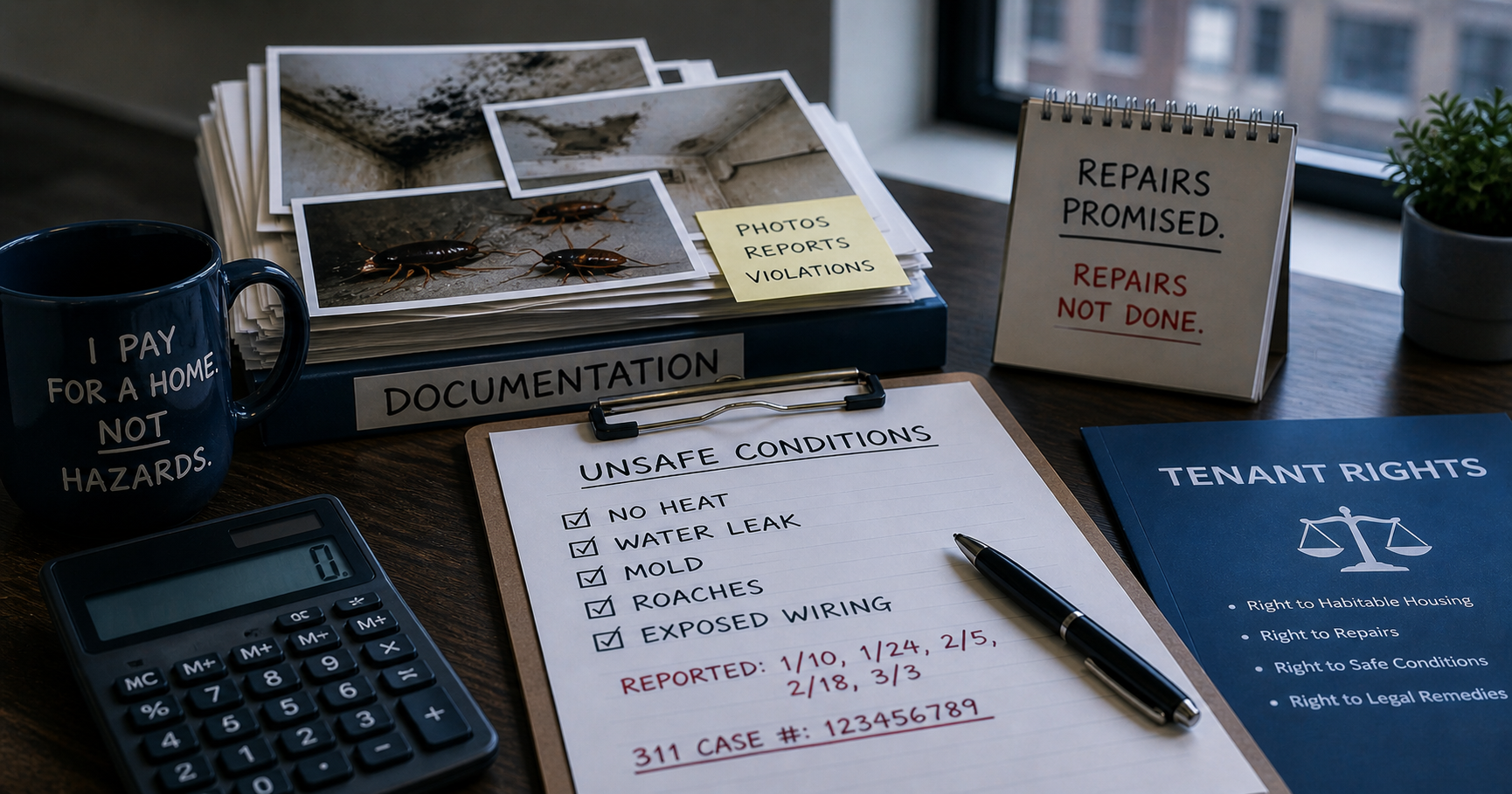
You've been living with serious habitability problems for months despite repeatedly asking your landlord to make repairs. Maybe you're dealing with no heat during a freezing winter, and the landlord keeps promising to fix the boiler but never does. Or perhaps you have a major leak that's caused extensive water damage and mold, and despite your complaints and even an HPD violation notice, the landlord hasn't remediated it. Or you're facing a severe pest infestation that the landlord refuses to properly address with professional extermination.
You're still paying full rent every month for housing that's unsafe, unhealthy, and not what you're legally entitled to. You're frustrated and feel like you're being cheated—paying for habitable housing but receiving a substandard, dangerous apartment. You're wondering whether you can do something with your rent to force the landlord's hand. Can you just stop paying until repairs are made? Can you hire someone to fix the problems yourself and deduct the cost from your rent? Or do you have to keep paying full rent indefinitely while living in terrible conditions?
You think: "Can I withhold my rent because my landlord won't make repairs? If I stop paying, will I get evicted even though the apartment is uninhabitable? Can I pay for repairs myself and subtract the cost from rent? What happens if I do these things and the landlord takes me to court? Am I required to keep paying full rent for an apartment that's not livable, or do I have any rights to reduce what I pay until conditions are fixed?"
Here's the truth: You can withhold rent or use "repair-and-deduct" in New York for serious habitability violations when landlords ignore repair obligations, but both options are legally risky remedies that require careful execution, strong documentation, and preparation to defend your actions in court—they're not casual tactics you can employ without significant legal exposure. New York law recognizes tenant rights to enforce the warranty of habitability through rent withholding and, in limited circumstances, repair-and-deduct, but there's no step-by-step statute spelling out safe procedures. Instead, courts evaluate these actions case-by-case based on the severity of violations, whether you gave landlord proper notice and opportunity to repair, reasonableness of your response, and strength of your documentation. Mishandling rent withholding or repair-and-deduct can result in eviction, liability for full rent plus fees, and damaged rental history.
Let me show you exactly when rent withholding is legally justified and how to do it safely, what repair-and-deduct means and when it's viable, what evidence you must gather to defend either approach, what the litigation risks are if your landlord sues, what safer alternative remedies exist that might be better options, and how to strategically use rent-related remedies while protecting yourself legally and financially.
Rent withholding—stopping rent payments or depositing them in escrow rather than paying landlord—is recognized under New York law as a mechanism to enforce habitability, but it comes with strict requirements and significant risks.
New York doesn't have a clean statutory provision saying "tenants may withhold rent if X, Y, Z conditions exist." Instead, rent withholding exists as a judicially-recognized remedy arising from warranty of habitability doctrine.
The underlying principle is that residential leases contain an implied warranty of habitability—landlords must provide housing that's safe, sanitary, and fit for human habitation. When landlords materially breach this warranty by failing to maintain habitable conditions, they're not providing what tenants contracted and paid for. Courts have recognized that tenants shouldn't be required to pay full rent for uninhabitable housing, and that withholding rent can be a legitimate method to pressure landlords to make necessary repairs.
The mechanism works through the eviction defense framework. When you withhold rent and landlord sues for nonpayment seeking to evict you, you raise the warranty of habitability as an affirmative defense. You're not denying you didn't pay rent—you're arguing landlord's breach of habitability excuses your nonpayment and justifies rent reduction (abatement) for the period conditions were uninhabitable.
Courts then determine whether habitability violations existed, how severe they were, what rent abatement is appropriate, and what amount you actually owe (full rent minus abatement). If violations were serious and your withholding justified, the court might find you owe significantly reduced rent or nothing. If violations were minor or your withholding unjustified, court might find you owe full rent plus fees, and landlord can proceed with eviction.
This framework means rent withholding is inherently confrontational and risky. You're essentially forcing a court battle where a judge will decide retroactively whether your withholding was justified. If you're right about severity of violations and follow proper procedure, you can successfully withhold. If you're wrong or lack proof, you face eviction.
Not every habitability violation or annoying condition justifies rent withholding. The violations must be serious enough to materially breach the warranty of habitability.
Serious breaches that can justify withholding include no heat or inadequate heat during winter (particularly extended outages or chronic failures), no hot water or recurring hot water failures, major leaks causing flooding, extensive water damage, or ceiling collapse, severe mold infestations affecting large areas and causing health issues, serious pest infestations (roaches, mice, rats, bedbugs) that are pervasive and persistent, sewage backups or persistent sewage problems, exposed electrical wiring or major electrical hazards creating fire or shock risks, structural dangers (collapsing ceilings, unsafe stairs, major damage), broken or inadequate locks compromising security, and combinations of multiple moderate violations that collectively make housing substantially uninhabitable.
The standard is whether violations are serious enough that paying full rent for such housing is unreasonable. Living without heat in January justifies withholding because you cannot reasonably be expected to pay full rent for freezing housing. Severe mold making you sick justifies withholding because you're not receiving habitable housing.
Minor issues generally don't justify withholding: cosmetic problems, minor leaks quickly repaired, isolated pest sightings, small areas of peeling paint, squeaky doors, worn but functional appliances. Courts won't excuse rent nonpayment for these lesser violations.
The severity assessment is ultimately made by judges. What you consider serious might not meet judicial standards, or vice versa. This uncertainty is why rent withholding is risky—you're betting a judge will agree violations warranted your action.
You cannot simply stop paying rent the moment you discover a problem. Landlord must first have notice and reasonable opportunity to make repairs.
Provide written notice to the landlord specifically describing problems, requesting repairs, and allowing reasonable time for correction based on severity (24 hours for emergencies like no heat, 30 days for serious hazards like mold or pests, as discussed in previous articles).
Only after reasonable time passes without adequate landlord response can withholding be justified. If you report no heat Monday and withhold rent Wednesday without giving landlord reasonable time to restore heat, your withholding is premature and unjustified. But if you've reported problems repeatedly over months with no adequate repair, withholding becomes justifiable.
Document the notice and landlord's failure:
This procedural compliance is critical. Courts won't excuse rent withholding if landlord never had fair notice and chance to fix problems. Proper notice and waiting reasonable time protects you legally.
If you've determined withholding is justified based on serious violations, proper notice, and landlord failure to repair, follow these practices to minimize legal risks.
Deposit rent in separate escrow-style account, not spend it. Open a separate savings account and deposit your rent payments there each month instead of paying landlord. This demonstrates good faith—you're not trying to avoid paying rent, you're holding it pending repair or court determination of what's owed.
Having rent available is crucial if court determines you owe some amount. If judge finds conditions warranted 40% rent reduction but you owe remaining 60%, and you've spent all the money, you can't pay the judgment and face eviction. But if rent is in escrow, you can immediately pay whatever court determines you owe.
Continue documenting violations while withholding. Take ongoing photos showing problems persist, keep logs of continued failures, gather additional violations or inspection reports. This evidence proves violations weren't fixed and continued during withholding period.
Communicate to landlord that you're withholding due to uninhabitable conditions and will pay reduced rent or deposited rent once repairs are made or court determines appropriate abatement. Written communication creates record of your position.
Prepare for litigation. Assume landlord will sue for nonpayment. Organize all evidence: photos, violations, communications, documentation of notice and landlord's failure to repair. Be ready to present comprehensive case in Housing Court.
Expect partial abatement, not 100% rent excuse. Courts often determine that serious violations warrant substantial rent reduction—30%, 50%, sometimes 70% or more—but not always complete excuse from rent. Be prepared to pay whatever portion court determines you owe.
When you withhold rent, landlord will almost certainly sue for nonpayment in Housing Court.
The lawsuit alleges you failed to pay rent for X months and seeks judgment for the unpaid amount plus fees and court costs, and a warrant of eviction removing you from the apartment.
Your defense is warranty of habitability: you present evidence of violations, landlord's knowledge and failure to repair, and argue rent should be abated (reduced) to reflect the dwelling's diminished value during violations, meaning you owe less than landlord claims (or nothing if abatement equals or exceeds withheld rent).
Court will determine:
Possible outcomes:
Legal representation is highly advisable. Housing Court can be navigated pro se but is complex, and having attorney significantly improves chances of favorable outcome.
Repair-and-deduct is the remedy where you arrange and pay for necessary repairs yourself, then deduct the cost from rent you owe landlord.
Unlike some states with explicit repair-and-deduct statutes, New York doesn't have clear statutory authorization for this remedy.
Case law and practice have recognized repair-and-deduct in limited circumstances as part of habitability enforcement and contract setoff principles. The theory is that when landlord breaches the obligation to maintain habitable conditions and tenant arranges necessary repairs, tenant can offset the repair costs against rent owed—essentially, tenant performed landlord's obligation and reduced landlord's debt to tenant by that amount.
Courts scrutinize repair-and-deduct heavily because it involves tenant unilaterally determining what repairs are necessary, selecting contractors, incurring costs, and deciding to deduct from rent—all without landlord agreement or court approval. This creates obvious potential for abuse (tenant claiming excessive costs, unnecessary work, or inflated bills).
The remedy is viable but risky, and generally limited to relatively modest, clearly necessary repairs for serious habitability violations where landlord has refused to act despite notice.
Repair-and-deduct is most defensible in specific circumstances.
The problem clearly affects basic habitability and is not cosmetic or minor. Broken heating system in winter, major plumbing failure (burst pipe, non-functioning toilet), serious electrical hazard requiring immediate professional repair, broken exterior locks compromising security, roof leak causing water damage—these essential habitability issues can justify tenant-arranged repairs.
You've provided written notice and reasonable time for landlord to make repairs, and landlord has refused, failed to act, or unreasonably delayed. You cannot use repair-and-deduct for problems landlord never knew about or hasn't had time to address.
The repair is urgent enough that waiting for court-ordered repairs through HP proceedings would cause unacceptable harm. If your toilet is broken and sewage is backing up, waiting weeks or months for Housing Court process isn't reasonable—emergency repair is justified.
The cost is reasonable and necessary. You obtain fair market rate for the work from legitimate contractor, get receipts, and the repair actually addresses the problem. You can't hire your friend to do questionable work at inflated rates or claim excessive costs.
You notify landlord of your intention: "I notified you of [problem] on [date] and gave you [time period] to repair. Since you have not made repairs, I am arranging for [specific repair] with [contractor] at estimated cost of [amount]. I will deduct this cost from next month's rent and provide you with receipts."
This notice gives landlord final chance to make repairs themselves and creates record of your reasonable process.
Repair-and-deduct comes with significant limitations making it appropriate only for specific, limited situations.
Cost limitations: Deductions should be modest relative to monthly rent. Spending $200-500 to fix a necessary repair might be defensible. Spending $3,000-5,000 for major renovation is much riskier and more likely to be challenged. Many tenant attorneys advise keeping repair-and-deduct to relatively small, necessary repairs.
Scope limitations: Basic, essential repairs (heating, plumbing, electrical, locks, critical structure) are most defensible. Improvements, upgrades, or non-essential repairs are not justified.
Landlord challenge risk: Landlord may sue claiming the repairs were unnecessary, costs excessive, work improper, or problem wasn't serious enough to justify self-help. You must then prove necessity, reasonableness, and proper procedure.
Eviction risk: If landlord sues for nonpayment because you deducted repair costs from rent, and court agrees with landlord that deduction was unjustified, you owe the full rent plus potential fees and face eviction.
Many attorneys recommend getting legal advice before repair-and-deduct, and using it only for modest, clearly necessary emergency repairs—not as routine remedy for habitability violations. For larger problems or non-emergency situations, HP proceedings or other remedies may be safer.
If you've determined repair-and-deduct is appropriate, follow meticulous procedure.
Written notice to landlord detailing the problem, your prior requests for repair, reasonable deadline for landlord to make repair, and your intention to arrange repair yourself and deduct cost if landlord doesn't act by deadline.
Obtain written estimates from licensed contractors for the necessary work. Multiple estimates strengthen your case that cost is reasonable.
Arrange repair with legitimate, licensed contractor (where licenses are required). Avoid using friends, relatives, or informal arrangements that might appear questionable.
Get detailed receipts and documentation:
Deduct from rent with written explanation. When paying next month's rent, include letter: "Enclosed is $X representing rent minus $Y deducted for [specific repair] performed by [contractor] on [date]. Attached are contractor invoice and receipts. This deduction is made pursuant to landlord's failure to make necessary repairs despite notice on [date] and reasonable opportunity to repair."
Keep copies of all documentation: notice to landlord, estimates, invoices, receipts, photos, deduction explanation letter.
This meticulous documentation proves you followed reasonable process, costs were fair, repair was necessary, and deduction was justified if landlord challenges it.
Whether you're withholding rent or using repair-and-deduct, comprehensive documentation is essential to defend your actions if landlord takes you to court.
Proving serious habitability violations exist is foundational to both remedies.
Photographic and video evidence showing:
Official violations and inspections:
These official determinations that government inspectors found violations are extremely persuasive evidence conditions are serious.
Written descriptions and logs:
You must demonstrate landlord was aware of problems and had reasonable opportunity to fix them but failed.
All repair requests sent to landlord:
Landlord responses (or lack thereof):
Timeline showing notice-to-failure progression:
January 10: Email to landlord reporting no heat January 12: Follow-up call, landlord promises repair January 20: Heat still out, second email January 25: Still no heat, called 311 February 1: HPD inspection, violation issued February 15: Heat still not properly fixed February 28: Begin withholding rent / arrange repair-and-deduct
This documented timeline proves landlord had ample notice and time but failed to act, justifying your remedy.
If you used repair-and-deduct, documentation of the repair itself is critical.
Pre-repair documentation:
Repair documentation:
Reasonableness evidence:
This package proves you followed reasonable process, hired legitimate contractor at fair price for necessary work—defending against landlord claims of excessive costs or unnecessary repairs.
When landlord sues for nonpayment, present organized evidence package:
Chronological timeline showing problem onset, repeated notice to landlord, landlord's failures, official violations, your decision to withhold or repair-and-deduct, and ongoing problems.
Evidence binders or files with:
Written narrative explaining your case: problems existed, you notified landlord, they failed to repair, you took justified action to enforce habitability.
Professional presentation of evidence makes favorable impression on judges and strengthens credibility of your claims.
Given the significant risks of rent withholding and repair-and-deduct, New York tenant advocates strongly recommend considering safer alternatives before resorting to these self-help remedies.
Filing HP (Housing Part) case in Housing Court is often safer than unilateral rent withholding.
HP proceedings are tenant-initiated lawsuits compelling landlord repairs. You file petition documenting violations, landlord is summoned to court, judge hears evidence and can order specific repairs with deadlines, appoint administrators to make repairs if landlord won't, grant rent abatement for violation periods, and hold landlord in contempt with penalties if they don't comply.
Advantages over withholding:
The process involves filing petition with evidence, serving landlord, attending hearings, presenting your case, obtaining court orders, and enforcing compliance.
Free assistance available through Housing Court Answers (NYC: 212-962-4795), legal aid organizations, and court help desks.
HP proceedings are proactive, court-supervised way to enforce habitability without the risks of self-help remedies.
Direct negotiation with landlord, backed by evidence of violations, can achieve resolution without litigation.
Approach landlord with documentation of serious violations: "Given the ongoing [mold/heat failures/pest problems] documented in these photos and HPD violations, I believe rent should be reduced to reflect the uninhabitable conditions. I propose [X% reduction] until repairs are completed, or alternatively, early lease termination allowing me to vacate without penalty."
Landlords may agree because:
Get agreements in writing:
Written agreement creates enforceable contract and avoids all litigation risk.
Reporting violations to housing authorities triggers official enforcement without tenant taking financial risks.
Call 311 (NYC) or contact local code enforcement to request inspections. Agencies issue violations, impose fines, set correction deadlines, and can pursue escalating enforcement if landlords don't comply.
Agency pressure often compels repairs when tenant requests don't, because violations carry financial penalties and can block permits or certificates of occupancy landlords need.
Combined with other remedies, official violations strengthen your position whether you're negotiating, pursuing HP proceedings, or defending rent withholding.
Perhaps the most important recommendation is getting legal advice before withholding rent or repair-and-deduct.
Legal Aid, Legal Services NYC, regional legal services (find via LawHelpNY.org), and private tenant attorneys can:
Many services are free or low-cost based on income.
Consultation doesn't commit you to any action but informs your decision with professional legal assessment rather than guessing whether your case is strong enough.
Attorneys regularly see tenants who withheld rent for insufficient reasons, or with inadequate documentation, facing eviction. Legal advice can prevent these disasters.
If you're dealing with serious habitability violations and considering rent withholding or repair-and-deduct, a strategic, documented approach maximizes your chances of success and minimizes risks.
Before withholding or deducting, create comprehensive evidence file documenting violations, notice to landlord, landlord's failures, and impacts on you.
Spend weeks or months if necessary gathering photos, obtaining official violations, documenting communications, and building airtight case. The stronger your evidence before you act, the safer your position when landlord sues.
Don't rush into withholding or repair-and-deduct impulsively when angry about conditions. Calm, methodical case-building is more effective than reactive self-help.
Send landlord formal written notice: "I am notifying you of serious habitability violations: [list specific problems]. These conditions violate New York's warranty of habitability and [cite specific codes/violations if you have them]. You must complete repairs by [reasonable deadline based on severity]. If repairs are not made by this deadline, I will be forced to pursue legal remedies including [withholding rent / arranging repairs and deducting costs / filing HP proceedings]."
This notice:
Rent withholding makes sense when:
Repair-and-deduct makes sense when:
HP proceedings make sense when:
Negotiation makes sense when:
Match remedy to your goals, risk tolerance, and situation.
Whatever remedy you choose, continue documenting:
Documentation discipline separates successful defenses from losing ones.
You can withhold rent or use repair-and-deduct for serious habitability violations in New York, but both are legally risky remedies requiring careful execution, strong evidence, and readiness to defend your actions in court.
Rent withholding is justified when serious breaches of habitability exist (no heat, severe mold, major leaks, pest infestations, hazards), landlord had notice and reasonable time to repair but failed, and you're prepared for eviction defense.
Best practices: Deposit rent in separate escrow account, not spend it. Document everything. Expect partial abatement not 100% rent excuse. Be ready to pay whatever court determines you owe.
Repair-and-deduct is viable for modest, clearly necessary emergency repairs when landlord refuses to act despite notice. Requires documented necessity, reasonable costs from legitimate contractors, proper procedure, and receipts.
Critical evidence: Photos/videos of violations, official HPD or code violations, all communications with landlord proving notice and failure to repair, timeline, contractor documentation for repair-and-deduct.
Safer alternatives often better: HP proceedings for court-ordered repairs and abatement. Negotiated rent reduction or lease termination. Code complaints triggering agency enforcement. Legal consultation before acting.
If landlord sues for nonpayment, you must defend with strong evidence that violations justified your actions. Weak cases result in eviction.
Treat rent withholding and repair-and-deduct as litigation preparation from day one, not casual tactics. With serious violations, proper procedure, and comprehensive documentation, they can successfully enforce your right to habitable housing. Without these elements, they're paths to eviction.