Tenants lose a staggering amount of money every year to four words: "normal wear and tear." Not because the phrase means nothing — but because landlords have figured out that most tenants think it means whatever the landlord says it means. And that misunderstanding is worth a fortune.
Here's the thing the industry is quietly counting on you not to grasp: "normal wear and tear" is not a vague, squishy zone where the landlord gets to decide what counts. It's a real legal line, with real content, and — this is the part they'd rather you didn't know — it lands overwhelmingly in the tenant's favor. Normal wear and tear is, by definition, the landlord's cost to bear. It cannot lawfully be deducted from your deposit. The whole game is convincing you that the line is blurry so you won't notice how much of what they charge you falls squarely on the side that's theirs to pay.
So let's un-blur it. Because once you can actually tell the difference between wear and damage — with the same clarity a court would — most of the deductions on a typical move-out statement stop looking legitimate and start looking like exactly what they are: charges for things the landlord was always going to have to pay for anyway.
Start with the actual distinction, because it's far clearer than landlords let on.
Normal wear and tear is the gradual, expected deterioration of an apartment from ordinary living. It is what happens to any home simply because a human being lived in it for a couple of years. Faded paint. Carpet worn thin in the walking paths. Small nail holes from hanging pictures. Light scuffs on the floor. Faded or slightly discolored fixtures. Hairline cracks in the walls from the building settling. Loose grout. None of this is your fault, none of it is chargeable, and all of it is the landlord's responsibility as the ordinary cost of owning rental property. Courts have said so directly — in New York, a long-standing case established that faded paint and small nail holes are simply inherent to ordinary living. They are not damage. They are what living looks like.
Damage is different in kind, not degree. It's harm beyond ordinary use — the result of accident, neglect, or abuse. Large or gaping holes in the wall, not pin-sized nail holes. Broken fixtures, not faded ones. Burns, pet stains, and gouges in the carpet, not ordinary thinning. Doors torn off hinges. Unapproved paint colors. A cracked window from rough handling. This is what a landlord may legitimately deduct for, because it's harm you caused beyond the normal course of living there.
See the pattern? The dividing line is not the landlord's opinion. It's whether the condition is the expected result of ordinary use (wear, their cost) or harm beyond ordinary use (damage, your cost). Scuffed floors: wear. Broken fixture: damage. Worn carpet: wear. Carpet with a bleach stain: damage. Faded paint: wear. Crayon mural: damage. The line is real, it's knowable, and courts apply a "reasonable person" standard to it — asking what an ordinary person would consider expected wear versus genuine harm — that tends to favor the tenant unless the landlord can show real neglect. The landlord's entire advantage evaporates the moment you know which side of that line a given item falls on.
Now take that line and lay it against a typical deduction statement, because this is where the money is.
Most itemized deductions overreach. Not always through outright lying — often through quietly reclassifying wear as damage and hoping you can't tell the difference. "Repainting: $400." But faded, ordinary paint after a two-year tenancy is wear — their cost, not yours. "Carpet replacement: $900." But carpet worn from normal foot traffic is wear. "Cleaning fee: $250." But routine cleaning of a reasonably-kept apartment is generally the landlord's cost, not a chargeable damage. Line by line, a large share of the typical deduction statement is composed of wear items dressed up in damage language, betting you'll read "repainting" and assume you owe it.
So dismantle it line by line. Take the statement and interrogate each entry with one question: is this the expected result of ordinary living, or harm beyond it? Faded paint — wear, strike it. Worn carpet — wear, strike it. Small nail holes — wear, strike it. General cleaning — usually wear, strike it. What survives that pass is only genuine damage: the actual broken fixture, the actual burn, the actual gouge. And very often, what survives is a fraction of what they charged — sometimes nothing at all.
Then hit the survivors with a second question, the one landlords least expect a tenant to know: even for genuine damage, what was the useful life of the thing, and how old was it? This is the deduction-killer. The law in many places doesn't let a landlord charge you the full replacement cost of an item that was already partway — or all the way — through its natural lifespan. Carpet has a useful life of roughly five to seven years. If the carpet was already six years old and near the end of its life when you stained it, the landlord cannot bill you for a brand-new carpet, because you didn't cost them a new carpet — you cost them the tail end of an old one that was due for replacement anyway. A California court made exactly this ruling: a landlord couldn't charge full replacement for a carpet approaching the end of its five-year cycle, even though it was stained. The same logic applies to paint, appliances, fixtures — everything has a useful life, and you owe, at most, the remaining value, not a full upgrade.
That last word — upgrade — is the whole scam in miniature. Landlords routinely try to better their property at the tenant's expense: charging you to replace the worn ten-year-old carpet with brand-new carpet, so they end the tenancy with an asset worth more than when you arrived, funded by your deposit. That's not restoring the unit to its prior condition. That's improving it on your dime, and it's not allowed. When you dismantle a statement, you're looking for exactly this: wear billed as damage, and damage billed at full-replacement-cost when only depreciated value is owed. Strip both out, and most inflated deduction statements collapse.
This "betterment" trap is worth lingering on, because it's the single most lucrative move landlords make and the one tenants are least equipped to challenge. Everything in an apartment is aging on a schedule whether you live there or not. The paint was going to need redoing. The carpet was going to wear out. The appliances were marching toward the end of their service life on their own timeline, regardless of your tenancy. A landlord who uses your deposit to reset all those clocks to zero — new paint, new carpet, new fixtures — has quietly made you pay for maintenance that was coming due anyway, and pocketed the difference between "used" and "new" as pure gain. The useful-life principle exists precisely to stop this: you are responsible, at most, for the value you actually consumed beyond normal use, never for the replacement of something that was already at or near the end of its natural life. So whenever you see a full-replacement charge, ask how old the item was. The older it was, the less you owe — and past its useful life, you may owe nothing at all, because there was no remaining value left for you to have destroyed.
One more line-item rule to keep in your pocket: a repair deduction generally can't exceed the actual cost of the repair. If fixing the thing cost the landlord a hundred dollars, the deduction is a hundred dollars — not a padded number, not an estimate that happens to absorb your whole deposit.
To see how fast a statement unravels under this treatment, take a realistic one. You get back $300 of a $1,600 deposit, with this attached: "Repainting, $500. Carpet replacement, $650. Cleaning, $200. Repair broken closet door, $150." It looks official, it looks itemized, and it swallows $1,300. Now run it.
Repainting, $500 — was the paint faded from two years of ordinary living, or did you paint the walls neon without permission? If it was just faded, that's wear, and the $500 is theirs to pay. Strike it. Carpet replacement, $650 — worn from foot traffic, or destroyed? If it's worn, that's wear; strike it. And even if there were a genuine stain, the carpet was already four years into a five-to-seven-year life, so they'd owe you a new carpet's worth of use they got — you'd owe, at most, a fraction of $650, not the whole thing, and certainly not a brand-new upgrade. Cleaning, $200 — did you leave it reasonably clean? Routine cleaning is generally wear; strike it. That leaves the closet door, $150 — a genuinely broken fixture, real damage, legitimately yours. But if the actual repair cost $80, the deduction is $80, not $150.
Watch what happened. A $1,300 deduction that looked airtight collapsed, under two questions and a calculator, to $80 — and that's the typical result, not a lucky one. The statement was designed to be accepted whole. It was never designed to be taken apart.
Your concepts touched on the pre-move-out inspection, and it's worth being clear-eyed here, because this tool cuts both ways.
Used honestly, a pre-move-out inspection protects the tenant: the landlord has to tell you, before you leave, what they intend to deduct for, and you get a chance to fix those things while you still can. That's the tenant-friendly version, and you should absolutely use it.
But some landlords try to run it the other way — as a fishing expedition, a chance to walk through pointing at every faded wall and worn floorboard, narrating a long list of "problems" designed to soften you up so that when the inflated deduction statement arrives, you've been primed to accept it. They use the inspection to manufacture the impression of damage, cataloguing ordinary wear in a grave tone so it feels chargeable.
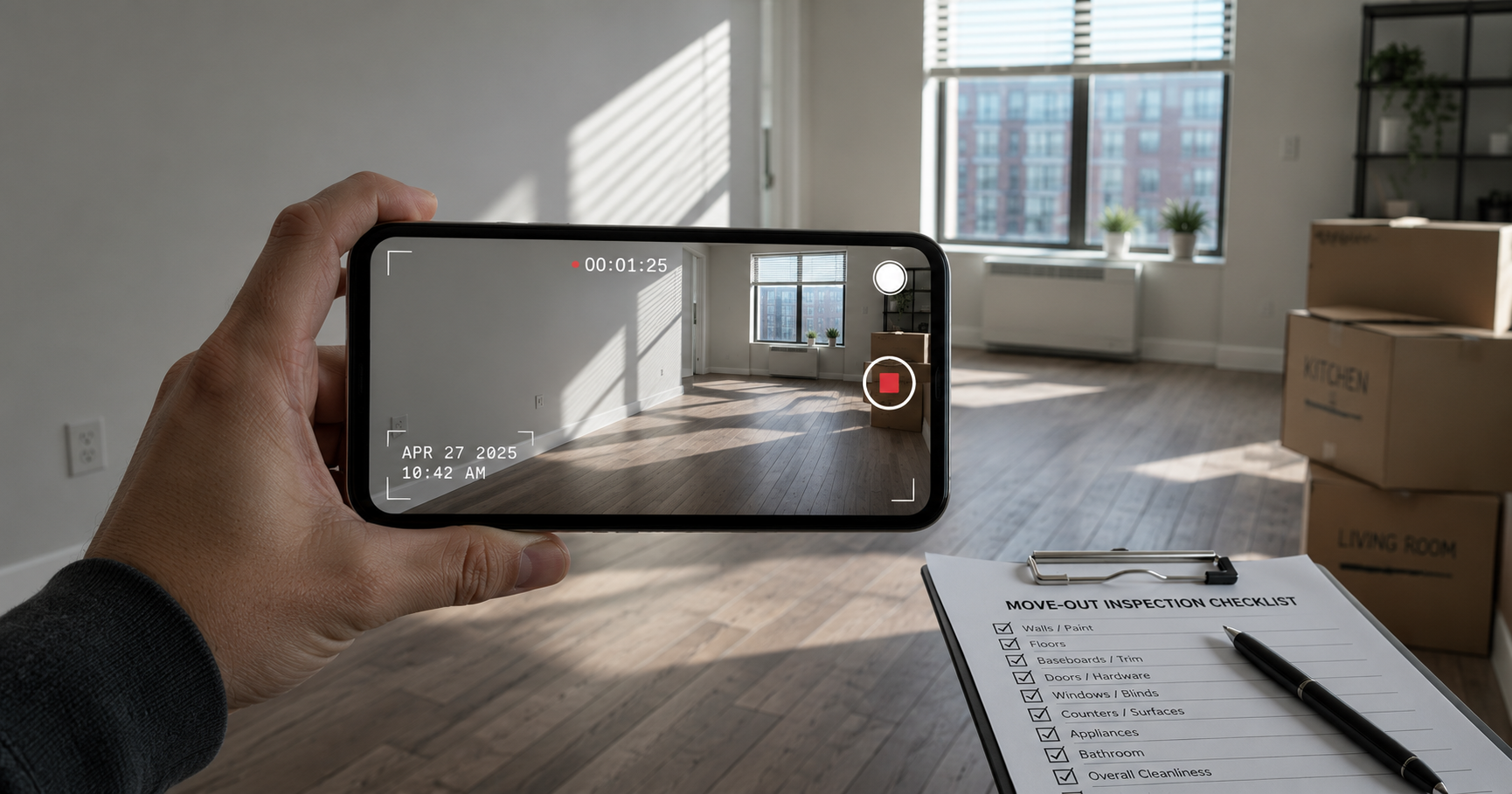
Counter it with the same line you now know cold. When a landlord points at faded paint during a walk-through and frames it as something you'll be charged for, that's not a fact — it's a claim, and it's a claim that's wrong. You don't have to argue in the moment, but you don't have to accept it either. Document the inspection yourself: photograph and video everything they flag, so you have your own dated record of the actual condition of each item they're building a case around. Then, when the deduction statement comes, run it through the two questions — wear or damage, and useful life — exactly as above. The inspection they meant to use to intimidate you becomes, if you're documenting, just more evidence for your side: a dated record showing that what they called "damage" was ordinary wear all along. The tool only works as intimidation on a tenant who doesn't know the line. You do now.
Step back and see what's really going on here.
"Normal wear and tear" was never genuinely ambiguous. Courts apply it constantly, the categories are well-established, and the line — expected result of ordinary use versus harm beyond it — is clear enough to sort almost any real item. The ambiguity is manufactured. It's a fog the industry benefits from maintaining, because a tenant who believes the phrase is vague is a tenant who assumes the landlord gets to define it, and a tenant who assumes that will pay for faded paint, worn carpet, routine cleaning, and full-price replacement of half-dead carpet without ever objecting. The vagueness isn't a property of the law. It's a product sold to tenants, and its entire purpose is to transfer money that the law says belongs to you.
So refuse to buy it. The next time a deduction statement lands, don't read it as a bill you owe — read it as a set of claims to be tested, most of which won't survive contact with the two questions. Is this wear or damage? And if it's damage, am I being charged for the remaining life of the thing, or for a brand-new upgrade the landlord always wanted? Run every line through that, and watch how much of the "damage" turns back into what it always was: the ordinary, expected, landlord's-cost consequence of a person having lived in a home.
The myth was never "normal wear and tear." Normal wear and tear is real, and it's on your side. The myth was that you couldn't tell the difference — and you just did. Find out where you stand.