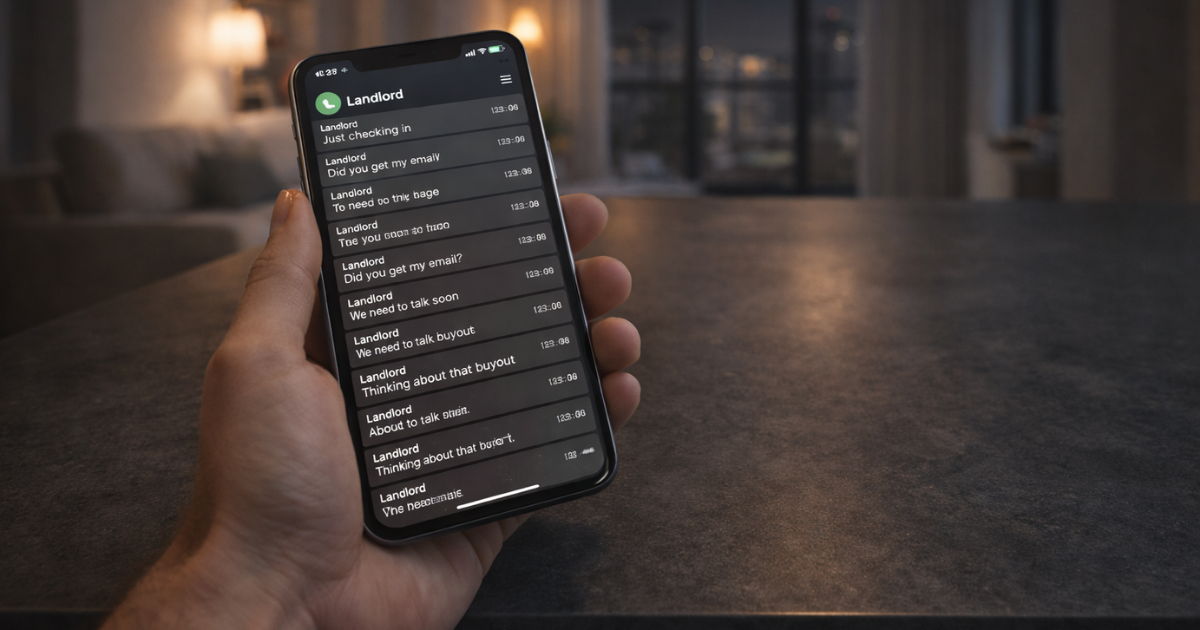
Your phone buzzes. Another text from your landlord asking if you've "thought more about that buyout offer." Twenty minutes later, another text about a minor building rule. An hour after that, a call asking when you'll be home so they can "discuss something." The next morning at 7am, an email about lease renewal. That evening at 10pm, three more texts asking if you got their earlier messages. Your phone rings at 11:30pm—it's your landlord again.
You're exhausted. You dread looking at your phone. You can't concentrate at work because your landlord keeps calling. But you're also wondering: "Is this actually illegal harassment? Or am I being too sensitive about a landlord who's just... really communicative? At what point does 'overly involved landlord' cross the line into 'this is against the law'?"
This question—where constant contact becomes illegal harassment rather than just annoying behavior—confuses tenants because the line depends on factors like frequency, timing, content, and intent rather than a simple numerical threshold.
Here's the legal standard: Contact becomes harassment when the frequency, timing, tone, and content cross from "normal business communication" into a course of conduct that disturbs your peace, feels coercive, or is designed to pressure you into moving out or surrendering your tenant rights.
It's not about whether your landlord is chatty or has poor boundaries. It's about whether the pattern of constant contact serves a legitimate business purpose or is being weaponized to harass you. Let me show you exactly where that line is, what New York law says about excessive landlord contact, and when you can legally tell your landlord to stop.
Before we get to the legal standards, let's acknowledge why this particular form of harassment is so confusing:
Legitimate reasons landlords need to contact tenants:
You think: "My landlord has legitimate reasons to contact me sometimes, so maybe this constant contact is just them being thorough?"
The issue: Legitimate contact needs don't justify EXCESSIVE contact. One email about rent is reasonable. Ten calls, fifteen texts, and five emails about rent in one day is harassment.
Harassment contact often masquerades as:
The content seems innocent, but the volume and timing reveal the true purpose: wearing you down, invading your peace, maintaining psychological pressure.
You think: "They're being friendly, so this can't be harassment, right?"
Reality: Frequency and timing matter more than superficially friendly tone. Friendliness at 11pm every night is still harassment.
Cultural and power dynamics make you hesitate:
You internalize the message that you should be available to your landlord whenever they want to reach you.
This prevents you from recognizing that YOU have the right to peaceful enjoyment of your home, which includes not being constantly harassed by communication.
Let's establish the legal framework:
New York harassment law defines harassment as acts or omissions intended to:
Excessive contact can meet this standard when:
It disturbs your peace and quiet: Constant calls/texts/emails prevent you from relaxing, sleeping, working, or living normally in your home.
It interferes with comfortable use of your apartment: You can't enjoy your home because you're constantly fielding landlord communications or dreading the next contact.
It's intended to pressure you: The pattern reveals intent to wear you down, pressure a buyout, discourage complaints, or force you out.
New York City's Housing Preservation and Development (HPD) specifically lists these as examples of harassment:
"Late-night calls intended to pressure tenants to move out"
This explicitly recognizes that calls outside normal hours, especially when designed to pressure tenants to vacate, constitute harassment.
"Repeatedly contacting or visiting a tenant during non-business hours when the tenant has not asked to be contacted"
This addresses both frequency ("repeatedly") and timing ("non-business hours") and notes that unwanted contact (when tenant hasn't requested it) can be harassment.
Key takeaway from HPD guidance: You don't need to prove physical threats or property damage. Excessive unwanted contact, particularly at unreasonable hours, is legally recognized as harassment.
The Attorney General's office flags as harassment:
"Repeated contact in a manner intended to harass"
This includes contact at unusual hours, contact at work without tenant's consent, especially in connection with buyout pressure.
What this means: If your landlord is calling you at work repeatedly, contacting you late at night, or bombarding you with buyout-related communications, the AG's office recognizes this as potential harassment.
For excessive contact to be harassment, courts look for:
Pattern: Multiple incidents of unwanted contact over time, not just one or two calls.
Intent: Evidence that contact is designed to harass, pressure, or disturb rather than accomplish legitimate business purposes.
Unwanted nature: You've expressed (or it's obvious from context) that the contact is unwanted, yet it continues.
Impact: The contact is actually disturbing your peace, causing stress, or interfering with your life.
Let's categorize landlord contact patterns:
What this looks like:
Frequency: Occasional contact as needed for legitimate business reasons (monthly rent reminders, scheduling needed repairs, annual lease discussions, emergency issues).
Timing: During normal business hours (roughly 9am-7pm on weekdays, reasonable hours on weekends for urgent matters).
Content: Specific, relevant to actual tenancy issues (rent payment, repair scheduling, lease compliance, building maintenance).
Tone: Professional, businesslike, respectful.
Response to boundaries: If you ask for communications via email only or during certain hours, landlord respects those preferences.
Examples of normal contact:
Why this isn't harassment: Frequency is reasonable, timing is appropriate, content is legitimate, tone is professional, and landlord respects boundaries.
What this looks like:
Frequency: More contact than necessary, but not constant (few times per week rather than few times per day).
Timing: Mostly during business hours but occasionally at inconvenient times.
Content: Mix of legitimate business and unnecessary communication (asking questions that could wait, following up on things already addressed, being chattier than needed).
Tone: Can be friendly or slightly pushy, but not threatening or intimidating.
Response to boundaries: If you set clear boundaries, landlord mostly respects them (though might occasionally slip).
Examples of annoying contact:
Why this usually isn't harassment: While annoying, it doesn't rise to the level of disturbing your peace or showing intent to pressure you. However, if frequency increases, timing worsens, or you set boundaries that landlord ignores, this can cross into harassment.
When it BECOMES harassment: If the "annoying" contact persists after you've clearly requested less communication, if it escalates in frequency, if it's combined with other forms of pressure (buyout offers, deteriorating conditions), or if timing shifts to unreasonable hours.
What this looks like:
Frequency: Constant, excessive contact—multiple calls/texts/emails per day, sometimes dozens of communications.
Timing: Regular contact during non-business hours (late night, early morning, weekends), contact at your workplace after you've asked landlord not to.
Content:
Tone: Can range from aggressive to manipulatively friendly, but underlying pressure is clear. May include threats, intimidation, or coercive language.
Response to boundaries: Landlord ignores your requests to limit contact, may escalate contact after you set boundaries, explicitly refuses to respect your preferences.
Examples of harassment contact:
Why this is harassment:
Disturbs peace and quiet: Constant communication prevents you from relaxing, sleeping, or living normally. You dread your phone buzzing. You can't escape the landlord's presence even in your own home.
Shows intent to pressure: Pattern reveals purpose is to wear you down, not accomplish legitimate business. Especially clear when combined with buyout offers or pressure to move.
Continues despite clear boundaries: You've asked landlord to stop or limit contact, they refuse. This proves the contact is unwanted harassment, not legitimate business communication.
Interferes with your life: You can't concentrate at work, can't sleep, feel stressed and anxious constantly.
If you're unsure which category you're in, apply these practical tests:
Count the communications over a typical week:
Normal: 1-3 communications per week for routine matters, possibly more if there's an active repair issue or lease negotiation.
Annoying: 5-10 communications per week, more than necessary but not overwhelming.
Harassment: 10+ communications per day, or 30+ per week, especially when many are about the same non-urgent topic or have no clear business purpose.
Red flag volume patterns:
When are communications happening?
Normal: During standard business hours (9am-7pm weekdays, 10am-6pm weekends for non-emergencies).
Annoying: Occasional communication slightly outside business hours (8am or 8pm), but generally appropriate timing.
Harassment: Regular contact outside reasonable hours:
Red flag timing patterns:
What are the communications about?
Normal: Specific, legitimate business matters (rent collection, repair scheduling, lease terms, building issues, legal notices).
Annoying: Mix of legitimate and unnecessary (asking questions that could wait, being overly detailed about minor things, chatty personal questions).
Harassment:
Red flag content patterns:
How does landlord respond when you set boundaries?
Normal: Landlord respects your preferences (email only, certain hours, specific topics).
Annoying: Landlord mostly complies but occasionally forgets or slips up.
Harassment:
Red flag boundary violations:
How is this affecting you?
Normal: Communications are mildly inconvenient but don't cause significant stress.
Annoying: Communications are frustrating and you wish they'd stop, but they're not causing serious psychological distress.
Harassment:
Red flag psychological impacts:
Let's apply these thresholds to real scenarios:
Pattern: Landlord emails once per month on 25th reminding that rent is due on 1st. Occasionally texts to schedule repair appointments for issues tenant reported. Called once this year about emergency pipe burst. Sent email in November about lease renewal.
Tests:
Conclusion: Normal business contact, NOT harassment.
Pattern: Landlord texts 3-4 times per week about minor building issues, sometimes asks personal questions, occasionally calls to ask if tenant received email from an hour ago. All contact during daytime hours. Tenant finds it excessive but hasn't explicitly asked landlord to stop.
Tests:
Conclusion: Annoying and excessive, but not quite harassment yet. However, if tenant sets boundaries and landlord ignores them, or if frequency increases, this could cross into harassment.
Recommended action: Set clear written boundaries now before it escalates.
Pattern: Landlord calls 5-10 times per day, texts 15-20 times per day. Calls at 10pm, 11pm, even midnight. Content includes buyout pressure ("have you thought about my offer?"), complaints about tenant, demands for immediate responses. Tenant requested email-only communication. Landlord ignored request and escalated contact. Tenant dreads phone, can't sleep, constantly anxious.
Tests:
Conclusion: This is CLEARLY harassment. Multiple red flags, meets legal standard.
Recommended action: Document everything, report to HPD (if NYC), contact legal services, consider harassment proceeding in court.
Pattern: Landlord was communicating 2-3 times per week (annoying but manageable). Tenant refused buyout offer. Since refusal, landlord now contacts 10+ times per day, including late-night calls. Messages include repeated buyout mentions and suggestions tenant would be "happier elsewhere." Tenant asked for email only. Landlord continues calling.
Tests:
Conclusion: This crossed from annoying to harassment. The timing (escalation after buyout refusal), volume increase, boundary violations, and late-night contact all indicate harassment.
Recommended action: Document the pattern showing escalation after buyout refusal (this proves retaliatory intent), report to HPD, seek legal help.
If you're experiencing excessive contact that's approaching or clearly in harassment territory:
Send an email (keep a copy for your records) stating your communication preferences:
Template:
"[Landlord name],
I am writing to establish clear communication preferences for our landlord-tenant relationship.
Going forward, please contact me:
Please do not:
I need these boundaries to maintain my ability to work, sleep, and enjoy peaceful use of my apartment. I will respond to all legitimate business communications sent via [preferred method] during [specified hours].
Thank you for respecting these preferences.
[Your name] [Date]"
Why this matters:
Creates a record: Proves you explicitly requested limited contact, making any continued excessive contact clearly "unwanted" (key element of harassment).
Establishes reasonableness: Your boundaries are reasonable (you're still allowing legitimate business communication), showing you're not being difficult—landlord's excessive contact is the problem.
Provides evidence: When landlord violates these boundaries, you have written proof they're ignoring your explicitly stated preferences, which strengthens harassment claim.
Create a comprehensive log:
For each call/text/email, record:
Save everything:
Why this matters:
Proves the pattern: Documentation shows frequency, timing, and escalation over time.
Establishes harassment elements: Your notes about content and impact help prove intent to harass and actual disturbance of your peace.
Provides court evidence: If you bring harassment proceeding, this documentation is your evidence.
In New York City:
Call 311 and say "I want to report tenant harassment." Specifically mention:
HPD will:
Outside NYC:
Contact your local housing/code enforcement to report harassment patterns.
Contact NY Attorney General's office (ag.ny.gov) especially if buyout pressure is involved.
Contact legal services:
NYC:
Outside NYC:
Tell intake: "My landlord is harassing me through excessive calls, texts, and emails. They contact me [X times per day], including late at night. I've asked them to stop and they won't. I have documentation."
What lawyers can help with:
Options for legal relief:
HP (Housing Part) Harassment Proceeding in Housing Court (NYC):
Supreme Court Injunction (Statewide):
What courts can order:
Understanding the tactic helps you recognize it:
Constant contact creates psychological exhaustion.
The goal: Make you so tired of dealing with landlord that you'll:
Why it works if you don't fight back: Death by a thousand cuts. No single call is a dramatic event, but cumulative effect is psychologically crushing.
Excessive contact establishes landlord's power and your subjugation.
The goal: Remind you constantly that landlord can intrude on your life whenever they want, making you feel you have no autonomy or privacy.
Why it works if you don't fight back: You internalize powerlessness. You accept that you must be available to landlord 24/7.
Landlord contacts you excessively, then claims you're "unresponsive" or "difficult to reach" when you stop answering.
The goal: Create false documentation that you're not cooperating, which landlord uses to justify:
Why it works if you don't fight back: Your attempt to escape harassment gets twisted into "evidence" against you.
Excessive contact is rarely the only harassment tactic.
Often combined with:
The goal: Multi-front harassment campaign that makes life unbearable from multiple angles simultaneously.
Why it works if you don't fight back: You're overwhelmed by harassment from multiple directions and cave to pressure.
Here's what you need to know:
There's no magic number of calls/texts that automatically equals harassment. Instead, courts look at totality of circumstances: volume + timing + content + intent + impact + boundary violations.
But practical thresholds exist: Multiple communications per day about non-urgent matters, especially late-night contact, especially after you've set boundaries, is almost certainly harassment.
You have the right to set reasonable boundaries. Landlords need to communicate about legitimate business (rent, repairs, legal notices), but they don't have unlimited access to you.
Excessive contact that disturbs your peace and seems designed to pressure you IS legally recognized harassment by HPD, AG's office, and courts.
You don't have to tolerate it. You can set boundaries, document violations, report to authorities, and bring court action to stop it.
Taking action sends a message: That you know your rights, won't be pushed around, and will use legal tools to protect yourself.
Landlords count on you feeling powerless and not knowing the line exists. Now you know the line. Enforce it.
Set your boundaries in writing. Document every violation. Report the harassment. Get legal help if it continues.
Your peace, your sleep, your ability to live without constant intrusion—these are legally protected.
Defend them.