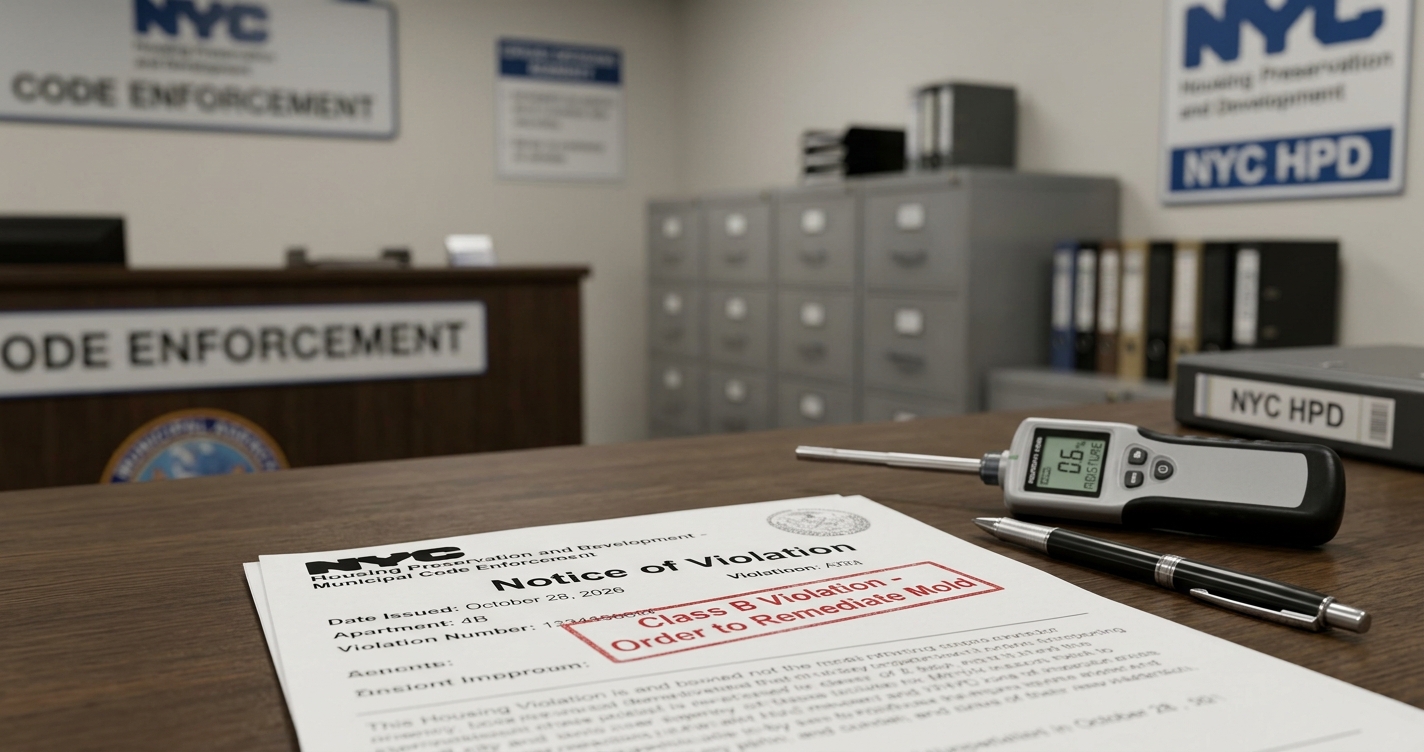
A tenant who discovers mold spreading across a bathroom ceiling or blooming behind a damp wall often reaches two conclusions at once: that the mold is there, and that it is making them sick. The headaches, the cough, the rashes, the fatigue—it all seems to line up with the mold, and the connection feels obvious. If the mold is real and the symptoms are real and they appeared together, surely the mold is the cause. But in a courtroom, that intuitive leap is exactly where a mold case can fall apart. Proving that mold exists in your apartment is one thing. Proving that the mold caused your illness is another battle entirely—and it is a much harder one.
A decision from New York's highest court illustrates the gap. In Cornell v. 360 West 51st Street Realty, LLC, a tenant named Brenda Cornell sued for personal-injury damages, claiming that dampness and mold in her apartment had made her ill. She described symptoms—respiratory problems, dizziness, skin rashes—that she attributed to the mold and dampness, which developed around the time of construction and water problems in the building. There was no real dispute that she had experienced symptoms or that there were damp and moldy conditions. The case turned on something else: whether she could prove, with the kind of evidence the law requires, that the mold exposure actually caused her injuries. The Court of Appeals held that she could not. It found her expert evidence insufficient to establish causation, reversed a lower court that had let her claim proceed, and reinstated the dismissal of her personal-injury complaint against the defendant that had moved for it.
But the court was careful about what it was and was not deciding, and this is the single most important thing to understand about the case. It expressly said its decision did not—and could not—stand for the proposition that dampness and mold cannot cause the kinds of injuries Cornell alleged. The court was not ruling that mold is harmless or that mold can never make someone sick. It was ruling, narrowly, that this plaintiff had not demonstrated the necessary cause-and-effect relationship on this particular record. The science of mold and health was not resolved against tenants; one tenant's proof was found wanting.
The Cornell case—a decision of the New York Court of Appeals—teaches lessons that every tenant dealing with mold should understand. There is a fundamental difference between a claim to get mold fixed or to reduce rent for living with it, and a claim for money damages for an illness the mold allegedly caused. Proving medical causation requires far more than photographs of mold and a timeline of symptoms; it requires rigorous scientific and medical evidence of a specific kind. And expert evidence is often what determines whether a personal-injury mold claim ever reaches a jury. This guide explains what happened, why proving mold exists is not the same as proving it made you sick, why a timeline and photographs are not enough for a personal-injury claim, and how the demanding requirements of causation shape what a tenant can realistically achieve.
The tenant, Brenda Cornell, lived in an apartment in a building where, she alleged, damp and moldy conditions developed—connected to water intrusion and to construction work in the building around 2003. She experienced a range of health symptoms, including respiratory difficulties, dizziness, and skin rashes, and she came to attribute these illnesses to the dampness and mold in and around her apartment. Believing the conditions had made her sick, she brought a lawsuit seeking personal-injury damages—money to compensate her for the illnesses she said the mold exposure had caused.
This was not a case about getting the mold cleaned up or reducing her rent. It was a personal-injury case: a claim that the exposure had damaged her health and that she was entitled to damages for that harm. And in a personal-injury case, the plaintiff must prove not only that there was a hazardous condition and that she was injured, but that the condition caused the injury. Causation—the link between the mold and the illness—was the heart of the case.
The litigation accordingly focused on the scientific and medical evidence connecting the claimed mold exposure to Cornell's symptoms. Both sides presented expert evidence. Cornell's experts offered opinions attempting to tie her illnesses to the mold. The defense presented expert evidence to the contrary, including evidence that the mold in the apartment was present at levels and in a distribution typical of an ordinary indoor environment, and challenging whether the exposure could have caused the injuries claimed. The dispute became a contest over the adequacy of the causation evidence—whether Cornell's proof was sufficient to establish that the mold had actually made her sick, or whether it fell short of what the law demands.
The case moved through the courts with mixed results. The trial court granted summary judgment to the defendant, dismissing the claim on the ground that Cornell had not adequately established causation. The intermediate appellate court reversed, reinstating the claim and allowing it to proceed. The case then reached the Court of Appeals, the state's highest court, which sided with the trial court. It held that Cornell's evidence was insufficient to overcome the defendant's showing that her injuries were not caused by the alleged exposure. It reversed the intermediate court and reinstated the summary judgment dismissing the personal-injury complaint against the defendant that had moved for it. Cornell's claim, in the end, did not reach a jury, because the court concluded she had not produced the kind of causation evidence the law requires to get there.
And then came the court's crucial qualification. Having ruled against Cornell on the sufficiency of her proof, the court expressly disclaimed any broader holding about mold and health. Its decision, it said, did not—and indeed could not—stand for the proposition that a cause-and-effect relationship between dampness and mold and the kinds of injuries alleged does not exist. Cornell, the court explained, simply had not demonstrated such a relationship on this record. The ruling was about the failure of proof in this case, not a declaration that mold is incapable of causing illness. That distinction is the key to reading the case correctly, and this guide returns to it throughout.
The foundational lesson of Cornell is the distinction between the existence of mold and the causation of illness by mold. These are two separate facts, requiring two separate kinds of proof, and a tenant can readily establish the first while entirely failing to establish the second. Collapsing them—assuming that because the mold is proven and the sickness is proven, the causation is proven—is the error that defeats many personal-injury mold claims.
Establishing that mold exists is usually straightforward. You can see it, photograph it, have it tested and identified. The dampness that feeds it can be documented. The conditions are physical and observable, and proving them is a matter of ordinary evidence. Likewise, establishing that you have been ill is usually straightforward: you have symptoms, you have seen doctors, you have a medical history documenting your complaints. The mold is real and the illness is real, and both can be shown without much difficulty.
Causation is the bridge between them, and it does not follow automatically from the two endpoints. The question causation asks is whether the mold actually caused the illness—not whether both happened to be present, not whether the symptoms appeared around the same time as the exposure, but whether the exposure was, as a matter of scientific and medical fact, the cause of the specific injuries claimed. This is a question about mechanism and about proof: can this kind of exposure cause this kind of harm, and did it cause this particular person's harm? Answering it requires more than observing that the mold and the illness coexisted. It requires evidence that establishes the causal link itself.
Cornell illustrates why this bridge can collapse even when both endpoints are solid. No one seriously doubted that there were damp and moldy conditions or that Cornell had symptoms. What she could not establish, to the court's satisfaction, was that the mold had caused the symptoms—that the one produced the other as a matter of demonstrated fact rather than apparent coincidence. Her proof reached the existence of the mold and the existence of her illness, but it did not adequately span the gap between them. And because causation is an essential element of a personal-injury claim, the failure to prove it was fatal, regardless of how well the mold and the illness were established.
This is counterintuitive, because the human mind naturally infers causation from coincidence, especially when a plausible story connects the two. Mold is widely understood to be unhealthy; symptoms appeared alongside the mold; the inference that the mold caused the symptoms feels compelling. But the law does not accept that inference on its own in a personal-injury case. It demands proof of the causal relationship—proof that goes beyond the coexistence of the exposure and the illness and establishes that the exposure was actually responsible. The gap between "the mold was there and I got sick" and "the mold made me sick" is where the law requires evidence, and it is where Cornell's claim, and many like it, founder.
For a tenant, the essential realization is that you may be entirely right that you have mold and entirely right that you are ill, and still not have a provable personal-injury claim, because proving that the mold caused the illness is a distinct and demanding task. The existence of the mold is not proof that it made you sick. The two are different facts, and the second is the hard one. Understanding this from the outset prevents a tenant from assuming that documenting the mold and the symptoms is enough—because for a personal-injury claim, it is not.
If proving the mold and the illness is not enough, what is required? Cornell makes clear that medical causation in a case like this demands rigorous scientific and medical evidence—not merely photographs of the mold and a chronology of when symptoms appeared. Understanding the kind of evidence the law requires explains why so much personal-injury mold litigation turns on expert proof, and why intuitive evidence falls short.
The law in New York analyzes causation in cases like this through two distinct inquiries, often described as general causation and specific causation. General causation asks whether the substance at issue is capable, as a scientific matter, of causing the kind of injury alleged—whether mold exposure can cause the respiratory problems, the dizziness, the rashes a plaintiff claims. Specific causation asks whether the exposure actually caused this particular plaintiff's injuries—whether the mold in this apartment, at the levels this person was exposed to, caused this person's illness. A plaintiff generally must establish both. It is not enough to show that mold can cause harm in the abstract; the plaintiff must also show that it caused her harm in fact. And it is not enough to show that this plaintiff got sick; the plaintiff must also show that mold of this kind is capable of causing the illness.
Each of these inquiries requires more than a timeline and photographs. General causation requires scientific evidence—typically accepted scientific literature or data—establishing that the type of exposure can produce the type of injury. A mere association, a correlation in which the exposure and the illness tend to appear together, is not the same as a cause-and-effect relationship, and courts are wary of treating association as causation. A plaintiff must show that the causal capacity is genuinely supported, not merely that some studies note a correlation. Specific causation requires evidence about the plaintiff's actual exposure—including, often, some reckoning with how much exposure the plaintiff experienced—and evidence linking that exposure to the plaintiff's particular condition, typically through careful medical analysis that rules out other possible causes.
These are demanding requirements, and they are why photographs and a symptom timeline, however vivid, do not suffice. Photographs prove the mold exists; they say nothing about whether mold can cause the plaintiff's illness or whether it caused this plaintiff's illness. A timeline showing symptoms appearing after exposure proves temporal sequence—the symptoms came after the mold—but sequence is not causation. Many things that follow an exposure in time are not caused by it. The law requires proof that bridges the scientific and medical gap, and that proof comes from qualified experts applying accepted methods, not from the intuitive appeal of a chronology.
In Cornell, this is precisely where the claim failed. The court found the plaintiff's expert evidence insufficient on causation. On general causation, the evidence did not adequately establish that the mold could cause the health effects claimed—showing, at most, an association rather than a demonstrated cause-and-effect relationship accepted in the scientific community. On specific causation, the expert evidence did not adequately account for the actual exposure—failing, for instance, to grapple with how much mold exposure the plaintiff had experienced—and did not adequately refute the defense's evidence that the mold was present at ordinary indoor levels. The proof, in other words, did not meet the rigorous standard that medical causation demands. It offered the kind of connection a layperson might find persuasive—mold present, illness present, the two associated in time—but not the kind of scientific and medical demonstration the law requires.
For a tenant, the lesson is sobering but important. If you intend to claim that mold made you sick and to recover damages for it, you will need far more than evidence that the mold existed and that you fell ill around the same time. You will need rigorous expert evidence establishing both that mold can cause your kind of illness and that it caused yours in fact, accounting for your actual exposure and ruling out other causes. This is a high bar, and it is not met by the evidence most tenants instinctively gather. Recognizing this early allows you to understand what a personal-injury mold claim actually requires—and to assess, realistically, whether it is within reach.
One of the most practically valuable aspects of Cornell is what it implies by contrast: that a personal-injury claim is a distinct and especially difficult kind of mold claim, and that it is not the only, or even the most accessible, way for a tenant to address mold. Understanding the difference between a personal-injury claim and the other remedies available for mold is essential to choosing a realistic path.
A personal-injury claim, as Cornell shows, seeks money damages for an illness caused by the mold, and it requires proving medical causation to the demanding standard the court applied. This is the hardest kind of mold claim, because it puts the difficult question of causation at its center. To win, a tenant must prove not just that mold existed and that she was harmed, but that the mold caused the harm, with rigorous expert evidence. Many tenants cannot meet this burden, as Cornell could not, even when the mold and the illness are genuine.
But there are other kinds of claims a tenant with mold can bring, and they do not require proving medical causation at all. A claim to get the mold fixed—to compel the landlord to remediate the condition and repair the source of the dampness—is grounded in the landlord's obligation to maintain habitable premises. It asks for an order requiring the landlord to address the condition, not for damages for an illness. To pursue it, a tenant must show that the mold and dampness exist and constitute a condition the landlord is obligated to fix—the kind of thing photographs, testing, and a record of complaints can establish. The tenant does not have to prove that the mold made anyone sick; the tenant has to prove that the condition is one the law requires the landlord to remedy.
Similarly, a rent-reduction claim—seeking an abatement of rent to reflect the diminished value of living with mold and dampness—is grounded in the warranty of habitability. It asks that the rent be reduced because the condition made the home less habitable than the tenant is paying for. Again, this does not require proving medical causation. It requires showing that the condition existed and that it materially affected the habitability of the home, diminishing its value. A tenant living with significant mold and dampness may be entitled to a rent reduction for the period of the condition regardless of whether the tenant can prove the mold caused a specific illness.
The distinction is crucial because it means a tenant is not limited to the hardest claim. A tenant who cannot prove medical causation—who cannot meet the Cornell standard—may still have strong claims to compel repair of the mold and to reduce rent for living with it. These claims rest on the existence of the condition and its effect on habitability, not on the contested and difficult question of whether the mold caused an illness. They are often far more achievable, because they do not require the rigorous expert causation evidence that defeats so many personal-injury claims. A tenant focused solely on suing for the illness may overlook these more accessible remedies.
For a tenant, the practical guidance follows directly. Think carefully about what you are actually trying to achieve. If your goal is to get the mold fixed and to be compensated through reduced rent for having lived with it, you are pursuing habitability-based remedies that do not require proving the mold made you sick—and those are often within reach. If your goal is to recover money damages for an illness you attribute to the mold, you are pursuing a personal-injury claim that requires proving medical causation to a demanding standard, as Cornell illustrates—and that is a much harder road. The two are not the same, and a tenant should understand which one fits the goal, because the proof required and the likelihood of success differ enormously. The repair and rent-reduction claims are the workhorses of tenant mold cases; the personal-injury claim is the exceptional and difficult one.
Cornell also illustrates a procedural reality that shapes personal-injury mold litigation: expert evidence often determines whether a claim ever reaches a jury, because the sufficiency of the causation proof is tested before trial through summary judgment. Understanding this helps a tenant grasp why the quality of expert evidence is not a detail but the whole ballgame in a personal-injury mold case.
Summary judgment is a procedure by which a court can decide a claim, or dismiss it, without a trial, when the evidence is insufficient to support an essential element. In a personal-injury case, causation is an essential element, and if the plaintiff cannot produce evidence sufficient to establish causation, the claim can be dismissed on summary judgment before it ever reaches a jury. This is what happened in Cornell: the defendant moved for summary judgment, arguing that Cornell could not prove the mold caused her injuries, and the ultimate result—after the case reached the Court of Appeals—was that summary judgment was granted and the claim dismissed. The claim did not fail at trial; it never got to trial, because the causation evidence was found insufficient as a matter of law.
The role of expert evidence in this process is decisive. Because medical causation must be established through expert testimony—a layperson cannot competently opine on whether mold caused an illness—the adequacy of the plaintiff's expert evidence is what the court evaluates on summary judgment. If the expert evidence meets the standard, establishing general and specific causation with accepted methods and adequate support, the claim survives and can proceed toward trial. If the expert evidence falls short—if it shows only association rather than causation, fails to account for actual exposure, or does not refute the defense's contrary evidence—the claim can be dismissed. The expert evidence is the gatekeeper. It determines whether the plaintiff has made a sufficient showing to get past summary judgment and reach a jury.
In Cornell, the expert evidence did not clear the bar. The court scrutinized the plaintiff's causation experts and found their opinions insufficient—not supported by the kind of scientific demonstration required for general causation, and not adequately tied to the plaintiff's actual exposure for specific causation. Because the expert evidence was inadequate, the claim could not survive summary judgment, and it was dismissed. The jury never weighed Cornell's story, because the court concluded, as a matter of law, that she had not produced evidence from which a jury could properly find causation.
This has a significant implication for how a personal-injury mold claim must be built. The claim lives or dies on the strength of its expert evidence, and that strength is tested early, before trial. A plaintiff cannot count on getting to a jury and telling a compelling story; the plaintiff must first produce expert causation evidence rigorous enough to survive a summary-judgment challenge. This front-loads the difficulty: the hardest part of the case—proving causation through expert evidence—must be accomplished before the case ever reaches the point of a trial. A claim with weak expert evidence does not get a second chance before a jury; it ends at summary judgment.
For a tenant, the lesson is that a personal-injury mold claim requires marshaling strong expert evidence from the outset, because that evidence will be tested before any trial and will determine whether the claim proceeds. This is expensive, demanding, and uncertain—qualified experts, rigorous methods, and adequate data are required, and even then the evidence may be found wanting, as Cornell's was. A tenant contemplating a personal-injury mold claim should understand that the case will turn on expert causation evidence evaluated on summary judgment, and should be realistic about whether such evidence can be assembled. This is another reason the repair and rent-reduction remedies—which do not require this kind of expert causation proof—are often the more practical path.
It helps to translate Cornell into the situation of an ordinary tenant, because the case speaks directly to a common and distressing experience.
Imagine you have mold in your apartment—visible growth, a damp and musty environment—and you have been feeling unwell, with symptoms you believe the mold is causing. Your instinct is that the mold is making you sick and that your landlord should be held responsible for your illness. You photograph the mold, you track your symptoms, and you prepare to seek compensation for what the mold has done to your health. Cornell tells you to pause and think carefully about what you are trying to prove and how.
The case teaches that proving the mold exists and that you are ill is not enough to win damages for the illness. To recover for a mold-caused illness, you must prove medical causation—that the mold can cause your kind of illness and that it caused yours in fact—through rigorous expert evidence, and that proof will be tested before trial on summary judgment. Photographs and a symptom timeline, however convincing they feel, do not establish causation. This is a high and expensive bar, and many tenants, like Cornell, cannot clear it even when their mold and their illness are real.
But Cornell also points you toward what you can more readily achieve. If your goal is to get the mold remediated and to be compensated through reduced rent for living with it, those remedies rest on the landlord's habitability obligations and the existence of the condition—not on proving the mold made you sick. You can pursue an order compelling the landlord to fix the mold and the dampness, and you can seek a rent abatement for the period you lived with the condition, by showing that the mold and dampness existed and materially affected your home's habitability. These claims are often within reach where a personal-injury claim is not, because they do not require the difficult causation proof.
And Cornell teaches an important note of balance: the difficulty of proving a mold-caused illness does not mean mold is harmless or that such illnesses are not real. The court expressly disclaimed any holding that mold cannot cause the injuries alleged; it ruled only that this plaintiff's proof fell short. Your symptoms may well be real and may well be related to the mold. The law's demanding causation standard is about what can be proven to a legal certainty in a damages case, not about whether mold can affect health. This matters both for taking your own health seriously—you should address mold and seek medical care regardless of what you can prove in court—and for understanding that a failed or unviable personal-injury claim does not mean your concerns are baseless.
What you would do, understanding all this, is separate your goals and match them to the right claims. Address the mold itself: report it to your landlord, document it, and pursue remediation and rent reduction through habitability claims, which do not require proving causation. Take care of your health: see doctors, follow their advice, and remove yourself from the exposure if it is affecting you, regardless of the litigation calculus. And if you are considering a personal-injury claim for a mold-caused illness, understand that it requires rigorous expert causation evidence that will be tested before trial, and get knowledgeable legal and expert advice before committing to that difficult path. A lawyer experienced in these cases can assess, realistically, whether the causation evidence can be assembled, and can advise you on the more accessible habitability remedies in the meantime.
The reason the hypothetical tracks the case is that the case is the hypothetical, litigated to the state's highest court. A tenant with real mold and real symptoms sought damages for a mold-caused illness and lost—not because mold is harmless, but because she could not prove causation to the standard the law demands. The pattern is instructive for any tenant tempted to assume that documenting mold and illness is enough to win a personal-injury claim, and it redirects attention to the remedies that are actually within reach.
Knowing the case is one thing; applying it is another. Here is how a tenant dealing with mold can approach the problem with realistic expectations.
Separate the existence of the mold from the question of causation. Proving mold exists is usually straightforward; proving it caused an illness is a distinct and much harder task. Do not assume that because you can document the mold and your symptoms, you can prove the mold made you sick. The two are different, and the second requires far more.
Match your claim to your goal. If you want the mold fixed and compensation for living with it, pursue habitability-based remedies—an order compelling remediation and a rent abatement—which rest on the condition's existence and effect on habitability, not on medical causation. If you want damages for an illness, understand that you are pursuing a personal-injury claim requiring rigorous proof of causation. Choose the path that fits your goal, and recognize that the habitability remedies are usually more achievable.
Understand what medical causation requires. A personal-injury mold claim requires expert evidence establishing both that mold can cause your kind of illness (general causation) and that it caused yours in fact (specific causation), accounting for your actual exposure and ruling out other causes. A mere association between the mold and your symptoms, or a timeline showing symptoms after exposure, is not enough. The proof must meet a demanding scientific and medical standard.
Know that expert evidence is tested before trial. In a personal-injury case, the sufficiency of your causation evidence will be evaluated on summary judgment, and if it falls short, the claim can be dismissed without ever reaching a jury—as happened in Cornell. The strength of your expert evidence, assembled from the outset, determines whether the claim proceeds. A compelling personal story does not substitute for adequate expert proof.
Take your health seriously regardless of the litigation. The difficulty of proving a mold-caused illness in court does not mean mold is harmless or your symptoms are not real. The Cornell court expressly declined to hold that mold cannot cause such injuries. Address the mold, remove yourself from the exposure if it is affecting you, and seek medical care based on your health, not based on what you can prove in a lawsuit.
Document the mold and your complaints. For the habitability remedies especially, keep photographs and any testing of the mold, a record of the dampness and its source, and a documented history of your complaints to the landlord and the landlord's responses. This evidence supports a claim to compel repair and to reduce rent, and it establishes the condition regardless of the causation question.
Get knowledgeable help before pursuing a personal-injury claim. Because a personal-injury mold claim turns on expert causation evidence that is expensive, demanding, and uncertain, consult a lawyer experienced in these cases before committing to that path. Such a lawyer can assess whether the necessary expert evidence can realistically be assembled, advise you on the more accessible habitability remedies, and help you avoid pouring resources into a claim that, like Cornell's, cannot meet the causation standard. Many tenant attorneys and legal aid organizations can help you evaluate your options.
It is worth being especially careful about the scope of Cornell v. 360 West 51st Street Realty, LLC, because this case is unusually easy to over-read. It is a decision of the New York Court of Appeals, the state's highest court, and it carries strong authority on the question it decided: what a plaintiff must show to establish causation in a personal-injury claim of this kind, and that this plaintiff did not show it. The demanding causation framework it applied—requiring rigorous expert evidence of both general and specific causation—is the law, and it governs personal-injury mold claims in New York.
But the court went out of its way to limit what it was holding, and that limitation must be honored. The court expressly stated that its decision did not, and could not, stand for the proposition that dampness and mold cannot cause the kinds of injuries alleged. It was not ruling that mold is harmless, that mold cannot make people sick, or that mold-illness claims are inherently baseless. It was ruling only that this plaintiff, on this record, failed to demonstrate the necessary cause-and-effect relationship. The case is about a failure of proof, not a scientific verdict against the possibility of mold-caused illness. A reader who takes Cornell to mean that mold cannot harm health, or that such claims are hopeless, has misread it.
What the case reliably establishes is the difficulty of the personal-injury claim and the kind of proof it requires—not a judgment that the underlying health concerns are unfounded. A different plaintiff, with rigorous expert evidence genuinely establishing general and specific causation and adequately accounting for exposure, could potentially meet the standard Cornell applied. The case sets the bar; it does not declare the bar impossible to clear. And critically, it says nothing to diminish the habitability-based remedies—repair and rent reduction—that do not depend on proving causation at all and that remain available to tenants dealing with mold regardless of the Cornell standard.
What is reliable, then, is this framework. Proving that mold exists is not the same as proving it caused an illness; the two are distinct, and the second requires far more. A personal-injury claim for a mold-caused illness requires rigorous expert evidence of general and specific causation, which is tested on summary judgment and often determines whether the claim reaches trial. Photographs and a symptom timeline do not establish causation. But a tenant dealing with mold is not limited to the personal-injury claim: habitability-based remedies to compel repair and reduce rent rest on the condition's existence and effect, not on causation, and are often more achievable. And the difficulty of proving a mold-caused illness in court reflects the demands of legal proof, not a conclusion that mold is harmless. Those are the principles the case puts on display.
The lasting lesson of Cornell v. 360 West 51st Street Realty, LLC is that a mold problem can involve two very different legal fights, and a tenant must not mistake one for the other. The first fight is about the mold itself—getting it fixed and being compensated for living with it. That fight rests on the existence of the condition and its effect on the habitability of your home, and it is often winnable without extraordinary difficulty, because it does not require proving that the mold made you sick. The second fight is about your health—recovering damages for an illness the mold allegedly caused. That fight rests on medical causation, and it is hard: it requires rigorous expert evidence that the mold can cause your illness and did cause it, evidence that will be scrutinized before trial and that defeated the plaintiff in Cornell despite real mold and real symptoms.
For you as a tenant, that means being clear-eyed about which fight you are in. Documenting the mold and your symptoms proves the mold exists and that you are ill; it does not prove the mold made you sick, and a personal-injury claim demands that harder proof. If what you want is remediation and a rent reduction, you can often get there through habitability claims that do not require proving causation at all. If what you want is damages for an illness, understand that you face the demanding causation standard Cornell applied, and that assembling the necessary expert evidence is expensive and uncertain—reason to get knowledgeable advice before committing to that path.
And hold onto the balance the court itself struck. The difficulty of proving a mold-caused illness in court does not mean mold is harmless or your health concerns are imaginary; the Court of Appeals expressly said as much. Take the mold seriously, protect your health, and pursue the remedies that fit your situation. Proving mold exists is not the same as proving it made you sick—but the law gives tenants real tools for the first fight even where the second is out of reach. Knowing the difference is what lets you fight the battle you can win.