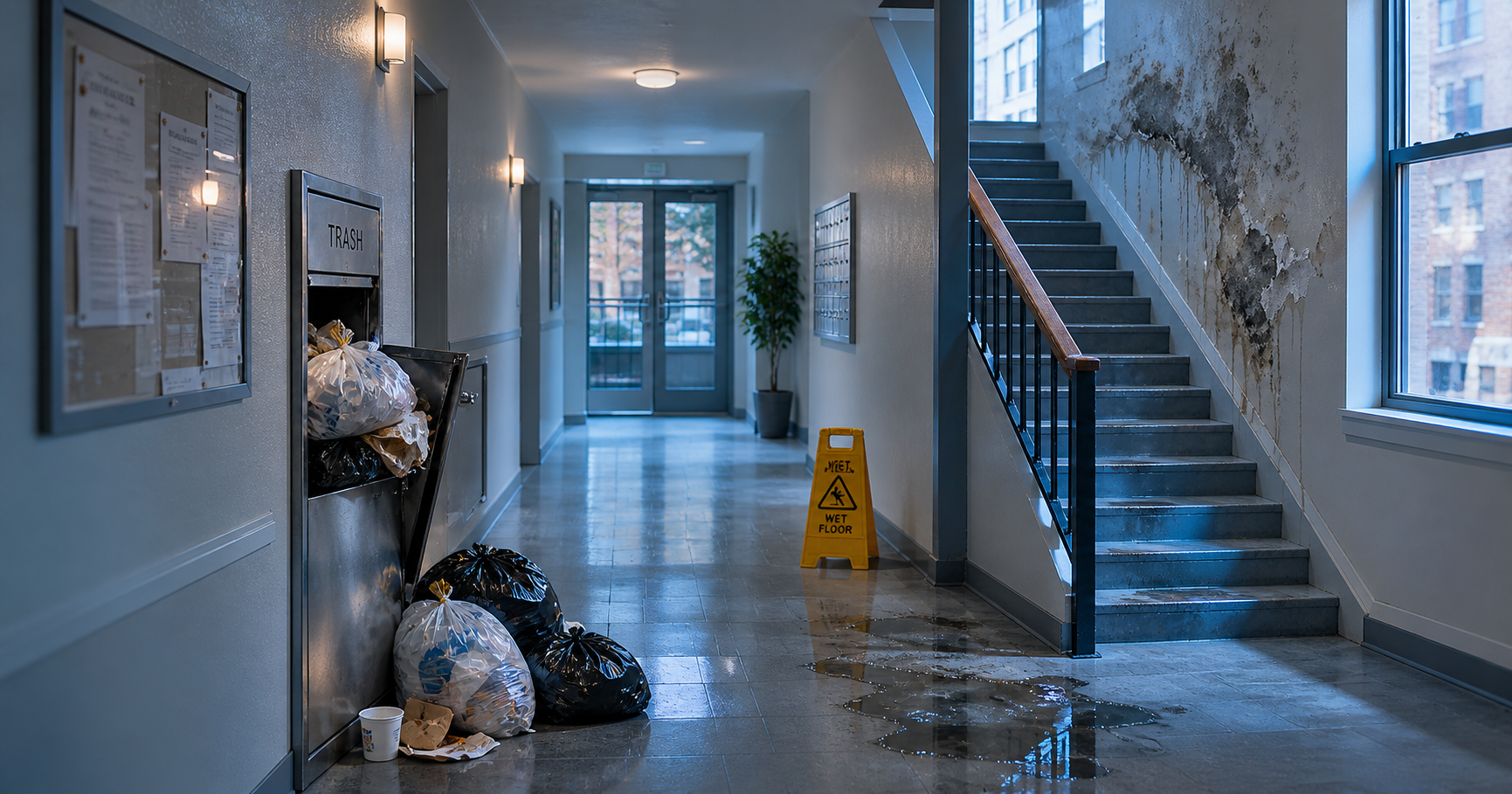
You live in a multi-unit building, and you're increasingly concerned about conditions in the common areas—the hallways, stairwells, basement, lobby, and other shared spaces outside your individual apartment. The trash chute on your floor has been overflowing for weeks, with bags piling up in the hallway creating a foul smell and attracting roaches and flies. Or maybe there's a persistent sewage odor in the basement and first-floor hallway that makes you nauseous every time you enter or exit the building. Or perhaps water has been leaking from the ceiling in the stairwell for months, creating puddles on the steps, peeling paint and drywall, and visible mold growing on the walls.
You've mentioned these problems to your landlord or building management multiple times, but nothing substantial has been done. Maybe they clean up the trash once, but it overflows again within days. Or they claim to be investigating the sewage smell but never actually fix the source. Or they patch the water leak temporarily, but it returns with the next rain. The problems persist, and you're wondering whether these common area issues are serious enough to be legal violations or if they're just unfortunate aspects of building life you have to tolerate.
You think: "Do problems in hallways and common areas actually matter legally, or are landlords only required to maintain my individual apartment? When does overflowing trash cross from 'annoying' to 'unsafe'? How bad does a sewage smell have to be before it's a health hazard? Is ongoing water damage in stairwells a legal issue? Can I do anything about common area problems, or are they outside my rights as a tenant? At what point do these conditions make my building legally unsafe?"
Here's the truth: In New York, persistent problems in common areas—overflowing trash, sewage smells and leaks, ongoing water damage in hallways and stairwells—cross from mere inconveniences to legal unsafe and uninhabitable conditions when they're substantial, ongoing, create health or safety hazards, and the landlord fails to adequately address them despite notice. New York's warranty of habitability explicitly covers not just individual dwelling units but also common areas of multi-unit buildings, requiring landlords to maintain shared spaces "in good repair and clean and free of vermin, garbage, or other offensive material." When common area conditions are so unsanitary or hazardous that they affect your ability to safely access and occupy your apartment, they violate habitability regardless of your apartment's internal condition.
Let me show you exactly why common area conditions are legally significant under New York's habitability standards, when overflowing trash becomes a habitability violation, when sewage smells and leaks create unsafe conditions, how water damage in common areas supports legal claims, what evidence you need to document common area problems, and what legal remedies you can pursue for unsafe building conditions.
Before examining specific problems, understand why conditions outside your individual apartment door matter under habitability law.
New York's warranty of habitability doesn't stop at your apartment threshold—it encompasses the entire residential building including all common areas tenants must use to access and occupy their dwellings.
The legal requirement for multi-unit buildings is that landlords must maintain common areas including hallways, stairwells, lobbies, basements, elevators, trash rooms, laundry facilities, courtyards, and any other shared spaces in good repair, clean condition, and free of vermin, garbage, and other offensive materials. This isn't optional or aspirational—it's a mandatory habitability obligation.
The rationale is straightforward: tenants cannot safely and healthily occupy their apartments if the building's common areas through which they must pass are unsafe, unsanitary, or hazardous. If you have to navigate trash-filled hallways attracting vermin, breathe sewage fumes in stairwells, or risk slipping on water-damaged steps to reach your apartment, your housing is not habitable even if your apartment's interior is perfect. Habitability must be assessed holistically including the entire residential environment.
New York housing codes and regulations explicitly list common area maintenance requirements. The New York State Multiple Dwelling Law requires landlords to maintain common areas in safe, sanitary condition. NYC Housing Maintenance Code similarly mandates that building owners keep halls, stairs, roofs, and other public parts in good repair and clean and free of vermin and rubbish.
Court decisions and housing agency guidance consistently recognize common area conditions as affecting habitability. HPD (in NYC) and local code enforcement agencies inspect and issue violations for common area deficiencies. Courts consider common area conditions when determining whether housing meets habitability standards and calculating appropriate rent reductions.
The connection between common area conditions and your individual habitability is direct and significant.
Access and egress is the most fundamental connection. You must use hallways, stairwells, and building entrances to enter and exit your apartment. If these paths are unsafe due to trash hazards, sewage exposure, water damage creating slip risks, or other dangers, your ability to safely occupy your dwelling is compromised.
Exposure to hazards occurs whenever you traverse common areas. If hallways have persistent sewage odors, you breathe contaminated air daily. If trash attracts vermin, those pests migrate to apartments including yours. If water damage creates mold in stairwells, you're exposed to mold spores when using stairs. Common area hazards don't stay confined to common areas—they affect building residents.
Security and safety depends partly on common areas. Dark hallways with broken lights create crime and fall risks. Broken locks on building entrances compromise security for all tenants. Structural damage in stairwells or poorly maintained elevators create injury risks affecting everyone.
The cumulative impact on quality of life is substantial. Returning home daily to the stench of sewage, navigating trash-strewn hallways, stepping over puddles from persistent leaks—these conditions create stress, disgust, and the feeling of living in unsafe, degraded housing even if your individual apartment is acceptable.
Legal authorities recognize this holistic view of habitability. NYC 311 guidance explicitly states that unsanitary common areas, sewage smells in buildings, and water damage in public spaces are reportable habitability issues. Housing codes, tenant guides, and legal resources all treat common area conditions as legitimate habitability concerns, not matters outside tenant rights.
Trash accumulation in common areas is one of the most common and most clearly actionable habitability violations.
Landlords have specific, mandatory obligations to maintain buildings free of garbage and offensive materials.
The warranty of habitability requires landlords keep common areas "clean and free of vermin, garbage, or other offensive material." This language directly targets trash accumulation—garbage is explicitly prohibited from common areas, and the requirement is cleanliness, not mere tolerability.
NYC Housing Maintenance Code and similar state and local regulations mandate that building owners provide adequate trash receptacles, arrange for regular trash collection, and keep hallways, stairwells, and other public areas free of accumulated waste. Buildings with trash chutes must maintain them in working order. Buildings with trash rooms must keep them clean and pest-free.
Health and safety codes additionally regulate trash handling to prevent disease transmission, pest infestation, and fire hazards. Accumulated trash violates sanitation requirements and creates documented health risks.
The landlord's obligation isn't just to provide trash cans—it's to maintain a system ensuring trash doesn't accumulate in common areas and to promptly address any breakdowns in that system. When trash chutes overflow, when trash room doors are left open allowing odors and pests to spread, when garbage bags pile up in hallways—these failures violate landlord obligations.
Occasional brief trash issues differ from ongoing accumulation that creates unsafe conditions.
Temporary overflow—trash piling up for a day because collection was delayed over a holiday weekend, for example—might not constitute habitability violation if promptly resolved. The key is temporary and occasional, not chronic and recurring.
Persistent accumulation clearly violates habitability. If trash overflows regularly (weekly, daily, or constantly), if trash bags remain in hallways for days or weeks, if the trash chute is perpetually jammed requiring residents to leave bags in common areas indefinitely—these ongoing conditions constitute garbage accumulation prohibited under habitability requirements.
The associated hazards strengthen habitability violation claims:
Vermin attraction is the most direct and serious consequence. Accumulated trash attracts cockroaches, mice, rats, and flies. Legal resources and tenant guides explicitly identify "accumulated trash and debris" as a classic sign of conditions conducive to pest infestations. When trash overflow predictably leads to vermin in hallways that then spread to apartments, the habitability violation is clear and serious.
Foul odors from decomposing garbage create "offensive material" explicitly prohibited in habitability requirements. Persistent garbage smell in hallways and stairwells makes common areas unpleasant and potentially unhealthy to traverse. The odor alone—independent of other hazards—can constitute the "offensive material" habitability violation.
Fire hazards arise from trash accumulation in hallways and near exits. Combustible materials blocking egress paths violate fire codes and create life-safety risks. Trash near electrical panels, heating equipment, or in stairwells creates serious fire hazards landlords must eliminate.
Unsanitary conditions from garbage juice, rotting food, and waste material on floors and walls create health risks through pathogen exposure and make common areas objectively unsanitary.
The location matters: Trash in designated trash rooms, while still problematic if overflowing, is less serious than trash accumulating in hallways, stairwells, or near apartment doors where residents must pass through it. Trash in or near exits creates additional fire safety violations.
Proving ongoing trash problems requires systematic documentation.
Photograph trash accumulation:
Document frequency:
Record vermin associated with trash:
Note health and safety impacts:
This documentation proves trash problems are substantial, ongoing, and create hazards—not isolated, minor, or quickly resolved issues.
Sewage-related problems in common areas are particularly serious habitability violations due to significant health risks.
Sewage exposure creates documented health hazards that clearly violate habitability standards requiring safe, sanitary housing.
Sewage contains pathogens including bacteria, viruses, and parasites causing serious diseases. E. coli, Salmonella, Hepatitis A, and numerous other disease-causing organisms are present in sewage. Even sewage odors indicate presence of sewage gases that can carry pathogens and toxic substances.
Hydrogen sulfide in sewage gases is toxic and potentially deadly in high concentrations. Lower concentrations cause headaches, nausea, respiratory irritation, and eye irritation. The characteristic "rotten egg" smell of sewage is hydrogen sulfide, and its presence indicates health hazards beyond mere unpleasantness.
Exposure routes from sewage in common areas include:
The psychological impact of persistent sewage odors also affects habitability. Having to smell sewage daily when entering or exiting your building creates disgust, stress, and legitimate health concerns about what you're being exposed to.
Not all plumbing odors constitute sewage violations, but persistent, strong sewage smells and actual sewage presence clearly do.
Strong, persistent sewage odors in basements, hallways, or other common areas that recur regularly or are constantly present violate habitability. If every time you use the stairs or hallway you encounter sewage smell, if the building entrance consistently smells of sewage, if the basement has permanent foul odor—these conditions are ongoing sanitation hazards.
Actual sewage backups or leaks—visible sewage water in basements, sewage backing up into drains or toilets in common bathrooms, sewage-contaminated areas—constitute immediate, serious habitability violations requiring emergency response. Standing water that appears to be or smells like sewage is a health emergency.
Recurring problems despite landlord attempts to address them demonstrate inadequate remediation. If sewage smell returns within days or weeks of supposed repairs, if backups recur regularly, the underlying cause (broken sewer lines, blocked drains, failing septic systems) hasn't been fixed and habitability violations persist.
NYC 311 explicitly lists "sewage indoors" and "strong sewage odors" as apartment and building-wide maintenance complaints that tenants should report to HPD. This official guidance categorizes sewage issues alongside mold and pests as serious habitability concerns, not minor maintenance issues.
Health department and municipal materials treat sewage exposure as potential health hazards requiring professional assessment and remediation. The presence of sewage or sewage gases in residential environments is not considered a minor inconvenience but a sanitation emergency.
Sewage issues require careful documentation showing persistence and severity.
Describe and photograph:
Create odor logs:
Date | Location | Odor Strength | Duration | Reported to Landlord? |
| 4/10 | Basement stairs | Strong, nauseating | Constant | Email 4/10 |
| 4/15 | First floor hallway | Moderate | All day | Follow-up 4/15 |
| 4/20 | Building entrance | Strong | Morning and evening | Called 4/20 |
Document health impacts:
Report to authorities:
Ongoing water intrusion and damage in common areas creates both immediate hazards and long-term health and safety risks.
Water damage in common areas violates habitability through multiple mechanisms.
Structural safety concerns arise when water damage affects stairs, ceilings, floors, or load-bearing elements. Water-damaged stairwells with sagging treads, deteriorating railings, or weakened structural members create fall and collapse risks. Ceiling damage from leaks can lead to falling plaster or drywall creating injury hazards.
Slip and fall hazards from puddles, wet surfaces, and water accumulation on floors create immediate injury risks. Stairwells with water leaks creating slippery steps are particularly dangerous. Standing water in hallways or lobbies creates obvious fall hazards.
Mold growth from persistent moisture is perhaps the most serious long-term consequence. Water-damaged walls, ceilings, and floors in common areas become mold-contaminated, exposing all building residents to mold spores whenever they traverse those spaces. Mold in stairwells, hallways, or basements affects everyone in the building, not just adjacent apartments.
Property deterioration from chronic water intrusion demonstrates landlord failure to maintain the building in good repair. Peeling paint, bubbling drywall, stained ceilings, rotting wood—these visible signs of water damage show the building is not being properly maintained.
Brief leaks quickly repaired don't typically violate habitability, but persistent or recurring water problems clearly do.
Ongoing active leaks—water currently coming through ceilings, walls, or windows in common areas—violate habitability from the moment they begin if not promptly addressed. A stairwell ceiling that leaks every time it rains, a hallway with water coming through the wall from plumbing leaks, a basement that floods with every heavy rain—these active ongoing leaks are clear violations.
Chronic water damage visible in deteriorated building materials indicates long-term water intrusion that hasn't been properly fixed. Even if water isn't actively leaking at the moment of observation, ceiling stains, bubbling paint, soft or warped drywall, mold growth, and damaged flooring all prove persistent moisture problems that violate habitability.
Recurrence after attempted repairs demonstrates inadequate remediation. If the landlord patches a leaky ceiling but it leaks again with the next rain, if water damage reappears in the same location repeatedly, the underlying cause (roof damage, plumbing defects, building envelope failures) hasn't been addressed and habitability violations persist.
Associated mold strengthens habitability violations. When water damage has progressed to visible mold growth on common area walls, ceilings, or in corners of stairwells, both the water intrusion and the mold constitute habitability violations requiring comprehensive remediation.
NYC 311 guidance includes "water leaks, holes, cracks, or peeling paint" as maintenance issues tenants should report. When these conditions are chronic, widespread, or associated with dampness and mold, housing agencies treat them as serious habitability violations, not cosmetic concerns.
Fair housing and habitability guides list chronic water intrusion and resulting damage as bases for "unlivable" or "unsanitary" findings. Water damage affecting building structure, creating mold, or making common areas hazardous supports habitability violation claims and rent reduction arguments.
Water damage documentation should show extent, duration, and consequences.
Photograph water damage comprehensively:
Document progression over time:
Record hazards created:
Note landlord responses:
Certain circumstances make it undeniable that common area conditions violate habitability and justify legal action.
Problems that are ongoing rather than temporary clearly cross into habitability violation territory.
Conditions lasting days or weeks without correction violate habitability. Trash overflowing for a week, sewage smell persisting for ten days, water damage present for months—these timeframes demonstrate the landlord is not maintaining habitability, not that brief, isolated issues occurred and were promptly fixed.
Regular recurrence even if individual episodes are addressed indicates systemic failure. If trash overflows weekly despite being cleaned, if sewage smell returns monthly, if water leaks after every rain—these patterns prove underlying building defects that landlord must comprehensively repair, not just repeatedly patch.
The cumulative burden from recurring problems affects habitability even if any single incident might be tolerable. Living in constant uncertainty about whether common areas will be safe and sanitary this week creates stress and demonstrates uninhabitable conditions.
Common area problems become more clearly legal violations when they create specific identifiable hazards.
Vermin infestations tied to common area conditions (trash attracting roaches and mice, standing water breeding insects) make the connection between common area failures and apartment habitability direct. When you can trace pest problems in your apartment to trash or sanitation failures in hallways, the landlord's common area neglect is directly causing apartment habitability violations.
Mold exposure from water-damaged common areas affects your health whenever you use those spaces. If stairwells have visible mold from persistent leaks, you inhale mold spores daily going to and from your apartment. This health exposure supports habitability claims.
Injury risks from structural damage, slippery surfaces, or hazardous conditions justify immediate legal action. If common area conditions create actual physical danger (risk of falls, collapse, exposure to sewage), these are serious safety violations requiring emergency response.
Documented health effects—respiratory symptoms from sewage gases, illnesses from pathogen exposure, injuries from hazardous conditions—provide concrete evidence that common area problems are affecting your health and safety, strengthening habitability violation claims.
The landlord's response (or lack thereof) is critical in determining whether violations are actionable.
Proper notice to landlord through written complaints creates the documentation that landlord was aware of problems and had opportunity to correct them. Each time you report overflowing trash, sewage smells, or water damage via email or formal complaint, you establish landlord knowledge.
Inadequate landlord response—cosmetic fixes, temporary cleanups that don't address root causes, promises without action, or complete inaction—demonstrates breach of habitability obligations. If landlord cleans trash once but doesn't fix the underlying trash handling system, if they claim to be investigating sewage smell for months without fixing it, if they patch leaks that immediately recur, these inadequate responses prove habitability violations.
Reasonable time for correction has passed. Brief problems promptly fixed don't violate habitability. But when weeks or months go by with ongoing common area issues despite tenant complaints, the landlord has had ample time to correct violations and their failure to do so is actionable.
If common area conditions are violating habitability, systematic documentation and strategic action can force landlord compliance.
Photographic and video evidence:
Written logs:
Communications with landlord:
Official reports:
NYC: Call 311 for:
HPD will inspect and can issue violations for common area code violations including unsanitary conditions, water damage, inadequate trash disposal, and pest-conducive conditions.
Outside NYC: Contact:
Official violations create enforceable legal obligations on landlord with correction deadlines and potential fines, and provide documentary evidence for legal proceedings.
Rent reduction (abatement) can account for common area conditions reducing the value of your housing. If you must navigate trash-strewn, sewage-smelling, water-damaged hallways daily to access your otherwise decent apartment, courts can reduce rent to reflect this diminished value.
HP (Housing Part) proceedings allow you to bring landlord to court to compel common area repairs. Courts can order specific remediation with deadlines—clean trash regularly, fix sewage source, repair water leaks—and impose penalties if landlord doesn't comply.
Harassment claims in severe cases where common area neglect appears deliberate or retaliatory can support enhanced remedies.
Constructive eviction in extreme situations where common area conditions make the building effectively uninhabitable might justify lease termination.
Collective action with other tenants strengthens cases. If multiple residents complain about common area problems, coordinate documentation and reporting, and pursue legal action together, the collective impact is greater.
Common area conditions—overflowing trash, sewage smells, water damage—are legally significant habitability issues when persistent, substantial, and creating health or safety hazards.
New York's warranty of habitability explicitly covers common areas, requiring landlords maintain halls, stairs, and shared spaces in good repair, clean, and free of garbage and offensive materials.
Overflowing trash creating vermin, odors, and fire hazards clearly violates habitability when ongoing.
Sewage smells and leaks create serious health hazards through pathogen and toxic gas exposure—these are not minor issues.
Chronic water damage indicating long-term leaks, creating structural risks and mold, supports unsafe conditions claims.
Problems are clearly legal violations when: persistent (days/weeks, not hours), recurring regularly, creating associated hazards (vermin, mold, injury risks), and landlord has notice but fails to adequately remedy.
Document everything: Photos/videos dated and showing extent, written logs of frequency and impacts, communications with landlord, official violation reports.
Report in writing to landlord describing unsanitary/unsafe common area conditions. Call 311 (NYC) or local code enforcement for official inspections and violations.
Pursue legal remedies: Rent abatement reflecting diminished value, HP proceedings compelling repairs, collective action with other affected tenants.
Common area conditions affect your habitability and safety. You have legal rights to safe, sanitary building conditions, not just a safe apartment.
Find out if you have a case in 30 seconds →