You've been going back and forth about this for a while now.
Some days the apartment just seems old — tired paint, dated fixtures, the general wear of a building that's been lived in hard for decades. Nothing you'd complain about. Other days you catch that smell again in the bathroom, or the heat goes out for the third time this month, or you notice the lock on the back door doesn't quite catch, and something in you says: this isn't right. And then, almost immediately, the second voice arrives. It's an old building. You knew that when you moved in. The rent's cheap for the neighborhood. Everyone's apartment has problems. You're being precious about this.
So you do nothing, and the question just circulates: is this place actually unsafe, or is it merely run-down and I'm making too much of it?
Here's what this article gives you: a way to answer that. Because "unsafe" is not a vibe or a matter of how tolerant you are. It's a question with a structure — about health, about fire, about security, about whether the basic services a dwelling is supposed to provide are actually working. Those are things you can walk through and assess, one room at a time. The reason the question has felt unanswerable isn't that you lack the judgment to answer it. It's that you've been trying to answer it in your head, all at once, against a standard you were never given.
So let's give you the standard, and a method. We'll do a room-by-room safety walkthrough, sort what you find into cosmetic versus health-and-safety, flag the repeated failures of basic services that often matter most, note any health effects you've been having, and pull it all onto a single page. At the end you'll have a real answer — and if the answer is that your apartment has genuine habitability problems, you'll have the beginning of the documentation you need to do something about it.
One thing to settle before we start, because it may be the belief doing the most work to keep you quiet: the condition of your apartment is not a function of your rent. A cheap apartment is allowed to be small, dated, unfashionable, and worn. It is not allowed to be unsafe. Those are different categories, and the discount you're getting was never a discount on safety. Let's find out which category you're actually in.
It helps to know what standard you're measuring against, because "unsafe" isn't a word you're supposed to define for yourself from scratch.
Most places recognize something along the lines of a warranty of habitability — a baseline obligation that a rented dwelling be fit for people to live in. In New York, it's Real Property Law § 235-b, and its actual language is worth knowing, because it answers several of the questions that have probably been circling in your head. The statute says that in every residential lease — written or oral — the landlord is deemed to warrant that the premises are fit for human habitation, and that occupants "shall not be subjected to any conditions which would be dangerous, hazardous or detrimental to their life, health or safety."
Read that standard again: dangerous, hazardous or detrimental to life, health or safety. That's the test. Not "unattractive." Not "old." Not "worse than you'd like." This is the legal version of the distinction the audit is built on, and it's why the two-bucket sort maps onto something real rather than being an arbitrary organizing scheme.
Several features of this are worth pulling out.
It covers the common areas too, not just your unit. The statute reaches the premises "and all areas used in connection therewith in common with other tenants" — so the unlit stairwell, the broken lobby door, the hallway with no working smoke detector are all within scope. Tenants routinely overlook this, assuming their rights stop at their own door. They don't.
It says nothing whatsoever about your rent. The obligation is not proportional to what you pay. A tenant paying below market gets exactly the same habitability protection as a tenant paying a premium, because the standard is a floor, not a service tier. Your cheap rent bought you a smaller, older, less fashionable apartment. It did not buy you a reduced entitlement to heat.
It cannot be waived. The statute is explicit: any agreement by a tenant waiving or modifying these rights is "void as contrary to public policy." So a lease clause purporting to sign away habitability is unenforceable, and the argument that you accepted the conditions when you moved in carries no legal weight. "You knew what you were getting into" is a moral argument, not a legal one — and not a very good moral argument either.
And it's implied in every lease automatically, whether or not anyone wrote it down. You don't need to find it in your lease. It's there regardless.
There's one carve-out that matters: conditions caused by the tenant's own misconduct, or by people under the tenant's control, aren't a breach. If you created the problem, it's yours to fix. But the ordinary failures of an aging building are the landlord's to address, not yours to absorb because the building is old.
None of which tells you whether your apartment crosses the line. That's what the audit is for. But it does tell you what you're looking for: not ugliness, not age, not whether you're getting a bargain. Conditions dangerous, hazardous, or detrimental to life, health, or safety — plus the basic services a dwelling is required to provide. Keep that standard in mind as you walk.
Start with a walkthrough. Physically go room to room — kitchen, bathroom, bedrooms, living areas, hallways, closets, the entry — and write down anything that looks or feels unsafe. Not anything ugly. Anything unsafe.
Look for the things that matter. No heat, or heat that fails. Repeated loss of hot water or electricity. Mold, or the musty smell that indicates it even when you can't see it. Pests — roaches, mice, bedbugs. Exposed wiring. Missing or broken locks. Missing, dead, or absent smoke and carbon monoxide alarms. Water where water shouldn't be: leaks, stains spreading on a ceiling, damp that never dries.
A few of these deserve a closer look than tenants usually give them. Check the smoke and carbon monoxide alarms by actually pressing the test button — not by observing that a device is mounted on the ceiling. A dead alarm and no alarm are the same alarm. Check that every exterior door and every accessible window actually locks, and locks properly, rather than sort of catching if you lift the handle. Look under the sinks, where slow leaks live unnoticed for years and where mold gets its start. Look at the outlets and switches: are any warm to the touch, scorched, loose in the wall, or held together with tape? Look behind and beneath furniture in rooms that smell musty, since that's where you'll find what you've been smelling.
The discipline that makes this work is a single question, applied to everything you notice: does this pose a risk to health, fire safety, or security — or does it just look bad? That question is the whole audit in miniature. A scratched floor looks bad and threatens nothing. A cracked window that won't lock threatens your security. A stained ceiling might be cosmetic, or it might be the visible edge of a leak growing mold inside the wall. You're not cataloguing your apartment's appearance. You're asking, in each room, what could actually hurt you.
Write down what you feel as well as what you see, because some of the most serious problems are not visual. Mold often announces itself as a smell before it appears as a stain. A gas issue is a smell. Cold is a sensation. Bad air is a sensation. If a room consistently smells musty, or makes you feel unwell, or is noticeably freezing when the heat is supposedly on, write that down — "musty smell in bathroom, constant, worse after showers" is a real observation, not a vague impression.
Take photos as you go. It costs you nothing and it means that whatever you find is documented from the first day you looked, with dates attached. You may never need them. If you do, you'll be glad they exist.
Don't stop at your own front door. Walk the common areas too — the stairwell, the hallway, the lobby, the entry, the basement if you use it. Is the stairwell lit? Does the building's front door actually lock, or has it been propped or broken for months? Are there smoke detectors in the hallways? Is there standing water in the basement, or a smell? These areas are squarely within your habitability protections, and they're the ones tenants most reliably fail to audit, because it doesn't occur to them that the hallway is their business. It is. A building entry door that doesn't lock is a security condition affecting your dwelling as directly as your own broken lock would.
And go slowly. Walk the whole place with this one question in mind. Most tenants doing this for the first time find things they'd stopped seeing — the alarm that's been chirping and then stopped chirping (which usually means the battery died, not that the problem resolved), the lock that hasn't worked properly in a year, the corner of the closet that's been damp so long it's just how the closet is. Normalization is powerful. The walkthrough is how you undo it.
Now separate what you found into two lists, because this sorting is where the anxious ambiguity finally breaks.
Bucket A is mostly cosmetic. Peeling paint. Worn carpet. Old fixtures. Dated cabinets, scuffed floors, a bathroom that's ugly. These things make an apartment unpleasant. They are not, generally, what habitability law is concerned with.
Bucket B is health and safety. Mold. Leaks. Structural cracks. Infestations. Missing alarms. Unsafe wiring. Broken entry locks. These are the conditions that can make an apartment legally unsafe, because each one carries an actual risk to the people living there.
Go through your walkthrough notes and put every item in one bucket or the other. Do it honestly — including honestly conceding the Bucket A items. The peeling paint really does go in Bucket A. The ugly fixtures really do go in Bucket A.
And here's why that honesty serves you rather than weakening you: the credibility of your Bucket B list depends on your willingness to fill Bucket A. A tenant who says "everything in this apartment is a hazard" will be believed about nothing. A tenant who says "look, the carpet's worn and the paint's peeling and I'm not asking anyone to do anything about that — but there's mold in the bathroom wall, the smoke detector is missing, and the back door doesn't lock" is enormously more credible, because they've demonstrated they can tell the difference. Your ability to say "that one's just cosmetic" is precisely what makes your Bucket B items land.
Now look at what the sorting has done. Before, you had an undifferentiated cloud of complaints and a suspicion you were being unreasonable. Now you have two lists — and the question that was tormenting you has an answer visible on the page. If Bucket B is empty, you have a run-down apartment, and that's genuinely useful to know; you can stop carrying the suspicion. If Bucket B has items in it — mold, no alarms, a lock that doesn't work — then you are not being precious. You have identified specific health and safety conditions, and the fact that the apartment is also old and worn has nothing to do with it.
Some items will resist sorting, and it's worth knowing how to handle them, because the borderline cases are where the self-doubt makes its last stand. The general rule: if a cosmetic-seeming problem is a symptom of a safety problem, it belongs in Bucket B, and what determines this is usually what's behind or beneath it.
Peeling paint is the classic example. In a post-1978 building it's probably cosmetic. In an older building with small children present, peeling paint raises lead concerns, and lead is unambiguously a health hazard — same visual, different bucket, because of what the paint might be. A water stain on the ceiling looks cosmetic and may be the visible edge of an active leak feeding mold inside the wall. A drafty window is an annoyance; a window that won't close or lock is a security and heat-retention problem. A cracked tile is cosmetic; a crack in a wall that's growing, or that lines up with a door that's stopped closing, may be structural.
The question to ask of every borderline item is: is this the whole problem, or is this what the problem looks like from outside? When you don't know — and often you won't — put it in Bucket B with a question mark and note why. "Ceiling stain, bedroom, growing since December — leak?" is an honest entry that flags real uncertainty. You're not required to diagnose. You're required to notice, and to say plainly what you noticed and what you don't know. An inspector or a landlord's plumber can determine what's behind the wall. Your job is to record that something is visibly wrong there.
That visual separation is the confidence. You didn't argue your way to it. You sorted your way to it.
Some of the most legally significant problems don't show up in a walkthrough at all, because they're not conditions you can photograph. They're failures — of heat, of hot water, of electricity, of plumbing — and what makes them serious is not any single instance but the pattern.
So write down, as precisely as you can: how often and for how long do you lose heat? Hot water? Electricity or essential plumbing? Reconstruct what you can from memory, then start tracking going forward. "The heat went out three times in January — the 4th through the 7th, the 15th, and the 22nd through the 24th" is a completely different statement from "the heat's unreliable," and the first one is the one that matters.
Understand why the pattern is what counts. A boiler that fails once and gets fixed the next day is life; buildings have equipment and equipment breaks. Multiple days or weeks without heat in winter is something else entirely — it's a failure to provide a basic service that a dwelling is required to provide, and the duration and repetition are precisely what make it legally significant rather than merely unfortunate. The same logic applies to hot water and electricity. One outage is an incident. A pattern of outages is a condition.
This is also where a great many tenants dramatically underestimate their own situation, because the failures are spread across time and each one gets absorbed as it passes. You endure four days without heat, the heat comes back, and the four days vanish from your reckoning — until the next outage, which you also endure and also forget. Nobody keeps a running total in their head. So when someone asks whether the heat is reliable, you say "it goes out sometimes," which sounds like nothing, when the truth is that you spent eleven days of last winter in a cold apartment.
Write the total down. That's the entire trick. Dates, durations, running count. The number is almost always worse than the impression, and the number is what's real.
Note the season, too. Heat failures in winter carry an urgency that the same failure in May does not, because the risk to health is direct and immediate. If you're losing heat in cold weather, you are not dealing with an inconvenience. You're dealing with the thing habitability law was substantially written to address.
It's worth knowing that heat isn't left to a landlord's discretion or judgment about whether it's "warm enough in here." Many places set actual, specific, numerical requirements. New York City's are worth knowing precisely, because they're typical of how these rules work and because they're wonderfully concrete. Heat season runs October 1 through May 31. During it, between 6:00 a.m. and 10:00 p.m., if the outdoor temperature is below 55°F, your apartment must be at least 68°F. Between 10:00 p.m. and 6:00 a.m., it must be at least 62°F — and that nighttime floor applies regardless of how warm it is outside. Hot water is separate and stricter: it must be provided year-round, at a minimum of 120°F at the source, with no seasonal exceptions at all.
Look at what those numbers do for you. They convert an argument into a measurement. "It's cold in here" is a complaint a landlord can wave away as your subjective preference. "It was 61 degrees in my living room at 3 p.m. on January 12, when it was 38 outside" is not a matter of opinion — it's either above the standard or below it, and 61 is below it.
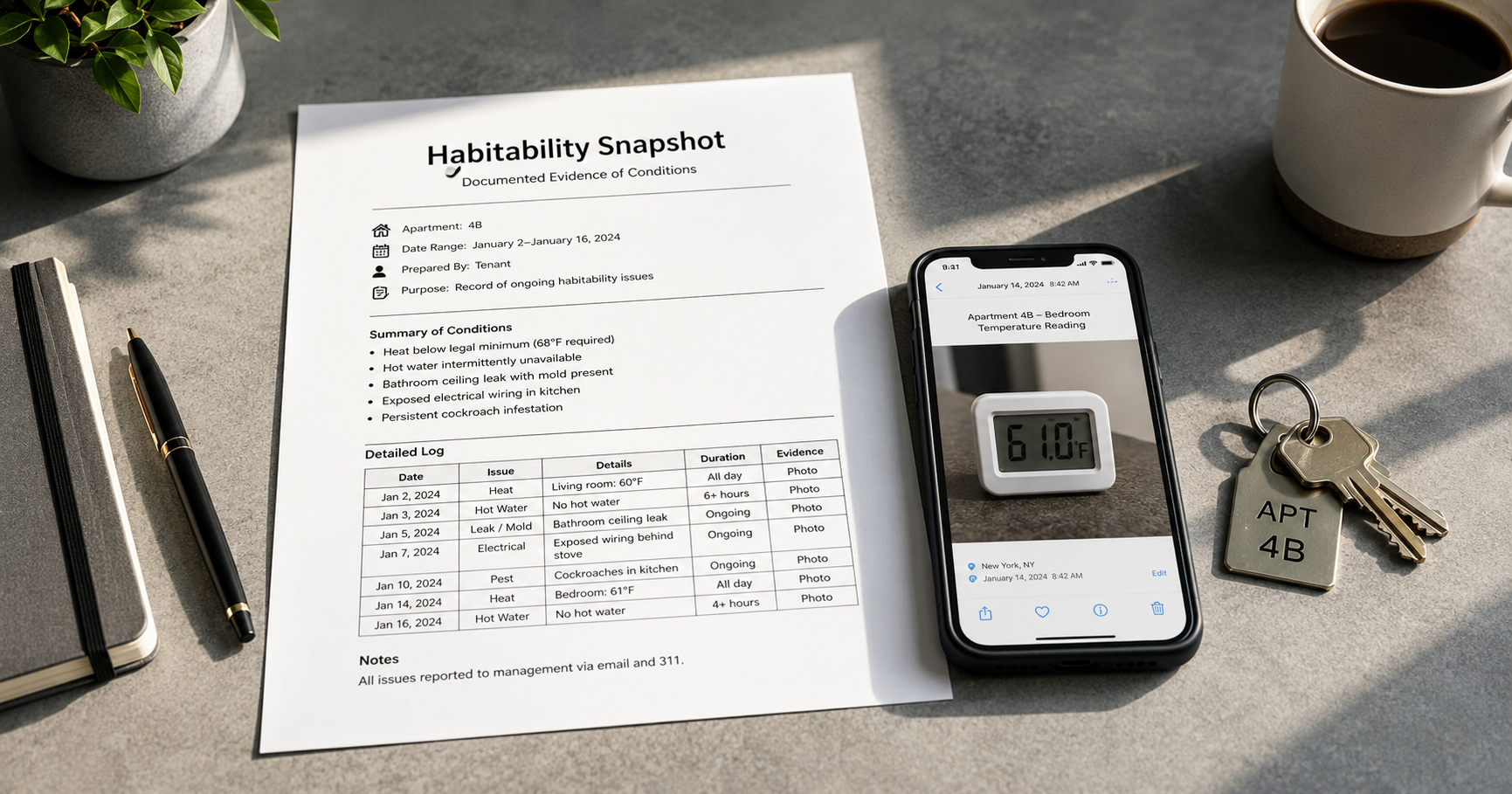
So buy a cheap indoor thermometer. When the apartment is cold, photograph the thermometer with the date and time visible, and note the outdoor temperature. Do it repeatedly, at different times of day, and keep the photos. What you're building is not an impression that your apartment is chilly — it's a dated record of indoor temperatures against a published legal standard. That's the kind of evidence that makes a heat complaint land, and an inspector responding to a 311 call will be taking exactly the same measurement you are.
Document the failures as they happen, too. Text your landlord when the heat goes out — not only because you should report it, but because the text is timestamped and creates a record of the outage and of their notice of it. A phone call leaves nothing behind. A text leaves a dated entry proving both that the heat failed and that they knew. Over a winter, those texts become your running total, assembled without any effort beyond hitting send.
This step asks you to notice something you may have been actively avoiding: whether the apartment is making you sick.
Think honestly about symptoms and their timing. Headaches. Breathing issues — coughing, wheezing, congestion that never resolves. Rashes. Sleep problems. Anxiety that seems tied to being in the unit. And then ask the question that turns a symptom into evidence: does it track the apartment? Does the cough improve when you're away for a weekend and return within a day of coming home? Does the headache correlate with the days the musty smell is strongest?
Keep a simple symptom diary. Date, time, what you're experiencing, and what was happening in the apartment — "strong mold smell," "no heat since Tuesday," "exterminator hasn't come." That's it. A few lines when something happens.
The reason this matters is that health effects are often the piece that transforms an issue from arguable to serious. Mold in a wall is a condition. Mold in a wall plus a documented pattern of respiratory symptoms that improve when you leave the apartment is a health hazard with an effect. The diary is what establishes the connection, and it does so far more credibly than memory, because it's contemporaneous — written as it happened, before you knew whether it would matter.
Two honest notes here. First, I'm not suggesting you can diagnose yourself, and neither should you try. If you're experiencing real symptoms, see a doctor — both because your health warrants it and because a medical record documenting your symptoms and their timing is substantially stronger evidence than your own diary alone. Tell the doctor about the conditions in your apartment. Let them make the medical judgments.
Second, don't overreach. If you have a cough and no idea whether it's the apartment, write down the cough and the uncertainty. "Congestion for three weeks; unclear if related" is an honest entry, and honest entries make your file trustworthy. The goal is an accurate record, not a persuasive one — and as it happens, accurate records turn out to be the persuasive ones.
Include the anxiety if it's there. Living somewhere that doesn't feel safe has real effects, and the sleep you're not getting because the front door doesn't lock properly is a genuine consequence of a genuine condition.
There's a particular test worth applying deliberately, because it's the most useful thing a symptom diary can capture: the away-and-back test. Do your symptoms change when you leave? A weekend at a friend's, a week away for work, a holiday at a relative's — these are natural experiments, and they're diagnostic in a way that nothing you do inside the apartment can be. If your congestion clears on day two of a trip and returns within a day of coming home, and that happens consistently across several trips, you have a pattern that points hard at the building. Note it every time you're away: when you left, how you felt while gone, how you felt on returning. That comparison is often more persuasive than any single symptom entry, because it isolates the apartment as the variable.
And be aware of who else is affected. If a child in the household has developed a cough, if a partner's asthma has worsened, if a housemate reports the same headaches — that's significant, both because it corroborates that something in the unit is causing it and because health effects on children in particular tend to be taken very seriously. Note their symptoms too, with dates, and get them seen by a doctor if warranted.
The reason all of this matters, beyond your health itself, is that a documented health effect can transform how a condition is understood. Mold is a maintenance issue in the abstract. Mold plus three people in the household with documented respiratory symptoms that improve when they leave the apartment is a hazard actively harming the occupants — which is precisely the language habitability law uses. You're not manufacturing that connection. You're recording it if it's there.
Now pull it together onto a single page — the document that everything else will be built on.
Summarize three things. The worst issues from Bucket B: the specific health and safety conditions, described plainly. How often they occur: the frequency and duration of the service failures, with your dates and totals. And any health impact: what you've been experiencing and how it tracks the conditions.
That's the whole page. It doesn't need to be longer, and it shouldn't be. Something like: Mold in bathroom wall, present since at least October, musty smell constant and worse after showers. Heat failed three times in January, total 11 days without heat. Smoke detector missing from hallway since I moved in. Back door lock does not latch. Persistent congestion since November that clears when I'm away for more than two days.
Read that back and notice what it is. That's not a complaint about an old apartment. That's a specific, dated, factual account of health and safety conditions in a dwelling — and it's the thing you didn't have when you started reading, when all of this was a swirl of ambiguity and self-doubt.
This snapshot is the basis for everything that comes next. It's what you'll draw on to make a written repair request to your landlord, which is almost always the right first step and which starts the clock on their obligation to act. It's what you'd bring to a housing agency or an inspector if you needed to file a complaint. It's what a tenant advocate or a lawyer would want to see in the first five minutes. And it's what you'd rely on if the conditions were ever serious enough to raise questions about your obligations under the lease.
A word about that first step, since it's where most people should go from here. Put your repair request in writing, not because a phone call doesn't count but because a written request is dated and provable, and the date matters — it establishes when the landlord knew. Draw the request straight from your snapshot: specific conditions, plainly described, with the dates and durations you've recorded. Keep it calm and factual, exactly as you'd want it read by someone else later, because it may well be. And keep a copy.
Be aware, too, that some of the more forceful remedies tenants hear about — withholding rent, repair-and-deduct, rent-reduction complaints — have real procedural requirements, and getting them wrong can hurt you. In New York, for instance, a rent-reduction complaint to the state agency requires that you first notify the landlord in writing, and it must be filed within a specific window after that notice. Withholding rent invites a nonpayment case, which you'd then have to defend. None of this means those remedies are unavailable to you; it means they're worth a conversation with a tenant advocate or legal services organization rather than an improvisation. Your snapshot is exactly what makes that conversation productive.
Keep it factual and dated, and keep updating it. Conditions change, new failures accumulate, and the snapshot should reflect the current state of things. A document you started in November and have maintained through March is far more powerful than one written from memory in March.
And keep the photos with it. The page is the summary; the photos and the diary and the dates are what stand behind it.
Let's watch the audit do its work.
Imagine a tenant in an old building, rent well below market for the area, who has spent two years talking herself out of her own perceptions. The apartment is unquestionably shabby — scuffed floors, ancient kitchen, paint peeling in the hall. And there are other things. The bathroom has smelled musty since she moved in. The heat is unreliable in a way she's never quantified. There's no smoke detector in the hallway, and she thinks there was one once. She's had a cough since the fall. Whenever she considers calling the landlord, the second voice arrives: it's a cheap apartment in an old building, what do you expect, don't be that tenant.
Run it her way, and nothing happens. Every individual item is explicable, the apartment's general shabbiness contaminates her judgment about the serious items, and the low rent functions as a kind of moral argument against complaining. Two years pass. The mold grows. The cough persists.
Now run the audit. She walks every room with one question — health, fire, security, or just ugly? — and writes down what she finds, photographing as she goes. Then she sorts. Bucket A: peeling paint, scuffed floors, ugly kitchen, worn carpet. She writes them down honestly and lets them go; she's not asking anyone to fix her cabinets. Bucket B: musty smell and suspected mold in the bathroom, missing smoke detector, back door lock that doesn't latch, heat failures.
Then she does the thing she'd never done: she counts. Going back through texts to her landlord and her own calendar, she reconstructs last winter. The heat was out January 4–7. Again on the 15th. Again the 22nd–24th. Eleven days. She had genuinely believed the answer was "it goes out sometimes."
She buys a $12 thermometer. Three weeks later, on a cold morning, she photographs it reading 61°F at 9 a.m., with her phone's weather app showing 34°F outside in the same shot. She now has, in one image, an indoor temperature seven degrees below the legal minimum under conditions where the minimum plainly applies. She sends her landlord a text about it — calm, factual — which does double duty as a report and as a timestamped record that he was told.
She starts a symptom diary and notices, within two weeks, that her congestion is markedly better after a weekend at her sister's and returns within a day of coming home. It happens again over a long weekend in March. She books a doctor's appointment and mentions the apartment and the mold smell.
Then she writes her one page: mold, missing alarm, broken lock, eleven days without heat in one month plus a documented 61-degree reading, respiratory symptoms that track the unit.
Look at what happened there. Nothing about the apartment changed. The rent is still cheap and the building is still old and the paint is still peeling. But the question she'd been carrying for two years — am I being unreasonable? — is answered, and the answer is no, and she can see why on a single page. Bucket A is right there proving she knows the difference. Bucket B is four items that have nothing to do with aesthetics. And the thing she'd been treating as a matter of opinion — whether it's too cold in here — turns out to have a number attached to it, and the number is below the line.
Same apartment, same tenant. The difference is that she stopped adjudicating it in her head and walked it with a clipboard.
Step back and see what you have now that you didn't have an hour ago. A walkthrough that separated risk from appearance. Two buckets, sorted honestly, with your Bucket A concessions making your Bucket B list credible. A real count of how often the basic services fail and for how long. A record of what your body has been doing and whether it tracks the unit. And a one-page snapshot that turns all of it into something you could hand to a landlord, an inspector, or an advocate.
Here's the reframe to carry out of this. The question "is it unsafe or just run-down?" felt like a question about your character — whether you're reasonable or precious, tough or entitled, grateful for a cheap apartment or a complainer. It was never that. It's a question about conditions, and conditions can be walked through, sorted, counted, and written down. Your uncertainty was never evidence that you were overreacting. It was evidence that you'd never been handed a standard to measure against. Now you have one.
And notice how completely the two categories can coexist. Your apartment can be genuinely shabby and genuinely unsafe. The peeling paint doesn't cancel out the mold. The low rent doesn't purchase the missing smoke detector. The building's age doesn't make the broken lock acceptable. These are separate facts, and the reason they've been tangled together in your head is that they arrived in the same apartment — not because they're actually related. The audit's whole function is to untangle them, which is why sorting into buckets does more for your clarity than any amount of thinking ever did.
So walk the rooms. Ask the one question in each. Sort into two lists, honestly. Count the days you went without heat — actually count them. Notice what your body's been telling you. Write the page.
It's worth saying plainly what the hour costs you and what it might return. The audit takes an afternoon. It requires no lawyer, no expense beyond a cheap thermometer, no confrontation with anyone, and no commitment to do anything at all with what you find. You are not filing anything by walking through your own apartment with a notepad. You're just finding out. And the range of outcomes runs from "I can stop worrying about this" to "I have a documented, dated record of serious conditions that I can act on" — with nothing worse than an afternoon at risk. Very few decisions in tenancy are that lopsided.
If Bucket B comes back empty, you've bought yourself real peace of mind at the cost of an hour. And if it doesn't, you're no longer a person with a vague, exhausting suspicion about their apartment. You're a person with a dated, specific, credible record of health and safety conditions — which is exactly what you need to do something about them. Find out where you stand.