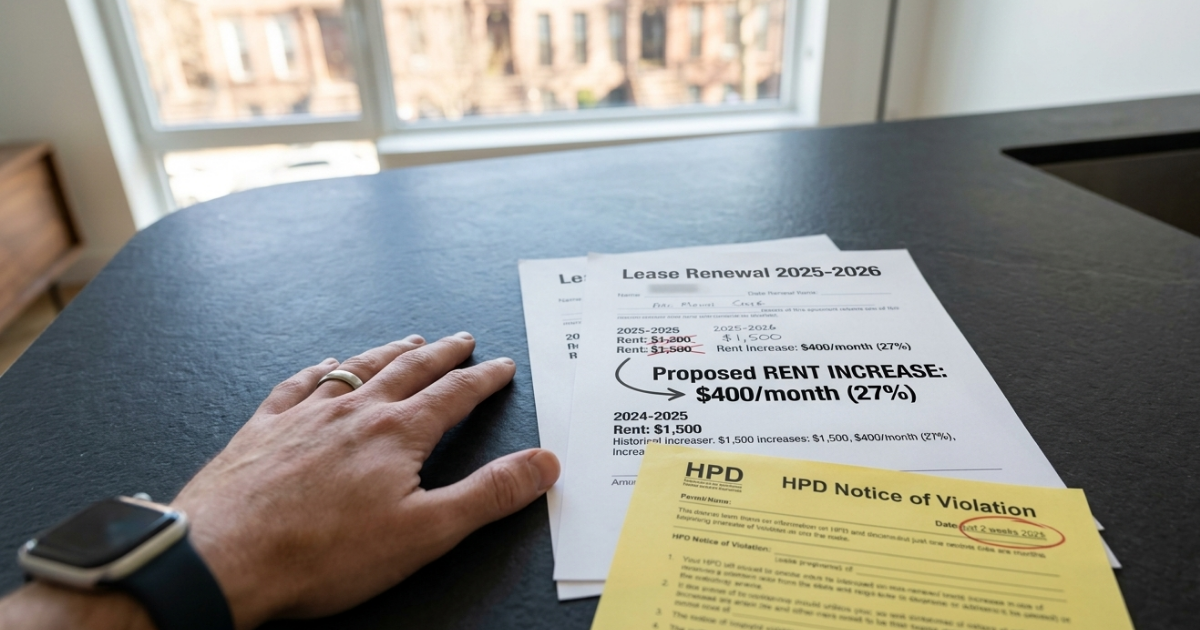
You've been living in your apartment for three years. Your rent has increased modestly each year—$50 here, $75 there, in line with what you expected. Then your bathroom ceiling started leaking. You asked your landlord to fix it. They ignored you. The leak got worse. You called 311 and reported it to HPD. An inspector came, confirmed the leak and found other violations—mold, missing smoke detectors, faulty wiring. Violations were issued.
Two weeks later, you get a notice. Your landlord is raising your rent by $400 per month—a 27% increase. This is nothing like the modest increases you've received in previous years. The timing is impossible to ignore. You think: "This is punishment for calling HPD. They're trying to price me out because I reported them. But can I prove that? Is a rent increase actually illegal retaliation? Or can landlords raise rent for any reason they want?"
This situation—a sudden, substantial rent increase immediately following a repair request or housing complaint—is one of the most common and insidious forms of landlord retaliation. It's designed to punish you financially for asserting your rights while maintaining plausible deniability ("It's just a business decision, not retaliation").
Here's the truth: Yes, a rent increase right after you request repairs or file a housing complaint can absolutely constitute illegal retaliation under New York law. The law specifically prohibits landlords from "substantially altering the terms of your tenancy"—which includes major rent increases—in retaliation for complaints about housing conditions.
Not only that, but if the increase comes within approximately one year after your complaint, New York law presumes it's retaliatory, and your landlord has to prove it's not. The burden of proof is on them to justify the increase as legitimate rather than punitive.
Let me show you exactly how retaliation law applies to rent increases, what makes a rent hike retaliatory versus legitimate, how the timing presumption works, and what you can do to fight back.
Why Rent Increase Retaliation Is So Effective (And So Common)
Before we get to the legal framework, let's understand why landlords use this tactic:
Tactic 1: Financial Punishment That Seems "Legal"
Landlords think rent increases are untouchable:
- "I can raise rent for any reason or no reason"
- "Market rate justifies any increase I want"
- "Tenant can't prove my motive"
The rent increase punishes you financially:
- Makes staying in apartment unaffordable
- Forces you to choose between paying increase or moving
- Creates financial stress and hardship
You think: "Even if this feels like retaliation, how can I prove it? Landlords are allowed to raise rent, aren't they?"
What you don't know: While landlords generally have discretion over rent, they CANNOT use rent increases to retaliate. Retaliation law limits that discretion.
Tactic 2: Plausible Deniability
Landlord can claim:
- "Market conditions justify the increase"
- "Property taxes went up"
- "I'm bringing rent in line with comparable units"
- "It's just a business decision, nothing to do with the complaint"
You think: "They have an excuse that sounds legitimate. How do I prove it's really about my complaint?"
What you don't know: The timing presumption law accounts for this. When increase follows complaint closely, the law presumes retaliation despite landlord's stated reasons. Landlord must prove their excuse is true.
Tactic 3: Achieving Same Goal as Eviction Without Court Process
Eviction requires:
- Filing court papers
- Proving grounds for eviction
- Facing tenant defenses
- Risk of losing in court
Retaliatory rent increase achieves same goal (getting you out) without court:
- You can't afford the increase
- You move out "voluntarily"
- Landlord faces no judge, presents no evidence
- Landlord gets what they wanted (you gone) without legal fight
You think: "If I just move out, I avoid conflict. Maybe that's easier."
What you don't know: You have the right to challenge retaliatory rent increases. You don't have to move. The law protects you.
Tactic 4: Chilling Effect on Future Complaints
If rent increase retaliation works:
- You move out
- Other tenants see what happened
- Other tenants learn: "Don't complain or rent goes up"
- Future violations go unreported
You think: "I should have just kept my mouth shut about the violations."
What you don't know: This is exactly the chilling effect retaliation law is designed to prevent. You have the right to complain without financial punishment.
What New York Law Says About Rent Increases as Retaliation
Let's establish the legal framework:
The Core Anti-Retaliation Law: RPL § 223-b
Real Property Law § 223-b prohibits landlords from:
"Substantially altering the terms of the tenancy"
In retaliation for:
Making good-faith complaints to landlord or government agencies about housing conditions, code violations, or safety issues
"Substantially altering the terms" explicitly includes:
- Major rent increases
- Significant changes to lease conditions
- Reduction of services
- Addition of onerous new requirements
Courts and legal experts have consistently identified large rent increases following complaints as a classic example of retaliatory alteration of tenancy terms.
What "Substantially Altering" Means
"Substantial" doesn't mean "any change at all." The law recognizes some changes to tenancy terms are normal.
Factors courts consider in determining whether change is "substantial":
Size of rent increase:
- Small increase consistent with past years (e.g., annual $50 increase continuing as usual) → Probably not substantial
- Large increase dramatically exceeding past pattern (e.g., annual $50 increases for years, then suddenly $400 increase) → Substantial
Percentage increase:
- 3-5% increase in line with inflation/market → Less likely substantial
- 20%, 30%, 40%+ increase → Substantial
Comparison to similar units:
- Increase brings rent in line with comparable market rate units → Less likely retaliatory
- Increase makes rent far exceed comparable units → Suggests retaliation
Pattern and targeting:
- Building-wide increase affecting all tenants similarly → Less likely retaliatory (though could still be if entire building complained)
- Increase targeting only you or only tenants who complained → Strong retaliation indicator
Bottom line: A large rent increase that represents a dramatic departure from past practice, especially when targeted at complaining tenant, is a "substantial alteration" covered by retaliation law.
The Expanded Timing Presumption (Approximately One Year)
New York has expanded retaliation protections to create a presumption period:
If landlord substantially alters your tenancy terms (including through major rent increase) within approximately one year after your good-faith complaint, courts can presume the action is retaliatory.
What this means:
Timeline:
- March 1: You request repairs from landlord
- March 15: You call 311/HPD about conditions
- March 25: HPD inspects and issues violations
- April 10: Landlord sends notice of substantial rent increase
Legal presumption: Because rent increase notice came within one month of your complaint (well within one-year presumption window), court presumes the increase is retaliatory.
Burden shifts to landlord: Landlord must prove the increase is based on legitimate, non-retaliatory reasons.
What landlord must prove:
- Market conditions justify the increase
- Building-wide factors (taxes, operating costs) necessitate increase
- Rent was previously below market and increase brings it in line
- Decision was made for legitimate business reasons unrelated to your complaint
If landlord can't prove legitimate non-retaliatory reason, the increase is deemed retaliatory and unenforceable.
Note on Rent-Regulated and Good Cause Apartments
If your apartment is rent-stabilized or covered by Good Cause Eviction Law:
Additional protections apply:
Rent stabilization:
- Rent increases are capped by Rent Guidelines Board limits
- Increases above legal limits are automatically invalid
- Retaliation claim adds another layer of protection
Good Cause Eviction Law:
- Rent increases above certain thresholds (currently 10% in some jurisdictions, or 5% + inflation) may be deemed "unreasonable"
- Unreasonable increases can't be used to force tenant out
- Retaliatory increases violate both Good Cause protections AND retaliation law
Retaliation protections apply IN ADDITION to these caps. Even if increase is technically within allowed percentage, it can still be retaliatory if timing and circumstances show it's punishment for complaint.
What Makes a Rent Increase Retaliatory vs. Legitimate
Let's break down the factors courts examine:
Factor 1: Timing (MOST IMPORTANT)
The closer the rent increase is to your complaint, the stronger the retaliation claim:
Very strong retaliation indicator:
- Increase notice within days or weeks of complaint/HPD inspection
- Increase notice within 1-3 months of complaint
Strong retaliation indicator:
- Increase notice within 3-6 months of complaint
- Well within one-year presumption window
Moderate retaliation indicator:
- Increase notice within 6-12 months of complaint
- Still within presumption window but more time has passed
Weaker retaliation indicator:
- Increase notice more than one year after complaint
- Presumption may not apply, but circumstantial evidence can still show retaliation
Example timelines:
Strong retaliation case:
- January 15: Tenant requests heat repair
- January 25: Tenant calls 311 about no heat
- February 1: HPD inspects, finds violations
- February 20: Landlord sends notice of $500/month rent increase
- Timeline: 5 weeks from complaint to increase notice → Very strong retaliation indicator
Moderate retaliation case:
- March 1: Tenant reports mold to HPD
- March 15: HPD issues violations
- August 1: Landlord sends notice of $300/month increase
- Timeline: 5 months from complaint to increase → Still strong, within presumption window
Timing is often the most powerful evidence because it's objective and hard to explain away.
Factor 2: Size and Pattern of Increase
How the increase compares to past practice and market conditions:
Historical Pattern Analysis
Compare current increase to past increases:
Example suggesting retaliation:
- Year 1-2: Rent increased $50
- Year 2-3: Rent increased $75
- Year 3-4: Rent increased $50
- Year 4-5 (after HPD complaint): Rent increased $450
Pattern: Years of modest increases, then sudden massive increase after complaint → Strong retaliation indicator
Example suggesting legitimate market adjustment:
- Year 1-2: Rent $1,200 (significantly below market)
- Year 2-3: Rent $1,250 (still below market)
- Year 3-4: Rent $1,300 (still below market)
- Year 4-5: Rent $1,600 (bringing to market rate)
- Complaint happened in Year 4, increase notice also in Year 4
Analysis: If landlord can prove rent was substantially below market for years and increase brings it in line with comparable units, may overcome presumption. BUT timing is still suspicious—why now, right after complaint?
Percentage Analysis
How large is the increase as a percentage?
Minimal increase (usually not substantial):
- 3-5% increase in line with inflation
Moderate increase (possibly substantial depending on context):
Large increase (almost certainly substantial):
- 20%+ increase
- 30%+ increase is extremely substantial
- 40-50%+ increase is massive and hard to justify
Example:
- Previous rent: $1,500
- Increase: $600
- New rent: $2,100
- Percentage: 40% increase
- This is substantial and requires strong justification to overcome retaliation presumption
Comparison to Similar Units
How does your rent compare to similar apartments?
Strong retaliation indicator:
- Your rent after increase significantly exceeds comparable units
- Other tenants in building didn't get similar increases
- Only you (the complaining tenant) got the massive increase
Possible legitimate explanation:
- Your rent was significantly below market
- Increase brings you in line with comparable units
- Other similar units are renting for the new amount
- BUT landlord must prove this with evidence, not just claims
Factor 3: Selective Targeting
Is the increase applied uniformly or selectively?
Strong retaliation indicators:
Only you got the increase:
- Other tenants' leases renewed with modest increases
- Only the tenant who filed the HPD complaint got massive increase
- Clear selective targeting
Only complaining tenants got increases:
- Multiple tenants reported violations
- All complaining tenants received substantial increases
- Non-complaining tenants didn't
You got a much larger increase than others:
- Building-wide increases, but yours is 2x or 3x what others got
- Disproportionate targeting
Weaker retaliation claim:
Building-wide increase:
- All tenants received similar percentage increases
- Applied uniformly regardless of complaint history
- Legitimate business decision affecting everyone
However: Even building-wide increase can be retaliatory if all or most tenants filed complaints, and increase is punishment for collective action.
Factor 4: Landlord's Communications and Behavior
What landlord said or did around the time of the increase:
Direct evidence of retaliation (rare but powerful):
- "If you call HPD again, I'll raise your rent"
- "You want repairs? Fine, but rent is going up"
- "This increase is because you complained about me"
- Any explicit connection between complaint and increase
Circumstantial evidence of retaliation:
- Hostile communications after your complaint
- Threats of various kinds
- Comments suggesting displeasure with your complaint
- Sudden change in landlord's treatment of you after complaint
Example:
- Tenant reports violations
- Landlord sends angry text: "You shouldn't have called the city on me"
- Two weeks later, rent increase notice arrives
- Landlord's communication proves retaliatory motive
Landlord's justification matters:
Weak justifications suggesting pretext:
- Vague claims about "market conditions" without evidence
- "I can raise rent whenever I want"
- Inconsistent explanations
- Justifications that don't hold up under scrutiny
Stronger justifications (that may overcome presumption if well-documented):
- Documented property tax increase
- Documented increases in operating costs
- Evidence of significant capital improvements
- Market analysis showing rent was below comparable units
Factor 5: Context of Other Retaliatory Actions
Is rent increase part of larger retaliation pattern?
Strong retaliation indicator if increase is combined with:
- Service interruptions after complaint
- Sudden "inspections" or harassment
- Eviction threats
- Construction harassment
- Other forms of pressure
Example:
- Tenant reports violations in March
- Landlord starts doing surprise inspections in April
- Landlord stops responding to repair requests in May
- Landlord sends massive rent increase in June
- Pattern shows coordinated retaliation campaign
Isolated increase:
- Increase is the only change in landlord's treatment
- No other retaliatory behaviors
- Weaker retaliation claim (though timing alone may still prove it)
Real Examples: Retaliatory vs. Legitimate Rent Increases
Let's apply the framework to specific scenarios:
Scenario 1: Clear Retaliatory Increase
Facts:
- Tenant lived in apartment 4 years
- Annual rent increases: $50, $60, $75 (3-5% annually)
- Rent currently $1,500/month
- February 1: Tenant reports lead paint and mold to HPD
- February 15: HPD inspects, issues violations
- March 1: Landlord sends lease renewal with rent increase to $2,000/month ($500 increase, 33%)
Analysis:
Timing: ✓ One month after HPD violations—very strong indicator
Size/Pattern: ✓ 33% increase vs. historical 3-5% increases—dramatic departure from pattern
Selective targeting: ✓ (Assume other tenants got usual modest increases)
Landlord justification: Landlord claims "market conditions" but provides no documentation
Conclusion: This is clearly retaliatory. Timing, size, and pattern all point to retaliation. Landlord's vague "market conditions" excuse without evidence can't overcome presumption.
Legal outcome: Increase deemed retaliatory and unenforceable. Tenant can stay at current rent or modest increase consistent with past pattern.
Scenario 2: Possible Legitimate Increase (But Timing Still Suspicious)
Facts:
- Tenant lived in apartment 3 years
- Rent has been $1,200/month entire time (never increased)
- Comparable units in neighborhood rent for $1,800-$2,000/month
- Landlord has documentation showing rent is $600-$800 below market
- April 1: Tenant reports multiple violations to HPD
- April 20: HPD issues violations
- May 15: Landlord sends lease renewal with increase to $1,800/month ($600 increase, 50%)
Analysis:
Timing: ✗ 6 weeks after complaint—strong retaliation indicator, within presumption window
Size/Pattern: Mixed—50% is huge, BUT rent was genuinely below market for years
Market comparison: ✓ Landlord has evidence comparable units are $1,800-$2,000
Landlord justification: "Rent was below market, bringing to market rate"
Key question: Why now? If rent was below market for 3 years, why increase it immediately after HPD complaint rather than earlier?
Likely outcome: Close case. Landlord might overcome presumption if they have strong documentation that rent was significantly below market AND can explain timing (though timing is suspicious). Tenant should challenge. Court may find retaliation OR may allow some increase but less than full amount (e.g., phased increase to reduce retaliatory impact).
Scenario 3: Building-Wide Increase (Likely Not Retaliatory)
Facts:
- Tenant in 50-unit building
- Property taxes increased 15%
- Operating costs increased significantly
- Landlord implementing building-wide increase of 12% for all tenants
- Multiple tenants, including complaining tenant, receive same 12% increase
- Tenant had filed HPD complaint 2 months before increase notice
Analysis:
Timing: Within presumption window, BUT...
Selective targeting: ✗ Building-wide increase affecting all tenants equally
Justification: Documented property tax and operating cost increases affecting entire building
Pattern: All tenants treated similarly
Conclusion: Likely not retaliatory. Even though timing falls within presumption window, uniform application and documented business reasons suggest legitimate increase, not retaliation targeting complaining tenant.
However: Tenant should verify other tenants actually got same increase. If landlord claims "building-wide" but complaining tenant's increase is disproportionate, that's evidence of retaliation.
Scenario 4: Retaliatory Increase Disguised as "Market Rate"
Facts:
- Tenant rent $1,400/month
- Comparable units in building rent for $1,500-$1,600
- January 15: Tenant files HPD complaint
- February 1: HPD issues violations
- February 20: Landlord sends increase to $2,100/month ($700 increase, 50%)
- Landlord claims "bringing to market rate"
- But even landlord's own comparable units are only $1,500-$1,600, not $2,100
Analysis:
Timing: ✓ 5 weeks after complaint—strong retaliation indicator
Size: ✓ 50% increase is massive
Market comparison: ✗ Landlord's claimed "market rate" of $2,100 exceeds their own comparable units by $500-$600
Landlord justification: Claims "market rate" but numbers don't support it
Conclusion: Clear retaliation. Landlord is using false "market rate" excuse. Even if increase to $1,500-$1,600 might be justifiable, increase to $2,100 far exceeds market and is retaliatory.
Legal outcome: Increase deemed retaliatory. Tenant stays at current rent or court might allow modest increase to actual market rate ($1,500-$1,600) while rejecting retaliatory $2,100 demand.
What You Can Do If You Get Retaliatory Rent Increase
If you receive a substantial rent increase shortly after requesting repairs or filing a housing complaint:
Action 1: Don't Panic and Don't Immediately Move Out
Your first instinct might be: "I can't afford this. I have to move."
STOP. Before deciding to move:
Understand that:
- The increase may be legally unenforceable if it's retaliatory
- You may have the right to stay at your current rent
- Moving out gives landlord exactly what they wanted without you asserting your rights
- You have legal options to challenge the increase
Don't make hasty decisions. Get legal advice first.
Action 2: Document Everything Immediately
Create comprehensive timeline and evidence:
Your complaint history:
- When you first requested repairs from landlord (dates, method of communication)
- When you called 311/HPD (complaint numbers, dates)
- When inspections occurred
- When violations were issued
- Save all related documents: emails, texts, 311 confirmations, HPD violation notices
Rent history:
- Your past rent amounts
- Past rent increases (amounts and percentages)
- Current rent
- Proposed new rent
- Calculate percentage increase
The increase notice:
- Date you received rent increase notice
- Exact amount of increase
- Any reasons landlord gave for increase
- Save the actual notice document
Timeline document:
- Create clear chronological timeline:
- [Date]: First repair request to landlord
- [Date]: Called 311, complaint #[number]
- [Date]: HPD inspection
- [Date]: Violations issued
- [Date]: Received rent increase notice
- Calculate days between complaint and increase notice
Comparable rent information (if possible):
- What similar units in your building rent for
- What comparable apartments in neighborhood rent for
- Evidence showing whether landlord's claimed "market rate" is accurate
Communications:
- Any texts, emails, or conversations where landlord:
- Expressed anger about your complaint
- Connected increase to complaint
- Made threats
- Gave explanations for increase
Action 3: Get Legal Advice BEFORE Deciding Whether to Pay Increase
CRITICAL: Consult with tenant lawyer before taking any action on the increase.
Contact legal services:
NYC:
- Legal Services NYC: 917-661-4500
- Legal Aid Society: 212-577-3300
- Housing Court Answers: 212-962-4795
- Metropolitan Council on Housing: 212-979-0611
Outside NYC:
- Use LawHelpNY.org to find legal services in your county
Tell intake: "I received a large rent increase [X days/weeks] after I reported housing violations to HPD. The increase is [X%] and far exceeds past increases. I believe it's retaliatory and I need advice on whether to challenge it."
What lawyers will evaluate:
- Whether increase is "substantial" under retaliation law
- Whether timing creates presumption of retaliation
- Strength of your evidence
- Whether landlord's justification (if any) is credible
- Your options for challenging increase
Lawyers will advise you on strategic options:
Option A: Pay the increase under protest while challenging it Option B: Refuse to pay increase, continue paying current rent, and defend if landlord files eviction Option C: Negotiate with landlord Option D: File affirmative lawsuit challenging increase as retaliatory
Don't decide alone. The right strategy depends on your specific situation, strength of evidence, and risk tolerance.
Action 4: Understand Your Strategic Options
Option 1: Continue Paying Current Rent (Don't Pay Increase)
How this works:
- You continue paying your current rent amount
- You don't pay the increased amount
- Landlord will likely file eviction for "nonpayment" (claiming you owe the increase)
- In eviction court, you raise retaliation defense under RPL § 223-b
- You argue increase is retaliatory and therefore unenforceable
- If you win, you stay at current rent
Pros:
- Forces landlord to prove increase is legitimate (burden on them)
- You can raise all retaliation defenses in court
- If you win, you don't pay increase
- Right to Counsel provides free lawyer in eviction case
Cons:
- You face eviction proceeding (stressful even if you win)
- Risk of losing if court finds increase legitimate
- Eviction case on your record (even if dismissed)
Best for: Strong retaliation cases with clear timing and pattern
Option 2: Pay Increase Under Protest While Challenging
How this works:
- You pay the increased rent
- You explicitly state in writing you're paying "under protest"
- You file affirmative lawsuit or claim challenging increase as retaliatory
- You seek refund of overpayment if you win
Pros:
- No eviction case against you
- You maintain possession of apartment
- No risk of eviction judgment
Cons:
- You're paying more money while case is pending
- You need to affirmatively bring legal action
- More complex legal process
- May not get free Right to Counsel lawyer (since it's not eviction defense)
Best for: Cases where you can afford the temporary increase and want to avoid eviction proceeding
Option 3: Negotiate With Landlord
How this works:
- Lawyer sends letter to landlord citing retaliation law
- Points out timing, size of increase, legal presumption
- Proposes negotiated resolution (smaller increase, phased increase, withdraw increase)
- Landlord may back down rather than face legal challenge
Pros:
- May resolve without court
- Faster resolution
- Less adversarial
Cons:
- Landlord may refuse to negotiate
- You may end up accepting some increase even if fully retaliatory
- No precedent or court determination
Best for: Cases where you want to avoid litigation and landlord seems reasonable
Option 4: File Affirmative Legal Action
How this works:
- You file lawsuit in Supreme Court seeking:
- Declaration that increase is retaliatory
- Injunction prohibiting enforcement of increase
- Damages for retaliation
- Proactive legal attack rather than waiting for landlord to evict
Pros:
- You control timing and framing
- Can seek damages beyond just blocking increase
- Strong statement of your rights
Cons:
- More complex than eviction defense
- May not qualify for free legal services
- Takes time and resources
Best for: Strong cases where you want to take offensive legal action, especially if combined with other retaliation
Your lawyer will help you choose the best strategy based on:
- Strength of your retaliation evidence
- Your financial situation
- Your risk tolerance
- Whether you're in rent-regulated apartment
- Local court patterns
Action 5: Prepare to Prove Retaliation in Court (If Necessary)
If your strategy involves court (eviction defense or affirmative action), prepare evidence:
Documents to organize:
- Timeline showing complaint → violations → increase
- HPD complaint records and violation notices
- Rent history showing past increases vs. current increase
- Communications with landlord
- Comparable rent information (if available)
- Any evidence of landlord's false justifications
Testimony to prepare:
- Your repair requests and landlord's response (or non-response)
- Why you called HPD
- When you received increase notice
- How increase compares to past increases
- Whether landlord gave reason for increase
- Any statements landlord made connecting increase to complaint
- Impact on you (can you afford it, are you being forced out)
Your lawyer will:
- Present timeline evidence showing presumption applies
- Challenge landlord's claimed justifications as pretextual
- Argue size and pattern of increase show retaliation
- Present your testimony and documents
- Cross-examine landlord on their justifications
Action 6: Understand What Happens If You Win
If court finds increase is retaliatory:
Increase is unenforceable:
- You don't have to pay the increased amount
- Lease renews at current rent (or modest increase consistent with past pattern)
- Landlord cannot evict you for refusing to pay retaliatory increase
Possible additional relief:
- Attorney fees: Landlord may have to pay your legal fees
- Damages: You may recover damages for retaliation (especially if you paid increase under protest)
- Penalties: Landlord may face civil penalties for retaliation
- Injunction: Court may prohibit future retaliation
You stay in your apartment at affordable rent, and landlord learns retaliation has consequences.
Special Considerations for Rent-Regulated and Good Cause Apartments
If your apartment has additional protections:
Rent-Stabilized Apartments
Rent Stabilization provides caps on increases:
- Annual increase limits set by Rent Guidelines Board
- Currently 2.75% for 1-year renewal, 5.25% for 2-year renewal (as of 2024, subject to change)
- Increases above these limits are illegal regardless of retaliation
Retaliation analysis:
If proposed increase exceeds RGB limits:
- Increase is automatically illegal
- You report to DHCR (Division of Housing and Community Renewal)
- Retaliation is additional violation on top of rent stabilization violation
If proposed increase is within RGB limits but retaliatory:
- Even "legal" percentage can be retaliatory based on timing and circumstances
- You can challenge as retaliation even if within allowed percentage
- Example: RGB allows 2.75%, landlord always gave 0-1%, suddenly after complaint gives maximum 2.75%—timing and pattern suggest retaliation
Good Cause Eviction Law Coverage
If your apartment is covered by Good Cause:
Good Cause limits rent increases:
- Generally, increases above 10% (or 5% + CPI in some jurisdictions) are deemed "unreasonable"
- Unreasonable increases can be challenged
- Landlord can't use unreasonable increases to force tenant out
Retaliation analysis:
If increase exceeds Good Cause limits:
- Challenge on both Good Cause grounds AND retaliation grounds
- Two independent violations
If increase is within Good Cause limits but retaliatory:
- Can still challenge as retaliation based on timing
- Example: 9% increase (technically under 10% Good Cause threshold) but follows complaint by 3 weeks and exceeds historical pattern—still retaliatory
Combined protections are powerful: You have multiple legal arguments against retaliatory increases in regulated apartments.
The Truth About Rent Increase Retaliation
Here's what you need to know:
Rent increase retaliation is explicitly illegal under NY law. RPL § 223-b prohibits "substantially altering tenancy terms" in retaliation for complaints, and courts recognize large rent increases as classic retaliation.
The timing presumption is powerful. Increase within approximately one year of complaint creates legal presumption of retaliation. Burden shifts to landlord to prove legitimacy.
Landlords often can't overcome the presumption because:
- Timing is too suspicious
- Size of increase is too large compared to past pattern
- Market justifications don't hold up to scrutiny
- Selective targeting reveals retaliatory motive
You don't have to accept retaliatory increases. You have legal right to challenge them, and legal services can help you do it.
Free legal representation is available through Right to Counsel (if landlord files eviction) or legal services organizations.
Challenging retaliation sends a message to landlord that you know your rights and won't be financially bullied into silence.
If you don't challenge retaliation, you either:
- Pay unaffordable rent, OR
- Move out
Both outcomes give landlord exactly what they wanted: financial punishment for asserting your rights.
The law exists to prevent this. Use it.
Document the timeline. Get legal advice. Challenge the increase. Stay in your home at fair rent.
Your right to complain about unsafe conditions without financial retaliation is legally protected.
Defend it.
Find out if you have a case in 30 seconds →