A landlord who lets a lead hazard go unaddressed often assumes the worst that can happen is a repair order—a notice to fix the problem, followed by the fix, and the matter closed. In that view, ignoring lead hazards carries no real penalty beyond eventually having to do what should have been done anyway. But that assumption badly underestimates what the law can require. A landlord who ignores lead hazards, especially persistently and across many properties, can face far more than a repair order: direct payments to the families harmed, substantial funding earmarked to eliminate the hazards, and even restrictions on the landlord's ability to sell the properties until the dangers are resolved. Ignoring lead is not a cost-free gamble that ends, at worst, with a belated repair. It can be expensive, and it can tie the landlord's hands.
A New York case out of Syracuse makes the point concretely. The Attorney General, working with Syracuse and Onondaga County, sued a landlord named Todd Hobbs and his companies over repeated lead-safety violations. The scale of the problem the authorities described was striking: 413 violations across 19 properties over a span of eight years, and at least eleven children poisoned by lead while living in those properties. This was not a single oversight or an isolated lapse; it was a documented history of persistent violations across a portfolio of rental housing, with real children harmed along the way. The settlement that resolved the case required the landlord to pay $175,000—but how that money was allocated, and what else the settlement required, is the instructive part. Of the $175,000, $55,000 was designated for current and former tenants harmed by lead exposure, and $120,000 was earmarked to address the lead hazards at the properties. On top of the money, the landlord was barred from selling those properties without the Attorney General's approval until the lead hazards were resolved.
The Hobbs matter—resolved through a settlement announced by the Attorney General alongside Syracuse and Onondaga County officials—illustrates principles that reframe what ignoring lead hazards can cost a landlord. A documented inspection history can reveal that violations are persistent rather than isolated, transforming a landlord's exposure from a one-time problem into a pattern of recurring failure. The money in a settlement like this is not all the same: part compensates the families harmed, while a larger part is designated to fund the elimination of the hazards themselves—two different purposes with two different destinations. And a settlement can go beyond money to restrict what the landlord may do with the properties, barring their sale until the hazards are resolved, so the owner cannot simply offload the problem and walk away. This guide explains what the authorities found, how inspection histories reveal persistent violations, why the distinction between compensating families and funding remediation matters, and why restricting property sales is a meaningful tool against landlords who would otherwise avoid their unresolved problems.
The defendants were Todd Hobbs and two companies associated with him, TLH Holdings and TLH Properties, operating rental properties in and around Syracuse. The case against them was brought not by the Attorney General alone but in collaboration with local authorities—Onondaga County and the City of Syracuse—reflecting a coordinated effort by state and local government to address lead hazards in the area's rental housing. The lawsuit was filed in the summer of 2023, and it alleged repeated and persistent violations of lead-safety laws across the landlord's properties.
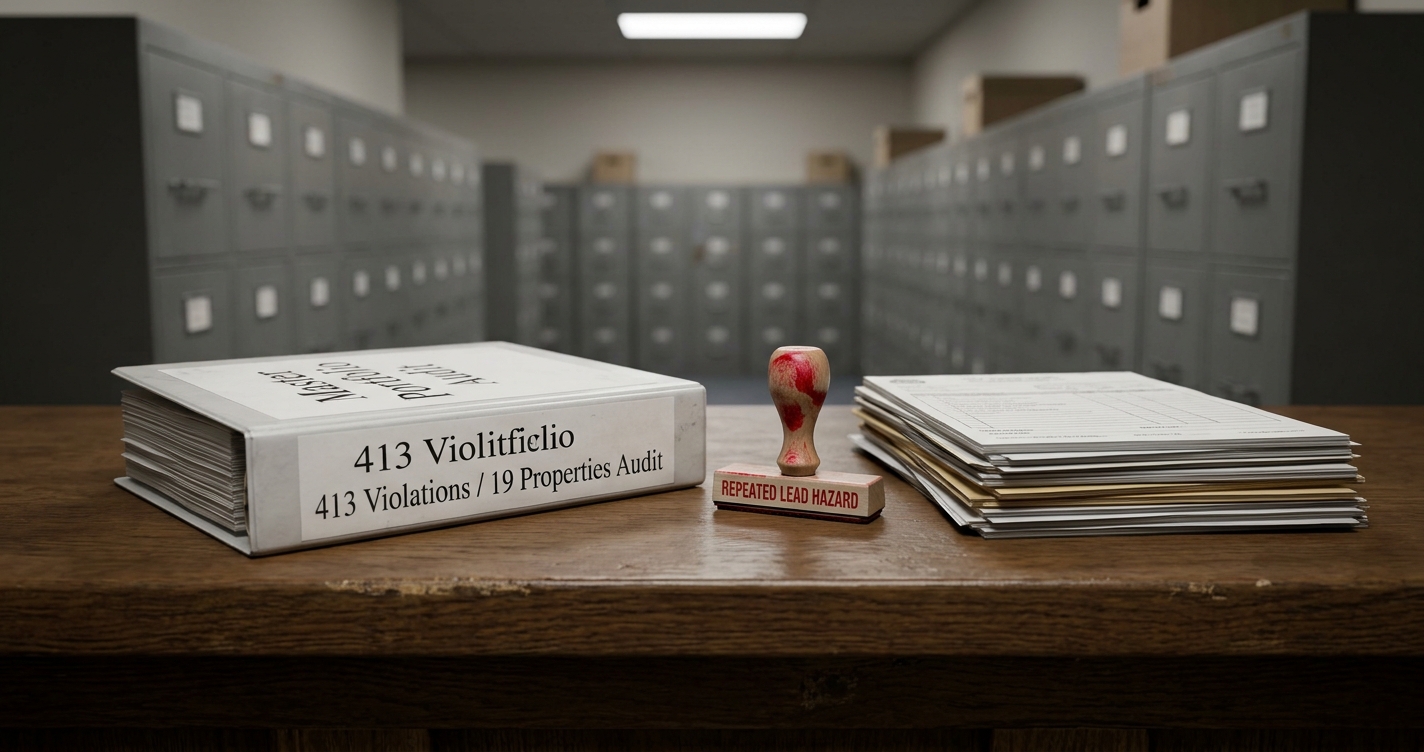
The numbers the authorities reported convey the scope of the problem. There were 413 violations identified across 19 properties, accumulated over a period of eight years. That is not a snapshot of a single moment of noncompliance; it is a record built up over years, across nearly two dozen properties, reflecting a sustained pattern of lead-safety failures. And the human toll was documented as well: at least eleven children were poisoned by lead while living in these properties. Lead poisoning in children causes serious, often irreversible harm, and eleven poisoned children is a grave figure—evidence that the violations were not merely technical or paper failures but conditions that actually harmed the most vulnerable residents the lead laws are designed to protect.
The combination of the long time span, the large number of violations, and the number of properties involved paints a picture of persistent, portfolio-wide failure rather than an isolated incident. A landlord might have a single violation at a single property through momentary oversight; that is a different matter from 413 violations across 19 properties over eight years. The latter reflects a sustained failure to comply with lead-safety obligations, repeated across a portfolio and over a long period, with children poisoned in the process. This pattern is central to understanding both why the enforcement response was as substantial as it was and what the inspection record revealed, as discussed below.
To resolve the case, the landlord agreed to a settlement requiring payment of $175,000, allocated in a specific and telling way. Of that total, $55,000 was designated for current and former tenants who had been harmed by lead-paint exposure at the properties over the preceding years—money directed to the families who suffered from the lead conditions. The larger portion, $120,000, was earmarked to address the lead hazards at the 19 properties with lead-related violations—money dedicated to eliminating the dangers themselves. In addition to the money, the settlement barred Hobbs from selling the properties without the Attorney General's approval until the lead hazards were resolved. This restriction on sale, layered on top of the financial obligations, is a distinctive feature of the settlement and one of its most practically important terms.
The allocation and the sale restriction together reveal an enforcement strategy aimed at multiple goals at once: compensating the families harmed, funding the actual elimination of the hazards, and preventing the landlord from evading the obligation by disposing of the properties. Each piece serves a distinct purpose, and understanding them clarifies what the settlement accomplished—and what a landlord who ignores lead hazards can actually face.
One of the most important lessons of the Hobbs matter lies in the numbers themselves: 413 violations, 19 properties, eight years. These figures are the product of an inspection history, and that history is what transformed the case from a dispute about isolated conditions into a case about persistent, systemic failure. Understanding how an inspection record builds this picture is valuable, because it shows why a landlord cannot easily dismiss lead violations as one-off accidents and why a documented history is such powerful evidence.
A single lead violation, viewed in isolation, might be explained away. A landlord might say a hazard developed unexpectedly, that it was promptly addressed, that it was an anomaly. One violation at one property at one time does not, by itself, establish a pattern. But lead-safety enforcement does not depend on single snapshots. Inspections occur over time—by the city, by the county, by health authorities responding to complaints or to children's elevated lead levels—and each inspection creates a record. Over years, those records accumulate into a history, and the history tells a story that no single inspection could. When that history shows 413 violations across 19 properties over eight years, the story is not one of isolated accidents; it is one of persistent, repeated failure to comply with lead-safety obligations.
This accumulation matters because persistence changes the character of the violation. A pattern of recurring violations, documented over time, demonstrates that the landlord was not merely unlucky but was systematically failing to meet its obligations—and, crucially, that it continued to fail even as violations were identified. An inspection history that shows violations recurring year after year reveals that the landlord was on notice of the problems and did not fix them, or fixed them only to let them recur, or let the same kinds of failures persist across property after property. The record establishes not just that hazards existed, but that the landlord's failure to address them was ongoing and pervasive. That is a far more serious matter than a single lapse, and it supports a correspondingly more serious enforcement response.
The inspection history also connects the violations to their consequences. The record in the Hobbs matter included not only the violations but the poisoning of at least eleven children. An inspection and health-monitoring history that documents both the hazards and the harm—violations identified and children poisoned—builds a compelling case that the landlord's persistent failures had real, grave effects. The history ties the pattern of noncompliance to the injuries it caused, demonstrating that the violations were not abstract regulatory failures but conditions that actually harmed children.
For a tenant, the significance of inspection histories is twofold. First, it underscores the value of reporting lead conditions to the authorities, because each report and each inspection adds to the record. A condition you report may seem like a single problem, but it becomes part of a history that, over time and across tenants, can reveal a landlord's pattern of failure. Your report is not just about your apartment; it contributes to the documentation that can establish persistent, portfolio-wide violations. Second, it means that a landlord's history matters. If your landlord has a record of repeated lead violations—at your building or across its properties—that history is relevant and powerful. It shows that the problem is not an isolated accident but part of a pattern, which strengthens the case for serious enforcement. A documented history of persistent violations, as the Hobbs matter shows, is exactly what elevates a lead case from a routine repair matter to a substantial enforcement action.
The $175,000 settlement in the Hobbs matter was not a single pot of money serving a single purpose. It was deliberately split: $55,000 for the tenants harmed by lead exposure, and $120,000 to address the lead hazards at the properties. This division reflects two distinct purposes—compensating the families who were harmed, and funding the elimination of the hazards themselves—and understanding the distinction is essential to reading the settlement honestly and grasping what it accomplished.
The $55,000 designated for current and former tenants is compensation. It is money directed to the families who suffered from lead-paint exposure at the properties—the people harmed by the landlord's failures, including, one understands, the families of children poisoned by lead. The purpose of this portion is remedial in the compensatory sense: to provide something to those who were injured by the conditions. This is the part of the settlement that functions like compensation for harm, flowing to the individuals who bore the consequences of the lead hazards.
The $120,000 earmarked to address the lead hazards is something different. It is not compensation to anyone; it is funding dedicated to eliminating the dangers—to remediating the lead hazards at the 19 properties so that they no longer threaten the children and families who live there. The purpose of this portion is preventive and corrective: to fix the problem itself, to remove the hazards from the housing, to protect current and future residents from exposure. This money is directed at the properties and the hazards, not at any individual, and its goal is to make the housing safe rather than to compensate for past harm.
The distinction matters for several reasons. First, it reflects the dual nature of what lead enforcement must accomplish: it must both address the harm already done and prevent future harm by eliminating the hazards. Compensating the families acknowledges and partially redresses the injury; funding remediation ensures the danger is actually removed so that it does not continue to harm people. A settlement that only compensated past victims would leave the hazards in place to poison future residents; a settlement that only funded remediation would do nothing for those already harmed. The Hobbs settlement does both, with distinct allocations for each purpose.
Second, and this is the point your attention should rest on, the distinction is essential to describing the settlement accurately. It would be a serious mistake to characterize the entire $175,000 as compensation to tenants, or to suggest that the harmed families received $175,000. They did not. The portion designated for the harmed tenants was $55,000; the larger $120,000 was earmarked for remediating the hazards, not for compensating anyone. In fact, most of the settlement—roughly two-thirds—was dedicated to hazard remediation rather than to tenant compensation. An honest account must keep these separate: the compensation to families was the smaller portion, and the majority of the money was directed at fixing the dangerous conditions themselves. Collapsing the two, or describing the whole sum as a tenant-compensation fund, would misstate what the settlement actually provided.
For a tenant, understanding this distinction clarifies what a settlement like this means for them and what it accomplishes for their housing. If you were harmed by lead exposure, the compensation portion is the part that might reach you—money for the families who suffered. But the larger remediation portion is also significant to you, perhaps even more so if you continue to live in the housing, because it funds the actual elimination of the hazards that threaten your home. The remediation money is not compensation you receive, but it is directed at making your housing safe, which is its own important benefit. Recognizing that a lead settlement serves both purposes—compensating harm and funding safety—helps a tenant understand the full value of such enforcement, and keeps expectations honest about which portion is compensation and which is dedicated to fixing the problem.
Beyond the money, the Hobbs settlement included a term that may be its most practically clever: the landlord was barred from selling the properties without the Attorney General's approval until the lead hazards were resolved. This restriction on sale addresses a loophole that landlords might otherwise exploit to escape their obligations, and understanding why it matters reveals a sophisticated feature of lead-hazard enforcement.
Consider the problem the restriction solves. A landlord facing an obligation to remediate lead hazards at its properties has, in the absence of such a restriction, a tempting escape route: sell the properties. If the landlord can sell the hazardous properties to someone else, it can walk away from the obligation to fix them, offloading both the properties and the unresolved hazards onto a new owner. The lead dangers would remain in the housing, now someone else's problem, and the original landlord—the one responsible for years of violations and the poisoning of children—would be free of the properties and the duty to remediate them. The sale would let the landlord avoid the very obligation the enforcement action was meant to impose.
The restriction on sale closes this escape route. By barring the landlord from selling the properties without the Attorney General's approval until the lead hazards are resolved, the settlement ensures that the landlord cannot use a sale to evade the remediation obligation. The landlord must resolve the hazards first; only then, or with the Attorney General's approval, can the properties be sold. This keeps the responsible owner on the hook for fixing the problem it created, and it prevents the hazards from being passed along to a new owner—who might be no more diligent, or who might use the transfer to reset the clock on enforcement. The restriction binds the properties to the obligation, so that the obligation cannot be shed by disposing of the properties.
This is important because property ownership can otherwise be fluid in a way that frustrates enforcement. Hazardous properties can change hands, and each transfer can complicate the task of holding anyone accountable for conditions that persist. A landlord who senses that enforcement is coming, or who simply wants to be rid of a problematic portfolio, might sell before the obligations are fixed, leaving the hazards unremediated and the accountability diffused. The sale restriction prevents this by freezing the landlord's ability to divest until the job is done. It ensures that the enforcement action actually results in remediated housing, rather than in a game of hot potato where hazardous properties are passed from owner to owner while the dangers persist.
The restriction also reinforces the settlement's other terms. The $120,000 earmarked for remediation is meant to fund the elimination of the hazards; the sale restriction ensures that the landlord remains in place to carry out the remediation and cannot abandon the properties before it is complete. The two work together: the money funds the fix, and the restriction keeps the responsible party bound to see it through. Without the restriction, the landlord might take the remediation obligation less seriously, knowing it could sell its way out; with it, the landlord must actually resolve the hazards to regain full control over the properties.
For a tenant, the significance of a sale restriction is that it protects against a particular kind of abandonment. A landlord cannot simply sell the building out from under an unresolved lead problem, leaving you with a new owner and the same hazards. The restriction keeps the responsible landlord accountable for fixing the conditions before it can divest, which increases the likelihood that the hazards in your housing will actually be remediated rather than passed along. It is a tool that recognizes a real-world evasion tactic—selling to escape responsibility—and forecloses it, ensuring that the obligation to make the housing safe travels with the responsibility, not away from it.
It helps to translate the Hobbs matter into the situation of an ordinary tenant, because the case speaks to a predicament many renters in older housing face.
Imagine you live in a rental property with lead hazards—deteriorating lead paint, perhaps, in a building old enough to contain it—and you suspect your landlord has been ignoring the problem, maybe for years, maybe across other properties the landlord owns. Perhaps a child in your home or your building has been affected. You might assume that the most you can expect is that, eventually, the landlord will be made to fix the specific hazard, and that will be the end of it. The Hobbs matter shows that the consequences for a landlord who persistently ignores lead hazards can be far greater, and that the enforcement response can protect you and your family in multiple ways.
The case teaches that a landlord's history matters, and that persistent violations are treated far more seriously than isolated ones. If your landlord has a documented record of repeated lead violations—at your building or across its portfolio—that history, built from inspections over time, can reveal a pattern of systemic failure that supports substantial enforcement. Your reports of lead conditions contribute to that record, which is one reason reporting matters: it adds to the documentation that can establish a landlord's persistent noncompliance. The authorities in Hobbs could act forcefully precisely because the inspection history revealed 413 violations over eight years, not a single lapse.
The case also teaches that enforcement can do more than order a repair. It can require the landlord to compensate the families harmed, as the $55,000 portion did; it can fund the actual remediation of the hazards, as the $120,000 portion did; and it can restrict the landlord's ability to sell the properties until the hazards are resolved, keeping the landlord accountable rather than letting it offload the problem. For you, this means that enforcement against a lead-ignoring landlord can both acknowledge the harm done to your family and ensure the dangers in your housing are actually eliminated—and that the landlord cannot escape by selling.
What you would do, understanding this, is report and document. Report lead conditions to the authorities responsible for lead safety—your local health department, housing agency, or code enforcement—because these reports trigger inspections that build the record. Document the conditions in your home and your communications with the landlord. If a child in your home has been affected by lead, take that with the utmost seriousness: seek medical care and testing, because lead poisoning is a grave matter, and consult about whether an individual claim for the child's injury may be available, separate from any public enforcement. And understand that the public enforcement machinery—the kind that produced the Hobbs settlement—exists to address a landlord's persistent failures, and that your reports help set it in motion.
The reason the hypothetical tracks the case is that the case is the hypothetical, documented across a portfolio and resolved through enforcement. Tenants and children in a Syracuse landlord's properties lived with persistent lead hazards that the landlord failed to resolve over eight years, and coordinated state and local enforcement compelled compensation, funded remediation, and barred the landlord from selling until the hazards were fixed. The individual tenant's situation—living with a hazard a landlord has ignored—is the same concern the enforcement action addressed at scale. Recognizing that persistent lead violations carry serious consequences, and that reporting contributes to the record that drives enforcement, is what lets a tenant engage the protections the law provides.
Knowing the case is one thing; applying its lessons is another. Here is how a tenant living with lead hazards can respond.
Report lead conditions to the authorities. Lead hazards and a landlord's failure to address them can be reported to the agencies responsible for lead safety—typically local health departments, housing agencies, or code enforcement. These reports trigger inspections, and inspections build the documented record that can reveal persistent violations. Reporting is not only about getting your own hazard addressed; it contributes to the history that can establish a landlord's pattern of failure and support serious enforcement.
Understand that a landlord's history matters. Persistent lead violations are treated far more seriously than isolated ones, and an inspection history accumulated over time is powerful evidence of systemic failure. If your landlord has a record of repeated lead violations, that history strengthens the case against it. Your reports add to that record, so documenting and reporting conditions contributes to establishing the pattern.
Document the conditions and your communications. Keep records of the lead conditions in your home—photographs, notes, any testing—and of your complaints to the landlord and the landlord's responses. This documentation supports both any individual claim and the broader record that enforcement authorities rely on. A documented history of a condition and a landlord's failure to address it is valuable evidence.
Take a child's lead exposure with the utmost seriousness. If a child in your home may have been exposed to lead, seek medical care and lead testing promptly; childhood lead poisoning causes serious, often irreversible harm, and early attention is critical. Beyond the medical response, understand that an individual claim for a child's lead injury may be available, separate from public enforcement, and that such claims are serious and time-sensitive—consult a lawyer experienced in lead cases.
Know that enforcement can do more than order repairs. Public enforcement against a lead-ignoring landlord can require compensation for harmed families, funding to remediate the hazards, and restrictions on selling the properties until the hazards are resolved—as the Hobbs settlement shows. Understanding the range of possible remedies helps you see that reporting a landlord's persistent failures can lead to meaningful protection, not just a belated repair.
Recognize the distinction between compensation and remediation. In a settlement like this, part of the money may compensate harmed families while a larger part funds the elimination of the hazards. Both matter: the compensation addresses harm done, and the remediation makes the housing safe. If you continue to live in the housing, the remediation funding is especially significant to you, even though it is not money you personally receive.
Get knowledgeable help. Lead-safety law and lead-injury claims involve specific legal rules and high stakes, especially for children's health. For a potential injury claim, consult a lawyer experienced in lead cases promptly. For a landlord's failures to comply with lead-safety obligations, tenant-rights organizations, legal aid groups, and the relevant enforcement agencies can help you report the problem and understand your rights. Given lead's irreversible harm, acting early on any concern is especially important.
Several intuitive but mistaken beliefs leave tenants underestimating their protections against a lead-ignoring landlord, and the Hobbs matter speaks to each.
The first misconception is that ignoring lead hazards leads, at worst, to a repair order. It can lead to much more: compensation for harmed families, substantial funding earmarked to remediate the hazards, and restrictions barring the landlord from selling the properties until the dangers are resolved. The repair is the floor, not the ceiling, of a landlord's exposure.
The second misconception is that lead violations are judged one at a time. They are often judged as a pattern. An inspection history accumulated over years can reveal persistent, systemic failure—413 violations across 19 properties over eight years, in Hobbs—which is treated far more seriously than an isolated lapse.
The third misconception is that the money in a settlement like this is all tenant compensation. It is not. In Hobbs, $55,000 went to harmed tenants and the larger $120,000 was earmarked to remediate the hazards. Most of the settlement funded fixing the dangers, not compensating individuals—two distinct purposes that should not be conflated.
The fourth misconception is that a landlord can escape a remediation obligation by selling the properties. The sale restriction forecloses this. Hobbs was barred from selling without the Attorney General's approval until the hazards were resolved, keeping the responsible owner on the hook rather than letting it offload the problem.
The fifth misconception is that reporting a lead hazard only helps your own apartment. Each report feeds an inspection record, and over time and across tenants that record can establish a landlord's portfolio-wide pattern. Your report contributes to the documentation that drives serious enforcement, benefiting far more than your own unit.
The sixth misconception is that a public settlement resolves a poisoned child's injury claim. It does not. The $55,000 compensation component is distinct from an individual personal-injury lawsuit a harmed child's family might bring, which has its own proof and its own potential recovery. Public enforcement and individual claims are separate avenues.
A feature of the Hobbs matter worth drawing out is that it was not a solo effort by the Attorney General. It was brought in coordination with Onondaga County and the City of Syracuse—state and local authorities acting together. This coordination is not incidental; it is part of what made the enforcement so effective, and understanding why reveals something about how persistent lead violations get caught and addressed.
Lead-safety enforcement depends on information, and that information is often distributed across multiple levels of government. Local health departments track children's elevated blood-lead levels and investigate their sources. Local code-enforcement and housing agencies inspect properties and record violations. These local bodies are frequently the first to encounter a lead problem—the ones who find the hazards, who connect a poisoned child to a particular apartment, who accumulate the inspection records over time. The state Attorney General, meanwhile, brings the authority and resources to mount a substantial enforcement action across a portfolio. When these levels of government coordinate, the local knowledge of the hazards and the state's enforcement power combine into something more potent than either could achieve alone.
The Hobbs matter illustrates this combination. The documented history of 413 violations across 19 properties over eight years is the kind of record that local inspections and health-monitoring build up over time. The identification of at least eleven poisoned children reflects the local health apparatus that tracks childhood lead exposure. And the enforcement action that converted this accumulated local record into a settlement—with compensation, remediation funding, and sale restrictions—reflects the Attorney General's capacity to act on that record at scale. The local authorities supplied much of the knowledge; the state supplied much of the enforcement muscle; together they produced a result that reached across the landlord's whole portfolio.
This coordination matters because persistent, portfolio-wide lead violations are exactly the kind of problem that can slip through gaps between agencies. A landlord operating many properties across a city might accumulate violations that, viewed by any single agency or at any single moment, look manageable or isolated. It is when the records are brought together—across agencies and across years—that the full pattern emerges. Coordinated enforcement is the mechanism that assembles the complete picture and acts on it, preventing a landlord from benefiting from the fragmentation of oversight. A landlord cannot as easily hide a pattern when state and local authorities are pooling what they know.
For a tenant, the significance is practical. It means that the various reports and inspections a tenant might trigger—calling the health department about a child's lead level, reporting a hazard to code enforcement—feed into a system that, when coordinated, can produce powerful results. Your report to a local agency is not a dead end; it can become part of a record that state and local authorities together use to hold a landlord accountable across its portfolio. It also means that a tenant facing a lead-ignoring landlord has more than one door to knock on: local health and housing agencies and, through them or alongside them, state enforcement. Understanding that these authorities can and do work together encourages a tenant to report, knowing the report contributes to a larger enforcement capacity rather than vanishing into a single overburdened office.
The coordination also reflects the seriousness with which lead hazards are treated. The fact that the state Attorney General joined with county and city officials to pursue a single landlord signals that persistent childhood lead poisoning is regarded as a grave public problem warranting a concerted governmental response. For a tenant, that seriousness is reassuring: a landlord's persistent lead failures are not a minor matter that authorities shrug off, but the kind of problem that can mobilize coordinated enforcement across levels of government, as the Hobbs matter shows.
It is worth being candid about the nature of the Hobbs matter. It was resolved through a settlement reached by the Attorney General, in coordination with Syracuse and Onondaga County, based on the authorities' allegations and findings, rather than by a contested trial. The account here reflects those allegations and the public record of the settlement, drawn from the official announcement. A negotiated settlement resolves the particular matter on agreed terms; it is not a judicial opinion announcing new legal rules. Its value lies in how concretely it illustrates the consequences a landlord can face for persistently ignoring lead hazards and the tools enforcement authorities can bring to bear.
What the matter does not do is resolve the individual injury claims of the children poisoned by lead, or establish the full measure of any child's damages. The $55,000 compensation portion was directed to tenants harmed by lead exposure, but a public enforcement settlement's compensation component is distinct from an individual personal-injury lawsuit a harmed child's family might bring to recover for the specific injury. A family whose child was poisoned by lead may have a separate individual claim, which involves its own proof and its own potential recovery, and which the Hobbs settlement neither provides nor forecloses. The matter is a public enforcement action addressing the landlord's violations and funding remediation, not a resolution of individual injury claims.
What is reliable, because it reflects New York's lead-safety enforcement and the findings in the matter, is the framework it illustrates. A landlord that persistently ignores lead hazards can face more than repair orders: compensation for harmed families, funding dedicated to remediating the hazards, and restrictions on selling the properties until the hazards are resolved. A documented inspection history accumulated over time can reveal persistent rather than isolated violations, establishing a pattern of systemic failure that supports substantial enforcement. The money in such a settlement serves distinct purposes—compensation for harm and funding for remediation—that should not be conflated, and the remediation portion may be the larger share. And a restriction on property sales prevents a landlord from evading its obligations by offloading the hazardous properties. Those are the principles the matter puts on display.
The enduring lesson of the Hobbs matter is that ignoring lead hazards is not the low-risk shortcut a landlord might imagine. A landlord who assumes the worst case is a repair order, to be dealt with only if and when the authorities insist, badly misjudges the exposure. Persistent lead violations—documented across properties and over years, with children poisoned along the way—can bring consequences that reach well beyond a repair: payments to the families harmed, substantial funding dedicated to eliminating the hazards, and restrictions that bar the landlord from selling the properties until the dangers are resolved. The $175,000 the Syracuse landlord agreed to pay, most of it earmarked for remediation, and the handcuffing of its ability to sell, are the measure of what ignoring lead can cost. The gamble that lead hazards can be neglected without real penalty is a gamble that can fail expensively.
For you as a tenant, that means the law offers more protection against a lead-ignoring landlord than a single repair order suggests. A landlord's history of persistent violations matters and is built from the inspection record that your reports help create. Enforcement can compensate harmed families, fund the actual elimination of the hazards in your housing, and keep the landlord from escaping by selling. And while a public settlement addresses the landlord's violations and funds remediation, a child harmed by lead may have a separate individual claim worth pursuing with knowledgeable help. Report lead conditions, document them, take any child's exposure with the utmost seriousness, and understand that the enforcement machinery exists to hold persistently negligent landlords accountable.
Lead hazards are a serious and, for children, often irreversible danger, and the law treats a landlord's persistent failure to address them accordingly. The consequences can include compensation, remediation funding, and sale restrictions—far more than a belated repair. The first step, for any tenant living with a lead hazard a landlord has ignored, is knowing that ignoring lead is not cheap, and that reporting the problem can set in motion protections that reach well beyond the single fix a landlord might otherwise grudgingly provide.