You're facing a crisis—your apartment has suddenly become uninhabitable due to a serious problem, and you've had to leave immediately to protect your health and safety. Maybe there was a major fire or flood that made your apartment unlivable. Or perhaps the ceiling collapsed from water damage the landlord ignored for months. Or the building was condemned by the city due to dangerous structural problems. Or you're dealing with such severe habitability violations—extreme mold, sewage backup, no heat in freezing weather, massive pest infestation—that you literally cannot stay there anymore.
You've had to scramble to find temporary housing—staying in hotels, with family, or in short-term rentals—and the costs are mounting rapidly. You're paying hundreds of dollars for hotels while also still technically owing rent on an apartment you can't live in. You've had to rent a truck to move your belongings into storage. You're incurring gas costs driving back and forth, extra food expenses, and if you're searching for a new permanent place, application fees and moving costs. The financial burden is crushing, especially on top of the crisis of losing your home.
You think: "Is my landlord legally required to pay for my hotel while my apartment is unlivable? Can I get reimbursed for the moving truck, storage fees, and all these emergency expenses? Should the city pay since they condemned the building? What about my rent—do I still have to pay rent for an apartment I can't live in? How do I get my landlord or someone to cover these costs, or am I just stuck paying everything out of pocket? Will anyone automatically help me with these displacement costs, or do I have to fight for every dollar?"
Here's the truth: You can often get displacement costs like hotels, moving expenses, and temporary housing covered—but not automatically, and you must actively pursue reimbursement by documenting expenses, identifying the responsible party (landlord, government condemning authority, or your renter's insurance), making formal demands, and if necessary, pursuing claims through Housing Court or Small Claims Court. Whether your apartment was formally condemned by a government agency (which may trigger relocation assistance programs) or became uninhabitable due to landlord neglect or damage (which may create landlord liability for your displacement costs), you're not entitled to automatic payment—you must prove what happened, document your expenses meticulously, demand compensation from the appropriate party, and potentially take legal action to recover what you're owed.
Let me show you exactly what the legal difference is between formal condemnation and uninhabitability from landlord neglect, what specific costs you may be able to recover, who might be responsible for paying (landlord, government, or insurance), what documentation you must preserve to support your claims, and how to actually pursue and recover these costs through demands and legal proceedings.
The path to recovering displacement costs depends significantly on whether your apartment or building was formally condemned by government authorities or simply became uninhabitable due to landlord failures or damage.
Government condemnation or vacate orders trigger specific legal frameworks and often entitle tenants to relocation assistance.
Formal condemnation occurs when a city, county, or state agency officially determines that a building or unit is unsafe, unfit for human habitation, or must be demolished, and issues an order requiring occupants to vacate. This is an official government action, not just your personal determination that the place is unlivable.
Common condemnation scenarios include structural dangers where building inspectors determine the structure is unsafe due to collapse risk, fire damage, or severe deterioration and issue vacate orders requiring immediate evacuation; eminent domain takings where government acquires property for public projects (redevelopment, infrastructure) and requires residents to relocate; widespread code violations so severe that entire buildings are condemned as uninhabitable; or environmental hazards like severe lead paint contamination, toxic mold, or other contaminants requiring resident evacuation.
When formal condemnation occurs, several legal protections and assistance programs may apply. Many jurisdictions have relocation assistance requirements when government agencies condemn residential properties, particularly when federal funding is involved or when condemnation is for redevelopment purposes. These programs recognize that tenants losing their homes through government action shouldn't bear the full financial burden of forced displacement.
Relocation assistance under formal condemnation programs typically covers moving costs including actual reasonable expenses for moving household belongings, replacement housing payments helping bridge the gap if new housing costs more than old housing, and in federal programs subject to Uniform Relocation Act, comprehensive relocation benefits including advisory services helping tenants find suitable replacement housing.
The condemning authority—whether city, county, state, or in some cases a redevelopment agency—is typically the responsible party for relocation assistance when they're the ones ordering displacement. Property owners may also have obligations to provide relocation assistance depending on the circumstances and jurisdiction.
Tenant rights under condemnation are often stronger because government recognizes its action is forcing displacement and fairness requires helping displaced residents. Federal and state relocation laws specifically provide protections when government entities condemn housing.
To access condemnation-related assistance, you must document that formal condemnation occurred (obtain copies of condemnation orders or vacate notices), contact the issuing agency about available relocation assistance programs, apply for assistance through proper channels with documentation, and follow up persistently as bureaucratic processes can be slow.
More commonly, apartments become uninhabitable not through formal government condemnation but through landlord neglect, sudden damage, or habitability violations that make the dwelling unlivable.
Uninhabitability from landlord neglect occurs when serious problems make the apartment genuinely unlivable—severe mold from landlord's failure to fix leaks, fire damage from electrical problems landlord ignored, collapsed ceilings from water damage landlord didn't repair, sewage backups from plumbing failures, extreme pest infestations landlord wouldn't address, or no heat for extended periods in freezing weather.
Sudden damage events can also create uninhabitability—fires, floods, burst pipes, or other acute incidents rendering the apartment suddenly unlivable, particularly when linked to landlord maintenance failures (electrical fire from faulty wiring, flood from neglected plumbing, collapse from ignored structural problems).
In these scenarios, there's no government agency providing relocation assistance because there's no formal condemnation. Instead, your avenue for recovering displacement costs is through claims against your landlord based on their breach of habitability obligations or negligence.
The legal theory is that landlord's failure to maintain habitable conditions or their negligence in maintaining the property caused you to be displaced and incur emergency housing and moving expenses. Since landlord's breach or negligence created the situation, they should bear the costs you incurred as a result.
Recovery mechanisms include rent abatement for periods you couldn't occupy the apartment (you shouldn't pay full rent for housing you couldn't use), reimbursement of actual displacement costs you incurred (hotels, temporary housing, moving expenses, storage), and potentially additional damages if landlord's conduct was particularly egregious or caused you other harms beyond just displacement costs.
Pursuing these claims requires legal action—typically through Housing Court for rent abatement and displacement costs related to habitability breaches, or Small Claims Court for recovering specific out-of-pocket expenses up to jurisdictional limits, or in serious cases with large damages, civil court actions for negligence and breach of contract.
The burden is on you to prove the apartment was uninhabitable due to landlord fault, that you reasonably incurred the expenses you're claiming, that the expenses were necessary consequences of the uninhabitability, and the amounts you're claiming are reasonable and supported by documentation.
Understanding which situation you're in determines your strategy for recovering costs.
Formal condemnation: Contact the condemning agency about relocation assistance, apply for available programs, follow official procedures, be prepared for bureaucratic processes and possible delays, and consult with attorneys or housing advocates familiar with relocation assistance laws if you encounter resistance.
Uninhabitability without condemnation: Focus on landlord liability, document landlord's fault and your resulting expenses, pursue rent abatement as immediate relief (stop paying rent for uninhabitable apartment), send formal written demands to landlord for reimbursement, and be prepared to sue in Housing Court or Small Claims Court if landlord won't voluntarily reimburse you.
Many cases involve elements of both—you may have uninhabitable conditions that led you to call code enforcement which then issued violations or even vacate orders (creating some official documentation though perhaps not full "condemnation"). In these hybrid situations, you pursue both landlord liability and any available government assistance.
Understanding what expenses are potentially recoverable helps you track and document the right costs and understand the scope of what you can claim.
The direct expenses of physically moving out of the uninhabitable apartment and relocating your belongings are typically recoverable.
Truck rental or moving company fees for transporting your household goods from the uninhabitable apartment to temporary or permanent new housing are reasonable necessary expenses caused by the displacement. Whether you rent a U-Haul for a few hundred dollars or hire professional movers for a few thousand, these costs directly result from being forced to leave your home.
Packing materials and supplies including boxes, packing tape, bubble wrap, and other materials needed to safely pack and move your belongings are part of moving costs.
Storage unit fees if you need to store belongings while in temporary housing or while searching for permanent replacement housing are displacement-related costs. The period of storage should be reasonable—a few months while you find permanent housing is typically justifiable.
Gas and mileage for moving trips, particularly if multiple trips are required or if new housing is distant from old apartment, can be claimed, usually calculated at IRS standard mileage rates.
Labor costs if you hired help for moving (even if informal, like paying friends) may be recoverable with documentation.
The principle is that you wouldn't have incurred these moving costs if not for the displacement caused by uninhabitability or condemnation, making them consequential damages or necessary expenses resulting from the situation.
When you can't immediately move into permanent replacement housing and must stay in temporary accommodations, these costs are often recoverable.
Hotel or motel expenses for nightly accommodation while displaced are classic temporary housing costs. If you had to leave your apartment suddenly due to fire, flood, condemnation, or severe hazards and stayed in hotels for days, weeks, or even months, these are direct consequences of displacement.
Short-term rental costs including Airbnb, extended-stay hotels, or other temporary furnished housing for periods while you search for permanent replacement housing or wait for your original apartment to be repaired (if applicable and you choose to return).
The reasonable period for temporary housing depends on circumstances. A few weeks to a couple months is generally reasonable while searching for new permanent housing or waiting to see if original apartment will be repaired. Extended periods (many months) may be questioned unless you can show you were actively searching for permanent housing and temporary stay was necessary.
Documentation requirements are strict for temporary housing—you need receipts, proof of payment, and ideally evidence that you were actually displaced (not just choosing to stay in hotel while maintaining your apartment).
Beyond reimbursing your emergency expenses, you're entitled to not pay rent for periods when the apartment was uninhabitable and you couldn't live there.
Rent abatement means rent reduction to reflect that you weren't receiving habitable housing during displacement period. If you couldn't occupy your apartment at all, rent abatement would typically be 100% for those days or months—you owe zero rent for a completely uninhabitable apartment you couldn't use.
If you already paid rent for the uninhabitable period, you can seek refund of rent paid for time you couldn't occupy the dwelling.
The principle is that you're paying for habitable housing. When housing becomes uninhabitable and you can't use it, you shouldn't pay for what you're not receiving. This prevents the unfair situation of paying both rent on uninhabitable apartment and hotel/temporary housing costs simultaneously.
Calculating abatement is usually straightforward for complete uninhabitability: if you couldn't occupy at all from March 15 to May 1, you owe zero rent for that period and are entitled to refund of any rent paid, plus reimbursement of actual temporary housing costs.
Various other costs resulting from displacement may be recoverable depending on circumstances.
Application fees and deposits for new permanent housing—if you had to secure new apartment, application fees, credit check fees, and security deposit for new place are costs you incurred because you were displaced.
Utility connection or disconnection fees incurred when leaving uninhabitable apartment and setting up utilities at new location.
Additional transportation costs if displacement created extra commuting (new temporary housing is farther from work, requiring more gas or transit costs) may be recoverable for the displacement period.
Extra food costs if displacement affected your ability to prepare meals (no kitchen access in hotel, having to eat restaurant meals) beyond what you normally would spend on groceries.
Replacing spoiled food or damaged belongings if the incident causing uninhabitability (flood, fire, severe mold) destroyed your property.
Lost wages if displacement required taking time off work to move, search for housing, or deal with the crisis.
In serious condemnation cases particularly those involving federal relocation programs, comprehensive "displacement expenses" can include broader categories like housing search assistance, moving advisory services, and other support.
The key is that expenses must be reasonably necessary consequences of the displacement and properly documented to be recoverable.
Determining who's legally and practically responsible for your displacement costs is critical to knowing whom to demand payment from.
When apartment became uninhabitable due to landlord's breach of habitability obligations or negligence, landlord is the appropriate party to pursue for costs.
Landlord fault scenarios include failure to maintain property leading to severe conditions (ignored leaks causing mold or collapse, neglected repairs causing fire or flood, failure to address pest infestations making dwelling unlivable), negligent repairs or maintenance creating hazards, knowing about dangerous conditions and failing to correct them, and generally breaching the warranty of habitability such that apartment became genuinely unlivable.
Legal theories for landlord liability include breach of warranty of habitability (landlord failed to provide habitable housing, you incurred costs as consequence), negligence (landlord's failure to use reasonable care in maintaining property caused uninhabitability and your resulting damages), breach of lease (landlord failed to fulfill lease obligations to provide habitable premises), and sometimes intentional misconduct if landlord deliberately created uninhabitable conditions.
What you can recover from landlord: Rent abatement or refund for uninhabitable period, reimbursement of temporary housing costs (hotels, short-term rentals), moving and storage costs, property damage if your belongings were destroyed, and potentially additional damages for inconvenience, emotional distress, or other harms in some cases.
Pursuing landlord liability requires proving landlord fault (through your evidence of prior notice, landlord's failures, official violations), documenting your expenses meticulously, making written demand on landlord for payment, and if landlord refuses, filing suit in Housing Court (for rent abatement and related costs) or Small Claims Court (for out-of-pocket expense reimbursement up to jurisdictional limits).
Landlords often resist paying displacement costs, necessitating court action to compel payment. But when you can prove uninhabitability was their fault and expenses were reasonable and necessary, courts regularly order landlords to pay these costs.
When government agency condemns property or issues vacate orders, they may be responsible for relocation assistance.
Government responsibility arises particularly when condemnation is for public purposes (eminent domain takings for redevelopment, infrastructure projects), when federal funding is involved (triggering Uniform Relocation Act requirements), or under state and local relocation assistance laws requiring aid to displaced residential tenants.
What government may provide: Moving cost payments, replacement housing payments if new housing is more expensive, advisory services helping find suitable housing, and depending on the program, additional displacement benefits.
Accessing government assistance requires identifying which agency condemned the property, contacting them about relocation assistance, applying through their procedures with documentation, and being persistent through bureaucratic processes.
Limitations: Government assistance programs often have specific eligibility requirements, may provide only partial cost coverage, can involve significant paperwork and delays, and may require you to meet certain criteria (income limits, residency requirements).
In some government condemnation cases, property owners rather than government agencies bear relocation assistance obligations, particularly when owners are pursuing demolition or conversion requiring tenant displacement.
If you have renter's insurance (tenant insurance policy), it may provide the fastest route to covering temporary housing costs.
Additional Living Expenses (ALE) coverage is a standard component of most renter's insurance policies covering increased living costs when your apartment becomes uninhabitable due to covered perils. Covered perils typically include fire, smoke damage, certain types of water damage (burst pipes but usually not flood), windstorm damage, vandalism, and theft making dwelling unlivable.
What ALE covers: Hotel or temporary housing costs above your normal rent, extra food costs if unable to cook, and other increased expenses from displacement, up to policy limits and for policy-defined periods.
Advantages of insurance: Typically the fastest way to get displacement costs covered (often within days after claim filing), insurance company handles payment directly rather than requiring you to pay and seek reimbursement later, and insurers may pursue subrogation against landlord or responsible parties to recover what they paid you.
Limitations: Only covers perils listed in policy (won't cover displacement from habitability violations like mold or pests unless tied to covered loss), subject to policy limits, may have deductibles, and may have time limits on how long they'll pay temporary housing.
If you have renter's insurance, file a claim immediately when displacement occurs. Don't assume it won't cover your situation—let the insurer investigate and determine coverage. Even if initial displacement cause isn't covered, related covered perils might be (e.g., habitability issue isn't covered but resulting water damage creating uninhabitability might be).
Tenant advocates note that in practice, renter's insurance is often quickest path to getting immediate help with hotel costs, after which you can still pursue landlord liability for amounts insurance didn't cover or for situations where insurance doesn't apply.
Sometimes multiple parties may share responsibility, and strategic considerations determine whom to pursue first.
Pursue insurance first if you have ALE coverage and situation might be covered—fastest relief and doesn't preclude later landlord claims.
Pursue landlord when uninhabitability clearly resulted from their fault, you have strong documentation, and no insurance or condemnation assistance applies.
Pursue government when formal condemnation triggered relocation assistance obligations and you meet eligibility requirements.
In some cases, you pursue multiple parties simultaneously or sequentially—insurance for immediate relief, then landlord for amounts insurance didn't cover, or government for relocation assistance plus landlord for additional damages beyond what government provided.
Recovering displacement costs requires meticulous documentation proving what happened, what you spent, and why those expenses were necessary and reasonable.
Official documentation of the uninhabitability or condemnation is foundational evidence.
For formal condemnation: Obtain copies of the condemnation order, vacate notice, or official communication from the condemning agency. This document proves government determined property was uninhabitable and ordered displacement. Request copies from the issuing agency, often available through their office or website.
For uninhabitability without formal condemnation: Collect HPD violations, code enforcement violation notices, inspection reports from building departments or health departments, written communications from agencies confirming unsafe or unsanitary conditions, and any emergency orders or findings.
If fire or other emergency: Get fire marshal reports, police reports if applicable, or other emergency response documentation.
These official documents prove that conditions were objectively serious and uninhabitable, not just your personal preference or overreaction. They establish third-party verification of the situation justifying your displacement.
Photographs and videos of conditions that caused uninhabitability supplement official paperwork—document mold, damage from fire or flood, collapsed structures, or whatever conditions made dwelling unlivable.
Every dollar you're claiming must be documented with receipts and proof of payment.
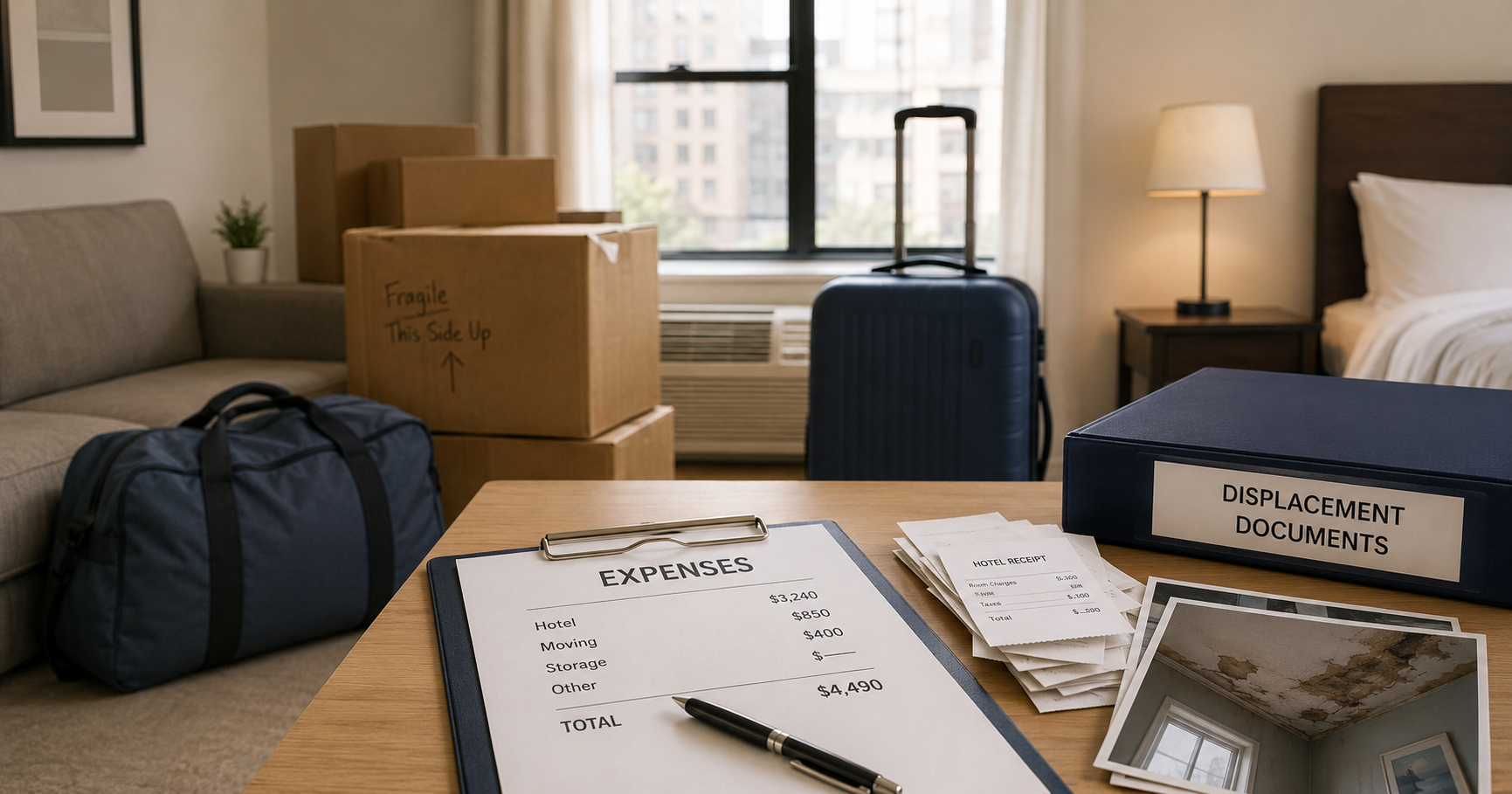
Hotel and temporary housing receipts including itemized hotel bills showing dates, nightly rates, and total charges, confirmation emails from Airbnb or short-term rentals, and credit card statements showing payments.
Moving expenses: Truck rental invoices, moving company bills, receipts for packing supplies, storage unit rental agreements and payment receipts, and gas receipts or mileage log with calculations.
All related costs: Application fees for new housing, utility bills, extra transportation costs, food expenses if elevated due to displacement, and receipts for damaged belongings needing replacement.
Organize chronologically and by category. Create spreadsheet summarizing all expenses with dates, descriptions, amounts, and where receipts are located in your file.
Without receipts, recovery is difficult or impossible. Courts and agencies need proof of actual expenditures—your testimony about costs isn't sufficient without documentation.
Save originals and make copies. Bring copies to court or claims proceedings while retaining originals for backup.
Precise timeline documentation proves how long displacement lasted and connects expenses to the uninhabitability period.
Key dates to document:
Timeline log format: "March 10, 2025: Ceiling collapsed from water leak. Apartment uninhabitable. Moved to hotel that night. March 11-April 15: Stayed in hotel, searched for new apartment. April 16: Moved into new permanent apartment. Total displacement: 37 days."
Dated documentation correlates expenses to displacement period, showing hotel charges from March 11-April 15 were reasonable and necessary because you had nowhere else to live during that period.
Before going to court, make formal written demand on the responsible party for reimbursement.
Written demand letter to landlord (if pursuing landlord liability) should include clear statement of what happened (apartment became uninhabitable due to [specific conditions]), why you hold landlord responsible (prior notice of problems, landlord's failure to repair, breach of habitability), summary of expenses incurred (with total amount), copies or description of supporting documentation attached, demand for payment of specific total amount, and deadline for response (typically 15-30 days).
Example language: "On [date], my apartment at [address] became uninhabitable due to [collapsed ceiling from water leak you failed to repair despite my complaints on [prior dates]]. I was forced to vacate immediately for my safety. I incurred [detailed list of expenses with amounts: $3,240 in hotel costs for 37 days, $850 in moving expenses, $400 in storage fees, total $4,490]. These expenses were necessary direct consequences of your failure to maintain habitable conditions as required by law. I demand payment of $4,490 within 30 days. If payment is not received, I will pursue legal action to recover these amounts plus any applicable penalties and court costs. Attached is documentation supporting all claimed expenses."
Send via email and certified mail creating proof of delivery and landlord knowledge.
This demand letter establishes you attempted to resolve the issue before suing, creates additional documentation of your claims, may prompt voluntary payment avoiding litigation, and provides basis for asking court to award attorney fees or penalties if jurisdiction allows recovery of collection costs.
When responsible parties won't voluntarily pay, court proceedings are necessary to compel reimbursement.
For rent abatement and housing-related displacement costs, Housing Court is appropriate forum, particularly in NYC.
HP (Housing Part) proceedings can include claims for rent abatement for periods of uninhabitability and reimbursement of displacement costs as damages resulting from habitability breaches.
File HP petition documenting uninhabitability, landlord fault, rent you shouldn't have paid, and additional costs you incurred. Present evidence of violations, your expenses, and causal connection between landlord's breach and your costs.
Courts can order: Rent abatement reducing or eliminating rent for uninhabitable period, reimbursement of documented displacement costs, repairs if applicable, and future rent reduction until violations are corrected.
If landlord sues you for nonpayment (because you stopped paying rent after displacement), raise habitability breach and displacement costs as counterclaim and defense, seeking offset of displacement costs against any rent owed.
Housing Court advantage: Judges are familiar with habitability cases and tenant displacement scenarios, procedures are relatively accessible to pro se tenants (though legal representation helps), and court can address both rent abatement and reimbursement in one proceeding.
Small Claims Court is simpler, faster forum for recovering specific out-of-pocket expenses up to jurisdictional limits (varies by state, often $5,000-$10,000).
File Small Claims complaint against landlord for dollar amount of documented expenses. Many jurisdictions allow online filing and provide standardized forms.
Bring to court hearing: All receipts and documentation organized, timeline of events, evidence of uninhabitability (photos, violations, official reports), proof landlord was at fault, and calculation showing total expenses.
Present your case: Explain what happened, why landlord was responsible, what expenses you incurred, and why amounts are reasonable. Judge reviews evidence and makes determination.
Small Claims advantages: Faster process than regular court (often heard within weeks or couple months), simplified procedures accessible to non-lawyers, lower or no filing fees, informal proceedings, and quick judgments.
Limitations: Recovery limited to jurisdictional cap (can't recover amounts above the limit), typically limited to monetary damages (can't get rent abatement for ongoing tenancy or court-ordered repairs), and no attorney representation in many Small Claims courts (parties represent themselves).
If displacement costs are relatively modest (under jurisdictional limit), Small Claims is often most efficient path to recovery.
When displacement costs plus other damages exceed Small Claims limits, or when case involves complex legal issues, civil court actions may be necessary.
File civil lawsuit for negligence, breach of warranty of habitability, breach of contract, or other applicable claims seeking recovery of all displacement costs, property damage, and potentially additional damages.
Civil court proceedings are more formal, complex, and time-consuming but allow recovery of unlimited amounts and more comprehensive relief.
Attorney representation is highly advisable for civil court litigation given complexity and stakes.
Potential damages beyond simple reimbursement can include emotional distress, punitive damages in cases of egregious landlord conduct, attorney fees and litigation costs if jurisdiction allows fee-shifting, and other consequential damages.
Winning judgment is only first step—enforcing collection requires follow-through.
If landlord doesn't voluntarily pay judgment: Pursue enforcement mechanisms including wage garnishment, bank account levies, property liens, and seizure and sale of landlord property.
Enforcement can be challenging if landlord lacks assets or attempts to evade collection, but judgments can remain enforceable for years and can be renewed.
Consult with attorneys or court personnel about enforcement procedures in your jurisdiction.
You can often get hotel, moving, and displacement costs covered when your apartment becomes unlivable, but recovery is not automatic—you must actively pursue reimbursement by documenting expenses, identifying responsible parties, and taking legal action if necessary.
Two main scenarios: Formal government condemnation may trigger relocation assistance programs from condemning authority. Uninhabitability from landlord fault creates landlord liability for your resulting displacement costs.
Recoverable costs include: Moving expenses (truck, movers, packing, storage), temporary housing (hotels, short-term rentals), rent abatement or refund for periods you couldn't occupy apartment, and related displacement expenses like application fees, utility costs, and property replacement.
Responsible parties: Landlord when uninhabitability resulted from their breach or negligence. Government condemning authority in formal condemnation cases with relocation assistance programs. Your renter's insurance for covered perils (often fastest relief).
Critical documentation: Official paperwork proving uninhabitability (condemnation orders, violation notices, inspection reports). Complete expense file with all receipts for every cost claimed. Timeline documenting displacement period and dates. Demand letter to responsible party before suing.
Recovery requires action: Send written demand for reimbursement. If refused, file in Housing Court for rent abatement and displacement costs, Small Claims Court for out-of-pocket expenses under jurisdictional limit, or civil court for larger claims. Present organized evidence proving uninhabitability, fault, and expenses.
Don't assume automatic payment or assistance. Proactively document everything, demand compensation, and pursue legal remedies. With proper documentation and procedure, courts regularly order reimbursement of reasonable displacement costs.