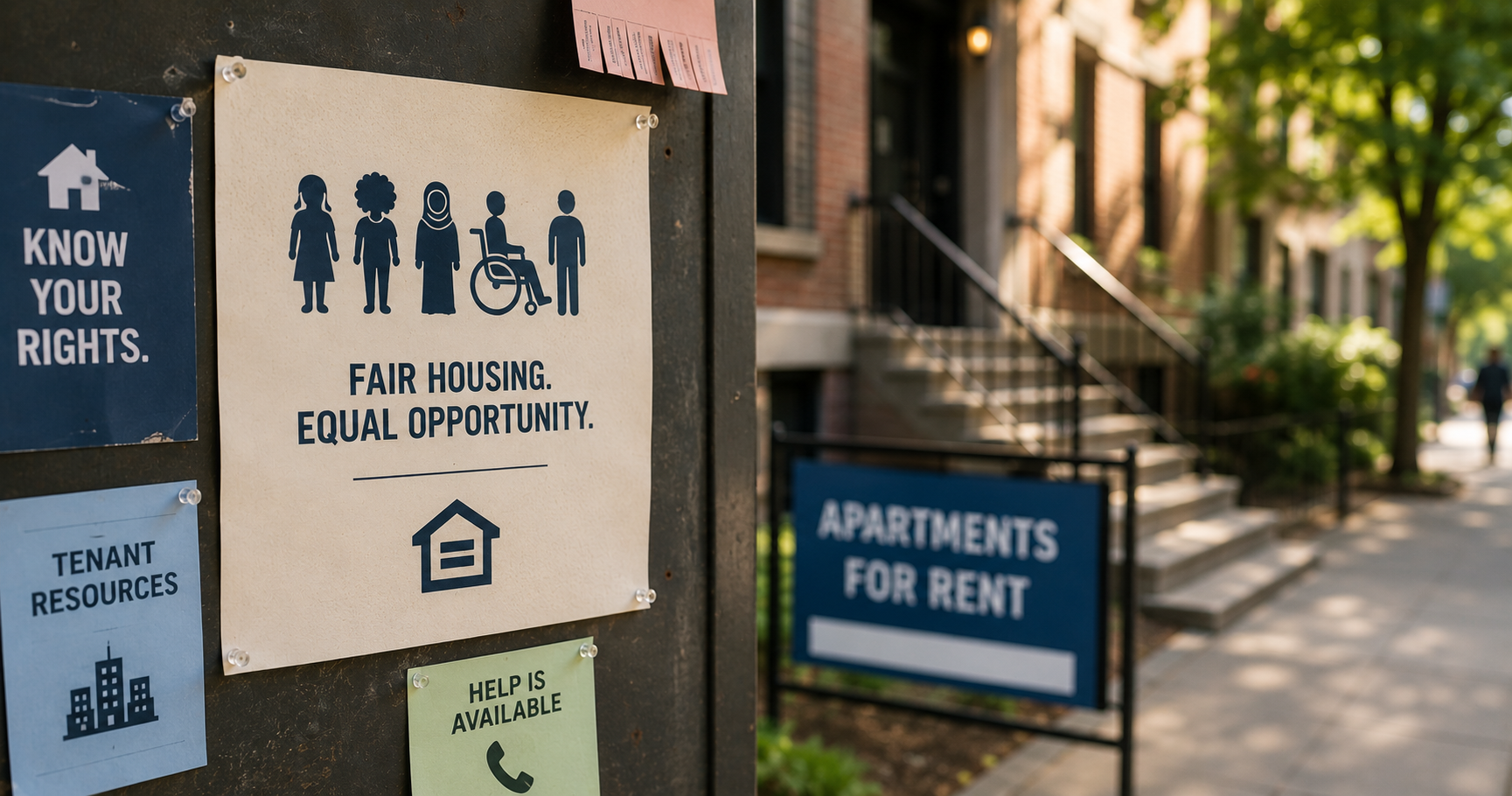
You're searching for an apartment and something happened that made you deeply uncomfortable. Maybe a landlord's tone changed dramatically when they learned your race, national origin, religion, disability, family status, or other protected characteristic. Maybe you were told the apartment was no longer available, but you saw the listing reposted days later. Maybe the landlord asked you intrusive questions about your immigration status, your family's origin, whether you have children, or your disability—questions they didn't ask other applicants. Maybe a building rejected your application without explanation while approving less-qualified applicants who looked or seemed different from you. Or maybe treatment was subtler: sudden coldness from staff, extra scrutiny of your finances, or being discouraged from pursuing an apartment through casual comments like "are you sure you'd be comfortable here?" or "I'm not sure this is the right fit for you."
You know the experience felt wrong in your gut—you felt unwelcome, treated unfairly, or judged based on something that shouldn't matter. But you've been second-guessing yourself ever since. You think: "Maybe it wasn't discrimination. Maybe I'm being too sensitive. Maybe it was just bad luck or rudeness. Who am I to claim discrimination? If I accuse someone of discrimination and I'm wrong, I'll be humiliated—people will think I'm playing the 'discrimination card,' or that I'm oversensitive, or trying to make excuses for my own application being rejected." You've talked to friends or family and some have suggested you're reading too much into it. So you downplay the experience, tell yourself "it was probably nothing," stop looking at that building, and never investigate whether what happened was actually illegal discrimination.
You move forward with your apartment search, but the experience lingers. You wonder if you should have pushed back. You worry that by not reporting it, you're letting discrimination happen unchecked. But the fear of being wrong, of being judged, of being seen as dramatic keeps you from taking action. So you absorb another housing market experience where you felt treated unfairly, and you never find out whether what happened crossed from "being treated rudely" into "illegal discrimination."
Here's the truth: If treatment in your rental search felt like discrimination based on a protected characteristic, it probably was—and the legal standard for discrimination is much lower than you imagine, not requiring proof of conscious bias or intentional targeting, but rather evidence that you were treated differently based on a protected characteristic, which subtle discrimination frequently accomplishes through apparently "neutral" reasons that actually mask protected-characteristic-based discrimination. Your instinct that something was wrong is actually reliable data—discrimination victims often sense discriminatory intent even when it's not explicitly stated, and housing discrimination agencies and courts specifically understand that discrimination often operates subtly through coded language, pretextual explanations, and differentiated treatment that would be unremarkable in isolation but reveals discriminatory pattern when examined. Naming what happened as discrimination isn't dramatic or oversensitive—it's recognizing rights violations you experienced, and testing whether your experience was actually discrimination carries no risk and potentially protects your rights and prevents future discrimination.
Let me show you exactly what housing discrimination is and why subtle discrimination counts equally to overt discrimination, how discrimination operates through apparently neutral reasons that mask protected-characteristic-based bias, what specific warning signs indicate you may have experienced illegal discrimination, why your instinct that something was wrong is reliable data about what probably happened, what to do if you suspect discrimination without fear of being wrong, and how discrimination laws actually work to protect you even from subtle, hard-to-prove discrimination.
Housing discrimination law protects against far more than explicitly hostile treatment based on protected characteristics.
Federal Fair Housing Act and New York State Human Rights Law protect against discrimination in housing on multiple bases that many tenants don't realize are legally protected.
Protected characteristics under Fair Housing Act and NY Human Rights Law include race and color, national origin, religion, disability (including physical and mental disabilities), familial status (having children or being pregnant), sex and gender identity, sexual orientation, military status (under NY law), criminal record restrictions (under NY law in limited circumstances), and domestic violence victim status (under NY law).
What's illegal is discrimination in any aspect of the rental process including whether to rent to someone, terms and conditions of rental, advertising practices, tenant selection, lease terms, management practices, and treatment during tenancy.
"Discrimination" doesn't require that landlord is consciously biased or intentionally targeting you personally. It's illegal even if landlord tells themselves they have neutral reasons. What matters legally is whether the treatment was based on a protected characteristic, whether that basis was conscious or unconscious, intentional or unintentional.
This is critical distinction: You don't need to prove discriminatory intent. You just need to show the treatment was different because of a protected characteristic. If landlord denies you housing and approves someone similarly situated from a different racial background, that's discrimination even if landlord didn't consciously think "I'm discriminating based on race." The disparate treatment based on the protected characteristic is what makes it illegal.
You might think discrimination has to be explicit ("we don't rent to families" or "no Muslims here") to be illegal. Actually, subtle discrimination is equally actionable.
Subtle discrimination operates through multiple mechanisms including pretextual reasons masking real reason (rejecting application claiming "insufficient credit" when similarly situated applicant with worse credit was approved), coded language hiding protected characteristic concerns ("not a good fit for this neighborhood," "are you sure you'd be comfortable here," "we like quiet families"), differential treatment based on protected characteristics (treating minority applicants less warmly than white applicants, more skeptical of minority applicants' finances), additional requirements or scrutiny for protected-characteristic applicants (asking only certain applicants for extra documentation, requiring higher deposits or co-signers), steering toward or away from certain buildings or neighborhoods, and friendly rejection that discourages without explicitly refusing.
All of these are illegal discrimination even though they don't involve explicit racial epithets or obvious bias. The discrimination operates through subtlety and ambiguity, which is actually how most discrimination works in practice.
Courts regularly find discrimination based on subtle factors including different application standards, differential questioning, different tone or warmth toward different applicants, pretextual reasons that don't hold up to scrutiny, and disparate impact (seemingly neutral policies that disproportionately exclude protected groups).
Your fear that subtle discrimination "doesn't count" is unfounded. Subtle discrimination counts equally and is actually the most common form of discrimination in housing.
You might fear that proving discrimination is your responsibility. Actually, burden of proof works in your favor.
Under Fair Housing Act and NY Human Rights Law, once you establish a "prima facie case" (basic factual foundation suggesting discrimination), burden shifts to landlord to explain their allegedly discriminatory action with legitimate, non-discriminatory reason.
What you need to show: You applied for housing, you were qualified (met legitimate application criteria), you were rejected or treated differently, and the rejection/treatment correlates with a protected characteristic (landlord approved non-minority applicants, or treated minority applicants differently).
Once you show this, landlord must prove their decision was based on legitimate, non-discriminatory reasons—not subjective preferences, not "feeling" about you, but actual business reasons that would apply equally to other applicants.
This burden shift is powerful protection. Landlords claiming discrimination just happened to reject all minority applicants for coincidental reasons faces uphill battle explaining away disparate treatment.
You don't need to prove landlord is racist or intentionally discriminating. You just need to show you were treated differently based on protected characteristic. Landlord then has to explain that difference through legitimate reasons.
You might think discrimination only counts if it's systematic pattern. Actually, single incident of discrimination is actionable.
Single incident of discrimination (one time you were rejected or treated unfairly based on protected characteristic) is sufficient for Fair Housing Act complaint or lawsuit. You don't need to show pattern of conduct against multiple people.
Pattern and practice cases involve systematic discrimination affecting multiple applicants, strengthening evidence and establishing more serious violations, but aren't required for complaint. Even isolated incident is illegal.
Your individual experience matters legally. You don't have to wait for pattern—if you were discriminated against once, that's actionable.
Understanding common mechanisms of discrimination helps you recognize it in your own experience.
Landlords often claim legitimate business reasons for decisions that are actually based on protected characteristics.
The pattern: Landlord rejects application citing "insufficient credit," but you later discover applicant with worse credit from different racial background was approved. The stated reason (credit) is pretextual—the real reason was the applicant's race.
Common pretexts include financial reasons (insufficient income, bad credit, not enough savings) when similarly situated applicants with worse finances are approved, unit availability claims (apartment just rented, no longer available) when unit is later relisted, tenant profile concerns (not a good fit, doesn't match building character, we're looking for a different type of person), background check issues (past eviction, criminal record) when similarly situated applicants with similar issues are approved, and neighborhood concerns (are you sure you'd be comfortable here, this is a quiet building, you might not fit in).
How to recognize pretexts: Compare your application to approved applicants—if different standards were applied, stated reason is likely pretextual. If reason given contradicts observable facts (unit claimed to be rented shows up in new listings), it's pretextual. If reason would apply to other applicants but only you were rejected for it, it's likely pretextual.
The illegality comes from the pretextual application—pretexts themselves aren't necessarily illegal, but when they mask discrimination, they're illegal.
Landlords use coded language to express concerns based on protected characteristics without explicitly stating them.
Common coded language includes "good neighborhood" or "bad neighborhood" (often racial coding), "quiet" or "peaceful" (often code for no children, no minorities), "upscale" or "professional" (often code for white, wealthy), "family-oriented" (often code for no same-sex couples), "values" or "character" (often code for religious or racial preference), "fit" or "compatibility" (often subjective code for protected characteristics), "discretionary preference" (allowing landlord to reject for unstated reasons correlated with protected characteristics), and "types" of tenants (suggesting certain categories of people aren't welcome).
These phrases aren't inherently illegal. But when used to justify differential treatment based on protected characteristics, they constitute discrimination.
Example: Landlord tells minority applicant "this is a quiet building, I'm not sure you'd be comfortable here" while telling white applicant the same apartment is "vibrant community." The coded language masks racial discrimination.
You recognize coded language instinctively—that's why something felt wrong. Your gut sense that the language was concerning is usually accurate.
Landlords sometimes treat applicants differently based on protected characteristics without even trying to hide it.
Manifestations include warmer, more helpful tone with some applicants than others, more skeptical questioning of some applicants' finances than others, extra documentation requirements for certain applicants, different application standards (higher deposits, co-signers) for different applicants, willingness to negotiate terms with some applicants but not others, differential showing behavior (rushing some applicants through, giving others detailed tours), and different follow-up (calling some applicants back, not calling others).
These different treatments reveal unconscious bias operating in decision-making. Landlord might not consciously realize they're treating people differently, but the treatment itself is discriminatory.
You notice differential treatment—if landlord was warmer with another applicant or scrutinized your finances more, you sensed that difference. Trust that observation.
Landlords sometimes discourage protected-characteristic applicants from certain buildings or steer them toward different neighborhoods.
Steering might involve discouraging minority applicants from certain buildings ("that building is very expensive, you might want to look at the building three blocks over"), encouraging families with children away from family-oriented buildings, directing same-sex couples toward specific neighborhoods, or requiring disability applicants to look at only accessible units rather than allowing choice.
The illegality is in limiting options based on protected characteristics rather than allowing applicants to choose from full range of available housing.
You experience steering when landlord suggests alternatives without you asking, seems to be pushing you away from certain options, or limits what you're shown based on characteristics not application qualifications.
Landlords sometimes reject applicants by claiming concern about applicant's comfort or fit.
The framing: "I want you to be comfortable here," "I'm not sure this is the right neighborhood for you," "Are you sure you'd be happy here?" These statements discourage without explicitly rejecting, but effectively exclude based on protected characteristics.
The implication is often that you wouldn't be welcomed, that the building or neighborhood isn't "for people like you," or that your presence would be uncomfortable—all discrimination mechanisms.
This form of discrimination is insidious because it seems friendly while accomplishing exclusion. You're not explicitly rejected; you're subtly discouraged.
Your reaction to these statements (feeling unwelcome, sensing judgment) reflects the discrimination present in them.
Specific circumstances suggest discrimination occurred and warrant investigation.
A key sign of discrimination is being treated differently from similarly situated applicants.
Warning signs: You were rejected while applicant with worse qualifications was approved, different standards were applied to you than other applicants (you were required to have co-signer, others weren't), you received less information or shorter meeting than other applicants, different application fees or requirements were charged to you, or you were asked different or more intrusive questions than other applicants.
Comparing treatment reveals discrimination. If landlord's standards or process varied based on protected characteristics, discrimination likely occurred.
How to investigate: Ask landlord what standards were applied to approval decisions, ask other applicants about their experiences (were they asked certain questions, required to provide certain documentation), check application requirements posted online versus what you were told, and note any inconsistencies between how you were treated and how others were treated.
Discrimination often reveals itself through sudden shifts in how you're treated.
Warning signs: Landlord was warm and helpful, then attitude changed when you mentioned you have children, that you use wheelchair, that your name suggests particular national origin, or that you're in same-sex couple. The dramatic shift suggests protected characteristic triggered the change.
The shift wouldn't logically be triggered by anything in the interaction except the protected characteristic. Landlord's sudden coldness after learning about family status or disability signals discrimination.
You notice this shift—it's often so obvious that you comment on it internally ("why did they suddenly get cold?"). Trust that observation.
Discrimination sometimes manifests as convenient unavailability triggered by learning protected characteristic.
Warning signs: Apartment was available when you first called, but became suddenly unavailable after visit or application, apartment is re-listed shortly after you're told it's unavailable, unit is available to certain applicants but not others, or availability status changes based on applicant characteristics.
The timing of unavailability revealing protected characteristics is the tell. If unit wasn't available to you but is available to another applicant, discrimination occurred.
How to investigate: Check listings after being told unit is unavailable, ask if unit will be available again, visit building after being rejected to see if it's still listed, and document timelines of availability claims.
Discrimination sometimes involves asking certain applicants questions or imposing requirements others don't face.
Warning signs: Landlord asked intrusive questions about your immigration status, family plans, disability details, marital status, or sexual orientation that weren't asked of other applicants, you were required to provide documentation (co-signer, extra financial proof) that wasn't required of others, you were subjected to background checks or credit checks others weren't, or screening was more stringent for you than others.
Non-neutral application processes suggest discrimination. If everyone isn't subjected to same questions and requirements, different standards reveal bias.
How to investigate: Ask landlord what questions are standard for all applicants, ask other applicants whether they were asked certain questions, request written copy of application criteria to compare to questions actually asked, and note any inconsistencies.
Discrimination against people with disabilities often involves denying reasonable accommodations.
Warning signs: Landlord refused to allow service animal claiming "no pets," refused to allow needed accessibility modifications claiming they're not allowed, made negative comments about disability or accessibility needs, charged extra for modifications, or expressed reluctance about renting to someone with disability despite qualification.
Disability discrimination often operates through denial of accommodations. If landlord won't accommodate documented disability while accommodating other tenant needs, discrimination occurred.
How to investigate: Send disability accommodation request in writing to create documentation, cite Fair Housing Act protections for reasonable accommodations, research building's history of accommodation requests, and document landlord's response.
Sometimes discrimination is explicit enough that you don't need to wonder.
Warning signs: Landlord made comments about your race, ethnicity, religion, family status, disability, sexual orientation, or national origin; landlord expressed preference for certain types of tenants; landlord made stereotypical comments about your group; or landlord asked questions specifically probing protected characteristics.
Explicit comments are strongest discrimination evidence. You don't need to question whether you misunderstood or overreacted—the comments themselves may constitute discrimination.
How to document: Write down exact language immediately, include date, time, and context, note any witnesses, and document any contemporaneous reactions (you felt unwelcome, you cried, you left the showing early).
Your gut sense that discrimination occurred is actually based on real signals you're picking up, even if subtle.
Discrimination victims often experience specific emotional responses that signal something discriminatory occurred.
Common emotional responses to discrimination include feeling unwelcome or unwanted (often from tone shifts, coded language, or explicit expressions), feeling judged for protected characteristics (often from extra scrutiny, intrusive questions, or differential treatment), feeling stereotyped (from comments or assumptions about your group), feeling dismissed or not taken seriously (from being less engaged with than other applicants), and feeling angry or violated (from recognition that you weren't treated equally).
These emotional responses aren't overreaction or oversensitivity—they're appropriate reactions to actual discrimination. Your instinct that something was wrong is detecting real discrimination.
Trust your feelings. If you felt uncomfortable, unwelcome, judged, or unfairly treated, something discriminatory likely occurred. Your emotional response is reliable data.
Your sense that something doesn't add up often reflects real logical inconsistencies in how landlord explained their decision.
You notice: Stated reason doesn't make sense given landlord's behavior toward other applicants, decision seems arbitrary or unfairly harsh, or explanation changes when you ask follow-up questions.
These inconsistencies suggest the stated reason is pretextual and discrimination is hiding underneath. Your skepticism about landlord's explanations is well-founded.
Logic detector in your brain is flagging that something doesn't make sense. Usually when something doesn't make sense, it's because you're being lied to or something is hidden—in this case, hidden discrimination.
Coded language and dog-whistle discrimination are specifically designed to communicate bias subtly—and you pick up on the subtle communication instinctively.
You recognize coded language without needing to analyze it explicitly. Phrases like "good fit," "quiet building," or "are you sure you'd be comfortable here" trigger recognition that something concerning is being said without being said directly.
This intuitive recognition is result of lifetime of experiencing social communication. You're very good at picking up on unspoken messages and subtext. When you sense coded language, you're probably right.
Your gut reaction to the coded language is reliable data. If something felt like it was expressing bias, it probably was.
Individual experiences of discrimination are never truly isolated—they reflect broader patterns of discrimination in housing market.
Housing discrimination is well-documented, pervasive, and systematic. Fair Housing Center testing consistently finds discrimination against protected groups in rental market. Your experience isn't unique—it's part of pattern other people also experience.
If you experienced discrimination, you're not crazy or oversensitive. You experienced something many others experience. Your individual experience is valid reflection of systemic discrimination.
This context helps you trust your experience. You're not the problem. The discrimination is real.
You can investigate discrimination suspicions and report if discrimination occurred, with no risk of being "wrong."
Creating detailed record of what happened is essential and costs nothing.
Document: Date and time of interaction, location (building address, which apartment shown), who you interacted with (landlord's name, building staff), what happened (conversation, showing, application process), what was said (exact language if possible, tone and demeanor), protected characteristics involved (how your protected characteristic came up in the conversation), what you were told (about availability, decision, next steps), and your emotional reaction (how the interaction made you feel).
Include: Comparison to other applicants if relevant (what happened differently with you versus others), changes in treatment (any shifts in landlord's tone or demeanor), timeline (how fast you were rejected, when unit was relisted), and any witnesses (who else was present or heard statements).
This documentation creates record of your experience. You're not trying to prove discrimination yet—you're just documenting what happened.
Research what Fair Housing Act and NY Human Rights Law actually protect against.
Review: Federal Fair Housing Act protections and what discrimination looks like, NYC Human Rights Law specific protections, examples of housing discrimination cases and what courts found discriminatory, and what housing agencies consider discrimination.
Resources: LawHelpNY.org, Fair Housing Center websites, NYC Commission on Human Rights, and NY State Division of Human Rights websites all provide information about housing discrimination.
This research helps you understand whether your experience falls into protected categories. You're educating yourself about your rights.
You can speak with fair housing agencies or advocates about your experience without committing to anything.
Organizations that investigate housing discrimination: NYC Commission on Human Rights (call 311 in NYC or (212) 416-0197), NY State Division of Human Rights (1-888-393-7220), or federal Fair Housing Center (contact information available through HUD website).
Legal organizations: Legal Aid, Legal Services, or tenant advocacy organizations provide free legal advice about discrimination.
Initial consultation is free and informational. You're not filing a complaint just by calling—you're asking whether your experience constitutes discrimination and what your options are.
No risk: If you call and describe your experience, fair housing agency will tell you whether it potentially constitutes discrimination. If you're uncertain whether something was discrimination, they can help you assess.
If you and fair housing agency determine discrimination likely occurred, you can file complaint.
Complaint process: File with NYC Commission on Human Rights (if in NYC), NY State Division of Human Rights (anywhere in NY), or HUD (federal complaint), all free to file, all investigate complaints, and all have power to take action if discrimination found.
No downside to filing: You're not risking anything by filing—you're putting discrimination on record, triggering investigation, and potentially preventing future discrimination.
Investigation is free: Fair housing agencies do investigation. You don't have to prove discrimination—agency investigates and makes determination.
Remedy if discrimination found: Landlord can be forced to rent to you, pay damages for harm, pay civil penalties, train staff on fair housing, and change practices preventing future discrimination.
If you file discrimination complaint or report suspected discrimination, landlord cannot retaliate.
Retaliation protections under Fair Housing Act make it illegal for landlord to retaliate against you for complaining about discrimination, participating in investigation, or opposing discriminatory practice.
You cannot be evicted, charged different rent, given worse service, or treated differently in retaliation for reporting discrimination.
If retaliation occurs, that itself is illegal and you have additional claims against landlord.
This protection means you can report discrimination without fear of landlord punishment.
If it felt like discrimination, it probably was—your instinct that something was wrong is reliable data based on real signals you're detecting about discriminatory treatment.
Housing discrimination doesn't require explicit bias or conscious prejudice. It's illegal even when subtle, operates through coded language and pretextual reasons, and includes single incidents not just patterns. The legal standard is whether you were treated differently based on a protected characteristic.
Subtle discrimination is most common form of discrimination in housing market: Pretextual reasons masking protected-characteristic bias, coded language hiding concerns, differential treatment based on protected characteristics, steering toward or away from certain buildings, and rejection framed as concern for your comfort are all legal discrimination.
Warning signs you may have experienced discrimination: You were treated differently from similarly situated applicants. Landlord's tone changed after learning about protected characteristic. Unit suddenly became unavailable after protected characteristic revealed. You received different questions or requirements than other applicants. Landlord refused disability accommodations. Explicit discriminatory comments were made.
Your emotional response to discrimination is reliable: Feeling unwelcome, judged, stereotyped, dismissed, or violated are appropriate reactions to actual discrimination. Your gut sense that something didn't make sense reflects real logical inconsistencies in landlord's explanations. You detect coded language instinctively through lifetime of experiencing social communication. Your individual experience reflects broader patterns of housing discrimination.
You can investigate without committing to anything: Document your experience thoroughly. Research Fair Housing Act protections. Contact fair housing agencies or legal organizations for free consultation about whether experience constitutes discrimination. No obligation in initial consultation.
Filing discrimination complaint carries no risk: Fair housing agencies investigate for free. You're protected from retaliation if you report. Complaint puts discrimination on record. If discrimination found, landlord can be forced to rent to you, pay damages, and change practices. Filing complaint doesn't lock you into anything.
Fear of being "wrong" shouldn't prevent you from investigating: If discrimination occurred, reporting protects your rights and prevents future discrimination. If something wasn't discrimination, fair housing agencies will advise you. Nothing bad happens from consulting about your experience. Fear of being wrong is keeping you from protecting yourself.
Trust your experience: You're not oversensitive. You're not overreacting. You're not playing the "discrimination card." You're recognizing treatment that was unfair, likely illegal, and rooted in bias against protected characteristic. Your experience matters legally even if subtle.
Name what happened as discrimination: Calling unfair treatment "discrimination" isn't dramatic—it's accurate naming of what probably occurred. You have right to live in housing free from discrimination based on protected characteristics. If discrimination occurred, you have legal remedies and protections.
Take action today: Document your experience. Research fair housing protections. Call fair housing agency or legal organization for free consultation. Start conversation about whether what happened was discrimination. Protecting your housing rights is too important to let fear silence you.