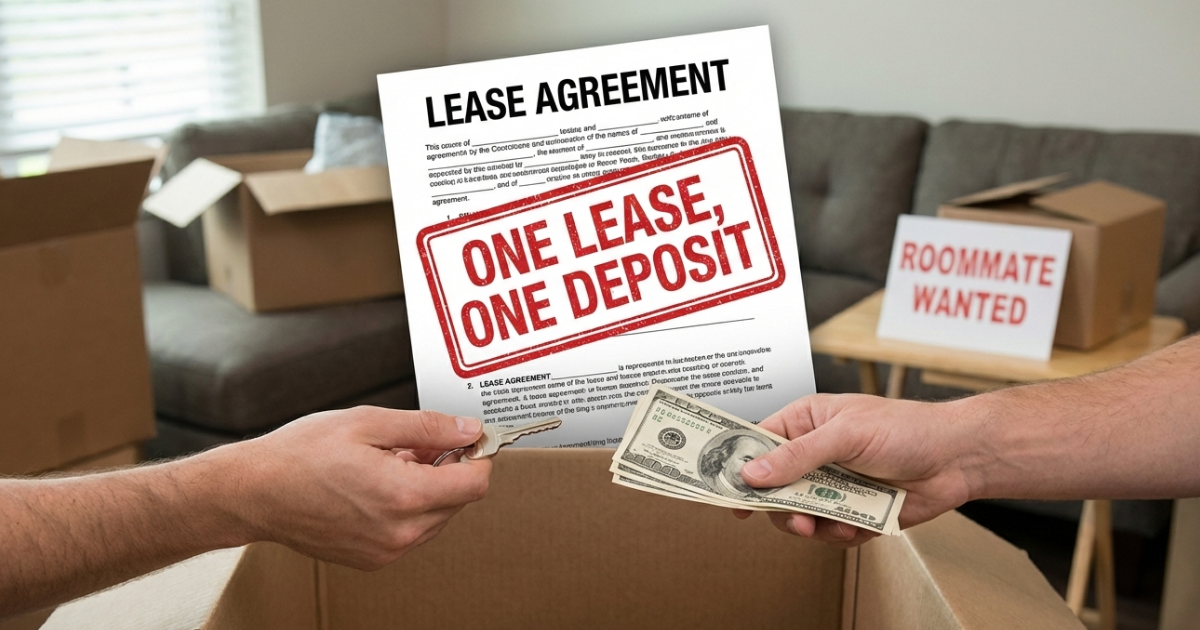
When you move out but your roommate stays, your landlord treats the security deposit like one big pot attached to the lease—not individual accounts for each person. That means getting your deposit money back becomes a roommate problem, not a landlord problem, and most people don't realize that until they're already gone and their former roommate stops responding to texts.
Here's how security deposits actually work when roommates split up in New York, and how to make sure you get your money back instead of funding someone else's rent.
The security deposit legally belongs to "the tenant" named on the lease. When multiple people sign as cotenants, you're all collectively "the tenant" in the eyes of the law. That's why landlords don't track who paid what portion—they just hold one lump sum tied to one lease.
New York landlords have one legal obligation with security deposits: return the full amount (or send an itemized deduction list and the balance) within 14 days after the tenancy ends and possession is surrendered. "Tenancy ends" means everyone moves out and returns the keys, not when one person decides they're done.
If your name stays on the lease even after you move out, or if your roommate's name stays on after they leave, the landlord can legally hold the entire deposit until the lease actually terminates. They're not required to calculate shares, mail checks to departed roommates, or get involved in your internal arrangements.
This catches people off guard. You assume that because you paid $1,200 toward a $2,400 deposit, you'll get $1,200 back when you leave. Your landlord assumes they're holding $2,400 against a lease that's still active, with at least one person still living there.
The landlord isn't being difficult—they're just treating the deposit exactly how the law allows them to treat it.
In practice, when one roommate moves out mid-lease, the money flows between roommates:
The remaining roommate pays you back. They keep living there, benefiting from the deposit coverage, so they reimburse your portion. When the lease eventually ends, they get the full deposit back from the landlord (assuming no damages) and keep the whole amount since they already paid you.
The incoming replacement roommate pays you directly. The new person moving in gives you cash for your share of the deposit. They're essentially buying your position. When the lease ends, they get "their" portion back as part of the total deposit returned to whoever's still on the lease.
The landlord releases you and takes a new deposit (rare). If your landlord agrees to formally remove you from the lease and accepts a new deposit from your replacement, they might refund your portion directly. This requires landlord cooperation and usually only happens when you're getting properly removed from the lease, not just moving out while staying liable.
That third option is the cleanest, but it's also the rarest because it requires your landlord to do extra paperwork they're not legally required to do.
Once all tenants move out and surrender possession by returning keys, the 14-day clock starts. Within 14 days, the landlord must either return the entire security deposit or send an itemized statement of deductions with the remaining balance.
If they miss that deadline—no itemized list, no refund—they forfeit the right to keep any of the money under New York General Obligations Law § 7-108. The full deposit is owed back, period.
At that point, any argument over "who gets what share" happens between the former roommates. If you paid half the deposit but your former roommate's name was the only one the landlord refunded it to, you sue your roommate, not the landlord.
The landlord's legal duty is fulfilled once they return the money to the lease-holders within 14 days. What happens after that is your problem to sort out.
Don't just move out assuming everyone will handle this fairly later. Get it in writing now, while you still have leverage.
Create a written agreement with your remaining roommate and, ideally, the landlord. It should state:
Document the apartment's condition on your move-out day. Take photos and videos of your room and all common areas. If damages show up later and your former roommate tries to blame you, you need proof the place was fine when you left.
Get your money before you leave. If the remaining roommate says they'll "pay you once the new person moves in," get that in writing with a specific deadline. If the incoming roommate is supposed to pay you directly, collect before you hand over keys or give them access.
The roommate who controls the apartment has all the leverage after you're gone. Don't give up your leverage (your presence, your keys, your cooperation) before you get paid.
If your former roommate collects a deposit from the replacement tenant but refuses to pay you your share, or if they get the full deposit back from the landlord at lease-end and won't split it, you sue them in small claims court.
Bring your evidence: proof you paid your portion of the original deposit (canceled check, Venmo receipt, bank statement), the lease showing you were both tenants, any written agreements about the deposit, and text messages or emails showing the arrangements you made.
New York small claims court caps at $10,000 for individuals ($5,000 for commercial claims). Most security deposit disputes fall well under that limit, and you don't need a lawyer. Filing fees are typically $15-$30 depending on the amount you're claiming.
Your former roommate benefited from either the replacement tenant's deposit money or from having the full deposit returned to them. The court will see this clearly when you present your payment proof and their refusal to pay you back.
Most people think security deposits work like bank accounts—separate contributions that can be withdrawn individually when each person leaves. That makes intuitive sense, but it's not how the law treats joint tenancies.
The law sees one lease, one deposit, one ending date. Everything between roommates about who paid what and who gets what back is a private arrangement, not a legal obligation the landlord has to track or enforce.
Once you understand that your landlord has zero legal duty to give you "your portion" when you move out mid-lease, the rest makes sense. You're not getting screwed—you just need to set up the right agreements with the people who will have access to that deposit money later.
Find out if you have a case in 30 seconds →