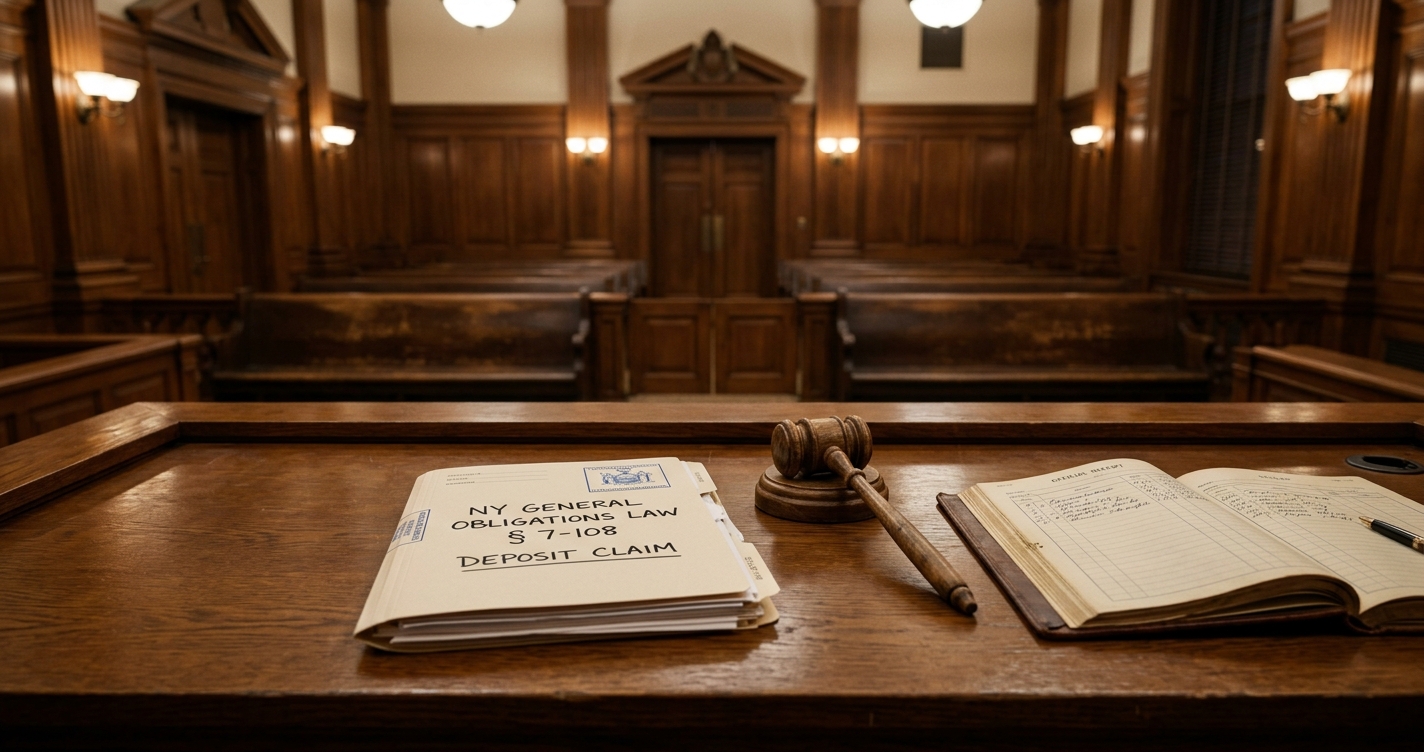
When a tenancy ends, the conversation about the security deposit often happens over the phone. The landlord calls, runs through a list of reasons the deposit is short—a cleaning charge here, a repair there—and the tenant, caught off guard, either accepts the explanation or walks away frustrated. For years, that phone call has felt like the landlord doing the right thing: reaching out, explaining, being transparent. But a New York court has now made something clear that many tenants—and plenty of landlords—did not fully understand. Telling a tenant why money was kept is not the same as providing the written itemization the law requires. And when a landlord relies on a phone call instead of something in writing, the consequence is not a reduced deduction. It is the loss of the right to keep any of the deposit at all.
That is the lesson of Bogom-Shanon v. Altman, 2025 NY Slip Op 25279, a 2025 small claims decision from the Civil Court of the City of New York, New York County. The case is modest in its dollar figures—a $1,600 deposit share—but significant in what it confirms about how New York's security deposit law actually works. A tenant represented himself. The landlord was an attorney. And the court held that because the landlord had explained his deductions only by telephone, rather than in a written statement, he had forfeited his right to retain any portion of the deposit. On top of that, the court found the violation willful and added punitive damages, bringing the total the landlord owed to $2,400 plus interest and costs.
If you are a tenant in New York trying to understand why your deposit was withheld, or whether a verbal explanation from your landlord counts as the "itemization" the law talks about, this guide walks through the rules the court applied, what they mean in plain terms, and how you can use them to protect your own money. The short version is this: in New York, written is what counts. But the longer version is worth understanding, because the details determine whether you get your deposit back, whether you can ask for more, and how to go about it.
New York's General Obligations Law § 7-108 governs what a landlord must do with a security deposit at the end of a tenancy. The statute sets a clock and a format. Within fourteen days after a tenant moves out, the landlord must return the deposit, and if the landlord intends to keep any part of it, the landlord must provide the tenant with an itemized statement indicating the basis for the amount retained. Miss the fourteen-day window, and the landlord forfeits the right to retain any portion of the deposit. This is not a penalty the tenant has to argue for. It is automatic, built into the statute.
For years, the open question in some tenants' and landlords' minds was what an "itemized statement" actually had to look like. Does it have to be a formal letter? Could it be an email? A text message? And—the question at the heart of Bogom-Shanon—could a landlord satisfy it by simply calling the tenant and running through the deductions out loud?
The court in Bogom-Shanon answered that last question directly. A telephone call does not satisfy the itemization requirement. The statute, the court reasoned, impliedly requires a written statement. The whole point of an itemized statement is to give the tenant a durable, reviewable record of exactly what was charged and why—something the tenant can read, keep, dispute line by line, and bring to court if necessary. A phone call leaves none of that. It vanishes the moment it ends, leaving the tenant with, at best, a vague memory of what was said and the landlord with nothing to be held to.
Importantly, the court was not demanding a particular formal document. It recognized that the writing could come "by letter, email, text, or any other written means." The landlord did not need a lawyer to draft something elaborate. A text message listing the deductions would have sufficed. What mattered was that there be something in writing. Because the landlord in this case had called the tenant and explained the deductions only verbally, he had failed to provide the itemized statement the statute requires—and under § 7-108, that failure meant he forfeited the right to keep any of the deposit.
This is the piece that surprises people. The landlord did not ignore the tenant. He did not go silent for weeks and then invent charges. He actually reached out within the required period and told the tenant, in his own words, why he was keeping the money. In a casual sense, he "itemized." But the law treats a verbal itemization as no itemization at all, because the law's protection depends on the tenant having a written record. Doing part of the right thing—contacting the tenant, explaining the reasons—does not substitute for doing the thing the statute actually requires.
To understand why the court drew such a firm line, it helps to understand what the itemized-statement requirement is for. The security deposit rules in New York were tightened significantly by the Housing Stability and Tenant Protection Act of 2019, and the itemization requirement is one of the central reforms. Before those changes, a tenant whose deposit was withheld often had little recourse short of a lawsuit, and little information to build that lawsuit on. The reforms shifted the balance by forcing landlords to put their reasoning on the record, quickly, and in a form the tenant can use.
A written itemized statement does several things at once. It tells the tenant precisely what the landlord is charging for—not "damages" in the abstract, but specific items: a replaced carpet, a repainted wall, a cleaning service, an unpaid utility. It creates a record the tenant can check against the actual condition of the apartment when they left, against photographs they took, against the move-in condition. It gives the tenant a basis to dispute specific charges rather than having to challenge a vague, unexplained total. And crucially, it preserves all of this in a form that survives the moment—something a judge can read months later in a small claims courtroom.
A phone call accomplishes none of that reliably. Two people can hang up from the same conversation with entirely different understandings of what was said. The tenant may remember being told "some cleaning and a little paint"; the landlord may insist he listed six separate charges totaling the full deposit. There is no way for a court to resolve that. The written-itemization rule eliminates the problem by requiring the landlord to commit the charges to a form that cannot later be reconstructed from memory in whatever shape is convenient.
The court's recognition that an email or text message would be enough is worth dwelling on, because it defeats the most common objection to the rule—that it is some kind of technicality designed to trap honest landlords. It is not. The bar is extraordinarily low. A landlord who genuinely wants to keep part of a deposit for legitimate reasons need only type those reasons into a text message and hit send. That takes a few minutes. The landlord in Bogom-Shanon had the tenant's phone number—he called it. He could have texted the same information. The reason the rule has teeth is precisely that it is so easy to comply with: if even a text would have satisfied the statute, then a landlord who provides nothing in writing has made a choice, not an innocent mistake.
For a tenant, the practical takeaway is to notice what form your landlord's explanation took. If your landlord called you and talked you through the deductions but never sent anything—no letter, no email, no text—then as a matter of law, you may not have received the itemized statement you were entitled to. That is not a small distinction. Under § 7-108, a landlord who fails to provide the required written itemization within fourteen days forfeits the right to retain any part of the deposit, regardless of whether some of the charges might have been justified. The landlord's reasons do not get evaluated on their merits at that point, because the landlord never put them in the form the law requires.
The word "forfeit" carries real weight here, and it is worth being precise about it, because tenants sometimes assume the fourteen-day rule just means the landlord has to hurry, or that a late or improper itemization simply opens the door to a negotiation. That is not how the statute operates.
When a landlord fails to provide a proper written itemization within the fourteen-day period, the landlord loses the right to keep any of the deposit. This is sometimes described as a strict-liability consequence, because it does not depend on the landlord's good faith, the reasonableness of the underlying charges, or whether the apartment really did need cleaning or repair. The question a court asks is not "were these deductions fair?" The question is "did the landlord comply with the itemization requirement?" If the answer is no, the deductions do not get a hearing on their merits. The deposit goes back to the tenant.
This is exactly what happened in Bogom-Shanon. The court did not weigh whether the landlord's reasons for the deductions were good ones. It did not take evidence on the condition of the apartment or decide whether a cleaning charge was warranted. It did not have to. Once the court determined that the landlord had provided only a verbal explanation and nothing in writing, the landlord's right to keep any portion of the deposit was gone. The full deposit share—$1,600—was owed back to the tenant.
For tenants, this is one of the most powerful features of New York's deposit law, and one of the most under-understood. You do not necessarily have to prove that your apartment was clean, or that the charges against you were unfair, to recover your deposit. If the landlord failed to follow the written-itemization procedure, the merits of the charges may never come into play. That does not mean condition and documentation are irrelevant—they matter a great deal in cases where the landlord did provide a proper written statement and the dispute is about whether the charges are justified. But where the landlord skipped the written statement entirely, the procedural failure can be decisive on its own.
One question that often comes up when a tenancy does not look like a standard one-year lease is whether these protections apply at all. Tenants in month-to-month arrangements sometimes assume that because they do not have a long written lease, or because their tenancy "rolled over" informally, they have fewer rights to their deposit. That assumption is mistaken, and Bogom-Shanon is a useful illustration of why.
New York's security deposit protections under General Obligations Law § 7-108 are not limited to tenants holding long-term written leases. They apply to residential tenancies broadly, including month-to-month arrangements. A month-to-month tenant who paid a security deposit is entitled to the same fourteen-day return window, the same written-itemization requirement, and the same forfeiture consequence when a landlord fails to comply. The form of the tenancy—whether it is a fixed one-year lease, a renewal, or a month-to-month arrangement that continued after an original lease expired—does not change the fundamental deposit rules.
This matters because month-to-month tenancies are extremely common, and they frequently arise precisely in the situations where deposit disputes happen. A tenant signs a one-year lease, the year ends, and rather than signing a new lease, the tenant simply stays and keeps paying rent each month. Under New York law, that continued occupancy with the landlord's acceptance of rent generally creates a month-to-month tenancy. When that arrangement eventually ends, the tenant may wrongly assume that the informality of the arrangement means the deposit rules are looser. They are not. The deposit the tenant paid at the start remains subject to the full statutory protections.
The same is true of the itemization requirement specifically. A landlord cannot treat a month-to-month tenant's deposit more casually than a lease tenant's. The written statement is required in both cases. A landlord who returns a month-to-month tenant's deposit short, with only a phone call by way of explanation, has the same problem the landlord in Bogom-Shanon had—regardless of whether the tenancy was governed by a signed lease or had quietly become month-to-month over time.
For a tenant, the practical point is not to let the informality of your tenancy talk you out of your rights. If you paid a security deposit, you are entitled to its return under the statutory rules, and the landlord is bound by the written-itemization requirement, whatever the shape of your tenancy. The absence of a current written lease does not weaken your deposit claim.
Returning the deposit was only part of what the court ordered in Bogom-Shanon. The landlord was also made to pay punitive damages—an additional sum on top of the deposit itself. Understanding when and why that happens is important, because it is a point where tenants both under-claim (not realizing extra damages are available) and over-expect (assuming they are automatic whenever a deposit is wrongly withheld). Neither extreme is right.
General Obligations Law § 7-108 provides that where a landlord's violation of the deposit rules is willful, the tenant may recover punitive damages of up to twice the amount of the deposit. The key word is "willful." Punitive damages are not triggered simply because a landlord kept money they should not have, or failed to return a deposit on time. The statute reserves the extra penalty for conduct that reflects something more than an ordinary failure—a knowing or deliberate disregard of the landlord's obligations.
This distinction matters because it means the mere fact of withholding does not, by itself, open the door to double damages. A landlord who makes a genuine, good-faith mistake about the rules—who returns a deposit a few days late, or who misunderstands what the itemization has to look like—might owe the deposit back without owing punitive damages, if the court concludes the violation was not willful. The tenant who assumes that any wrongly withheld deposit automatically comes with a two-times penalty is likely to be disappointed. Willfulness has to be established.
In Bogom-Shanon, the court found the violation willful, and the reasoning is instructive. The landlord was himself an attorney—someone who, the court reasoned, should have known what the law required. And there had been unreasonable delay in resolving the matter, which the court found particularly telling given that the landlord had retained counsel. A landlord who is a lawyer, or who hires one, and who nonetheless fails to comply with a straightforward written-itemization requirement and drags the dispute out, is not making an innocent mistake in the court's view. That combination—knowledge that should have informed better conduct, plus unreasonable delay—supported the finding of willfulness.
But the court also did something that tenants should pay attention to: it declined to award the maximum punitive damages. The statute would have allowed up to twice the deposit—here, $3,200 on top of the $1,600 returned. The court awarded half that amount, $800, bringing the punitive piece to one-half of the deposit rather than the full two-times multiplier. The court's reasoning was that a landlord who did contact the tenant and explain the deductions, even if only orally, is "perhaps not as morally culpable" as a landlord who never explains anything at all—who simply pockets the deposit and goes silent. The verbal explanation did not save the landlord from forfeiture, and it did not save him from a willfulness finding, but it did factor into how much punitive damage the court imposed.
The total, then, came to $2,400—the $1,600 deposit share returned, plus $800 in punitive damages—along with interest, costs, and disbursements.
There are two lessons in this for tenants. The first is that punitive damages are real and worth asking for when the facts support willfulness; a tenant who recovers only the bare deposit when the landlord's conduct was willful may be leaving money on the table. The second is that the amount is within the court's discretion up to the statutory cap, and courts will calibrate it to the landlord's actual conduct. A landlord who willfully violated the rules but made some effort to communicate may face a smaller penalty than one who showed complete disregard. Knowing this helps a tenant set realistic expectations and frame a claim honestly: you can and often should ask for punitive damages, but you build the case by showing the landlord's conduct was willful, not by assuming the maximum will follow automatically.
A detail of Bogom-Shanon that is easy to overlook, but genuinely useful for a large number of tenants, is that the tenant who sued was recovering his own share of a deposit he had paid together with a former roommate. He did not sue for the whole deposit the landlord held. He sued for his portion of it—$1,600—and the former roommate's separate share was not part of the case.
This matters because so many New York tenancies are shared. Two, three, or four people split an apartment, and the security deposit is pooled—each contributing a portion at move-in. When the tenancy ends, roommates often go their separate ways on different timelines and different terms. One may stay; others leave. One may be in close contact with the landlord; another may have moved out of state. A dispute over the deposit can leave an individual roommate wondering whether they can do anything about their own money when they no longer have the cooperation—or even the current contact information—of the people they once lived with.
Bogom-Shanon illustrates that an individual roommate's share can be the subject of their own claim. The tenant here pursued his own portion of the deposit, on his own, as a self-represented litigant in small claims court, without needing to assemble all the former roommates into a single lawsuit. His claim stood on his own contribution and his own right to its return under the deposit statute.
There is an additional wrinkle worth mentioning, because it comes from the same litigation. A companion decision in the same matter, from 2024, established that a former tenant could bring a deposit claim in small claims court—that the court had jurisdiction even though the person was no longer living in the apartment. The small claims statute allows claims by someone who "is or was a tenant," which means moving out does not close the door on recovering your deposit. You do not have to still be living there to sue for the deposit you paid.
For tenants in shared apartments, the practical guidance is encouraging. If you contributed to a security deposit and your share was not properly returned, you can generally pursue your own portion without being held hostage to your former roommates' availability or willingness to join you. You bring the claim for what you put in and what you are owed. This does not mean the mechanics are always simple—if the landlord held one undifferentiated deposit and returned part of it, there can be questions about how the shares break down and who received what—but the core principle is that your individual stake in a pooled deposit is something you can assert on your own behalf.
It helps to translate the legal rules into the kind of situation a tenant actually lives through, because the gap between "the statute says" and "what do I do on a Tuesday afternoon" is where a lot of people get stuck.
Imagine you and a roommate rented an apartment and each put $1,600 toward a $3,200 security deposit. Your lease ran a year, then quietly became month-to-month when you both stayed on without signing anything new. Eventually you move out. A week or so later, your landlord calls. He is polite. He explains that there was some cleaning to do, a wall that needed repainting, and a couple of other things, and that he is keeping the deposit to cover it. You are annoyed but not sure what to make of it. The conversation ends. Nothing arrives in writing—no email, no text, no letter. Weeks pass. The money never comes back.
Under the rules the court applied in Bogom-Shanon, several things are true about your situation. First, the fact that your tenancy had become month-to-month does not weaken your deposit rights; the full protections of § 7-108 still apply. Second, the landlord's phone call—however courteous and detailed—was not the itemized statement the law requires, because it was not in writing. Third, because the landlord failed to provide a proper written itemization within fourteen days, he may have forfeited the right to retain any portion of the deposit, regardless of whether the apartment genuinely needed cleaning or paint. Fourth, you can pursue your own $1,600 share without having to track down and involve your former roommate. And fifth, if the landlord's conduct is willful—if, say, he knew better, or he dragged the matter out unreasonably—you may be able to recover punitive damages on top of the returned deposit, though the amount is up to the court and will reflect how badly the landlord behaved.
What you would actually do with all of that is straightforward in outline. You would gather what you have: your lease or proof of the tenancy, proof of what you paid toward the deposit, any record of the landlord's communications (or the absence of them), and documentation of the apartment's condition when you left if you have it. You would send the landlord a written demand for the return of your deposit share, in writing, so that your own request is on the record and so the landlord has a clear opportunity to pay. And if that does not produce your money, you would consider small claims court, where a self-represented tenant—exactly like the claimant in Bogom-Shanon—can bring a deposit claim without a lawyer.
The reason this hypothetical maps so closely onto the actual case is that the actual case is this hypothetical, more or less. A tenant who split a deposit with a roommate, whose tenancy was not a tidy fixed lease, whose landlord explained deductions only by phone, went to small claims court on his own and recovered his full share plus punitive damages. The facts are ordinary. That is what makes the decision useful. It is not an exotic situation reserved for sophisticated litigants; it is the kind of thing that happens to renters constantly.
Knowing that the law is on your side is one thing; putting it to work is another. Here is how to move from understanding the rules to actually recovering your money.
Start by figuring out, as precisely as you can, what form your landlord's explanation took and when it came. The two questions that matter most are: Did the landlord provide anything in writing? and Did it come within fourteen days of your move-out? If the landlord returned your deposit short but never sent a written itemization—if all you got was a phone call, or nothing at all—then the forfeiture rule may be squarely in play. If the landlord did send something in writing but you believe the charges are unjustified, that is a different kind of case, one that will turn more on the condition of the apartment and your documentation. Both are winnable, but they are built differently, so it helps to know which one you have.
Gather your documentation. This includes your lease or other proof of the tenancy and its terms; proof of the deposit amount you paid and your individual share if it was pooled with roommates; any written communications from the landlord, including the absence of a written itemization (you can establish a negative—that nothing in writing ever arrived); photographs or video of the apartment's condition when you moved out, and at move-in if you have them; and a record of the dates, especially your move-out date, which starts the fourteen-day clock.
Send a written demand. Before going to court, put your request in writing to the landlord: state that you are owed the return of your deposit (or your share of it), note the amount, and ask for it by a specific date. Keep a copy. This does two things—it gives the landlord a clear chance to pay without litigation, and it strengthens your position if you do end up in court, because you have shown you asked properly and gave the landlord an opportunity to make things right.
Consider small claims court. New York City's small claims courts are designed for exactly this kind of dispute. They are meant to be navigable without a lawyer, the filing fees are low, and the Bogom-Shanon claimant's experience shows that a self-represented tenant can prevail. Small claims jurisdiction extends to someone who "is or was a tenant," so having moved out does not bar your claim. If your deposit share and any punitive damages fit within the small claims dollar limit, this is often the most practical path.
When you frame your claim, be clear and honest about what you are asking for. Ask for the return of your deposit share based on the landlord's failure to provide a proper written itemization within the fourteen-day window, if that is what happened. If the landlord's conduct was willful, ask for punitive damages as well—but understand that you will need to show willfulness, not merely that money was withheld, and that the amount is within the court's discretion up to twice the deposit. Setting out your request accurately, with the facts that support each piece of it, is far more persuasive than demanding a maximum penalty you cannot justify.
Finally, know when to get advice. Small claims court is built for self-represented tenants, and many deposit cases are well within reach without a lawyer. But if your situation is complicated—if the deposit was large, if there are disputes about how a pooled deposit should be divided, if the landlord is claiming substantial damage and has written documentation, or if your case involves issues beyond the deposit—it is worth talking to a tenant attorney or a local tenant-rights organization. Many offer free or low-cost consultations, and legal aid organizations across New York assist tenants with exactly these questions. Getting an informed read on your specific facts, especially before you take any step that could affect your position, is almost always worth it.
Several beliefs that sound reasonable keep tenants from recovering money they are owed. Each one is worth correcting directly, because the gap between what people assume and what the law provides is exactly where deposits get lost.
The first misconception is that an explanation is an itemization. As Bogom-Shanon makes clear, it is not—unless the explanation is in writing. A landlord can be entirely forthcoming on the phone, walk you through every charge, and still have failed to meet the statutory requirement. Tenants hear a thorough verbal account and conclude the landlord did everything right, so there must be nothing to contest. The opposite can be true: a landlord who explained everything out loud but put nothing in writing may have forfeited the right to keep any of the deposit. Do not let a courteous phone call persuade you that your rights were satisfied.
The second misconception is that you have to prove the apartment was spotless to get your deposit back. In many cases you do not. Where the landlord failed to provide a proper written itemization within fourteen days, the condition of the apartment may never become the issue, because the landlord forfeited the right to withhold before the question of damage could even be reached. The condition of the unit matters enormously in disputes where the landlord did itemize properly and the fight is over whether the charges are fair. But it is not a threshold you always have to clear. A tenant who assumes they cannot win because the apartment was less than perfect may be giving up a claim that turns entirely on the landlord's procedural failure, not on the state of the carpet.
The third misconception is that moving out ends your rights. It does not. The deposit statute protects your money after you leave, and small claims jurisdiction reaches someone who "is or was a tenant." You can pursue your deposit from a new address, a new city, or a new state. The clock that matters is the fourteen-day window after move-out for the landlord to return the deposit and itemize—not any deadline on your ability to sue. (There are general time limits on bringing any lawsuit, so you should not sit on a claim indefinitely, but moving out does not, by itself, close the door.)
The fourth misconception is that a pooled deposit is all-or-nothing—that you cannot do anything about your share unless all the roommates act together. Bogom-Shanon shows otherwise. The claimant pursued his individual portion on his own. If you contributed to a shared deposit, your contribution is your stake, and you can generally assert it without rounding up everyone you used to live with. This is a relief for the common situation where former roommates have scattered and lost touch.
The fifth misconception is that punitive damages are automatic—or, at the other extreme, that they are out of reach for an ordinary tenant. Neither is right. Punitive damages of up to twice the deposit are available only where the landlord's violation was willful, so they are not automatic on any wrongful withholding. But they are genuinely available, and a self-represented tenant can obtain them, as the claimant in Bogom-Shanon did. The honest middle position is the useful one: ask for punitive damages when the facts show willfulness, build the case for willfulness deliberately, and understand that the amount rests in the court's discretion up to the statutory cap.
The sixth misconception is that because the landlord is a lawyer, or has hired one, you are outmatched. If anything, Bogom-Shanon cuts the other way. The landlord in that case was an attorney, and the court treated his professional knowledge as a reason to find his violation willful—someone who should have known the rules and failed to follow them anyway. A tenant should not be intimidated out of a valid claim by the other side's legal credentials. The rules are the rules, and a self-represented tenant who knows them can hold a lawyer-landlord to them.
Much of what determines whether a tenant recovers a deposit is decided long before any dispute—in the ordinary habits of documentation during and at the end of a tenancy. A tenant who builds a record as they go is in a far stronger position than one who tries to reconstruct everything after a disagreement erupts.
At move-in, document the condition of the apartment thoroughly. Photographs and video, time-stamped, of every room, with particular attention to anything already worn, stained, or damaged, create a baseline that protects you against charges for pre-existing conditions. Keep any move-in inspection checklist you were given, and if the landlord offers a walkthrough, take it. New York law gives many tenants the right to request an inspection before move-out as well, specifically so that problems can be identified and addressed while you still have the chance to fix them—using that right, where it applies, can head off a dispute entirely.
Throughout the tenancy, keep records of what you paid and when, including the original deposit. Keep your lease and any renewals, and if your tenancy becomes month-to-month, keep the rent records that show the arrangement continued. If repairs were needed and you reported them, keep those communications, because the condition of the apartment at the end is more defensible when there is a record of how it was maintained throughout.
At move-out, document the apartment's condition again, as carefully as you did at move-in. The comparison between move-in and move-out photos is often the single most persuasive piece of evidence in a deposit dispute, because it shows a court exactly what changed—and, just as importantly, what did not. Note your move-out date precisely, since it starts the fourteen-day clock. Return keys in a way you can prove, and if possible, confirm your forwarding address with the landlord in writing, so there is no excuse for failing to send you the deposit and any itemization.
After move-out, watch the calendar and watch your mail and messages. If fourteen days pass with no deposit and no written itemization, that absence is itself significant, and you should note it. If the landlord sends a written itemization, read it line by line against your own documentation and decide which charges, if any, you genuinely dispute. If the landlord calls instead of writing, recognize that for what it is—and consider asking, politely, for the itemization in writing, which both preserves your rights and gives the landlord a chance to comply.
None of this requires special expertise. It requires a phone with a camera and the habit of keeping a few documents. But the difference it makes is substantial. The tenant in Bogom-Shanon prevailed in part because the facts were clean and provable: the landlord's failure to put anything in writing was not something that had to be inferred from a murky record. The more your own situation is documented, the more your case looks like that one—clear, provable, and hard for a landlord to talk around.
It is worth being candid about the scope of a decision like Bogom-Shanon. It is a small claims court decision, and small claims decisions, while they resolve the dispute in front of them, do not carry the same precedential weight as appellate rulings that bind lower courts. The value of the case for a tenant is less that it creates new binding law and more that it clearly applies and explains the statutory rules that already exist. The written-itemization requirement, the fourteen-day deadline, the forfeiture consequence, and the willfulness standard for punitive damages all come from General Obligations Law § 7-108 itself. Bogom-Shanon shows how a court reads and enforces them, and it is a particularly clean illustration because the facts isolate the central question so neatly: a landlord who explained but did not write.
What the case does not do is promise any particular outcome in your situation. Every deposit dispute turns on its own facts—what was paid, what form the landlord's communication took, when it came, what condition the apartment was in, and whether the landlord's conduct crosses into willfulness. A court faced with different facts could reach a different result. The point of understanding the case is to understand the rules and the way they are applied, so that you can assess your own position clearly and realistically, not to assume that your facts guarantee the same recovery.
What is reliable, because it comes from the statute and not just from one decision, is the underlying framework: in New York, a landlord who keeps part of a residential security deposit must provide a written itemized statement within fourteen days of move-out, and a landlord who fails to do so forfeits the right to retain any part of the deposit. That framework applies to month-to-month tenants, it can be enforced by a tenant acting alone in small claims court, it allows an individual to pursue their own share of a pooled deposit, and it permits—where the violation is willful—punitive damages of up to twice the deposit. Those are the tools. Bogom-Shanon simply shows one tenant using them.
The most useful thing to take away from this case is also the simplest. When your tenancy ends and the question of your deposit comes up, pay attention to the form of what your landlord gives you, not just the fact that they communicated. A friendly, detailed phone call feels like your landlord doing right by you. Legally, it may be the landlord doing nothing at all. The statute requires a written itemized statement within fourteen days, and the bar for "written" is low—a text message counts. A landlord who provides nothing in writing has not met that bar, however much they explained out loud, and the consequence is not a smaller deduction but the loss of the right to keep any of the deposit.
For you as a tenant, that means two things. Watch for the writing. If your landlord keeps part of your deposit and never sends you a written itemization, you may be entitled to the entire amount back, regardless of the condition you left the apartment in—and if the landlord's conduct was willful, to more. And keep your own records in writing too: make your demands in writing, document the apartment's condition, and preserve the dates. The same principle that holds your landlord to a written standard works in your favor when your own case is built on paper rather than memory.
A deposit is your money. New York law gives you specific, enforceable tools to get it back when a landlord holds it improperly, and those tools are well within the reach of an ordinary tenant acting on their own behalf. The first step is knowing that a phone call is not an itemized statement—and that in New York, written is what counts.