When your landlord files for eviction shortly after you complain about unsafe conditions or because of who you are, that's not a coincidence—it's illegal retaliation or discrimination. New York law provides powerful protections, but only if you can connect the dots between your protected activity (or protected characteristic) and your landlord's decision to evict you.
Most tenants facing retaliatory or discriminatory evictions assume they need a lawyer to prove what happened. The truth is simpler: you need a timeline, a paper trail, and an understanding of how legal presumptions shift the burden onto your landlord to explain their actions. Here's exactly how to build that proof and use it to beat an illegal eviction.
Retaliatory eviction happens when your landlord tries to evict you, refuses to renew your lease, or substantially changes your lease terms specifically because you exercised your housing rights. New York Real Property Law § 223-b makes this illegal and creates a legal framework that works heavily in your favor once you understand how to use it.
The most common protected activities that trigger retaliation protections include:
Making good-faith complaints to government agencies about health, safety, or housing code violations. This means complaints to HPD (Housing Preservation and Development), the Department of Buildings, code enforcement, the Attorney General's office, 311, or any other government body responsible for housing standards.
Trying in good faith to enforce your rights to repairs, habitability, or warranty of habitability. This includes calling your landlord repeatedly about broken heat, filing an HP (Housing Part) action in court to force repairs, or joining or starting a tenant association to advocate for building-wide issues.
Filing discrimination or harassment complaints with HUD (Department of Housing and Urban Development), the New York State Division of Human Rights, the NYC Commission on Human Rights, or fair housing agencies. Even the act of filing a complaint—before any finding is made—is protected activity.
The key phrase in all of these is "good faith." You don't need to be right about every detail of your complaint, and your complaint doesn't need to result in violations being issued. You just need to have genuinely believed there was a problem and complained about it through appropriate channels. That's good faith.
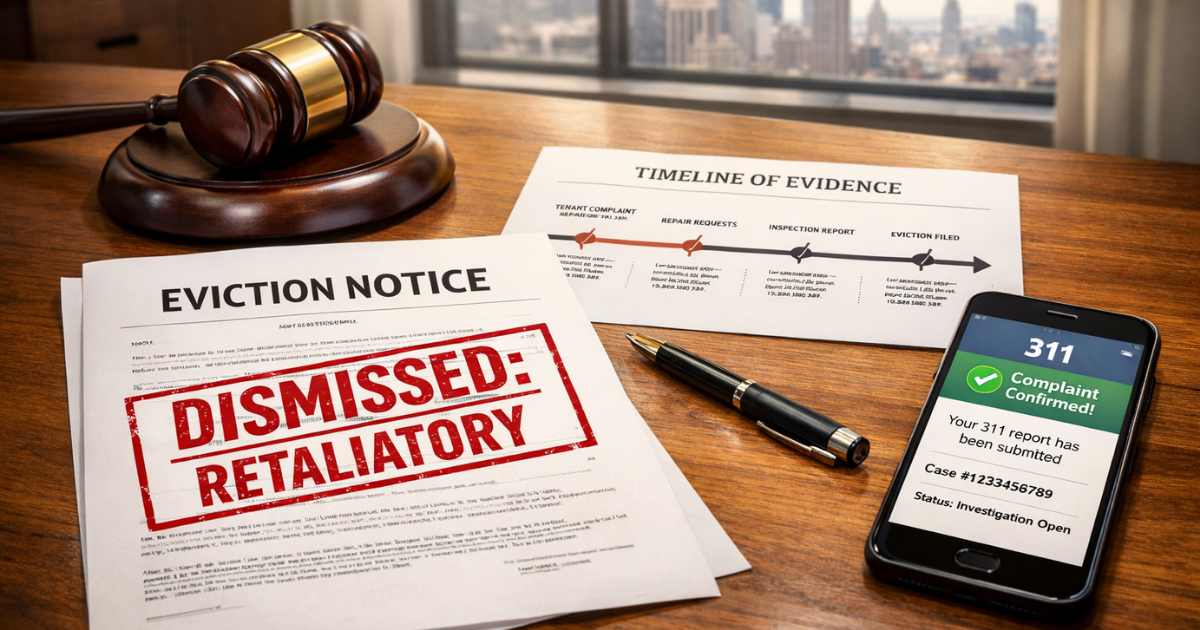
Here's where New York law gives you enormous leverage: RPL § 223-b creates a rebuttable presumption of retaliation if your landlord serves you with a termination notice or starts an eviction case within six months after you engage in protected activity.
Read that again, because it's critical. You don't have to prove your landlord's intent. You don't have to show they were angry about your complaint. You just have to prove two facts: (1) you engaged in protected activity, and (2) your landlord moved to evict you within six months afterward.
Once you prove those two facts, the law presumes the eviction is retaliatory, and the burden shifts entirely to your landlord to prove they had a legitimate, non-retaliatory reason for the eviction. They have to affirmatively prove their reason had nothing to do with your complaint.
This burden-shifting is huge. In most legal disputes, whoever makes the claim has to prove it. But in retaliation cases under RPL § 223-b, once you establish the basic timeline, your landlord is on defense. They have to convince the judge their claimed reason is real, legitimate, and not pretextual.
Building your timeline proof is straightforward:
Document when you engaged in protected activity. If you filed a 311 complaint on March 15, save the complaint number and confirmation. If you sent your landlord a certified letter on April 2 demanding heat repairs, keep the certified mail receipt. If you filed an HP action on May 10, keep the case number and filing receipt.
Document when your landlord took action against you. If they served you with a notice of non-renewal on June 1, note that date. If they filed an eviction petition on July 20, note that date. If they suddenly raised your rent by 40% or changed your lease terms on August 5, note that date.
Calculate the gap. Complaint on March 15, eviction filed July 20—that's four months. Well within the six-month presumption window. Your landlord now has to explain why they decided to evict you four months after you complained about code violations.
The closer the timing, the stronger your case. An eviction filed two weeks after a complaint is almost impossible for a landlord to explain as coincidence. An eviction filed five and a half months after a complaint is still covered by the presumption, but gives your landlord more room to argue other factors intervened.
Not every interaction with your landlord counts as protected activity. Complaining on social media that your landlord is "the worst" doesn't trigger RPL § 223-b protections. Telling your friends your apartment has problems doesn't count.
What does count:
Official complaints to government agencies. Calling 311 to report no heat. Filing online complaints with HPD about rodents. Emailing the Department of Buildings about structural issues. Contacting code enforcement about illegal conversions. These all count.
Court actions to enforce habitability. Filing an HP action asking the court to order repairs. Raising breach of warranty of habitability as a defense or counterclaim in a nonpayment case. Starting a rent strike through proper legal procedures. These all count.
Organizing or joining tenant associations. Meeting with other tenants to discuss building problems. Signing a petition to the landlord about common area maintenance. Forming a recognized tenant association. These all count.
Requesting reasonable accommodations for disabilities. Asking your landlord to allow an emotional support animal. Requesting a ground-floor apartment due to mobility limitations. Asking for extended payment time due to disability-related income interruptions. These count both as protected activity under retaliation law and as the basis for potential disability discrimination claims.
What you're looking for is formal exercise of your legal rights, not just private grumbling. The law protects tenants who use official channels to address legitimate housing issues.
Courts and agencies want proof, not just your word against your landlord's. The stronger your documentation, the harder it is for your landlord to claim their eviction decision had nothing to do with your complaints.
The foundation of your retaliation case is proof that you actually made the complaints you claim triggered retaliation. Collect:
311 complaint confirmations. When you call 311 about housing issues, you get a service request number. Save it. Screenshot it. NYC maintains records of all 311 complaints, and you can pull your complaint history showing what you reported and when.
HPD complaint receipts and inspection reports. If HPD came to inspect your apartment after your complaint, they generate reports and violation notices. Request copies. These documents prove you complained and prove the problems were real enough that HPD found violations.
HP action case numbers and orders. If you filed an HP action in Housing Court asking a judge to order repairs, that entire court file is documentation. The case number, the petition you filed, any court orders issued—all of it proves you exercised your right to habitability.
Emails and texts to your landlord. Every email you sent saying "the heat hasn't worked in three weeks" or "there's mold growing in the bathroom" is evidence. Every text message photo you sent showing broken fixtures or pest infestations counts. Forward these to a separate folder and back them up.
Certified mail receipts. If you sent your landlord formal demand letters via certified mail requesting repairs, those green return receipts prove delivery and date. They show you didn't just complain casually—you made formal, documented demands.
Photos and videos with timestamps. Modern phones embed date and time metadata in photos. Pictures of your apartment's conditions taken when you made your complaints help prove the complaints were legitimate, not made up to create a retaliation defense.
The more documentation you have, the less room your landlord has to claim you never complained or your complaints were trivial. A tenant who shows up in court with a stack of 311 confirmations, HPD violations, and certified mail receipts is credible. A tenant who claims they complained but has no records is fighting uphill.
Documentation that government agencies took your complaints seriously strengthens your case enormously. Collect:
HPD violation notices. If HPD inspected after your complaint and issued violations against your landlord, those notices prove your complaint was legitimate. Your landlord can't argue you made frivolous complaints when the city issued official violations.
Orders to correct. Court orders from HP actions requiring your landlord to make repairs show a judge found your habitability complaints valid. That official finding makes it nearly impossible for your landlord to claim the issues you complained about weren't real.
Letters confirming investigations. Even if an agency didn't ultimately issue violations, letters confirming they opened an investigation or made contact with your landlord prove you engaged the official process, which is all that's required for retaliation protection.
ECB (Environmental Control Board) hearing decisions. If your landlord was prosecuted by the city for housing violations and ECB issued findings or penalties, those decisions corroborate that your building had serious code problems—the same problems you complained about.
You don't need a finding in your favor to prove retaliation. You just need proof you made a good-faith complaint through official channels. But when you have official findings supporting your complaints, your retaliation case becomes overwhelming.
Evidence of how your landlord responded to your complaints can prove retaliatory intent directly:
Threatening messages or statements. If your landlord sent you an email saying "If you keep calling inspectors, you're not welcome here anymore," that's direct evidence of retaliatory motive. If your landlord texted "Stop making trouble or you'll be out," screenshot it immediately.
Sudden rent increases after complaints. You complain about lead paint on March 1. Your landlord proposes a 35% rent increase on March 15 when your building's typical increases are 3-5%. That timing and magnitude suggest retaliation.
Non-renewal notices shortly after protected activity. You file an HP action on April 10. Your landlord serves a notice of non-renewal on April 25 even though they've renewed your lease routinely for the past five years. The timing alone creates a strong inference of retaliation.
Sudden rule enforcement or new violations. You join a tenant association in May. In June, your landlord suddenly claims you violated your lease by having a small rug in the hallway outside your door, something they ignored for three years. Selective enforcement immediately after protected activity suggests pretext.
Change in landlord demeanor or communications. Before your complaint, your landlord was friendly and responsive. After your 311 call about mold, they stop responding to your messages and start communicating only through lawyers. That shift in relationship, tied temporally to your complaint, supports retaliation.
Save everything. Every email, text message, voicemail, and letter from your landlord gets saved and backed up. You're building a timeline showing cause and effect: you exercised your rights, your landlord's behavior toward you changed, then they moved to evict you.
One of the most powerful types of retaliation proof is showing your landlord treated you differently from similarly-situated tenants after you complained:
Other tenants with the same alleged violations weren't evicted. Your landlord claims they're evicting you for having a pet, but three other tenants in your building have pets and haven't been evicted. That selective enforcement, especially if it started after your HPD complaint, strongly suggests the pet violation is pretext for retaliation.
Similar late payments handled differently. You paid rent five days late in July and got served with a termination notice. Your neighbor paid rent two weeks late in August and just got a friendly reminder. If you're the one who filed complaints and your neighbor isn't, that differential treatment supports retaliation.
Rule changes applied only to you. Your landlord suddenly institutes a new "no deliveries after 8pm" rule and only enforces it against you—the tenant who recently filed a fair housing complaint. Other tenants continue getting deliveries at all hours. That's evidence of targeting.
Building-wide issues used against only you. Your building has package theft problems affecting everyone. You're the only tenant who gets threatened with eviction for "allowing unauthorized persons in the building" after you complained about broken locks to HPD. Why are you being blamed for a building-wide security problem? The timing and selective enforcement suggest retaliation.
Getting comparative evidence requires some investigation. Talk to neighbors. Ask what notices they've received. Find out if your landlord has enforced the same rules against others or if you're being singled out. Neighbors who are willing to provide brief written statements or testify can be powerful witnesses.
Discriminatory eviction is different from retaliation. Instead of punishing you for what you did, your landlord is targeting you because of who you are—specifically, because you belong to a protected class under fair housing and human rights laws.
Protected characteristics in New York include:
NYC's Human Rights Law is one of the broadest in the country and includes additional protected categories beyond state and federal law. If your landlord's decision to evict you was motivated in whole or in part by any of these characteristics, that's illegal discrimination.
Discrimination in housing can happen in two ways:
Disparate treatment means your landlord is deliberately targeting you because of your protected class. Example: Your landlord evicts you, a Black tenant, for one late rent payment but doesn't evict white tenants in the building with identical or worse payment histories. That's disparate treatment based on race.
Disparate impact means your landlord applies a policy or practice that appears neutral but disproportionately harms people in a protected class without a strong legitimate justification. Example: Your landlord has a blanket policy of evicting any tenant who receives rental assistance, which disproportionately impacts people with disabilities (who often receive SSI) and families with children (who often receive vouchers). Even if the landlord claims the policy applies to everyone equally, it has a discriminatory impact.
You don't need to prove your landlord is personally bigoted or used slurs. Discrimination can be subtle, institutional, and even unconscious. What matters is whether your protected characteristic played a motivating role in the eviction decision.
Building a discrimination case requires showing the connection between your protected characteristic and your landlord's actions:
Biased statements and comments. Your landlord makes comments about your race, religion, family size, disability, or other protected characteristic, especially close in time to the eviction decision. Examples:
Even if your landlord doesn't make these statements directly to you, statements to neighbors, other tenants, or building staff can be evidence. If a maintenance worker heard your landlord say "I'm trying to get rid of all the Section 8 tenants," that's admissible evidence of discriminatory motive.
Pattern evidence across multiple tenants. Your landlord only enforces certain lease provisions against tenants of a particular race. Your landlord routinely evicts families with children for minor noise complaints but tolerates the same noise from childless tenants. Your landlord refuses to negotiate payment plans with voucher holders but grants them to non-voucher tenants. These patterns show discriminatory practices even without direct statements of bias.
Timing relative to disclosure of protected status. You inform your landlord you're pregnant, and three weeks later you receive a lease non-renewal notice. You request a reasonable accommodation for your disability, and your landlord responds by filing for eviction instead of engaging in the interactive process. You notify your landlord your Section 8 voucher was approved, and suddenly they claim you're violating your lease. The proximity between disclosure and adverse action creates an inference of discrimination.
Refusal to accommodate disability. When you request a reasonable accommodation or modification due to disability and your landlord responds by trying to evict you instead of engaging in good faith, that's strong evidence of disability discrimination. The law requires landlords to engage in an interactive process, discuss accommodations, and only refuse if the accommodation would create undue burden. Eviction instead of discussion violates fair housing law.
Differential treatment of similarly-situated tenants. This is the most persuasive type of evidence. You have the exact same issue (late payment, alleged noise, unauthorized occupant) as another tenant, but you get evicted while they don't, and the difference is your protected characteristic. You're a single mother on Section 8; the other tenant is a childless professional paying market rent. That comparison speaks volumes.
Many tenants think they can't prove discrimination without their landlord explicitly admitting discriminatory intent. That's wrong. Courts recognize that discrimination is rarely that obvious.
Circumstantial evidence is enough. A combination of factors—timing, differential treatment, suspicious statements, pattern evidence, sudden changes in landlord behavior after learning about your protected status—can convince a judge or agency that discrimination played a role even without a confession.
Think of it like a puzzle. Each piece of evidence might seem small individually, but when you assemble all the pieces, the picture of discrimination becomes clear. Your landlord's comment about "those people" plus their pattern of evicting voucher holders plus their refusal to renew your lease right after your voucher was approved adds up to discrimination, even if no single piece of evidence would prove it alone.
The venue where you raise these claims matters because different forums have different procedures, timelines, and remedies.
For retaliation claims under RPL § 223-b, you typically raise them directly in Housing Court as part of your eviction defense. Include it as an affirmative defense in your Answer to the eviction petition:
"Petitioner's eviction is retaliatory and barred by Real Property Law § 223-b. Respondent made good-faith complaints to HPD regarding lack of heat and code violations on [dates]. Within six months of these protected complaints, Petitioner served a Notice of Non-Renewal dated [date] and filed this eviction proceeding. This temporal proximity creates a rebuttable presumption of retaliation. Petitioner has failed to demonstrate a legitimate, non-retaliatory reason for termination."
Attach your evidence as exhibits: 311 complaints, HPD violations, certified mail receipts, and timeline documentation.
The judge will address your retaliation defense as part of the eviction trial. If you prove the timing and protected activity, your landlord has to come forward with their alleged legitimate reason, and you get to challenge that reason as pretext.
You can also raise retaliation as a counterclaim seeking damages for the illegal retaliation. While defending against the eviction is usually the priority, a counterclaim for damages can provide settlement leverage and potential compensation if you prove the retaliation claim.
For discrimination, you have several options and can pursue them simultaneously:
New York State Division of Human Rights. This is the statewide agency that enforces the New York State Human Rights Law. You can file a discrimination complaint online or by mail within one year of the discriminatory act. The Division investigates, determines probable cause, and can hold administrative hearings. Filing here is free.
NYC Commission on Human Rights. If your apartment is in New York City, you can file with the NYC Commission, which enforces the NYC Human Rights Law—often broader and more protective than state or federal law. The Commission has strong enforcement powers and can award significant damages. Filing deadline is typically three years from the discriminatory act for housing cases.
HUD (U.S. Department of Housing and Urban Development). You can file a federal fair housing complaint with HUD within one year of the discrimination. HUD investigates and can refer cases to the Department of Justice for enforcement or to administrative law judges for hearings.
Federal court lawsuit. You can file a lawsuit in federal court under the Fair Housing Act within two years of the discrimination. This requires more legal sophistication and potentially hiring a lawyer, but it allows you to seek broader remedies including punitive damages.
Raise it in Housing Court. Even though discrimination is primarily handled by civil rights agencies, you can also raise it as a defense in Housing Court. You're arguing that the eviction itself is discriminatory and therefore should be dismissed.
Many tenants file both in Housing Court (to defend the eviction) and with a civil rights agency (to pursue the discrimination claim independently). This creates leverage:
You can ask the Housing Court judge to stay (pause) the eviction case under the doctrine of "primary jurisdiction" while the civil rights agency investigates. Judges often grant these stays, especially when there's a pending discrimination complaint raising serious questions about the eviction's legitimacy.
If the civil rights agency issues a finding of probable cause or determines discrimination occurred, that finding becomes powerful evidence in Housing Court. You can introduce the agency's decision and its factual findings to support your defense that the eviction is discriminatory.
The discrimination complaint also creates settlement pressure on your landlord. Fighting both an eviction defense and a civil rights investigation is expensive and time-consuming. Many landlords will dismiss the eviction or settle favorably to make both cases go away.
If you suspect your eviction is retaliatory or discriminatory, start building your proof immediately:
Open a document or notebook and create a chronological timeline of every relevant event:
Be specific. Don't write "sometime in March I called 311." Write "March 15, 2024, 2:30pm, called 311 about no heat, service request #123456789." Precision matters because you're building a timeline to show causation.
Create both physical and digital backups of every relevant document:
Scan or photograph paper documents: Lease, notices, letters from landlord, violation notices, court papers, certified mail receipts. Save to cloud storage with automatic backup.
Screenshot digital communications: Texts, emails, social media messages, online portals. Take screenshots showing full headers with dates and times. Back up to multiple locations.
Preserve voicemails: If your landlord left voicemails, record them to a file or save them through your phone company's voicemail-to-email feature. Voicemails of your landlord making discriminatory comments or threats are powerful evidence, but only if you preserve them.
Export message threads: Don't rely on keeping messages on your phone. Export entire text or email threads to PDF. Phones break, accounts get closed, evidence disappears. Make it permanent.
The single biggest mistake tenants make is assuming they'll be able to find these documents later when they need them. By the time you're preparing for court, it's too late to track down that text from six months ago. Save everything now.
You don't have to prove your case alone. Other people's observations strengthen your claims dramatically:
Neighbors who witnessed events. If your neighbor heard your landlord make discriminatory remarks, saw the inspector come to your apartment after your complaints, or can confirm your landlord treats you differently from others, ask them to write a brief statement. Even an informal written statement signed and dated helps. Better yet, ask if they'd be willing to testify if needed.
Other tenants with similar experiences. If you're not the only tenant your landlord is targeting—maybe they're evicting multiple voucher holders or multiple families with children—connecting with those tenants builds a pattern case. Multiple tenants showing the same discriminatory pattern is far stronger than one tenant's isolated claim.
Building workers or staff. Superintendents, doormen, maintenance workers, and property managers sometimes hear landlords make discriminatory statements or give discriminatory instructions. They may be reluctant to help while still employed, but they're potential witnesses if they're willing.
Tenant association members. If you joined a tenant association and that triggered retaliation, other association members can corroborate when you joined, what organizing activities occurred, and how your landlord reacted.
Get these people's contact information now. Memories fade, people move, employees change jobs. If you wait until trial to start looking for witnesses, they may be impossible to find.
Once your eviction case is in court, you have the right to request documents from your landlord through discovery. Request:
Rent ledgers for all tenants in the building (with names redacted for privacy). This lets you compare how your landlord handled late payments or rent issues for you versus others. If you were evicted for one late payment while others had multiple late payments without consequence, that's powerful differential treatment evidence.
Building-wide notices, rule changes, or policy updates. If your landlord claims they evicted you for violating a rule, get documentation of when that rule was created, how it was communicated, and how it's been enforced building-wide. Selective enforcement or rules created right before your eviction support pretext arguments.
Communications about you between landlord and staff. Emails or messages between your landlord and property managers or lawyers discussing you might contain admissions of retaliatory or discriminatory motive. At minimum, they show the decision-making process.
Prior eviction records. How many evictions has this landlord filed in the past three years? What percentage were against tenants with children, tenants of color, voucher holders, etc.? Pattern evidence emerges from this data.
Your landlord will often resist these discovery requests, but judges will order production if you show relevance to your retaliation or discrimination defense. Push for it.
Once you establish timing and protected activity (for retaliation) or protected status (for discrimination), your landlord will claim they had a legitimate, non-discriminatory, non-retaliatory reason for the eviction. Your job is to dismantle that claimed reason as pretext—a fake excuse covering the real illegal motive.
"Tenant violated the lease." Get your lease and review what it actually prohibits. Many landlords claim violations that aren't actually in the lease or misinterpret lease terms. If the claimed violation is ambiguous or if you didn't actually violate the provision, document that.
Also investigate: Has your landlord enforced this provision against other tenants? If this is a rule they've never enforced before or only enforce against tenants who complain or who belong to protected classes, that's selective enforcement showing pretext.
"Tenant was chronically late with rent." Pull your payment history. Were you actually chronically late, or did you have one or two late payments in a year of on-time payments? Characterizing occasional late payments as "chronic" problems is a common pretext tactic.
Compare to other tenants: Request ledgers showing whether other tenants had similar payment patterns without being evicted. If others had worse payment histories but you're the only one being evicted, and you're also the only one who filed HPD complaints, that's retaliation.
"Tenant engaged in nuisance behavior." What specifically? When? Where's the documentation? Vague claims of "noise" or "disturbances" are common pretexts, especially against families with children or people with mental health disabilities.
Get records: Request police reports, 311 complaints from neighbors, or building incident reports. If your landlord can't produce contemporaneous documentation of the alleged nuisance, their claim is likely fabricated pretext.
"Landlord wants to occupy the unit for family." This is a legitimate reason in many circumstances, but it's also a common pretext. Investigate whether your landlord actually has a family member who needs housing or whether they're using this excuse to remove you illegally.
If you're in a rent-stabilized building, there are strict procedures for owner-use evictions. If your landlord files an owner-use eviction right after you complained about code violations, the timing suggests retaliation. If they filed owner-use against you but not against other tenants in similar units, that suggests discrimination or selection based on your protected activity.
"Building is being renovated/sold/converted." Like owner-use claims, these can be legitimate business decisions, but they're also used as pretexts. The question is timing and selection: Why are you being evicted for renovation right after you filed a fair housing complaint? Why is your unit being "renovated" when others in the same condition aren't?
In rent-stabilized buildings, landlords need special approval for evictions based on substantial renovation or demolition. If they're claiming this reason, verify they've actually obtained necessary permits and approvals. Many landlords use this as pretext without any real renovation plans.
When your landlord provides their allegedly legitimate reason, you attack it by showing:
Inconsistency: Their claimed reason contradicts other evidence. They say you violated a no-pet policy, but your lease application disclosed your pet and they accepted it.
Timing: The "problem" they cite existed for months or years, but they only decided to evict right after your protected activity. If the issue was really serious, why did they tolerate it until you complained to HPD?
Selective enforcement: They enforce this rule only against you, not against similarly-situated tenants who aren't in protected classes or didn't engage in protected activity.
Shifting explanations: Their stated reason changes over time. First they say it's a lease violation, then they say it's chronic late payment, then they say they need the unit for family. Shifting stories indicate none of them are the real reason.
Implausibility: The stated reason doesn't make logical sense given the facts. They claim you're being evicted for "business use" because you work from home on a laptop—in 2024 when remote work is standard. That's implausible.
You're essentially saying to the judge: "Look at all these factors together. The timing, the selective enforcement, the shifting explanations, the inconsistencies. The real reason is retaliation/discrimination, and this claimed 'legitimate' reason is just cover."
If you successfully prove your eviction is retaliatory or discriminatory, several things can happen depending on the venue:
The eviction petition gets dismissed. The court cannot proceed with an illegal eviction. If the entire basis for the eviction is retaliatory or discriminatory, the case ends. Your landlord cannot evict you on those grounds.
You may be awarded attorneys' fees and costs. If you hired a lawyer and you win on retaliation or discrimination grounds, courts often award fees to be paid by your landlord. This makes it financially viable for lawyers to take these cases and punishes landlords for illegal conduct.
You can pursue damages through a counterclaim. Retaliatory and discriminatory eviction attempts cause harm—stress, moving costs, legal fees, emotional distress. You can counterclaim for damages, potentially including punitive damages if the conduct was particularly egregious.
Your landlord may be barred from retrying. Depending on the specific circumstances and court findings, your landlord may be permanently barred from evicting you based on the same pretextual grounds or may face heightened scrutiny if they attempt any future eviction against you.
Finding of probable cause or discrimination. The agency investigates and issues findings. A finding in your favor creates an official government determination that discrimination occurred, which has significant weight in other proceedings.
Monetary damages. Agencies can award compensatory damages for financial losses, emotional distress, and other harms. NYC Commission on Human Rights cases have resulted in substantial damage awards.
Injunctive relief. Agencies can order your landlord to take specific actions—restore your tenancy, change policies, undergo training, etc. These orders are enforceable through courts.
Civil penalties against the landlord. Beyond compensating you, agencies can impose fines and penalties against landlords who violated fair housing or human rights laws. These penalties punish illegal conduct and deter future violations.
Public findings that impact landlord reputation. Agency findings are public record. A finding that a landlord engaged in discrimination affects their ability to rent other units, obtain financing, and maintain their reputation.
Most retaliation and discrimination cases settle before final judgments. Once your landlord realizes you have solid evidence of illegal motive, the calculation changes:
Settlement of the eviction case: Your landlord agrees to withdraw the eviction and let you stay, often with a provision that they won't attempt eviction based on the same grounds again.
Monetary settlement: Your landlord pays you money to settle both the eviction and any discrimination claims. Settlements can include moving costs if you agree to leave, compensation for damages, and attorneys' fees.
Policy changes: In cases involving institutional discrimination, settlements sometimes include agreements that the landlord will change policies, provide staff training, or stop discriminatory practices building-wide.
Confidential settlements: Many landlords prefer to settle with confidentiality provisions so there's no public finding of discrimination. You can negotiate for higher settlement amounts in exchange for confidentiality if that's acceptable to you.
Strong evidence of retaliation or discrimination gives you enormous settlement leverage. Your landlord faces potential public findings of illegal conduct, damage awards, attorneys' fees, civil penalties, and reputational harm. Settling starts looking much more attractive than litigating and losing.
Retaliation and discrimination laws exist because landlords have massive power over tenants—the power to make you homeless. Without these protections, landlords could punish tenants for exercising their legal rights or discriminate with impunity.
The law recognizes that tenants won't report code violations, request disability accommodations, or join tenant associations if doing so means they'll be evicted. Society needs tenants to enforce housing standards and assert their rights. Retaliation and discrimination protections make it possible for tenants to do that without fear of losing their homes.
When you suspect your eviction is retaliatory or discriminatory, you're not just defending yourself—you're enforcing important public policy. Every successful retaliation or discrimination defense makes it harder for landlords to get away with these illegal practices against future tenants.
Use these protections. Document everything. Build your timeline. Gather your evidence. Raise these defenses in your Answer. File civil rights complaints. Force your landlord to explain their actions under oath.
The law is on your side when landlords target you for exercising your rights or because of who you are. All you need to do is connect the dots clearly enough that a judge or agency can see what really motivated the eviction. The closer in time your protected activity or disclosure is to the eviction action, the harder that connection is to deny.
Start building your proof today.