You're dealing with a landlord whose behavior makes you deeply uncomfortable—they show up unannounced multiple times a week, call or text you at all hours about non-urgent matters, ask intrusive personal questions, or make demands that seem unreasonable. But the relationship isn't openly hostile yet. Your landlord might even seem friendly in some ways, chatty and personable, just with terrible boundaries. You think about setting limits—telling them to stop dropping by without notice, asking them to only contact you during business hours, or insisting they follow the lease terms—but every time you consider it, you freeze.
The fear that stops you is vivid and specific: if you push back, everything will get worse. Your landlord will stop being "nice" and become openly hostile. The uncomfortable but manageable situation will escalate into something unbearable. Your landlord, feeling rejected or challenged, will retaliate by refusing to make repairs, finding excuses to enter your apartment even more often, threatening eviction, or making your daily life so tense and miserable that you'll regret ever speaking up. You imagine sending that firm letter or refusing that late-night phone call, and then having to live with an angry, punitive landlord who makes you pay for daring to set boundaries.
So you keep the peace. You answer the midnight texts. You let your landlord come in whenever they want. You tolerate the intrusive questions and unreasonable demands. You absorb the discomfort and boundary violations, telling yourself it's better to endure this than to risk making your landlord actively hostile. You're conflict-averse by nature, or you're already stressed by other life circumstances, or you're just trying to survive in housing you worked hard to get—and asserting boundaries feels like voluntarily choosing conflict and escalation when you could just keep your head down and get by.
Here's the truth: Setting clear, firm boundaries with landlords who engage in harassment or boundary violations typically reduces conflict and de-escalates situations rather than making them worse—because boundaries create structure, reduce ambiguity, establish consequences for continued violations, and demonstrate to landlords that you're not an easy target, while the absence of boundaries actually encourages escalating harassment by signaling that violations have no costs. Landlords who face no resistance to boundary violations don't become satisfied and stop—they continue and often intensify inappropriate behavior because it's working. Conversely, landlords who encounter clear, documented boundaries often modify their behavior because boundaries create accountability, legal risk, and recognition that continued violations will have consequences. The "nice" landlord with poor boundaries who faces firm pushback usually becomes more respectful, while the same landlord facing continued acceptance of boundary violations often becomes progressively more intrusive and entitled.
Let me show you exactly why accepting boundary violations actually encourages escalation while setting boundaries creates de-escalation, how to set boundaries in ways that reduce rather than increase conflict, what typically happens when tenants set firm boundaries with boundary-violating landlords, why your fear of making things worse is backwards—silence and acceptance create worse outcomes than boundary-setting, what psychological and legal mechanisms make boundaries protective rather than provocative, and how to distinguish between landlords who respond well to boundaries and those rare cases requiring different strategies.
Understanding the psychology and patterns of boundary-violating behavior helps you see why your current strategy of keeping the peace actually encourages escalation.
When landlords violate boundaries and face no pushback, they don't interpret this as "tenant is fine with my behavior so I should continue at this level." They interpret it as "tenant accepts this behavior so I can go further."
The escalation pattern follows predictable progression: Initial boundary violations are relatively minor—landlord shows up unannounced once, calls late once, asks one intrusive question. Tenant accepts these violations without objection, wanting to avoid conflict. Landlord interprets acceptance as permission and comfort, believing tenant doesn't mind or wouldn't push back. Violations become more frequent—weekly unannounced visits become multiple times per week, occasional late calls become nightly texts, one intrusive question becomes interrogations. Violations become more intrusive—landlord who entered with advance excuse now enters without any pretext, landlord who asked about your job now asks about relationships and finances, landlord who wanted updates now demands immediate responses.
This escalation isn't malicious planning—it's natural human behavior. When someone does something inappropriate and nothing bad happens, they do it more and go further. Boundaries are learned through enforcement. Without enforcement, people push boundaries further seeking the limit.
Your landlord may genuinely not realize their behavior is problematic if you've never indicated it is. By accepting violations without comment, you've inadvertently communicated that their behavior is acceptable. They won't suddenly realize on their own that they've crossed lines if you haven't drawn any lines.
The accommodation trap is that each time you accept a boundary violation to avoid conflict, you make the next violation more likely and more severe. You're not maintaining a stable uncomfortable situation—you're enabling an escalating one.
Your strategy of avoiding conflict by accepting boundary violations might prevent open confrontation, but it creates significant psychological costs.
Constant accommodation produces persistent anxiety (never knowing when landlord will show up or contact you, inability to relax in your own home), resentment that builds over time (anger at landlord for violations, anger at yourself for not speaking up), sense of powerlessness (feeling you have no control over your living situation, belief that you must accept whatever landlord demands), and deteriorating mental health (stress from ongoing violations, exhaustion from constant boundary management without boundary enforcement).
The relationship you're preserving through accommodation isn't actually peaceful—it's tense and anxiety-producing. You're trading open conflict for chronic stress. That's not peace; it's suppression of conflict at cost to your wellbeing.
Your landlord may not realize the relationship is problematic because you haven't communicated problems. They might think everything is fine while you're miserable. The "good relationship" you're afraid of ruining doesn't actually exist—there's the facade you maintain and the reality of your experience.
Accepting violations doesn't prevent escalation to unbearable situations—it creates the path to unbearable situations. Many tenants who eventually reach crisis points (illegal lockouts, extreme harassment, health impacts from stress) were trying to "keep the peace" for months or years before crisis hit. The accommodation strategy failed to prevent escalation; it enabled it.
Landlords, like all people, learn from consequences and lack thereof. When boundary violations produce no negative consequences, landlords learn those violations are acceptable.
Learning theory applies to landlord behavior: Behavior that produces desired outcomes and no negative consequences is reinforced and repeated. Behavior that produces negative consequences is reduced. Landlords who violate boundaries and face no pushback learn that violations work—they get access they want, information they want, control they want, without any downsides.
Your silence teaches your landlord that you won't enforce boundaries, that lease terms and legal rights don't matter to you, that they can gradually push further without resistance, and that you're someone who will accommodate rather than challenge violations.
Landlords develop patterns of how they treat different tenants. Some tenants they approach carefully because those tenants have established they'll push back. Other tenants they push harder because those tenants have established they won't resist. By accepting violations, you're training your landlord to see you as someone they can treat poorly without consequence.
This learning happens unconsciously often. Landlord doesn't necessarily think "this tenant won't push back so I'll violate their rights." They just develop habits and patterns based on what works and what doesn't. With you, violations work.
Many boundary-violating landlords present as friendly and personable, which makes tenants reluctant to set boundaries for fear of "ruining" the nice relationship. But the niceness often conceals entitled attitudes.
The pattern of the "nice but boundary-violating" landlord includes being friendly and chatty while completely ignoring your privacy and autonomy, asking personal questions in warm tone while being inappropriately intrusive, seeming concerned about you while using concern as excuse for surveillance, being generous with small things while violating major rights (might give you holiday gifts while entering illegally), and maintaining pleasant demeanor while expecting complete accommodation of their demands.
This isn't genuine niceness—it's entitlement wrapped in friendliness. Truly nice people respect others' boundaries. People who violate boundaries while acting friendly are demonstrating that their desire for access, information, or control matters more to them than your rights and comfort.
The friendliness makes you feel guilty about setting boundaries ("they're so nice, I shouldn't make them feel bad") but that's manipulation, whether intentional or not. You don't owe boundary violations to people just because they're superficially pleasant.
When you set boundaries with "nice but entitled" landlords, you discover whether the niceness was genuine (in which case they respect boundaries once communicated) or manipulation (in which case they become hostile when boundaries threaten their sense of entitlement). Either way, you gain clarity about what you're actually dealing with.
Contrary to your fears, setting clear boundaries typically reduces tension and inappropriate behavior rather than increasing it.
Much landlord-tenant conflict stems from ambiguity about expectations. Clear boundaries eliminate that ambiguity.
Before boundaries are set, landlord doesn't know what you consider acceptable or unacceptable (you haven't told them), landlord may genuinely believe their behavior is fine (especially if you've accommodated it), tenant is frustrated by violations but hasn't communicated frustration, and situation is primed for misunderstanding and escalation.
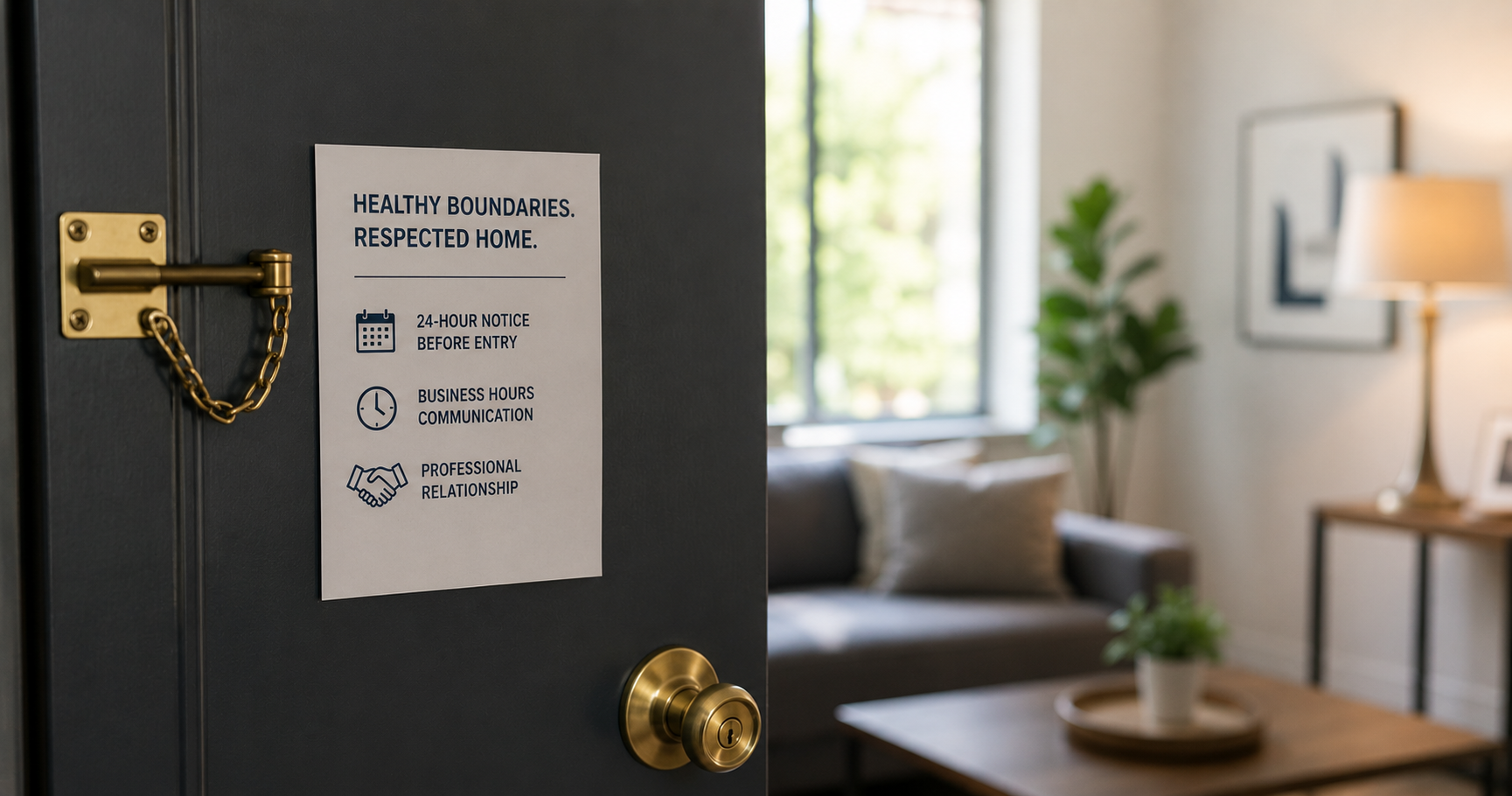
When boundaries are set clearly, landlord knows exactly what you expect (24-hour notice before entry, business hours communication only, etc.), ambiguity is eliminated about what's acceptable, landlord can adjust behavior accordingly if they choose to, and you have clear baseline for identifying continued violations.
The clarity itself is de-escalating. Many landlords respond to clear boundaries by thinking "oh, I didn't realize that bothered them, I'll stop" rather than "how dare they set limits." Especially landlords who are boundary-violators due to obliviousness rather than malice respond well to explicit boundary communication.
Example: Landlord who's been calling at 10 PM doesn't necessarily realize late calls are unwelcome. When you clearly state "please only contact me between 9 AM and 6 PM unless it's an emergency," many landlords simply comply. The boundary-setting resolves the issue without conflict.
Setting boundaries formally, particularly in writing, creates accountability that discourages continued violations.
Written boundaries create documentary evidence that you've communicated expectations, that landlord knows what appropriate behavior is, and that continued violations are knowing violations of communicated boundaries—eliminating landlord's ability to claim ignorance.
This documentation provides evidence for enforcement actions if violations continue (harassment complaints, retaliation defenses, court proceedings), creates legal risk for landlord who continues violations after clear boundary communication, and demonstrates your seriousness about enforcing boundaries.
Landlords who face documented boundaries often modify behavior because they recognize legal risk, understand you're creating evidence trail that could be used against them, realize you're not someone who will tolerate violations indefinitely, and don't want to face consequences (harassment violations, lawsuits, damage to reputation).
The accountability created by formal boundary-setting makes continued violations costly rather than cost-free, shifting incentives for landlord from "violate boundaries because it's easy and consequence-free" to "respect boundaries because violations create risk."
Boundary-violating landlords, like bullies, often target tenants they perceive as unlikely to push back. Clear boundaries demonstrate you're willing to assert rights.
When you set boundaries, you signal that you know your rights, that you'll document violations and take them seriously, that you're willing to engage enforcement mechanisms, and that you're not someone who can be pushed around indefinitely.
Landlords often reassess how they treat tenants who demonstrate they'll enforce boundaries. The landlord who's been boundary-violating may think "this tenant knows their rights and will take action, I should back off" rather than escalating hostility.
The deterrent effect of boundary-setting comes from demonstrating you're willing to stand up for yourself. Just as bullies usually move on from targets who fight back, boundary-violating landlords often reduce inappropriate behavior toward tenants who set clear boundaries.
Your fear is that asserting yourself will make landlord hostile, but often the opposite occurs—landlords become more respectful toward tenants who demonstrate they won't accept boundary violations without consequence.
Many boundary-violating landlords treat tenancy as personal relationship rather than business relationship. Boundaries restore professional distance.
The over-familiarity of boundary-violating landlords (treating your apartment like their personal space, treating you like friend or family rather than tenant, involving themselves in your personal life inappropriately, expecting emotional labor and accommodation) creates inappropriate intimacy that breeds boundary violations.
Setting boundaries reestablishes professional landlord-tenant relationship, clarifies that tenancy is business transaction not personal relationship, reduces landlord's sense of entitlement to your time and space, and creates healthy distance that actually improves relationship sustainability.
Example: Landlord who's been treating your apartment like their space, dropping by for chatty visits whenever they want, may feel comfortable doing so because they think you're friends. Setting boundary—"I need you to provide 24-hour notice before entering as required by law"—reminds landlord this is your home, not theirs, and reestablishes proper roles. This actually creates healthier, more sustainable relationship than false friendship based on your accommodation of violations.
Real-world outcomes of boundary-setting usually surprise tenants who expect escalation.
Most landlords, when faced with clear boundaries, respond by respecting them rather than escalating conflict.
Immediate compliance is common response—landlord who's been calling late stops calling after 6 PM once asked, landlord who's been dropping by gives 24-hour notice after being told it's required, landlord who's been intrusive backs off when boundaries are set.
Apologetic response occurs frequently—landlord says "I didn't realize that bothered you, I'll stop," expresses surprise that tenant found behavior problematic, and modifies behavior going forward.
Silent compliance where landlord doesn't explicitly acknowledge boundary-setting but simply stops violating boundaries going forward—they got the message and adjusted without discussion.
Improved relationship often follows boundary-setting as tension created by unspoken resentment dissipates once boundaries are clear, landlord feels clearer about expectations reducing their anxiety too, and both parties operate with better understanding of appropriate interaction.
These positive responses are common because many boundary violations stem from obliviousness, lack of clear communication, or landlord not realizing behavior is problematic. Once boundaries are clearly set, many landlords simply comply.
Small percentage of landlords respond poorly to boundaries, but their responses are identifiable and manageable.
Hostile responses might include landlord becoming explicitly angry about boundary-setting, retaliatory behavior (refusing repairs, threatening eviction, increased harassment), or aggressive pushback claiming they have right to violate boundaries.
These responses actually provide clarity about what you're dealing with—landlord whose violations were malicious rather than oblivious, landlord who feels entitled to violate your rights regardless of your objections, and landlord who was never "nice," just manipulative.
Hostile responses are legally risky for landlords. Retaliation is illegal and documented. Landlord who becomes hostile after boundary-setting creates evidence of their bad faith, strengthens your harassment case if one is needed, and demonstrates violations were intentional not inadvertent.
If landlord responds hostilely, you're better off knowing you're dealing with malicious boundary-violator rather than thinking they're "nice but annoying." You can then take appropriate action—document retaliation, report harassment, pursue legal remedies—from position of clarity rather than false hope that accommodating more will improve things.
The hostile response doesn't mean boundary-setting was wrong—it means landlord was always going to be problematic and boundary-setting revealed this sooner rather than later.
Some landlords test boundaries initially before deciding whether to comply.
Testing behaviors include continuing violations once or twice after boundaries are set to see if you'll enforce them, pushing back mildly ("but I need to be able to reach you anytime"), or trying to negotiate exceptions that undermine boundaries.
This testing is normal boundary dynamics. The landlord is determining whether your boundaries are firm or flexible, whether you'll enforce consequences for violations, and whether they can gradually wear down your boundaries.
Your response to testing determines outcome. If you consistently enforce boundaries during testing phase (reminding landlord of boundaries, documenting continued violations, indicating you'll take formal action), most landlords conclude boundaries are firm and stop testing. If you waiver or make exceptions, landlord learns boundaries aren't firm and continues violations.
The testing phase might feel like confirmation of your fears about escalation, but it's actually decision point—landlord determining whether respecting boundaries is necessary. Firm, consistent enforcement during testing leads to compliance.
While setting boundaries and seeing how landlord responds, documentation ensures you're protected regardless of outcome.
Document the boundary-setting by sending boundaries in writing (email or letter), keeping copies of all boundary communications, dating everything, and being specific about what boundaries you're setting.
Document landlord's response including any compliance with boundaries, any testing or continued violations, any hostile or retaliatory responses, and patterns over time.
This documentation protects you legally if landlord retaliates, provides evidence for harassment complaints if needed, demonstrates you attempted to resolve issues directly before formal action, and creates record of your reasonableness (you set clear boundaries) and landlord's unreasonableness (they violated them anyway).
With documentation, you're protected whether landlord responds well (great, problem solved) or poorly (you have evidence for legal action). The documentation ensures boundary-setting isn't risky—it's protective.
Strategic boundary-setting reduces likelihood of hostile responses and maximizes effectiveness.
How you communicate boundaries affects how they're received.
Written boundaries are more effective than verbal ones because they eliminate ambiguity and misunderstanding, create documentary record that you set boundaries, can be referenced later if violations continue, and signal seriousness of your expectations.
Specific boundaries work better than vague ones. Rather than "please respect my privacy," specify "Please provide 24-hour advance notice before entering my apartment except in emergencies as required by law." Rather than "don't contact me so much," specify "Please limit communication to business hours (9 AM-6 PM) and use email rather than phone for non-urgent matters."
Professional tone rather than emotional or accusatory tone increases likelihood of positive response. Frame boundaries as expectations going forward rather than complaints about past behavior. Focus on what you need rather than what landlord did wrong.
Example boundary-setting communication: "I'm writing to clarify communication and access expectations for my tenancy. Going forward, please provide 24-hour written notice before entering my apartment, as required by New York law, except in genuine emergencies. Please limit communication to business hours (9 AM-6 PM Monday-Friday) and use email for non-urgent matters. I value our professional landlord-tenant relationship and believe these boundaries will help maintain it. Thank you for your cooperation."
This communication is clear, specific, professional, and non-accusatory while being firm about expectations.
Grounding boundaries in law and contract makes them less about personal preference and more about legal obligations.
Citing law makes boundaries non-negotiable: "New York law requires 24-hour notice before landlord entry except emergencies" is more powerful than "I'd prefer you not drop by unannounced."
Referencing lease similarly grounds boundaries: "Per our lease section 4, rent is due on the first with five-day grace period, so I'll plan to pay within that timeframe as allowed."
Legal framing reduces ability of landlord to argue or push back (they can't argue with law), signals you know your rights and will enforce them, and demonstrates boundaries aren't arbitrary personal preferences but legal requirements.
You don't need to be confrontational about legal rights. Simply stating "as required by law" or "per our lease agreement" matter-of-factly is enough. The reference to law/lease does the work of establishing legitimacy.
Boundaries without enforcement mechanisms are just requests. Clear consequences make boundaries effective.
State what will happen if boundaries aren't respected: "If you continue to enter without 24-hour notice, I will file harassment complaints with HPD and may pursue legal action for violation of my right to quiet enjoyment."
Follow through on stated consequences if violations continue. Empty threats teach landlord to ignore your boundaries. Consistent follow-through teaches respect for boundaries.
Graduated consequences might start with documentation and reminders, escalate to formal complaints, and ultimately include legal action if violations persist.
The purpose of stated consequences isn't to threaten landlord—it's to clarify that boundaries have teeth and continued violations will result in escalating responses. Many landlords respect boundaries once they understand violations will result in formal action.
Your demeanor during boundary-setting affects outcomes.
Calm communication even when you're angry or frustrated increases likelihood landlord responds professionally rather than defensively, demonstrates you're serious and rational (not emotional or reactionary), and models the professional relationship you want to establish.
Avoid emotional language about how violations make you feel. Keep focus on behaviors and expectations: not "I feel violated when you barge in" but "I need 24-hour notice before you enter."
Professional boundaries are about behaviors not feelings. The less emotional the boundary-setting, the harder it is for landlord to dismiss as overreaction.
If landlord responds emotionally (gets angry, defensive, argumentative), don't match their energy. Remain calm, restate boundaries, and end conversation if necessary. Your calmness often de-escalates their emotion.
Certain psychological principles explain why boundaries typically de-escalate rather than escalate.
People generally respect others who respect themselves. Setting boundaries demonstrates self-respect.
The psychological principle is that people treat you how you treat yourself. If you accept boundary violations without objection, others learn they can treat you poorly. If you enforce boundaries consistently, others learn you expect to be treated respectfully.
Landlords who encounter tenant with clear boundaries often unconsciously elevate their opinion of that tenant (tenant who knows rights and enforces boundaries is more worthy of respect than tenant who accepts anything), adjust behavior to match tenant's self-respect level, and recognize that relationship requires mutual respect not just tenant accommodation.
This isn't fair (you shouldn't have to demand respect you deserve automatically) but it's realistic human psychology. Demonstrating you respect yourself by enforcing boundaries tends to increase others' respect for you.
Clear expectations reduce uncertainty and anxiety for everyone in a relationship, including landlords.
Landlords experience uncertainty too when expectations aren't clear: they don't know what tenant considers acceptable or problematic, they worry about tenant complaints or legal action (even if irrational), and they may feel ambiguity about appropriate landlord-tenant relationship.
Clear boundaries reduce landlord's uncertainty by establishing clear expectations, reducing their anxiety about "am I doing something wrong," and creating predictable, structured relationship.
Paradoxically, landlords often feel more comfortable with tenants who set clear boundaries than with tenants who accommodate everything. The boundary-setting tenant is predictable and clear. The accommodating tenant is unpredictable (will they suddenly snap? are they unhappy but not saying? will they sue later?).
Reduced anxiety for both parties creates more stable, less conflict-prone relationship.
Unspoken resentment from accepting boundary violations eventually explodes. Boundaries prevent this.
The accommodation cycle involves accepting violations to avoid conflict, building resentment over time, eventually reaching breaking point, and exploding in disproportionate response to final straw.
This explosion is what actually escalates conflict—not initial boundary-setting but delayed reaction after months of suppressed anger.
Early boundary-setting prevents resentment buildup by addressing violations when they're still manageable, maintaining communication rather than silent accommodation, and preventing buildup to explosive confrontation.
Landlords benefit from early boundary-setting too—they get clear feedback when they've crossed lines, rather than discovering months later that tenant has been unhappy all along.
Ironically, the relationship you're afraid boundaries will damage often becomes healthier after boundaries are set.
Relationships based on one party violating boundaries and other party silently accommodating aren't healthy—they're unsustainable. They create power imbalance, resentment, and eventual collapse.
Relationships with clear boundaries are more sustainable because both parties understand expectations, neither party builds resentment, power dynamics are more balanced, and relationship can be maintained long-term.
Many tenants report that their relationship with landlord improved after boundary-setting—not because landlord became different person but because clarity and structure replaced ambiguity and unspoken resentment.
The "good relationship" you're afraid of losing by setting boundaries wasn't actually good if it required you to accept boundary violations. Real good relationships include mutual respect for boundaries.
Small percentage of landlords don't respond well to boundaries. Understanding this scenario helps you prepare.
Some landlords continue violations despite clear boundaries. These landlords require different strategies.
Red flags for landlords who won't respect boundaries include openly stating they don't care about your boundaries or legal rights, continuing violations immediately after boundaries are clearly set, escalating violations in response to boundary-setting (retaliatory intensification), or explicitly hostile response to any assertion of rights.
These landlords were always going to be problematic. Your boundary-setting didn't create the problem—it revealed it. And you're better off knowing early what you're dealing with.
With non-boundary-respecting landlords, accommodation wouldn't have prevented problems—it would just have delayed and worsened them. These landlords require formal enforcement mechanisms not informal boundary-setting.
When landlords don't respect communicated boundaries, escalate to formal enforcement.
Document the boundary-setting and continued violations. This documentation shows you attempted to resolve issues informally before formal action, landlord had clear notice that behavior was problematic, and continued violations are knowing violations demonstrating landlord's bad faith.
File formal complaints with 311, HPD, or relevant agencies about harassment, violations, or retaliation.
Pursue legal action including HP proceedings for habitability violations, harassment lawsuits for persistent boundary violations, or retaliation defenses if landlord attempts eviction.
Get legal representation from Legal Aid or tenant attorneys who can escalate enforcement and impose consequences.
The boundary-setting wasn't wasted even if landlord didn't respect boundaries—it created documentary evidence and demonstrated your good faith efforts to resolve issues before formal action.
In rare cases where landlord's response to boundaries suggests genuine danger, safety takes priority.
Safety concerns arise if landlord responds with threats of violence, concerning escalation of aggressive behavior, or statements suggesting they might harm you or damage property.
If you feel unsafe, priority is protecting yourself not enforcing boundaries. Document everything, report threats to police, seek protective orders if appropriate, contact domestic violence or stalking resources if applicable, and prioritize leaving situation if necessary.
These extreme cases are rare but real. Boundary-setting revealing that landlord is dangerous doesn't mean boundary-setting caused the danger—it revealed pre-existing dangerous person. And knowing this sooner rather than later protects you.
If landlord responds poorly to reasonable boundaries, their response validates that boundary-setting was necessary.
Hostile response to reasonable boundaries reveals landlord's true character (entitled, unwilling to respect tenant rights, sees tenants as inferior not equal), confirms their boundary violations were malicious not oblivious, and demonstrates you were right to set boundaries and document violations.
The hostile landlord was never the "nice" person you thought. The niceness was facade masking entitlement. Their hostile response to boundaries removes the facade and shows you reality.
You're better off knowing what you're dealing with. The clarity allows you to take appropriate action—document harassment, report violations, pursue legal remedies, potentially plan to leave—from position of truth rather than false hope.
Your fear that setting boundaries will escalate conflict and make your life unbearable is backwards—accepting boundary violations creates the path to escalation and unbearable situations, while setting clear boundaries typically de-escalates conflict and improves relationships.
Boundary violations without consequences escalate over time. Landlords learn what they can get away with. Each accepted violation leads to more frequent and more severe violations. "Keeping the peace" through accommodation creates chronic anxiety, resentment buildup, and worsening boundary violations—not stable situation.
Setting clear boundaries typically produces positive responses: Most landlords comply with clearly communicated boundaries. Ambiguity is eliminated, creating clarity about expectations. Accountability mechanisms discourage continued violations. Professional distance is restored to landlord-tenant relationship.
Boundaries demonstrate you're not an easy target, that you know your rights and will enforce them. This deters boundary violations rather than inviting them. Landlords generally respect tenants who set boundaries more than tenants who accept violations.
How to set effective boundaries: Use clear, specific, written communication. Reference legal rights and lease terms grounding boundaries in law. State consequences for continued violations and follow through. Remain calm and professional throughout process.
Document everything during boundary-setting—boundaries you set, landlord's responses, any continued violations. Documentation protects you whether outcome is positive (great, problem solved) or negative (evidence for legal action).
Most landlords respond positively to boundaries. Minority who respond hostilely reveal their true character—they were always going to be problematic. Boundary-setting didn't create the problem; it revealed it sooner rather than later. With hostile landlords, escalate to formal enforcement mechanisms.
The psychological principles supporting boundaries: Boundaries create respect through demonstrated self-respect. Clear expectations reduce anxiety for both parties. Boundaries prevent resentment buildup that leads to explosive conflicts. Boundaries enable healthy, sustainable relationships.
The "good relationship" you're afraid of damaging by setting boundaries wasn't actually good if it required accepting boundary violations. Real good relationships include mutual respect for boundaries.
Your accommodation strategy doesn't preserve peace—it creates suppressed conflict that builds until crisis. Boundary-setting addresses violations when manageable, preventing escalation to crisis.
Setting boundaries isn't choosing conflict—it's choosing clarity, respect, and sustainable relationship over false peace based on your continued violation. The conflict you fear is already present in your anxiety and resentment; boundaries just make it addressable rather than hidden.
Find out if you have a case in 30 seconds →