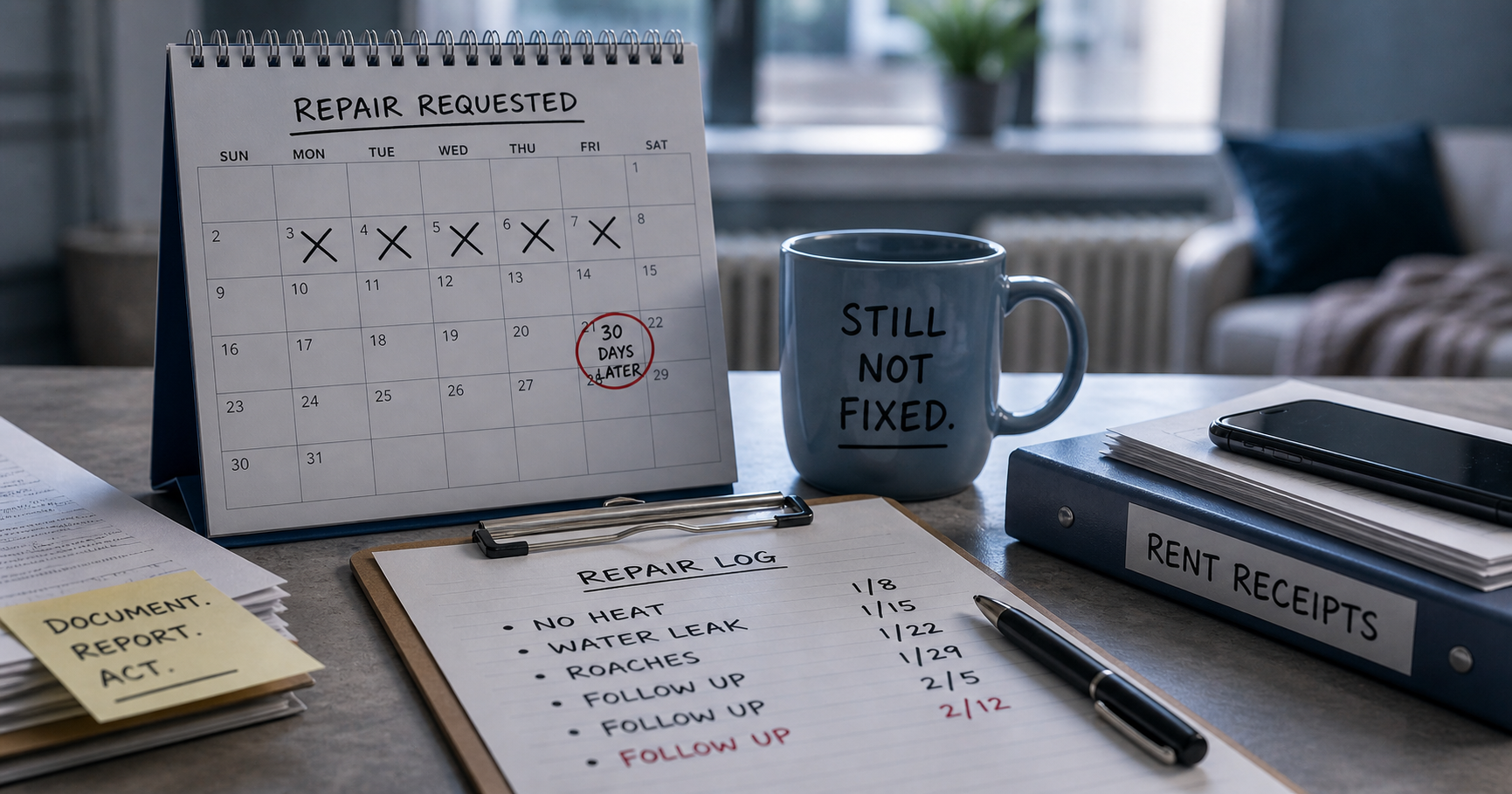
You've been asking your landlord to fix a serious problem in your apartment for what feels like forever. Maybe it's been three weeks since you first reported that you have no heat, and the landlord keeps saying "I'll send someone next week." Or perhaps you've been complaining about a major water leak for two months, and each time you follow up, you get promises that repairs are coming but nothing actually happens. Or you've reported roaches and mold repeatedly over the past six weeks, and while the landlord acknowledges the problem and says they're "working on it," you've seen no exterminator and no remediation crew.
You're frustrated and wondering how long you're legally obligated to wait. You think: "How many times do I have to ask before I can take legal action? Does the landlord get unlimited chances to fix the problem as long as they keep promising to do it? How long is 'reasonable' for repairs—a week, a month, three months? Am I just supposed to keep waiting indefinitely while living with dangerous or unhealthy conditions? At what point can I stop politely asking and start formally demanding repairs or pursuing legal remedies?"
Here's the truth: In New York, you don't have to wait forever giving your landlord unlimited chances to fix problems. Once you've provided clear notice of a habitability issue, the landlord gets only a "reasonable time" to actually complete repairs—and what's reasonable depends on the severity of the problem, ranging from approximately 24 hours for immediately hazardous emergencies like no heat in winter to around 30 days for serious but non-emergency hazards like mold or pest infestations, to up to 90 days for minor non-hazardous issues. After these reasonable timeframes pass without adequate repair, you can shift from requesting fixes to taking formal legal action including filing code complaints, pursuing Housing Part proceedings to compel repairs, seeking rent reductions, or in severe cases, potentially withholding rent or breaking your lease.
Let me show you exactly what "reasonable time" means for different types of repairs under New York law, how to properly provide notice that starts the clock on landlord obligations, what landlord promises and partial fixes mean legally, when you can stop waiting and start acting, what formal remedies become available after reasonable time passes, and how to strategically escalate from requests to legal enforcement.
Before knowing when to act, understand what timeframes the law considers reasonable for different types of repairs.
New York law doesn't specify exact repair deadlines for every possible problem in statute. Instead, courts and housing agencies apply a "reasonableness" standard that varies based on the nature and severity of the violation.
The fundamental principle is that landlords must make repairs within a reasonable time after receiving notice from the tenant. What's reasonable depends on several factors: the severity of the condition (does it threaten health or safety?), the urgency of repair needs (is this an emergency?), the complexity of repairs required (can it be fixed in hours or does it need extensive work?), and the availability of materials and contractors (are specialized parts or professionals needed?).
Courts evaluate reasonableness by asking whether the landlord acted with appropriate speed given the circumstances. A landlord who starts repairs promptly and completes them as quickly as feasible given the nature of work isn't violating habitability even if repairs take time. But a landlord who delays starting repairs, works sporadically, or takes far longer than the problem warrants does violate reasonableness requirements.
Housing agencies and enforcement authorities have developed practical guidelines about reasonable timeframes based on decades of enforcement experience. While these aren't rigid statutory deadlines, they represent what housing authorities and courts generally consider reasonable.
Certain problems threaten life or safety so immediately that they require emergency response and repair within approximately 24 hours of landlord notice.
Emergency conditions include no heat during heating season (particularly during extreme cold), no hot water, gas leaks (immediate danger of explosion or poisoning), major electrical hazards (exposed high-voltage wiring, electrical fires, total power loss), serious water leaks (burst pipes flooding apartments, ceiling collapse from water damage), sewage backups (raw sewage in living spaces), and total loss of essential utilities creating immediate health/safety risks.
The 24-hour expectation for emergencies reflects that these conditions can cause death, serious injury, or severe health consequences within hours. People can die from hypothermia in apartments without heat during freezing weather. Gas leaks can cause explosions. Sewage exposure creates disease risks. These aren't situations where tenants should wait days for repairs.
"Immediate" doesn't mean instant in the sense that repairs must be completed within minutes, but it does mean the landlord must respond immediately (within hours of notice), begin addressing the emergency that day, and complete repairs or provide temporary solutions (like space heaters for heat loss, emergency plumber for sewage) within about 24 hours.
HPD in NYC classifies certain violations as "Class C - Immediately Hazardous" requiring correction within 24 hours. This official classification confirms that 24-hour expectation for emergency repairs is the legal standard, not just good practice.
Practical application: If you report no heat on a freezing Tuesday morning, and by Wednesday morning there's still no heat and landlord hasn't sent anyone or provided temporary heating, the reasonable time has passed. If a sewage backup occurs Friday evening and by Saturday evening it hasn't been addressed, you can consider the landlord in violation and escalate.
Many serious habitability violations don't require emergency response but do need prompt correction within approximately 30 days.
Hazardous issues in this category include recurring leaks and water damage that aren't currently flooding but are ongoing problems, mold growth from moisture issues, pest infestations (roaches, mice, rats, bedbugs), broken locks compromising security, non-working appliances essential for basic living (refrigerator, stove), missing or non-working smoke detectors, inadequate heat or hot water (not total loss but insufficient), exposed wiring that's dangerous but not actively sparking, and lead paint hazards.
The 30-day standard reflects that while these conditions are serious and violate habitability, they don't require same-day emergency response. Thirty days gives landlords time to schedule professional pest control, arrange mold remediation, order and install appliances, or hire contractors for leak repairs—but it's not unlimited time.
HPD classifies many of these as "Class B - Hazardous" violations requiring correction within 30 days. Other housing agencies use similar timeframes for serious non-emergency violations.
The expectation is that landlords begin addressing these problems promptly (within days of notice) and complete repairs within the 30-day window. Starting repairs on day 29 doesn't satisfy the obligation—substantial progress should be underway and completion achieved within 30 days.
Practical application: If you report mold on January 15 and by February 15 (30 days later) the landlord hasn't arranged mold remediation, you've given reasonable time and can escalate. If you report mice on March 1 and by April 1 there's been no professional extermination, reasonable time has passed.
Less serious problems that don't threaten health or safety receive longer repair windows, typically around 90 days.
Non-hazardous issues include cosmetic problems like peeling paint (in post-1978 buildings without lead concerns), minor cracks in walls or ceilings that aren't structural, squeaky doors or floors, worn but functional flooring, minor plaster or drywall damage, non-functioning amenities that aren't essential (broken intercom, cosmetic lobby issues), and general wear-and-tear repairs.
The 90-day standard acknowledges that while these should be repaired, they're not urgent and can be scheduled around more serious work. Ninety days gives landlords flexibility to plan repairs, coordinate with contractors, and address higher-priority issues first.
The distinction from hazardous issues matters: cosmetic problems don't support emergency legal remedies, immediate rent reductions, or urgent court intervention. But they're still landlord responsibilities that must be addressed within reasonable time.
Practical application: If you report peeling paint in June and by September it's not repaired, you can pursue minor code violations or include it in broader habitability claims, but you likely can't pursue emergency remedies based solely on this issue.
While these timeframes provide general guidance, specific circumstances can make shorter or longer periods reasonable.
Complexity of repairs affects reasonable time. Simple fixes (replacing a broken lock) should happen faster than complex renovations (structural repairs requiring permits and inspections). But complexity doesn't justify indefinite delay—even complex repairs must proceed without unreasonable landlord delays.
Availability of parts or contractors can extend reasonable time somewhat. If specialized HVAC parts must be ordered or licensed asbestos contractors are booked, some delay is understandable. But landlords must act diligently to minimize delays—ordering parts immediately, scheduling contractors as soon as available.
Multiple violations may extend time needed to complete all repairs, but landlords must prioritize serious hazards and work systematically, not use multiple problems as excuse for addressing none.
Weather or external factors sometimes affect repair feasibility (can't repair roofs during blizzards), but these are temporary obstacles, not permanent excuses.
Tenant cooperation is required—if you refuse access for repairs, reasonable time doesn't run while access is denied. But if you provide access and landlord doesn't use it, that's landlord delay.
Reasonable time for repairs doesn't begin until the landlord has clear notice of the problem. Understanding notice requirements ensures you've properly started the clock on landlord obligations.
Written notice is strongly preferred and legally safest. Email, text message, or letter describing the problem creates documentary evidence that landlord was informed and when.
Notice must be clear and specific:
Verbal notice (phone calls, in-person complaints) can start the clock legally but is harder to prove. If you report a problem verbally, follow up in writing: "This confirms our phone conversation this morning about [problem]. Please address this issue immediately."
Discovery by landlord through inspections or obvious observation can constitute notice even without tenant report, but don't rely on this—always affirmatively notify landlord in writing.
Who to notify: Send notice to the landlord, property manager, building superintendent, or management company—whoever you normally contact for repairs. If you're unsure, send to all of them.
Save all communications:
Create a notice log:
Date | Problem Reported | Method | Landlord Response |
| 2/1 | No heat | "Will send super tomorrow" | |
| 2/2 | Follow-up: still no heat | Text | No response |
| 2/3 | Third notice: no heat 48+ hours | Email + 311 call | "Super coming Friday" |
Track landlord promises:
This documentation proves you gave notice, when you gave it, how landlord responded (or didn't), and whether promised repairs actually materialized.
Understanding how courts and agencies view landlord responses helps you recognize when you can stop accepting promises and start pursuing remedies.
The legal standard focuses on actual repair completion, not promises or intentions. A landlord who promises to fix something but doesn't actually do it within reasonable time violates habitability regardless of good intentions or sincere promises.
Courts recognize that some landlords use promises as delay tactics—repeatedly assuring tenants repairs are coming "next week" indefinitely without ever actually making repairs. This pattern of promise-without-delivery doesn't excuse violations.
"I'll get to it next week" repeated over months doesn't reset the clock each time. If reasonable time for a repair is 30 days, and landlord promises action weekly but does nothing for 60 days, they've violated reasonable time by 30 days—the repeated promises don't extend the deadline.
The question courts ask is: Did the landlord complete adequate repairs within reasonable time after notice? Not: Did the landlord respond to tenant complaints? or Did the landlord seem to intend to make repairs? Actual completion is the measure.
Inadequate repairs don't satisfy landlord obligations even if the landlord did something.
Temporary band-aids that address symptoms without fixing root causes don't cure violations. If a pipe leaks, and landlord patches it but leak recurs within days, the repair was inadequate. If landlord sprays for roaches once but infestation returns because entry points weren't sealed, the response was insufficient.
Cosmetic fixes covering problems without addressing them violate habitability. Painting over mold without fixing the moisture source causing mold growth doesn't eliminate the violation. Covering water damage without repairing the leak is inadequate.
Starting repairs late in the reasonable period and leaving them incomplete doesn't satisfy obligations. If reasonable time is 30 days and landlord starts work on day 28 but doesn't finish for another month, they've exceeded reasonable time.
The standard is completion of effective repairs that actually resolve the problem, not landlord effort or attempt. Good intentions don't maintain habitability—functional, safe, completed repairs do.
Once reasonable time passes without adequate repairs, you shift from requesting to demanding and pursuing formal remedies.
For emergencies (no heat, gas leaks, sewage): After 24 hours without response or repair, escalate immediately. Call 311 (NYC) or local emergency code enforcement. If still not resolved, pursue emergency court orders.
For hazardous issues (mold, pests, leaks): After 30 days without completed repairs, formal action is justified. File code complaints, begin documenting for Housing Part proceedings, consult with attorneys about rent abatement or repair-and-deduct.
For minor issues: After 90 days, you can include these in broader habitability claims or file code violations, though they alone might not support major legal action.
The pattern of broken promises is a clear trigger. If landlord has promised repairs multiple times over the reasonable period and done nothing, you're justified in concluding promises won't lead to action and formal intervention is necessary.
Step 1: Clear written notice with deadline. "I reported [problem] on [date]. It has now been [time period] without repair. This violates [reasonable time standard / warranty of habitability / housing codes]. You must complete repairs by [reasonable deadline, e.g., 7 days for serious issue]. Failure to do so will require me to pursue legal remedies including code complaints and Housing Court action."
This final notice gives one more chance while making clear you're prepared to act.
Step 2: Official complaints. File complaints with housing agencies to create official records and trigger inspections:
These agencies inspect, issue violations, and create official documentation of problems.
Step 3: Housing Court / legal proceedings. Once reasonable time has clearly passed and you have documentation (notice to landlord, passage of time, official violations if available), pursue legal remedies through Housing Part (NYC) or appropriate court proceedings.
Step 4: Enhanced remedies if severe. For serious ongoing violations, consider rent abatement claims, repair-and-deduct (with legal advice), or in extreme cases, constructive eviction claims.
Once you've given reasonable time without results, these legal tools become available.
Filing official complaints with housing authorities creates government enforcement pressure.
In NYC: Call 311 and report violations. Provide details about the problem, how long it's existed, and that landlord hasn't repaired despite notice. HPD schedules inspection, documents violations, issues violation notices to landlord with correction deadlines, and follows up with fines if landlord doesn't comply.
Official violations: Serve multiple purposes—create authoritative third-party documentation of problems, impose legal deadlines on landlord enforceable through fines, provide evidence for court proceedings, and demonstrate you pursued proper channels.
Outside NYC: Contact local building department, code enforcement, or health department. Process is similar—inspection, violation notices, enforcement.
HP proceedings in NYC are tenant-initiated court cases to compel landlord repairs.
When to file HP: After reasonable time has passed, you have clear documentation (notice to landlord, photos of problems, violations if available), and landlord still hasn't made adequate repairs.
What HP can achieve:
Process: File HP petition in Housing Court, serve landlord, attend hearing where you present evidence of violations and landlord's failure to repair, obtain court orders, and enforce through contempt proceedings if necessary.
Free assistance: Housing Court Answers (212-962-4795) helps tenants with HP proceedings. Legal Aid and legal services organizations provide representation.
Rent reduction reflects the diminished value of your apartment during periods when habitability violations exist.
The theory: You're paying rent for habitable housing. When housing isn't habitable due to landlord's failure to make timely repairs, you're not receiving what you pay for and deserve rent reduction.
Calculating abatement: Courts consider severity and duration of violations. Living without heat for a week in winter might support 50-100% rent reduction for that week. Living with mold for months might support 20-40% ongoing reduction. Multiple serious violations support larger reductions.
How to pursue: Through HP proceedings (requesting rent abatement as part of relief), as defense in non-payment proceedings (if landlord tries to evict for non-payment, you raise habitability as defense offsetting rent owed), or through separate breach of warranty claims.
Don't unilaterally withhold rent without legal advice—this creates risks. Safer approach is depositing rent in escrow or pursuing court-approved abatement.
In limited circumstances, New York law may allow tenants to arrange necessary repairs and deduct costs from rent.
Requirements are strict:
Risks are high if not done correctly—landlord can sue for unpaid rent, attempt eviction. This remedy should only be pursued with attorney guidance.
In extreme cases where violations are so severe and persistent that apartment is effectively uninhabitable, you may have grounds to break lease and move out without penalty.
Requirements:
This is drastic remedy requiring strong evidence and usually legal representation. Miscalculating can leave you liable for breaking lease.
You don't have to wait forever. Once you've given clear notice, landlords get one reasonable time period to make repairs—not unlimited chances.
Reasonable time varies by severity: ~24 hours for emergencies like no heat or gas leaks, ~30 days for serious hazards like mold or pests, ~90 days for minor cosmetic issues.
Landlord promises without actual repairs don't extend deadlines or satisfy obligations. Courts focus on completed repairs, not intentions.
Partial fixes that don't solve problems and temporary band-aids that fail are inadequate and don't cure violations.
After reasonable time passes without proper repairs, you can escalate: File official code complaints with 311 or local enforcement. Pursue Housing Part proceedings to compel repairs and seek rent reduction. In serious cases with legal advice, consider repair-and-deduct or constructive eviction.
Give one clear written notice describing problem and requesting repair. Document everything: your notice, landlord responses, passage of time, ongoing problems. After reasonable time, shift from asking to demanding through formal legal channels.
You're not required to indefinitely accept promises. You have legal tools to force accountability once reasonable time expires.