Your landlord keeps texting you at midnight about minor issues. Or they're doing construction that shakes your entire apartment for hours every day. Or they've "forgotten" to fix your broken heat for the third week in a row. Or they keep offering you money to move out, calling you at work, showing up at your door unannounced. Each time something happens, you think: "Is this harassment? Or am I being too sensitive? Am I overreacting to normal landlord behavior?"
This uncertainty—not knowing where the line is between "annoying landlord" and "illegal harassment," between "I should toughen up" and "I should take legal action"—keeps thousands of New York tenants from reporting serious harassment and protecting their rights.
The confusion stems from two competing voices in your head: one saying "this feels wrong and targeted," the other saying "maybe I'm being dramatic, maybe this is just how landlords are, maybe I'm too sensitive." You don't want to be the tenant who cries harassment over nothing, but you also don't want to tolerate illegal behavior because you talked yourself out of recognizing it.
Here's the truth: New York has a specific legal definition of harassment, and it's probably broader than you think. Most tenants facing what they worry is "just annoying behavior" are actually experiencing legally actionable harassment. The question isn't whether you're too sensitive—it's whether your landlord's conduct fits the legal standard. And if it does, you're not overreacting. You're experiencing illegal harassment that you have the right to stop.
Let me show you exactly where the legal line is, what counts as harassment under New York law, and how to tell if what you're experiencing crosses that line.
Before we get to the legal standards, let's address why you're doubting your own perceptions:
Your landlord (or their representatives) might be telling you:
This is gaslighting: making you doubt your own perception of reality by insisting that abnormal, targeted, illegal behavior is actually normal and you're the problem for objecting to it.
You internalize these messages and start questioning whether your legitimate concerns are actually you being "difficult" or "oversensitive."
If this is your first apartment, or you've only had good landlords before, you don't have a reference point for what normal landlord behavior looks like versus what crosses the line into harassment.
You think: "Maybe all landlords do this? Maybe I'm expecting too much? I don't know what's normal."
This uncertainty makes you hesitant to label behavior as harassment even when it clearly is.
You tell yourself:
This self-blame and minimization protects you from the scary reality that your landlord is deliberately trying to force you out, which would require you to take action. Minimizing feels safer than confronting.
You worry:
This fear paralyzes you. You'd rather tolerate possible harassment than risk making accusations that might be wrong.
Let's start with the legal definition so you have an objective standard to measure against:
New York law and NYC's Housing Maintenance Code define harassment as:
"Any act or omission by a landlord (or someone acting on their behalf) that causes, or is intended to cause, a tenant to:
Key elements to understand:
"Act or omission" = Harassment can be something landlord DOES (shutting off heat, threatening you, doing disruptive construction) OR something landlord FAILS to do (refusing to make necessary repairs, ignoring hazardous conditions).
"Intended to cause" = The law looks at landlord's intent. Are they acting with the PURPOSE of making you leave? Evidence of intent can be direct (landlord says "I want you out") or circumstantial (pattern of behavior that only makes sense if goal is forcing you out).
"Vacate OR surrender rights" = Harassment isn't just about forcing you to physically move out. It also includes pressuring you to:
Recent New York State laws expand the definition further. It's ALSO harassment when an owner:
Endangers your health or safety in order to pressure you to leave.
Impairs the habitability of your apartment with the intent to force you out.
Interferes with your "rest, peace, or quiet" for the purpose of getting you to vacate.
Some harassment can be charged as a misdemeanor or even a felony under these newer laws, meaning it's not just a civil violation—it's criminal conduct.
Harassment is NOT about whether you personally feel harassed or stressed. It's about whether your landlord's conduct fits the legal standard: acts or omissions intended to force you out or strip away your tenant rights.
You can feel extremely stressed by landlord behavior that ISN'T legal harassment (like a landlord who's genuinely incompetent but not trying to force you out).
You can experience legal harassment even if you don't feel particularly upset (like a landlord doing construction harassment you've gotten used to, but which still meets the legal definition).
Your subjective feelings aren't the test. Landlord's conduct and intent are the test.
Certain patterns of landlord behavior are clear red flags that cross the line from "annoying" to "illegal harassment":
What this looks like:
Heat shut off or repeatedly interrupted during heating season (October 1 - May 31) without a valid, short-term repair reason.
Hot water shut off or unreliable for days or weeks at a time.
Electricity, gas, or other essential services interrupted without legitimate emergency repairs requiring temporary shutoff.
Key indicators this is harassment:
Why this is harassment, not just bad maintenance: Essential services are fundamental to habitability. Deliberately interrupting them or "forgetting" to restore them is a classic harassment tactic to make living conditions unbearable so you'll leave.
Example: Tenant refuses landlord's buyout offer. Two weeks later, heat stops working. Tenant reports it. Landlord says "we'll fix it soon." Three weeks pass. Tenant complains again. Landlord says "parts are on order." This continues for two months in January and February. Meanwhile, other units in the building have heat. This is harassment—the pattern and timing suggest deliberate service interruption to punish refusal of buyout.
What this looks like:
Mold, lead paint, or other health hazards that landlord refuses to remediate despite your complaints and HPD violations.
Dangerous conditions (collapsing ceilings, broken stairs, exposed wiring, water damage) that landlord ignores or fixes inadequately.
Leaks, pest infestations, or structural problems that make the apartment increasingly unlivable, which landlord won't properly address.
Key indicators this is harassment:
Why this is harassment, not just negligence: All landlords have a legal duty to maintain habitability. But when a landlord deliberately refuses to make necessary repairs WHILE pressuring you to leave or AFTER you assert rights, the refusal becomes harassment—it's being used as a weapon to force you out.
Example: Tenant files HPD complaint about mold. HPD issues violations. Landlord does minimal cleanup that doesn't address the source. Mold returns. Meanwhile, landlord repeatedly tells tenant "if you don't like it here, I'll buy you out for $5,000." Tenant refuses. Mold worsens. Landlord continues to pressure for buyout while refusing proper mold remediation. This is harassment—landlord is using habitability failures as leverage to force buyout.
What this looks like:
Removing or changing locks without giving you a new key.
Removing your apartment door or making entry impossible.
Removing your possessions from the apartment without a court order.
Blocking your access to the building or your unit.
Key indicators this is harassment:
Why this is harassment: Illegal lockouts are one of the clearest forms of harassment. New York law is absolutely clear: landlords CANNOT physically prevent you from accessing your home without going through formal eviction proceedings. Any lockout without a court order and marshal is illegal harassment, full stop.
Example: Tenant pays rent on time every month. Tenant complains about broken elevator. Landlord changes apartment lock while tenant is at work and won't provide new key. Landlord says "you can have the key when you sign this agreement to move out by end of month." This is harassment AND illegal lockout—tenant has statutory right to get back in immediately and can call police.
What this looks like:
Late-night calls or texts that aren't emergencies, designed to disturb your peace.
Threats of violence (explicit or implied) if you don't move or comply with demands.
Threatening to call immigration or make false reports to authorities.
Showing up repeatedly at your door to pressure you, especially after you've asked to be left alone.
Following you, watching your apartment, or other stalking-type behavior.
Aggressive confrontations in hallways or common areas.
Key indicators this is harassment:
Why this is harassment: Intimidation and threats are never legitimate landlord business. They serve only one purpose: to frighten you into leaving or surrendering rights.
Example: Tenant joins tenant association organizing around building conditions. Landlord starts calling tenant at 11pm, midnight, 1am with "questions" about the lease. When tenant stops answering, landlord starts knocking on tenant's door at odd hours. Landlord makes comments like "I know where you work" and "Be careful what you're getting involved in." This is harassment—threatening behavior intended to punish organizing and pressure tenant to stop asserting rights.
What this looks like:
Filing eviction cases that have no merit and are quickly dismissed, but are refiled repeatedly.
Sending termination notices or rent demands when you're not in default or violation.
Using eviction threats to pressure you to accept buyouts or move out.
Filing frivolous eviction cases to harass you into settling or leaving.
Key indicators this is harassment:
Why this is harassment: Eviction proceedings are stressful, time-consuming, and can damage your record. Using them as a weapon when there's no legitimate basis is harassment designed to wear you down.
Example: Tenant is current on rent. Landlord files nonpayment eviction claiming tenant owes $10,000. In court, tenant proves they paid everything. Case dismissed. Two months later, landlord files new eviction claiming lease violation for "unauthorized occupant"—tenant's sister who visits on weekends. Case dismissed. Three months later, another eviction for "noise complaints" that can't be substantiated. This is harassment—pattern of frivolous evictions designed to pressure tenant to leave.
What this looks like:
Repeatedly offering money to move out combined with threats, pressure, or harassment.
Lying about your rights to pressure buyout (telling rent-stabilized tenants they're not stabilized, claiming you have to accept the offer, etc.).
Contacting you at work without permission to pressure buyout.
Combining buyout offers with deteriorating conditions (offer buyout while simultaneously refusing repairs).
Providing false information about rent stabilization status to trick you into accepting inadequate buyout.
Aggressive tactics: Showing up with buyout agreements demanding immediate signature, bringing multiple people to intimidate you, threatening eviction if you don't accept.
Key indicators this is harassment:
Why this is harassment: Offering buyouts isn't inherently illegal, but aggressive, deceptive, or coercive buyout tactics cross the line into harassment when they're designed to pressure you into giving up your tenancy or rights through intimidation or misinformation.
Example: Rent-stabilized tenant receives letter offering $15,000 to move out within 30 days. Tenant doesn't respond. Landlord shows up at tenant's door with two large men, buyout agreement in hand, saying "sign this now or we start eviction tomorrow." Landlord also tells tenant "you're not rent stabilized anymore, you have no protection." (Tenant actually IS stabilized.) This is harassment—intimidation, lies about legal status, and pressure tactics designed to coerce buyout tenant doesn't want.
What this looks like:
Unnecessary or prolonged noisy construction work that seems designed to disturb you rather than accomplish legitimate building improvements.
Work done without proper permits or safety measures.
Excessive dust, debris, or dangerous conditions from construction that impair your ability to live in the apartment.
Blocked entrances, removed amenities, or destruction of common areas that make building unusable.
Off-hours construction work (late night, early morning, weekends) that violates permits and building codes.
Construction in adjacent vacant units that creates unbearable noise/dust in your apartment specifically.
Key indicators this is harassment:
Why this is harassment: Legitimate building improvements are allowed, but when construction is used as a tool to make your life unbearable with the goal of forcing you out, it crosses into harassment. Patterns matter: Is this normal necessary work, or targeted abuse?
Example: Tenant in rent-stabilized apartment refuses buyout. Week later, landlord begins "renovation" of vacant unit next door. Jackhammering starts at 7am daily. Dust fills tenant's apartment. Work continues for months with no clear progress—they seem to be doing and redoing the same things. Landlord tells tenant "this is going to go on for a year, you should really take the buyout." Tenant complains to DOB, no permits filed. This is harassment—construction is pretextual tool to pressure buyout, not legitimate building improvement.
Not everything frustrating or wrong rises to the legal standard of harassment. Here's where the line gets drawn:
What this looks like:
Why this usually ISN'T harassment: Slow response to non-emergency repairs is bad landlord behavior and may violate warranty of habitability for cumulative issues, but unless it's part of a pattern to make you leave, it's negligence rather than harassment.
When it BECOMES harassment: If landlord refuses minor repairs while simultaneously pressuring you to move, if they fix similar issues for other tenants but not you, if delays are clearly pretextual and meant to frustrate you into leaving.
What this looks like:
Why this usually ISN'T harassment: People have bad days and communication styles differ. One-off rudeness or even occasional arguments aren't harassment unless they're part of a pattern of intimidation.
When it BECOMES harassment: If "rudeness" is actually veiled threats, if arguments are aggressive confrontations designed to intimidate, if pattern of hostile communication is clearly intended to make you uncomfortable enough to leave.
What this looks like:
Why this usually ISN'T harassment: Landlords sometimes need access for repairs on shorter notice than ideal. Occasional scheduling friction isn't harassment.
When it BECOMES harassment: If landlord demands entry at unreasonable hours repeatedly, uses access as excuse to intimidate you, enters without permission as power play, or pattern of access demands is clearly designed to disturb your peace and make you want to leave.
What this looks like:
Why this usually ISN'T harassment: Landlords have the right to maintain and improve buildings. Normal construction that follows rules isn't harassment even if it's annoying.
When it BECOMES harassment: If work is pretextual (no real purpose), if it's done at prohibited hours repeatedly, if safety measures are ignored endangering you, if it's targeted at your unit/adjacent areas to pressure you specifically, if landlord combines construction with buyout pressure.
Still unsure if what you're experiencing is legal harassment? Ask yourself these four questions:
The law looks for "course of conduct"—a pattern of behavior, not isolated incidents.
Ask yourself:
Why this matters: One instance of something annoying usually isn't harassment. But when landlord engages in repeated acts over time, especially if escalating, that pattern suggests harassment.
Examples:
❌ Probably not harassment: Heat broke once in winter, landlord fixed it within 3 days.
✅ Likely harassment: Heat has been interrupted 5 times this winter, each time taking 1-2 weeks to fix, landlord seems unconcerned, coincides with buyout offers.
Harassment involves intent: landlord WANTS you to leave or give up rights.
Ask yourself:
Why this matters: Timing and connection to your rights-assertion reveals motive. If bad behavior coincides with you exercising tenant rights, it's likely retaliatory harassment.
Examples:
❌ Probably not harassment: Landlord has been generally negligent about repairs for years with all tenants.
✅ Likely harassment: Landlord was responsive to repairs until you refused buyout, now suddenly everything takes forever to fix and landlord keeps mentioning "maybe you'd be happier somewhere else."
Harassment typically causes significant impact on habitability or livability.
Ask yourself:
Why this matters: The law protects against conduct that meaningfully impairs your ability to live in the apartment or enjoy basic habitability and peace.
Examples:
❌ Probably not harassment: Landlord replaced lobby furniture you preferred with different style (annoying but doesn't affect your apartment).
✅ Likely harassment: Construction has filled your apartment with dust for 3 months, you're developing respiratory issues, work happens at prohibited hours, landlord won't remediate dust.
Harassment often involves selective targeting of specific tenants.
Ask yourself:
Why this matters: Selective targeting reveals intent to force YOU specifically out, which is harassment. If landlord treats all tenants the same (badly), that's general negligence. If they single you out, that's harassment.
Examples:
❌ Probably not harassment: Building-wide heat outage affecting all 20 units equally, landlord working to fix.
✅ Likely harassment: Your heat is off while other units have heat, landlord says "parts for your unit are delayed," three weeks later still no heat, landlord suggests you accept buyout "since you're having heating issues."
If you answer YES to multiple questions—especially Questions 2 (Motive) and 4 (Targeting)—and the behavior fits the red-flag patterns listed above, you're experiencing likely legal harassment, not overreacting.
You don't need perfect certainty. If reasonable examination of the pattern, motive, impact, and targeting suggests harassment, treat it as harassment and take action.
Once you've determined that what you're experiencing likely meets the legal standard for harassment, here's what to do:
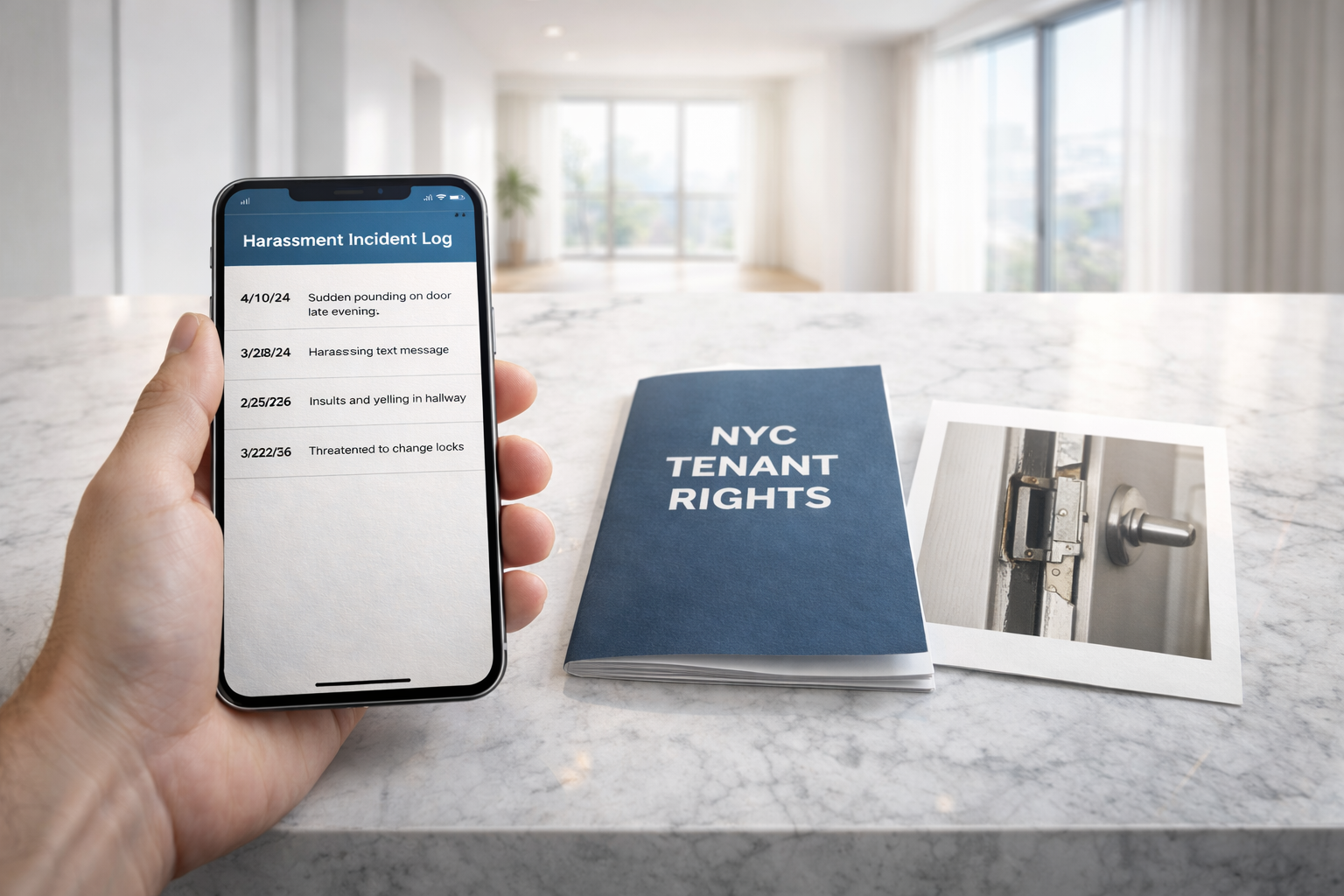
Create a detailed record:
Timeline document: Dates and times of every harassing incident with detailed description of what happened.
Photos and videos: Conditions in your apartment, construction, lack of services, anything showing the impact of harassment.
Copies of all communications: Texts, emails, letters, notices from landlord. Screenshot everything before it can be deleted.
Witness information: Names and contact info of neighbors or others who witnessed harassing behavior.
Evidence of your complaints: 311 call records, HPD complaint confirmations, emails to landlord about issues.
Why documentation matters: Harassment claims require proving a pattern of conduct. Your contemporaneous documentation is the evidence that proves the pattern.
NYC tenants:
Call 311 to report harassment to HPD (Housing Preservation and Development). HPD can investigate and issue violations.
Report construction issues to DOB (Department of Buildings) if construction harassment is involved.
Outside NYC:
Contact your local code enforcement or housing agency to report landlord violations.
Contact attorney general's office for serious harassment issues.
Contact legal services organizations:
NYC: Legal Services NYC, Legal Aid Society, Housing Court Answers (212-962-4795)
Outside NYC: Use LawHelpNY.org to find legal services in your county
Tell intake: "I'm experiencing tenant harassment and need legal advice or representation."
Lawyers can:
Options for legal action against harassment:
HP (Housing Part) Harassment Action in Housing Court:
Supreme Court Injunction:
Criminal Complaint:
Which option to pursue depends on your specific situation—discuss with legal services.
Remember:
Harassment is designed to make you give up. The goal is to make you so miserable or frightened that you move out or accept an inadequate buyout or stop asserting rights.
By recognizing harassment and taking action, you're refusing to be pushed out.
You have the right to:
Harassment is illegal precisely because these rights are protected. Asserting them isn't overreacting—it's exercising your legal rights.
You're not overreacting if:
You might be overreacting if:
But here's the key: when in doubt, err on the side of documenting and reporting.
Better to report something that turns out to be borderline and have authorities tell you "this doesn't quite meet the threshold" than to tolerate actual illegal harassment because you talked yourself out of recognizing it.
The consequences of under-reacting to real harassment (losing your home, suffering health impacts, being forced out illegally) are far worse than the consequences of over-reacting to borderline behavior (authorities investigate and determine it's not quite harassment, but you have documentation if it escalates).
Landlords engaging in harassment benefit from your self-doubt:
If you think you're overreacting:
Landlords want you to internalize the message that their illegal conduct is "normal" and your objection to it is "oversensitive."
This is why gaslighting is such a common harassment tactic. Landlords tell you "everyone deals with this" or "you're the only one complaining" specifically to make you doubt your own perceptions.
Don't fall for it.
If your gut tells you something is wrong, if the pattern looks targeted, if the timing suggests retaliation, if the behavior fits the legal red flags—trust your perception.
You're probably not overreacting. You're probably experiencing illegal harassment that the law protects you from.
Document it. Report it. Get legal help. Fight back.
Your home and your rights are worth protecting.