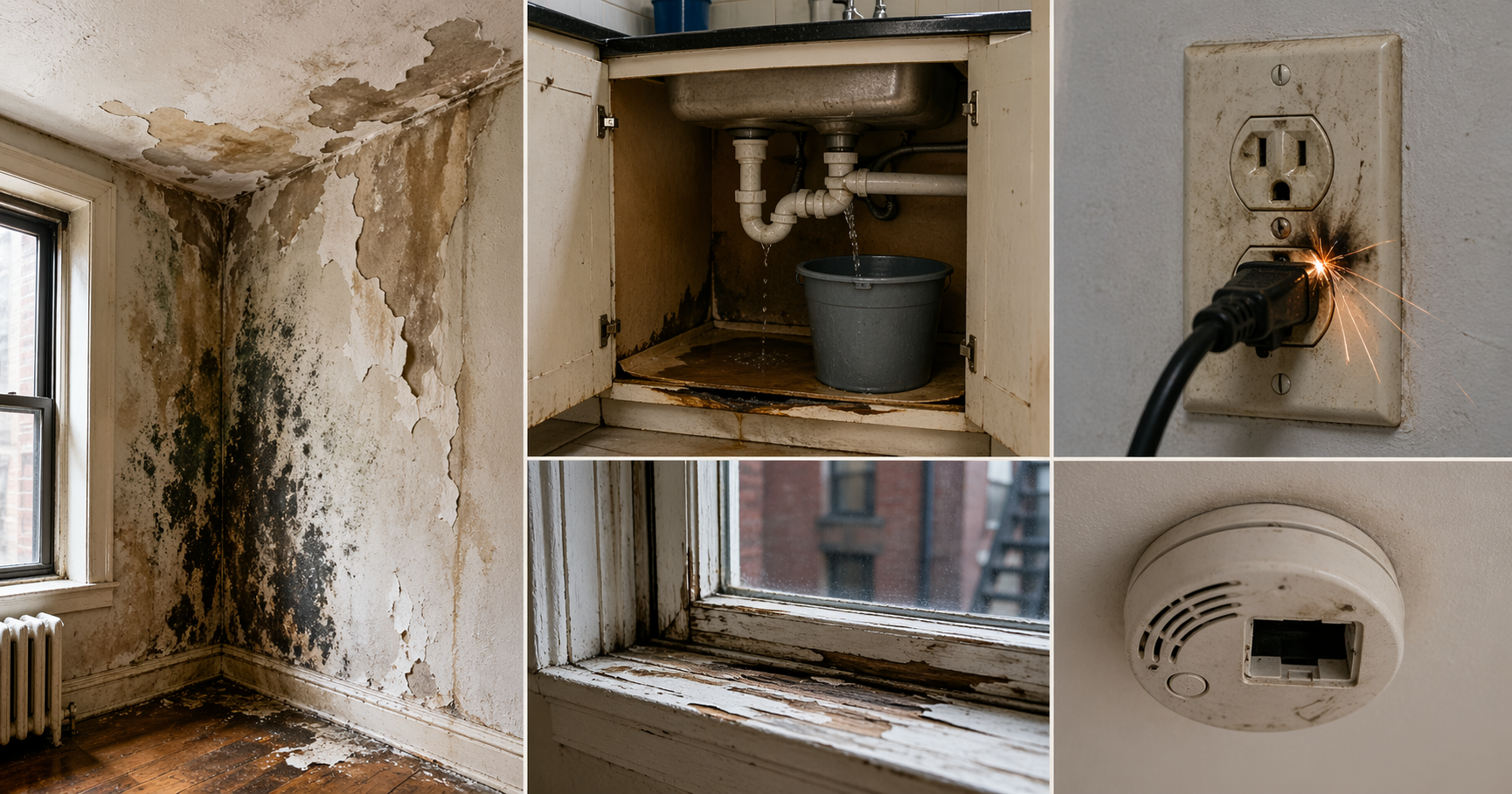
You're living in an apartment with problems. The paint is peeling in several rooms. There's a persistent leak under the kitchen sink that creates a puddle you have to mop up every few days. The heating is inconsistent—sometimes it works, sometimes it doesn't, and winter nights can get uncomfortably cold. You've seen a few roaches. The bathroom grout is cracked and discolored. The hardwood floors are scuffed and worn. The building's hallway smells musty. One of the outlets sparks occasionally when you plug things in.
You're frustrated and uncomfortable, but you're not sure whether these issues rise to the level of "legally uninhabitable" or if you're just living in an old, run-down building that, while unpleasant, doesn't violate any laws. You wonder: "How bad does it have to be before my apartment crosses from 'needs work' to 'legally unsafe'? What's the legal standard for habitability in New York? Can I withhold rent or break my lease because of these conditions? Or do I just have to accept that older apartments come with problems?"
Understanding this distinction is critical because it determines your legal rights and remedies. If conditions are merely cosmetic or minor, you may have limited options. But if your apartment is legally uninhabitable, you have powerful rights under New York law.
Here's the truth: In New York, your apartment is legally considered "unsafe" or "uninhabitable" when conditions threaten your life, health, or safety or violate basic housing code standards—not merely when the apartment looks old, worn, or aesthetically unpleasant. New York's warranty of habitability imposes strict requirements on landlords to maintain rental housing free from dangerous, hazardous, or health-threatening conditions, and violations of this warranty give you legal remedies including rent reductions, repair orders, and in extreme cases, the right to vacate without penalty.
Let me show you exactly what New York's warranty of habitability requires, which specific conditions cross the line from "run-down" to "legally uninhabitable," what merely cosmetic or minor issues don't rise to habitability violations, how to assess your own situation using a practical framework, and what steps to take if you believe your apartment is legally unsafe.
Before identifying specific violations, understand the fundamental legal requirement that applies to every rental in New York.
New York's warranty of habitability is a legal doctrine established through statute and court decisions requiring every residential rental to be fit for human habitation and maintained free of conditions dangerous, hazardous, or detrimental to life, health, or safety.
The warranty is implied in every residential lease in New York State, whether the lease is written or oral, whether the apartment is rent-regulated or market-rate, whether it's in New York City or rural upstate. The warranty exists automatically as a matter of law—landlords cannot opt out of it, and lease clauses purporting to waive the warranty are void and unenforceable.
"Fit for human habitation" means the dwelling must be suitable for people to live in safely and healthily. This isn't about luxury, modernity, or aesthetic appeal—it's about basic safety and health. A fit dwelling has functioning essential services (heat, hot water, electricity, plumbing), is structurally sound, is free from serious health hazards (mold, pests, lead paint exposure), and provides safe egress in emergencies.
"Dangerous, hazardous, or detrimental to life, health, or safety" sets the threshold for violations. Conditions must pose actual or potential threats to physical safety, health, or wellbeing to violate the warranty. Inconvenient or ugly conditions that don't threaten safety or health typically don't breach the warranty, while conditions that could cause injury, illness, or death do.
The warranty imposes ongoing obligations on landlords to maintain habitability throughout the tenancy, not just to deliver a habitable apartment at move-in. If conditions deteriorate during occupancy, landlords must address them to restore habitability. Tenants have the right to a continuously habitable dwelling for the duration of their tenancy.
Understanding who's responsible for maintaining habitability helps assess whether violations exist.
Landlords are responsible for maintaining the building structure, essential building systems (heating, plumbing, electrical), common areas, and correcting conditions that affect habitability regardless of what caused them (with limited exceptions for tenant-caused damage). Landlords cannot shift responsibility for habitability violations to tenants through lease clauses—the warranty is non-waivable.
Tenants are responsible for maintaining reasonable cleanliness in their units, not causing damage, properly using fixtures and appliances, and promptly notifying landlords of conditions needing repair. However, even if tenant behavior contributed to a condition, if it creates a habitability violation, the landlord typically must address it.
The key principle is that landlords cannot deliver or allow unsafe, unhealthy housing regardless of excuses. Lack of money to make repairs, blaming previous tenants, claiming ignorance of the problem—none of these defenses excuse habitability violations once the landlord has notice.
When habitability violations exist, tenants have multiple legal remedies.
Rent reduction or abatement is available when conditions violate the warranty. Courts can reduce rent—either temporarily while violations exist or retroactively for past periods of uninhabitability—to reflect the diminished value of the apartment. In severe cases, rent can be reduced to zero.
Repair and deduct allows tenants in some circumstances to arrange necessary repairs and deduct the cost from rent, though this remedy has strict procedural requirements and risks.
Constructive eviction occurs when conditions are so severe that the apartment is effectively uninhabitable, giving tenants the right to vacate without owing future rent and potentially to recover damages.
Damages can be awarded for harm suffered due to habitability violations—medical expenses from injuries or illnesses caused by violations, property damage, emotional distress, and other losses.
Court-ordered repairs through Housing Part proceedings (in NYC) or similar mechanisms can compel landlords to correct violations under judicial supervision.
These remedies give teeth to the warranty of habitability—it's not just an aspirational standard but an enforceable right with real consequences for violations.
Let's identify specific conditions that typically constitute habitability violations under New York law.
Heat and hot water are among the most fundamental habitability requirements, and their absence or inadequacy is a clear violation.
Heat requirements in New York City (and similar requirements in many jurisdictions) mandate landlords provide heat maintaining at least 68 degrees Fahrenheit during the day (6 AM to 10 PM) when outside temperature falls below 55 degrees, and at least 62 degrees overnight during heating season (typically October 1 through May 31). Inability to maintain these temperatures constitutes a serious habitability violation.
No heat in winter is an emergency habitability violation. Living without adequate heat during cold weather poses immediate health and safety risks including hypothermia, illness from cold stress, frozen pipes that can cause flooding, and inability to safely inhabit the dwelling. Courts treat heat violations extremely seriously and often grant emergency relief.
Hot water requirements mandate landlords provide hot water at a constant minimum temperature (typically 120 degrees Fahrenheit at the tap) year-round. Complete absence of hot water or hot water that's only available sporadically constitutes a habitability violation because it prevents basic hygiene, cooking, and cleaning necessary for healthy living.
Inconsistent heating or hot water—systems that work sometimes but fail frequently, especially during extreme weather—also violates habitability even if not complete absence. Tenants shouldn't have to tolerate unreliable essential services that force them to live in uncertainty about whether they'll have heat or hot water on any given day.
Water intrusion problems that are persistent, severe, or create secondary hazards like mold constitute habitability violations.
Recurring leaks that repeatedly return despite repairs, leak substantial amounts of water, or occur during every rain demonstrate the landlord's inability or unwillingness to maintain weatherproof conditions. Persistent leaks can damage property, create slip hazards, promote mold growth, and make portions of the dwelling unusable.
Flooding from plumbing failures—toilets that overflow repeatedly, pipes that burst or leak, drains that back up causing standing water—creates unsanitary conditions and water damage constituting habitability violations. Tenants shouldn't have to live with recurring flooding events that destroy belongings and create health hazards.
Visible mold growth on walls, ceilings, or other surfaces, especially when extensive or recurring, indicates moisture problems creating health hazards. Mold can cause or exacerbate respiratory conditions, allergies, and other health issues. While small, isolated mold spots promptly addressed might not violate habitability, extensive mold or mold that returns repeatedly after cleaning indicates underlying moisture problems the landlord must address.
Water damage to ceilings or walls—staining, bubbling paint, sagging drywall, visible water intrusion—signals active or recent leaks that, if unaddressed, violate habitability by indicating the dwelling is not weatherproof and potentially creating structural hazards.
Serious pest infestations that the landlord fails to address constitute habitability violations because they create unsanitary conditions and health risks.
Roach infestations beyond occasional isolated bugs—seeing roaches regularly, especially during daytime (suggesting large populations), finding roach eggs or feces, having roaches in food preparation or eating areas—indicate unsanitary conditions violating habitability. Cockroaches carry diseases, contaminate food, and make the dwelling unsuitable for healthy habitation.
Rodent infestations—mice or rats inside the living space, not just occasional sightings but evidence of nesting (droppings, gnaw marks, sounds in walls), rodent entry through holes in walls or floors—create serious health and safety hazards. Rodents carry diseases, damage property, contaminate food, and their presence indicates the dwelling is not properly sealed and maintained.
Bedbug infestations that the landlord fails to address through proper professional treatment constitute habitability violations. Bedbugs cause physical harm (bites, allergic reactions, secondary infections from scratching), psychological distress, sleep deprivation, and make the dwelling virtually uninhabitable for many people. Landlords must arrange proper remediation, not ignore or minimize bedbug problems.
The key is not isolated pest sightings (which might occur in any building) but infestations—ongoing, pervasive pest problems that the landlord fails to adequately address despite notice.
Electrical problems that create fire or shock risks violate habitability because they threaten immediate safety.
Exposed wiring—wires hanging from ceilings or walls, junction boxes without covers, outlets or switches with visible wiring—creates shock and fire hazards that clearly violate safety standards and habitability requirements.
Frequently sparking outlets or switches indicate electrical faults creating fire and shock risks. Occasional sparks when plugging or unplugging might be normal static, but outlets that consistently spark, smell of burning, feel hot, or show discoloration from heat indicate dangerous electrical problems requiring immediate professional repair.
Circuit breakers that trip constantly suggest electrical overloads, faulty wiring, or inadequate electrical service for the building's use. While occasional breaker trips might result from user error (running too many appliances), frequent trips indicating the electrical system cannot safely handle normal residential use constitute habitability issues.
Non-functioning electrical outlets or systems that leave portions of the dwelling without power violate habitability by preventing normal use of the space and potentially creating dependency on unsafe extension cords or adaptors that create fire hazards.
Structural problems that could cause injury or collapse violate habitability by creating immediate physical danger.
Collapsing or severely cracked ceilings—sagging plaster, large cracks suggesting structural failure, visible deterioration indicating imminent collapse—create fall hazards that could cause serious injury or death. Even if collapse hasn't occurred yet, conditions suggesting it might violate habitability.
Unstable stairs or broken railings in buildings pose serious fall risks. Missing or broken stair railings, stairs with gaps or missing treads, loose or wobbly stairs that shift underfoot, stairs without proper lighting—all create hazards that violate habitability and building codes.
Sagging or unstable floors—floors that bounce excessively, feel spongy, have visible sag, or show signs of structural failure—indicate potential collapse hazards that clearly violate habitability.
Broken windows that cannot close properly, have missing panes, or cannot be secured create security risks and weather exposure violating habitability, especially during winter when broken windows prevent maintaining required heat.
Conditions that impair escape from fire or prevent early fire detection constitute critical habitability violations.
Missing or non-working smoke detectors violate both building codes and habitability requirements. Every dwelling unit must have working smoke detectors, and landlords must install and maintain them. Tenants should test detectors monthly and replace batteries, but landlords must ensure detectors are present and functional.
Missing or non-working carbon monoxide detectors in dwellings with fuel-burning appliances or attached garages similarly violate codes and habitability. CO is a deadly, odorless gas, and working detectors are life-saving safety requirements.
Blocked or illegal fire exits—apartments with only one exit when codes require two, fire escapes that are blocked, locked, or inaccessible, windows that cannot open for egress, emergency exit doors chained or blocked—create life-threatening situations in fires and violate habitability and codes.
Illegal windowless rooms used as bedrooms violate codes. Every bedroom must have a window for light, ventilation, and emergency egress. Converting windowless spaces into bedrooms creates unsafe, illegal overcrowding and habitability violations.
In buildings built before 1978, peeling or chipping paint creates potential lead exposure hazards, particularly serious when children live in the dwelling.
Lead paint presumption applies to pre-1978 housing—paint in older buildings is presumed to contain lead unless testing proves otherwise. When this paint deteriorates (peeling, chipping, flaking), it creates lead dust and chips that children can ingest, causing serious neurological damage.
Landlords' lead paint obligations include maintaining painted surfaces in good condition (no peeling or chipping), addressing deteriorating paint promptly, and when children under 6 live in the unit or visit regularly, taking enhanced precautions including lead-safe work practices during renovations.
Peeling paint in units with young children creates presumptive lead hazards requiring immediate landlord response. Even if testing hasn't confirmed lead, the risk is serious enough that deteriorating paint constitutes a habitability violation in pre-1978 housing with child occupants or visitors.
Not every undesirable condition violates habitability—understanding what doesn't typically rise to violations helps calibrate expectations and focus on real legal issues.
Conditions affecting appearance without impacting safety or health generally don't violate habitability.
Old or ugly paint that's intact (not peeling or chipping) might be unsightly but doesn't threaten health or safety. Faded paint, colors you don't like, walls that need updating—these are aesthetic issues, not habitability violations. The warranty of habitability doesn't guarantee attractive décor, only safe housing.
Worn but functional flooring—scuffed hardwood, stained carpets that don't pose trip hazards, old linoleum that's intact—might look bad but if it's not creating safety hazards (trip risks, sharp edges, pest harboring), it's cosmetic, not a violation.
Outdated but working appliances don't violate habitability. An old refrigerator that still keeps food cold, a vintage stove that still cooks safely, a dated bathroom that functions properly—these might not be what you'd choose in a remodel, but functional is what habitability requires, not modern.
The distinction is between form and function. Habitability focuses on function—does it work safely and serve its purpose? Aesthetics, while they affect comfort and enjoyment, generally aren't the law's concern unless they signal underlying problems (like staining that indicates leaks).
Problems that occur but are addressed quickly and don't recur typically don't constitute ongoing habitability violations.
Non-recurring minor leaks that the landlord fixes promptly don't violate habitability. If the sink springs a small leak, you report it, and the landlord repairs it within a reasonable time without recurrence, that's normal maintenance, not a violation. The issue is persistent or severe problems that aren't fixed.
Isolated maintenance needs addressed responsively—a running toilet that's repaired, a stuck window that's freed, a loose doorknob that's tightened—represent normal landlord obligations being met, not violations. Habitability doesn't mean nothing ever breaks; it means serious problems are corrected.
Small cosmetic damage like minor nail holes, small paint chips that aren't lead hazards, scuffed baseboards, minor wall dings—these might be move-out cleaning issues or normal wear and tear, but they don't affect safety or health and don't violate habitability.
General cleanliness of the unit that's within the tenant's control isn't a landlord habitability issue.
Clutter and personal mess—your belongings scattered around, dishes in the sink, general disorganization—are your responsibility, not habitability violations. Landlords aren't required to keep your individual space clean; that's on you.
Dirt and dust from ordinary living that tenants should clean themselves aren't habitability issues. Normal housekeeping—vacuuming, mopping, wiping surfaces—is tenant responsibility. Habitability violations involve building-wide sanitation failures, not individual unit cleanliness within tenant control.
The exception is when tenant efforts to maintain cleanliness are defeated by building conditions—like overwhelming pest infestations that no amount of tenant cleaning can control, or water damage creating mold that returns despite tenant cleaning. When building conditions make it impossible for tenants to maintain sanitary conditions, habitability violations exist.
Issues based on personal preference, lifestyle choices, or desired upgrades generally aren't habitability violations.
Wanting more space doesn't make current space uninhabitable (unless it's illegally small or causes true overcrowding affecting health).
Preferring different layouts, finishes, or features isn't a habitability issue. You might want granite counters instead of laminate, a dishwasher instead of hand washing, a bathtub instead of a shower-only—but preferences aren't legal requirements.
Noise from neighbors or street might be annoying but unless it's so extreme it prevents sleep or constitutes harassment, it's generally not a habitability violation. Ordinary urban noise, neighbor sounds, street activity—these are realities of multi-family living, not violations.
To determine whether your conditions constitute habitability violations, use this analytical framework.
Ask whether the condition threatens your physical safety or health in concrete ways.
Safety risks include potential for injury (falls from structural issues, shocks or fires from electrical problems, injuries from broken fixtures), security risks (broken locks, uncontrolled building access), and emergency risks (blocked exits, no smoke detectors).
Health risks include exposure to toxins (lead, mold, carbon monoxide), unsanitary conditions (pest infestations, sewage problems, lack of hot water for hygiene), and conditions that can cause or exacerbate illness (extreme cold, mold, vermin).
If the condition creates real safety or health risks—not theoretical or minimal, but actual potential for harm—it likely violates habitability. If the condition is merely unpleasant, inconvenient, or unattractive without creating genuine safety or health threats, it likely doesn't violate habitability.
Ask whether the condition affects your ability to perform essential residential activities.
Essential activities include sleeping safely and comfortably, cooking and eating safely, maintaining personal hygiene, living in sanitary conditions, being warm in winter, having electricity for basic needs, and having safe ingress and egress.
If the condition prevents or seriously impairs these essential functions—you can't sleep because of cold, can't bathe because of no hot water, can't cook because of gas leaks, can't safely exit in emergency—it likely violates habitability. If essential functions remain possible, the condition might not violate habitability even if it's inconvenient.
Ask whether the condition violates specific housing codes or standards.
Housing codes establish minimum standards for heat, hot water, plumbing, electrical, structural soundness, fire safety, light and ventilation, and other aspects of residential housing. Violations of these codes typically constitute habitability violations.
If the condition violates clear code requirements—temperature below required heat levels, missing required smoke detectors, electrical issues creating code violations, structural problems below code standards—it likely violates habitability. Compliance with codes generally indicates habitability, while code violations suggest habitability problems.
Ask whether problems are severe, persistent, or accumulating.
A single minor issue might not violate habitability, but multiple problems accumulating can collectively render a dwelling uninhabitable even if each alone wouldn't. A small leak plus occasional pest sightings plus one broken outlet might each be manageable, but taken together with heating issues and mold, they accumulate into uninhabitability.
Persistence matters. A one-time problem promptly fixed doesn't violate habitability, but the same problem recurring repeatedly despite repairs suggests the landlord cannot or will not maintain habitability.
If conditions are severe (seriously threatening safety or health), persistent (recurring despite repairs), or accumulating (multiple problems creating cumulative burden)—the dwelling likely violates habitability. Isolated, minor, promptly-addressed issues likely don't.
If your assessment suggests habitability violations, take strategic action to document conditions and pursue remedies.
Evidence is critical for proving habitability violations and pursuing remedies.
Take photos and videos of every condition you believe violates habitability. Photograph water damage, mold, pest evidence, electrical hazards, structural problems, broken fixtures, malfunctioning systems—everything. Include date stamps if possible, or email photos to yourself to create dated records.
Create a detailed written log:
Keep all communications with the landlord about repairs—emails, texts, letters, work orders, receipts. These prove you provided notice and the landlord's response or failure to respond.
If possible, get witness statements from visitors, family, or neighbors who can attest to conditions.
This documentation proves violations exist, you notified the landlord, and the landlord failed to correct them—establishing your case for remedies.
Official inspections and violations create powerful evidence and can compel repairs.
In New York City, call 311 to report housing code violations. HPD (Department of Housing Preservation and Development) will schedule an inspection. Inspectors document violations, issue official violation notices to the landlord with deadlines for correction, and can pursue enforcement if landlord doesn't comply.
Outside NYC, contact local code enforcement (building department, health department, housing inspector) for your municipality or county. Request inspections of conditions you believe violate codes. Official violation notices strengthen your legal position.
For emergency conditions (no heat in winter, imminent structural collapse, gas leaks), call emergency services and code enforcement immediately. Some violations require emergency response.
Official violation records from government agencies are powerful evidence in court proceedings, rent reduction claims, and other legal actions. They provide objective, third-party verification of violations.
Navigating habitability violations and remedies often requires legal guidance.
LawHelpNY.org provides guides and resources on unsafe housing conditions and tenant rights, plus a directory of legal services organizations throughout New York.
Legal services organizations offer free legal help to income-eligible tenants:
Housing Court Answers (NYC): 212-962-4795 provides information and assistance to tenants navigating housing court.
Tenant unions and advocacy organizations can provide support, advice, and sometimes representation.
Private tenant attorneys can represent you in housing court, negotiate with landlords, and pursue habitability claims. Some work on contingency or sliding scales.
Legal help can:
Depending on your situation, different remedies might be appropriate.
Rent reduction (also called rent abatement) allows you to pay reduced rent reflecting the dwelling's diminished value during violations, or to recover past rent for periods of uninhabitability. This can be pursued through housing court HP (Housing Part) proceedings or raised as a defense in eviction proceedings.
HP proceedings (in NYC) allow tenants to bring landlords to court to compel repairs. Judges can order specific repairs with deadlines, appoint administrators to make repairs if landlord won't, and reduce rent until violations are corrected.
Repair and deduct allows tenants to arrange necessary repairs and deduct costs from rent, but has strict requirements (notice to landlord, reasonable repair costs, following proper procedures) and legal risks if not done correctly. Get legal advice before pursuing this remedy.
Withholding rent is extremely risky without legal guidance. While courts can reduce rent for habitability violations, unilaterally stopping rent payment can result in eviction. If considering this, consult an attorney and follow proper procedures (often involving depositing rent into escrow).
Constructive eviction allows you to break your lease and move out without penalty when conditions are so severe the apartment is effectively uninhabitable. This is a drastic remedy requiring conditions to be extremely serious and legal advice to pursue properly.
Reporting to regulatory agencies can prompt enforcement actions compelling repairs.
New York's warranty of habitability requires landlords to maintain housing free from dangerous, hazardous, or health-threatening conditions—not just to provide attractive housing.
Conditions that threaten safety or health—no heat, serious leaks and mold, pest infestations, electrical hazards, structural dangers, missing smoke detectors, lead paint exposure—violate habitability.
Cosmetic issues, aesthetic unattractiveness, old but functional fixtures, and normal wear and tear typically don't violate habitability unless they indicate underlying safety or health problems.
The test is: Does this condition threaten safety or health, impair essential residential functions, violate codes, and is it severe, persistent, or accumulating?
Document everything with photos, videos, written logs, and communications. Report to code enforcement for official inspections. Get legal help to understand your rights and pursue remedies.
You have the legal right to safe, healthy housing. Don't accept dangerous conditions. Assert your warranty of habitability rights.
Find out if you have a case in 30 seconds →