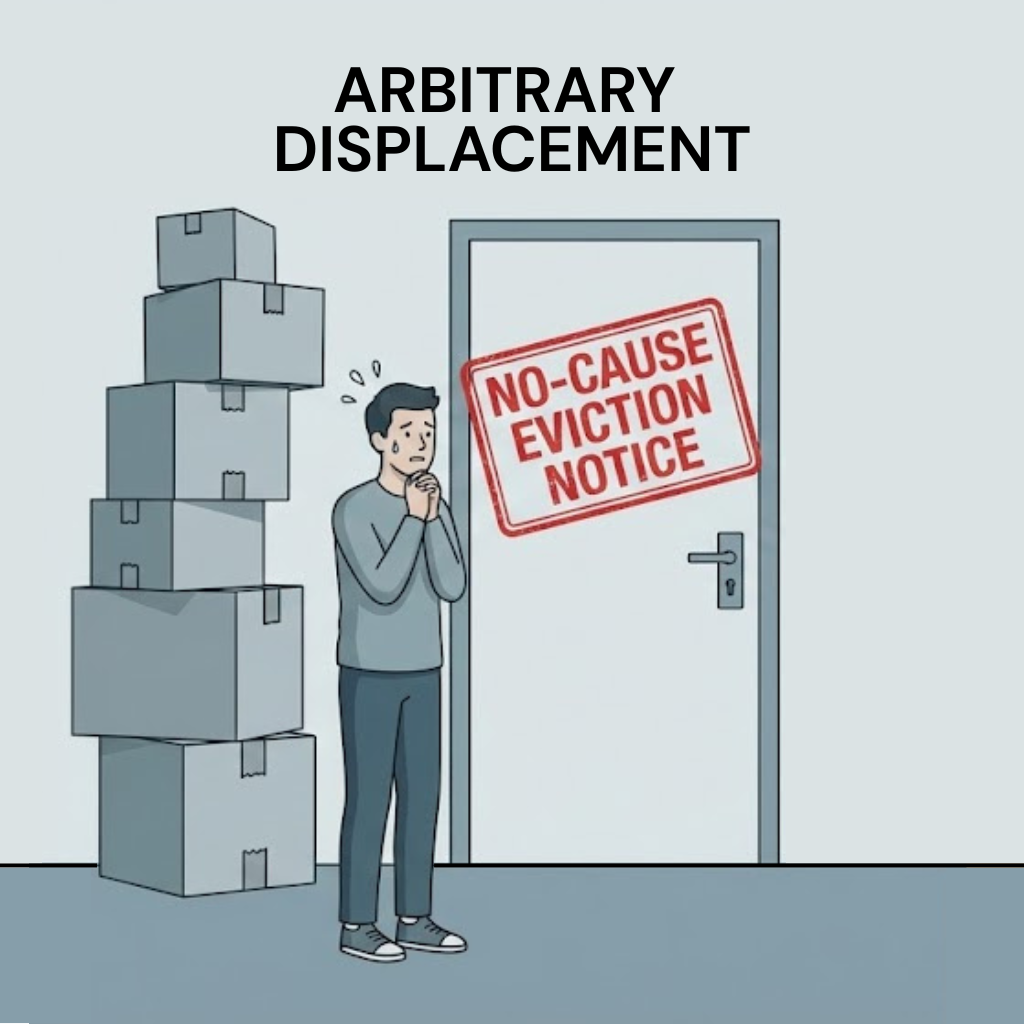
Whether your landlord needs a specific legal reason to evict you or can simply decide not to renew your lease depends entirely on where you live—and for New York tenants, that landscape just changed dramatically. Understanding if "just cause" protections apply to your apartment is what separates tenants who can be removed without reason from those whose landlords must prove legitimate grounds in court.
The difference isn't academic—it's the difference between stable housing and arbitrary displacement at your landlord's whim.
The National Divide: Just Cause vs. No-Cause Eviction
Across the United States, eviction laws fall into two fundamentally different approaches that create vastly different tenant protections.
Just cause jurisdictions:
- Landlords must have specific legal reason to evict
- Reason must be listed in statute or ordinance
- Landlord must prove grounds in court
- Can't simply refuse to renew without justification
- Examples: California, Oregon, New Jersey, Washington (statewide or major cities)
No-cause jurisdictions:
- Landlords can terminate tenancy with proper notice
- No reason required (especially month-to-month tenancies)
- Only requirement is following notice procedures
- Tenant has no defense unless can prove retaliation or discrimination
- Still majority of U.S. jurisdictions for non-subsidized housing
Why this matters profoundly:
In no-cause states, landlords can evict you because:
- They want to charge higher rent to new tenant
- They don't like you personally
- You complained about repairs (unless can prove retaliation)
- They want the unit for any reason
- No reason at all
In just cause jurisdictions, landlords must prove:
- You violated lease in significant way
- You didn't pay rent
- You're creating nuisance
- Owner genuinely needs unit for specific permitted reason
- One of the other enumerated grounds exists
The growing just cause movement:
Recent years have seen expansion of just cause protections:
- More states adopting statewide requirements
- Cities passing local just cause ordinances
- Increasing recognition that arbitrary eviction destabilizes communities
- Push for "good cause" or "just cause" as tenant protection
New York's 2024 Good Cause Eviction Law represents this national trend, bringing just cause protections to market-rate tenants in covered areas for the first time.
How State and Local Laws Create Different Rules
Understanding your eviction protections requires knowing which level of law applies to your specific situation.
State-Level Just Cause Laws
States with statewide just cause:
California:
- AB 1482 (2019) requires just cause statewide
- Applies to most tenancies over 12 months
- Lists specific grounds for eviction
- Exempts some newer construction and small landlords
Oregon:
- Statewide just cause since 2019
- Covers most residential tenancies after first year
- Specific enumerated grounds required
- Some exemptions for smaller landlords
New Jersey:
- Strong just cause protections in "Anti-Eviction Act"
- Applies to most residential tenancies
- 18 specific grounds listed in statute
- One of oldest state just cause laws
Washington:
- Just cause requirements for many tenancies
- Seattle and other cities have additional protections
- Specific grounds required
- Recent expansions of coverage
New Hampshire:
- Just cause protections for tenants in buildings with 6+ units
- After first year of tenancy
- Specific grounds required
Local Just Cause Ordinances
Major cities with just cause laws:
San Francisco, CA:
- Strong just cause ordinance predating state law
- Very limited grounds for eviction
- Owner move-in has strict requirements
- Tenant relocation assistance required for some evictions
Oakland, CA:
- Just cause required
- Specific grounds enumerated
- Enhanced protections beyond state law
Los Angeles, CA:
- Rent Stabilization Ordinance includes just cause
- Applies to covered rent-controlled units
- State law provides additional protections
Seattle, WA:
- Just cause ordinance applies broadly
- Specific grounds required after initial term
- Relocation assistance for certain evictions
Portland, OR:
- Local protections supplement state law
- Additional tenant protections
- Relocation assistance requirements
Washington, DC:
- Strong just cause protections
- Tenant opportunity to purchase
- Limited grounds for eviction
The Patchwork Problem
Why geography matters so much:
Two identical apartments, identical leases, identical situations—but in different cities, completely different tenant rights.
Apartment A (no-cause jurisdiction):
- Tenant complains about needed repairs
- Landlord gives 30-day notice to vacate
- No reason required
- Tenant has no legal defense (unless can prove retaliation, which is difficult)
- Must move out
Apartment B (just cause jurisdiction):
- Tenant complains about needed repairs
- Landlord must have specific legal ground to evict
- Repair complaints create retaliation presumption
- Tenant protected from arbitrary non-renewal
- Remains in apartment
The location determines everything.
Common "Just Cause" Grounds Across Jurisdictions
While specific language varies by state and city, just cause laws typically include similar categories of permissible eviction grounds.
Tenant-Fault Grounds
These blame tenant conduct for eviction:
Nonpayment of rent:
- Most fundamental just cause ground
- Must be for rent actually owed and due
- Some jurisdictions limit if nonpayment results from unreasonable rent increase
- Typically requires notice and opportunity to cure
Substantial or repeated lease violations:
- Material breach of lease terms
- Usually requires specific, significant violations
- Often requires notice and opportunity to cure
- Can't be minor or technical violations
- Examples: unauthorized pets, unauthorized occupants, subletting without permission
Nuisance or interference with other tenants:
- Disturbing neighbors' quiet enjoyment
- Excessive noise or disruptive behavior
- Threatening or harassing other residents
- Usually requires pattern, not single incident
Property damage:
- Negligent or intentional damage to unit or building
- Beyond normal wear and tear
- Substantial enough to justify eviction
- Typically requires significant damage, not minor issues
Illegal activity:
- Criminal conduct on premises
- Drug dealing or manufacturing
- Illegal business operations
- Usually requires proof of illegal activity
Refusal of access:
- Denying landlord reasonable access for repairs
- Preventing required inspections
- Blocking necessary maintenance
- Must be unreasonable refusal, not occasional inconvenience
No-Fault Just Cause Grounds
These don't blame tenant but provide landlord with legitimate reasons:
Owner or family move-in:
- Owner needs unit for their own occupancy
- Immediate family member needs to occupy
- Usually must be good faith, not pretextual
- Some jurisdictions require relocation assistance
- Often can't be used if owner has other vacant units
Demolition or substantial rehabilitation:
- Building being demolished
- Major renovation requiring unit to be vacant
- Must be genuine, with permits and plans
- Often requires relocation assistance
- Can't be pretextual
Permanent withdrawal from rental market:
- Taking unit off market permanently
- Converting to non-residential use
- Must be genuine intent, not temporary
- Can't be followed by re-renting
Sale of property:
- In some jurisdictions, property sale allows termination
- Often requires notice period
- May require good faith sale
- Some places don't allow this as just cause
Substantial rehabilitation required by government:
- Code enforcement orders requiring major work
- Work can't be done with tenant in place
- Must have official order or permit
- Usually requires relocation assistance
New York's Baseline Eviction Framework
Before understanding New York's new Good Cause Law, you need to know the foundation it builds on.
RPAPL § 711: Summary Proceeding Grounds
New York's general eviction statute lists specific grounds:
Nonpayment of rent:
- Tenant owes rent that's due
- Landlord must serve 14-day rent demand
- Most common eviction ground
Holdover after lease expiration:
- Lease term ended
- Tenant remains without landlord's consent
- Previously, landlords often didn't need reason to refuse renewal (market-rate units)
Holding over after sale:
- Property sold in foreclosure or execution sale
- New owner seeks possession
- Special notice requirements
Illegal or immoral use:
- Premises used for illegal purposes
- Immoral conduct on property
- Must be substantial violation
Objectionable tenant conduct:
- Behavior unreasonably interfering with others
- Creating nuisance
- Violating substantial lease obligations
Non-primary residence (regulated units):
- Rent-stabilized or rent-controlled tenants
- Unit not being used as primary residence
- Strict proof requirements
Other specific grounds:
- Government demolition or rehabilitation orders
- Cooperative or condo conversion
- Various special circumstances
What this meant before Good Cause:
For market-rate tenants, landlords could:
- Refuse to renew lease without stated reason
- Terminate month-to-month tenancies with proper notice
- Didn't need "just cause" to end tenancy
- Only needed just cause if pursuing court eviction of tenant who wouldn't leave
For rent-regulated tenants:
- Always had renewal rights
- Landlord needed good cause to refuse renewal
- Strong protections existed before 2024
Good Cause Law changed the game for market-rate tenants in covered areas.
New York's Good Cause Eviction Law: The Game Changer
Effective April 20, 2024, New York's Good Cause Eviction Law (Real Property Law Article 6-A) brought just cause protections to market-rate tenants in covered localities.
Where Good Cause Applies
Covered localities:
- New York City (all five boroughs)
- Localities that opt in: Albany, Rochester, Ithaca, Kingston, Poughkeepsie, Beacon, Newburgh, Nyack, Hudson, New Paltz, Fishkill, Catskill, Croton-on-Hudson, Binghamton
- Additional localities may opt in over time
Geographic scope matters: If you're outside covered areas, Good Cause doesn't apply. Your landlord doesn't need just cause to refuse renewal of market-rate lease.
What Properties and Tenants Are Covered
Good Cause applies to most market-rate rentals but has significant exemptions:
Exempt properties:
- Buildings with certificates of occupancy issued after January 1, 2009 (first 30 years)
- Rent-regulated apartments (already have separate protections)
- Owner-occupied buildings with 4 or fewer units (where owner lives in one)
- Small landlords (10 or fewer units total across all properties)
- Co-ops and condominiums
- Hotels and other transient housing
- Certain institutional housing
High-rent exemption:
- Units renting for more than 245% of HUD fair market rent
- Threshold varies by area and bedroom count
- 2024 NYC examples: roughly $3,500+ for 1BR, $4,200+ for 2BR (check current thresholds)
High-income exemption:
- When tenant's income exceeds certain threshold relative to rent
- Complex calculation
- Applies to very high earners
Landlord must prove exemption: If landlord claims exemption in non-renewal notice, they must prove it. Otherwise, Good Cause presumptively applies.
The "Just Cause" Grounds Under Good Cause Law
For covered NYC market-rate tenants, landlords can only evict or refuse renewal for these reasons:
1. Nonpayment of rent (RPL § 216(1)(a))
- Rent lawfully due and owing
- NOT resulting from unreasonable or unconscionable rent increase
- Tenant had opportunity to cure but didn't
What this means: Landlord can't manufacture nonpayment ground by imposing excessive rent increase then claiming nonpayment when you can't afford it.
2. Material lease violation (RPL § 216(1)(b))
- Breach of substantial lease obligation
- Tenant received 10-day cure notice
- Failed to cure within 10 days
- Violation must be material, not technical
What this means: Minor infractions don't count. Landlord must give you chance to fix issue. Violation must be serious enough to justify eviction.
3. Nuisance, illegal use, or damage (RPL § 216(1)(c))
- Committing nuisance
- Illegal use of premises
- Causing substantial damage negligently or intentionally
What this means: Your conduct must seriously harm property or other tenants. Occasional noise complaints or minor issues insufficient.
4. Refusal of access (RPL § 216(1)(d))
- Unreasonably refusing access for repairs
- Preventing landlord from performing required work
- Must be unreasonable refusal, not occasional scheduling conflicts
5. Owner or family occupancy (RPL § 216(1)(g))
- Owner or immediate family needs unit as primary residence
- No other vacant units available in building
- CANNOT be used against seniors (65+) or disabled tenants
- Must be genuine intent to occupy
What this means: If your landlord has empty apartments, they can't use this ground. If you're 65 or older or have disability, this ground doesn't apply to you at all.
6. Demolition (RPL § 216(1)(h))
- Good faith plan to demolish building
- Must have permits, financing, contractor agreements
- Genuine intent, not pretextual
What this means: Landlord must prove actual demolition plans with documentation, not just claim they might demolish someday.
7. Withdrawal from rental market (RPL § 216(1)(i))
- Permanently removing unit from rental market
- Must show genuine intent and financial justification
- Can't re-rent after claiming withdrawal
What this means: Landlord must prove they're actually taking unit off market, not just temporarily to renovate and re-rent at higher price.
8. Refusal to execute reasonable renewal (RPL § 216(1)(j))
- Landlord offered reasonable renewal lease
- Tenant unreasonably refused to sign
- Terms must be consistent with law
What this means: Landlord can't put unreasonable terms in renewal then claim you're unreasonable for refusing. Terms must comply with Good Cause and other laws.
9. Tenant refusal to provide access (RPL § 216(1)(k))
- For required repairs, inspections, or work
- After reasonable notice
- Tenant unreasonably denied access
How Rent Increases Interact with Just Cause
Critical connection: Good Cause doesn't just limit eviction grounds—it caps rent increases.
Rent increase limits:
- Generally 3% or 1.5 times Consumer Price Index (CPI), whichever is greater
- For 2024, typical cap around 8-10% depending on CPI
- Increases above cap presumptively unreasonable
Why this matters for eviction:
- If landlord imposes 20% increase and you can't pay
- Landlord tries to evict for nonpayment
- You have defense: nonpayment resulted from unreasonable increase
- Not valid just cause ground
Exceptions where higher increases allowed:
- Landlord proves substantially increased operating costs
- Major capital improvements
- Other justifications meeting legal standards
- Burden on landlord to prove justification
Notice Requirements Under Good Cause
Landlords must give specific written notice:
Non-renewal notice must:
- Specify which Good Cause ground landlord is asserting
- If claiming exemption from Good Cause, state specific exemption
- Provide factual basis for claimed ground
- Give proper advance notice (30, 60, or 90 days depending on tenancy length)
Termination notice must:
- State Good Cause ground
- Provide facts supporting ground
- Give opportunity to cure if applicable
- Meet timing requirements
Deficiency in notice: Creates defense in Housing Court. Landlord must prove both that just cause exists AND that they gave proper notice of it.
When Landlords Have Just Cause: Practical Examples
Understanding abstract legal standards requires seeing how they apply to real situations.
Scenario 1: Nonpayment Eviction
Situation: You're market-rate tenant in covered NYC building. Rent is $2,000/month. You stop paying after landlord imposes $500/month increase (25% increase).
No-cause jurisdiction:
- Landlord could refuse renewal for any reason
- Your nonpayment gives additional ground
- You'd likely lose and owe back rent
NYC under Good Cause:
- 25% increase exceeds reasonable cap
- Your nonpayment resulted from unreasonable increase
- Landlord doesn't have valid just cause for nonpayment
- You have strong defense
- May owe original rent but not inflated amount
Scenario 2: Lease Violation
Situation: Your lease says no pets. You get a cat. Landlord serves notice to cure, you don't remove cat. Landlord seeks eviction.
Analysis under Good Cause:
- Material lease violation (pets)
- You received cure notice
- Didn't cure within 10 days
- Landlord has valid just cause ground
- Landlord can proceed with eviction
Note: Even with just cause protections, you must comply with material lease terms. Just cause doesn't eliminate all eviction grounds—it eliminates arbitrary ones.
Scenario 3: Owner Move-In
Situation: Your landlord claims they need to move into your rent-stabilized apartment. Building has one vacant unit.
Analysis under Good Cause:
- Owner occupancy is permitted ground
- BUT landlord must use vacant unit first
- Can't use this ground if alternatives available
- Landlord doesn't have valid just cause
- You can remain
If no vacant units existed:
- Landlord would have valid just cause
- Unless you're 65+ or disabled (then ground doesn't apply at all)
Scenario 4: Complaint Retaliation
Situation: You complain to HPD about lack of heat. Two months later, landlord refuses to renew your lease claiming they want to renovate.
Analysis:
- Renovation/withdrawal might be just cause ground
- BUT timing suggests retaliation
- Retaliation law (RPL § 223-b) creates presumption
- Landlord must overcome retaliation presumption
- Likely not valid just cause due to retaliatory motive
This shows: Just cause grounds can be pretextual. Courts look at true motive.
Scenario 5: Month-to-Month Tenant
Situation: Your one-year lease expired. You stayed and landlord accepted rent, creating month-to-month tenancy. Landlord now wants you out to get higher-paying tenant.
Pre-Good Cause (market-rate):
- Landlord could terminate month-to-month with 30-day notice
- No reason required
- You'd have to leave
Post-Good Cause (covered unit):
- Landlord needs just cause even for month-to-month
- "Want higher rent" isn't a listed ground
- Landlord doesn't have valid just cause
- You can remain unless landlord has legitimate ground
This shows: Good Cause protects month-to-month tenants same as lease tenants.
Proving and Challenging Just Cause in Court
Having just cause requirements means both sides must prove their positions.
Landlord's Burden of Proof
What landlords must prove:
- One of the enumerated just cause grounds exists
- They followed proper notice requirements
- Ground is genuine, not pretextual
- Standard: clear and convincing evidence (high burden)
How landlords prove just cause:
- Documents showing lease violation
- Evidence of nonpayment
- Proof of nuisance (witness statements, police reports)
- For owner move-in: proof of intent to occupy
- For demolition: permits, contractor agreements, financing
Common landlord failures:
- Can't produce proper predicate notice
- Claimed ground is pretextual
- Evidence insufficient to meet burden
- Didn't give tenant opportunity to cure
- Exemption claim not supported
Tenant's Defense Strategy
Challenging just cause:
- Assert no valid ground exists
- Prove ground is pretextual (hiding real motive)
- Show retaliation or discrimination
- Demonstrate landlord didn't meet procedural requirements
- Prove exemptions don't apply
Discovery to challenge grounds:
- Request landlord's documents
- Depose landlord about true intent
- Obtain financial records (demolition claims)
- Get communications about property plans
- Check permit records
At trial:
- Present evidence undermining landlord's claimed ground
- Show alternative explanations for landlord's actions
- Prove retaliation or discrimination
- Demonstrate procedural defects
- Expert testimony if needed
The Clear and Convincing Standard
What this means: Higher than typical civil standard (preponderance = 51%) but lower than criminal (beyond reasonable doubt = ~99%). Roughly 75% certainty required.
Why this favors tenants:
- Landlord can't just barely prove grounds
- Must present compelling evidence
- Ambiguous situations favor tenant
- Doubts resolved against eviction
Practical effect: When landlord claims owner move-in but can't produce concrete evidence of intent to relocate, they lose. When demolition is claimed but no permits filed, they lose. Standard requires proof, not just assertions.
Comparing Just Cause Protections: NY vs. Other States
California's AB 1482
Similarities to NY Good Cause:
- Statewide just cause requirement
- Covers most residential tenancies after 12 months
- Specific enumerated grounds
- Rent increase caps tied to just cause
Differences:
- California's rent cap different formula (5% + CPI, max 10%)
- Different exemption thresholds
- Longer phase-in for coverage
- Some different permitted grounds
Oregon's Just Cause Law
Similarities:
- Statewide coverage
- Specific grounds required
- No-fault grounds require relocation assistance
Differences:
- Different rent increase limits
- Broader coverage (fewer exemptions)
- Different owner occupancy rules
- Relocation payments required for no-fault evictions
Seattle's Just Cause Ordinance
Similarities:
- Local just cause requirement
- Enumerated grounds
- Strong tenant protections
Differences:
- More generous relocation assistance requirements
- Different notice periods
- Stricter owner move-in requirements
- Additional protections beyond just cause
What NY can learn: States and cities with longer-standing just cause laws have developed case law and regulations addressing edge cases NY will soon face. Tenant advocates watch these jurisdictions for effective enforcement strategies.
What This Means for Different Tenant Types
Market-Rate Tenants in Covered NYC Areas
Before Good Cause:
- Landlord could refuse renewal for any reason
- No protection against arbitrary non-renewal
- Only recourse was proving retaliation or discrimination (difficult)
After Good Cause:
- Landlord must have valid just cause
- Can't refuse renewal arbitrarily
- Rent increases capped
- Strong protections comparable to rent-stabilized tenants
What you should do:
- Understand if your unit is exempt
- Document any landlord violations
- Keep evidence of rent payment
- Challenge improper non-renewal notices
- Assert Good Cause protections in court
Rent-Stabilized/Controlled Tenants
Good Cause doesn't apply: You already have renewal rights and just cause protections under rent regulation laws.
Why this matters:
- Don't confuse Good Cause with rent stabilization
- Your protections come from different law
- Rent stabilization often stronger
- Know which framework applies to you
Tenants in Exempt Buildings
If your building is exempt:
- Landlord doesn't need just cause
- Pre-Good Cause rules still apply
- Retaliation and discrimination laws still protect you
- Consider whether exemption claim is valid
Common invalid exemption claims:
- Landlord says building is exempt but it's not
- Claims small landlord status but owns more than 10 units through entities
- Claims high-rent exemption but rent below threshold
- Misrepresents construction date
Challenge improper exemption claims: Request proof. Landlord must substantiate exemption claim.
Tenants Outside Covered Areas
If you're in part of NY without Good Cause:
- Market-rate tenants don't have just cause protections
- Landlords can refuse renewal without reason
- Retaliation law (RPL § 223-b) still applies statewide
- Consider advocating for local opt-in
Practical Guidance: Knowing Your Rights
Step 1: Determine If Just Cause Applies to You
Questions to answer:
- What state and city do you live in?
- Is there statewide just cause law?
- Is there local just cause ordinance?
- What type of tenancy do you have (market-rate, rent-stabilized, subsidized)?
- When was your building constructed?
- How many units does landlord own?
- What's your rent compared to area thresholds?
Resources to check:
- Local housing authority
- Tenant rights organizations
- Legal aid providers
- City/state housing agency websites
Step 2: Understand What Grounds Apply
If just cause applies:
- Get copy of applicable law or ordinance
- Review list of permitted grounds
- Understand what landlord must prove
- Know your procedural rights
Key questions:
- What notice must landlord provide?
- What grounds apply to your situation?
- What's the burden of proof?
- What defenses can you raise?
Step 3: Document Everything
Maintain records:
- All rent payments (receipts, checks, confirmations)
- Lease and any modifications
- All communications with landlord
- Repair requests and responses
- Photos of apartment condition
- Witnesses to relevant events
Why this matters: You may need to prove landlord lacks just cause, or that claimed ground is pretextual. Documentation is your evidence.
Step 4: Get Legal Help When Facing Eviction
Free legal services:
- NYC Right to Counsel (covered evictions)
- Legal Aid providers
- Tenant rights organizations
- Law school clinics
When to get help:
- As soon as you receive eviction notice
- When landlord refuses to renew without reason
- If you think just cause applies but landlord disagrees
- Before signing any agreement
What attorney can do:
- Determine if just cause applies
- Challenge invalid grounds
- Assert all available defenses
- Negotiate better outcome
- Represent you in court
The Future of Just Cause Laws
National trend: More jurisdictions adopting just cause requirements as recognition grows that housing stability requires protection from arbitrary eviction.
New York specifics:
- Good Cause Law is new (April 2024)
- Implementation issues being worked out
- Court interpretations developing
- Possible legislative amendments
- Additional localities may opt in
What this means for tenants:
- Rights continue evolving
- Stay informed about changes
- Join tenant organizing efforts
- Advocate for protections
- Use available rights
What this means for landlords:
- Must adapt to new requirements
- Can't refuse renewal arbitrarily
- Must document legitimate grounds
- Face consequences for violations
Your Location Determines Your Protections
Where you rent dictates whether your landlord needs a reason to evict you or can simply decide they want you gone. In just cause jurisdictions like covered areas of New York, San Francisco, Oregon, and New Jersey, landlords must prove legitimate grounds meeting legal standards. In no-cause jurisdictions, landlords need only follow notice procedures.
For New York market-rate tenants in covered areas, Good Cause Eviction Law transformed housing security overnight. Landlords who could previously refuse renewal for any reason now must prove valid just cause. Rent increases that could previously force you out through manufactured nonpayment now face statutory caps.
Understanding if just cause applies to your apartment, what grounds your landlord must prove, and how to challenge insufficient grounds in court determines whether you have true housing stability or remain at your landlord's mercy.
Know your local laws. Document everything. Assert your rights. Get legal help. Your housing security depends on understanding whether landlords need just cause where you live—and if they do, making them prove it.
Find out if you have a case in 30 seconds →