Housing harassment has a strange quality: it almost never looks, in any single moment, like something you're allowed to make a fuss about. There's no one dramatic act to point to. There's just a slow accumulation of smaller things — the constant texts, the surprise entries, the pointed "reminders," the manufactured tension, the sense that your home has become a place where you're being worn down on purpose. And because no single incident seems big enough to justify raising hell, tenants do the thing the whole strategy depends on: they endure it. They absorb one more intrusion, one more message, one more bad week, telling themselves it's not worth the fight, until one day they've absorbed so much that they move out, or give up, or quietly stop reporting the unsafe conditions that started it all.
That endurance is not a side effect of harassment. It's the product. The entire point of low-level, grinding pressure is to get you to remove yourself — to make staying so unpleasant that you leave "voluntarily," so the landlord never has to evict you, never has to fix anything, never has to answer for anything. The system, for its part, tends to treat each incident as a minor annoyance, which reinforces your sense that you're overreacting and should just cope. And so the harassment works, not because it's legally bulletproof, but because it has convinced you that enduring it is your only option.
This article exists to break that belief, because the belief is the load-bearing wall. Once you understand that you do not simply have to endure it — that the grinding pressure is a recognizable tactic, that your leaving may not be as "voluntary" as it's made to look, that the accumulation can be documented into something undeniable, and that you can push back in writing without recklessly escalating — the whole thing loses the power it was borrowing from your resignation. Let's take that power back.
Start by understanding why a landlord who wants you gone would choose the slow grind over an obvious threat, because the logic reveals the weakness.
An overt threat — "get out or else," a shouted ultimatum, an explicit demand — is legally dangerous for a landlord. It's the kind of thing that's easy to recognize, easy to report, and easy to prove. A single clear threat can hand a tenant a clean case. So the more sophisticated form of harassment avoids the obvious act entirely and reaches instead for something quieter and, in its way, more effective: constant low-level pressure. A relentless stream of contact. Repeated entries. Petty enforcement. Engineered friction. Nothing you can isolate and call abuse, but an atmosphere that makes your home steadily less livable.
The reason this is the shrewder tactic is precisely that it's harder to prove. Each individual pressure — a text, a visit, a "just following the rules" notice — looks defensible on its own, even reasonable. There's no smoking gun because the method is designed not to produce one. And yet the cumulative effect can be every bit as powerful as a naked threat, sometimes more so, because it's sustained: it doesn't just frighten you once, it wears you down continuously, day after day, until leaving feels like relief rather than defeat. The landlord gets the outcome an eviction would give him — a tenant who leaves — without the risk, the cost, or the fingerprints.
But see what that trade costs him, because it's your opening. By choosing the grind over the threat, the landlord gives up the deniability of any single act in exchange for a pattern — and a pattern, unlike a moment, is something you can capture over time. He's betting that the individual incidents are each too small for you to act on, and that you'll never assemble them into the whole they actually form. That bet is the vulnerability. The very thing that makes low-level harassment hard to prove one incident at a time is what makes it damning when the incidents are laid end to end. His strategy only works if you keep experiencing it as scattered annoyances instead of documenting it as a campaign.
There's a concept worth understanding here, because it names something tenants feel but rarely have language for: the point at which "choosing" to leave stops being a real choice.
When conditions and conduct become severe enough — when the harassment, the disruption, the failure to maintain a livable home reach a level where staying is genuinely intolerable — a tenant who leaves isn't exercising free choice in any meaningful sense. They're being driven out. The law has a name for the extreme version of this: constructive eviction, the idea that a landlord who makes a home effectively uninhabitable has, in substance, evicted the tenant even though he never served a paper or went to court. He achieved the eviction through conduct instead of process — and the tenant's "voluntary" departure was nothing of the kind.
The mindset shift this offers is important, and it's liberating on its own. If you've been made to feel that leaving would be your decision — your failure, your giving up, your choice to abandon the fight — recognizing constructive eviction reframes it entirely. A departure that the landlord engineered through relentless pressure is not you quitting; it's you being forced out by someone who preferred grinding you down to evicting you honestly. That reframing matters emotionally, because the shame of "I gave up" is part of what harassment manufactures, and seeing the departure as driven rather than chosen dissolves that shame.
But be clear-eyed about the legal doctrine, because this is where care is essential. Constructive eviction as a legal claim has a high bar: it generally requires conditions that are genuinely severe, notice to the landlord and a chance to fix things, and — the part that surprises people — usually that you actually move out within a reasonable time, because the claim is that the place became unlivable. It is powerful but demanding, and it's also a decision with major consequences, since leaving is not something you can undo. So treat the constructive-eviction mindset as a source of clarity and self-respect — you are being driven out, not failing — but treat the constructive-eviction claim as something to pursue only with real advice. Before you leave anywhere on this theory, talk to a tenant-rights organization or a lawyer, because whether your specific situation meets the standard, and how to document it so the claim holds, is exactly what they can tell you and this article cannot. The feeling is valid. The legal move needs a professional's eyes.
Everything turns on documentation, because documentation is what converts the grinding pressure — designed to feel like scattered, unprovable annoyances — into a pattern that speaks with one voice. This is the concrete framework. Build it, and the harassment stops being deniable.
Keep an incident log. A single running record of every incident: the date, the time, what happened, and how it affected you. Every unwanted contact, every surprise entry, every petty enforcement action, every disruption. Each entry takes a minute; together they become a timeline, and the timeline is the thing no individual incident can explain away. "He harasses me" is a feeling; "thirty-one logged incidents in two months" is evidence.
Save the screenshots. Every text, every email, every written message — captured and kept, however trivial each seems, because the triviality is the point. A folder of individually harmless messages is precisely what demonstrates a campaign, since the volume itself is the wrong being done.
Export the voicemails. Save and back up voicemails rather than letting them auto-delete. A landlord's tone, his words, his frequency of calling — preserved audio is powerful and easily lost if you don't deliberately keep it.
Hold onto entry notices — and their absence. Keep every notice of entry you receive, and log every entry that came with no notice, because improper entry is both harassment and, often, independently unlawful. The pattern of how the landlord enters your home is a record worth building.
Line up witnesses. Note anyone who witnessed incidents — neighbors, guests, other tenants experiencing the same treatment. Corroboration from someone other than you is especially powerful, and other tenants being harassed the same way turns your individual complaint into evidence of a practice.
Get the code-enforcement records. If unsafe conditions are part of the picture, official inspection and violation records are third-party proof that doesn't depend on your credibility at all — a government record that the conditions were real. Where they exist, they anchor the entire file.
What this framework produces is a reversal of the landlord's whole bet. He wagered that you'd experience the harassment as isolated, forgettable, unprovable moments. The log, the screenshots, the voicemails, the entry records, the witnesses, the violations — assembled — are the moments made permanent and laid end to end, which is exactly the form in which harassment becomes visible and actionable. You're not just protecting yourself; you're building the thing a tenant-rights organization, an agency, or a court would need to see the pattern for what it is.
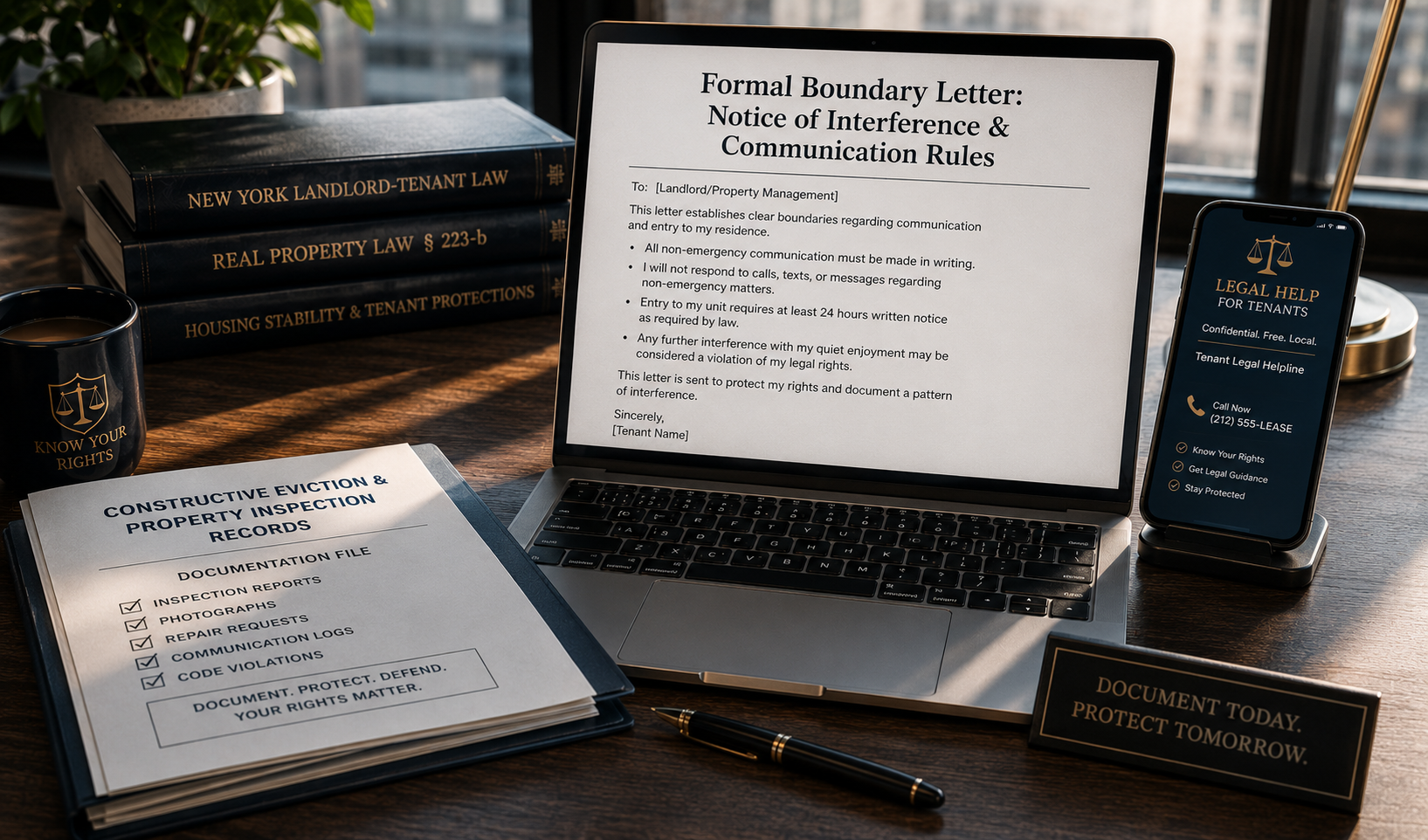
Documentation is the foundation; a carefully worded boundary letter is often the right next step, because it does something powerful without tipping into a confrontation that could backfire.
The instinct when you're being harassed is often to either say nothing — swallowing it, which is the endurance trap — or to explode, firing back angrily in a way that escalates the conflict and can even hand the landlord something to use against you. The boundary letter is the disciplined middle path. It's a calm, factual, written message that names the behavior and asks for it to stop, without insult, without threat, without heat.
It might state, plainly, that you've noticed a pattern of excessive contact or entry or pressure; that you're happy to cooperate with any legitimate, properly-noticed needs; but that you're asking for the behavior to stop and for communication and entry to follow the proper rules. That's it. Calm, specific, courteous, and firm. And it does two things at once, which is what makes it such an efficient move. First, it may actually work — a landlord engaged in casual grinding sometimes backs off the moment a tenant demonstrates, in writing, that they see the pattern clearly and aren't intimidated. The letter signals that the endurance the whole strategy relied on is over.
Second, if it doesn't work, the letter becomes some of the most valuable evidence in your file. It establishes, on a specific date, that you identified the behavior, asked for it to stop, and were reasonable about it — so that everything the landlord does afterward is now knowing continuation of conduct you formally objected to. It strips away his deniability: he can no longer claim he didn't realize, didn't mean anything by it, was just being attentive. You told him. In writing. The letter converts "persistent behavior" into "behavior continued after a clear, documented request to stop," which is a categorically stronger thing to be able to show.
The discipline is what makes it work, so keep it calm no matter how you feel. The boundary letter is powerful precisely because it's not a fight — it's a reasonable person making a reasonable request in a tone no one could fault, which both maximizes the chance the landlord backs down and maximizes how sympathetic you look if he doesn't. Save a copy, note the date, and let it do its quiet double duty.
Step back and see what the whole edifice of low-level harassment rests on. Not on legal strength — the grind is chosen precisely because it's deniable, which is another way of saying it's fragile once documented. Not on any genuine right of the landlord to wear you down. It rests on a single belief installed in the tenant: that this is something you simply have to put up with, that each incident is too small to act on, that leaving or coping is your only real option. Every part of the strategy is engineered to reinforce that belief, because the belief is the only thing making the strategy work.
So reject it, because it was never true. You do not have to endure being harassed out of your home. The grinding pressure is a recognizable tactic with a recognizable weakness — it trades a threat's power for a threat's provability, leaving a pattern you can capture. Your leaving, if it comes to that, may be far less voluntary than it's been made to feel, and far more like something done to you. The accumulation that felt like unprovable scattered annoyances can be assembled into an undeniable record. And you can push back, calmly and in writing, in a way that protects you whether or not it stops the behavior. None of that is available to a tenant who believes endurance is the only path. All of it is available the moment you stop believing that.
So start the log today. Save the next message instead of deleting it. Keep the voicemail. Write the boundary letter when you're ready, and keep a copy. And if the pressure has already made your home feel unlivable, get advice before you make any decision about leaving, because you may have more standing than you've been led to believe. The harassment was counting on your silence and your sense that you had no choice. You have both a voice and a choice. Find out where you stand.